

A calibration call-out fee is more than a travel charge. For on-site call out fees for calibration Canberra businesses request, the quote can reflect mobilisation, the instruments involved, site access and the calibration scope. Without those details, budgeting is difficult, particularly when taking equipment out of service could interrupt operations.
It’s reasonable to want clarity about what a fee covers and what documentation the work will provide. On-site calibration lets instruments stay at your facility and can reduce the need to remove and transport them. Planning the work around access and operating schedules can also help limit disruption. Zenith Sales & Calibrations Pty Ltd provides on-site calibration in Canberra, with the service scope shaped around the instruments and work required.
This article explains the main factors that influence a call-out quote, what to include in a calibration request, and how to prepare your site and schedule. It also explains how to specify certificate requirements, including whether you need NATA-endorsed or traceable documentation, so the proposed scope is clear before work begins. Use these points to assess whether on-site calibration suits your operation and to request a useful quote.
Key Takeaways
- Understand how mobilisation, instrument workload, site access and reporting requirements shape on-site call out fees for calibration in Canberra.
- Separate the call-out charge from instrument calibration, certification, repairs and any other work included in the agreed scope.
- Compare on-site and laboratory calibration based on equipment transport, operational downtime, site conditions and certificate requirements.
- Prepare an instrument list with identifiers, ranges, locations and current calibration records to support a clear quote request.
- Plan access and scheduling around operational needs, and specify the calibration scope and documentation required.
What Canberra Calibration Call-Out Fees Cover
A calibration call-out fee is a charge associated with mobilising a technician and mobile equipment to perform agreed work at a client’s site. It covers the site visit component, while the calibration of each instrument and any required documentation are defined by the service scope. Unlike laboratory calibration, where equipment is sent to a controlled facility, on-site calibration takes place at your workplace. The underlying process compares an instrument’s measurements with a reference standard; see what calibration means.
For businesses reviewing on-site call out fees for calibration in Canberra, the important question is which tasks the proposed scope includes. Mobilisation, instrument testing, certificate requirements and additional work are separate considerations. The fee isn’t a universal rate: it depends on the service agreed for the site and its instruments.
Which parts of an on-site calibration visit may be charged separately?
A quote may distinguish technician attendance and mobilisation from the calibration work completed on each instrument. The workload can vary by instrument type, measurement range and required calibration points. Documentation requirements matter too. A traceable certificate and a NATA-endorsed certificate are not interchangeable, and endorsement applies only within the relevant accreditation scope. Ask for each component to be identified in the proposed scope.
Calibration establishes how an instrument performs against a reference. Repair or adjustment is different work and may require separate assessment and authorisation. For pressure instruments, see our pressure gauge calibration service.
Why do Canberra site conditions affect the service scope?
Instrument locations and access arrangements affect visit planning. Equipment spread across work areas, positioned in restricted-access locations or integrated into operating processes may need coordination before calibration can begin. Include site entry procedures, access limitations and relevant operating conditions in your quote request.
The number and type of instruments also shape the work required at a Canberra facility. A group of similar instruments may need different preparation and testing from a mixed inventory of gauges, thermometers and electrical instruments. A detailed list helps define the visit, but doesn’t imply a bundled rate or discount.
Before approving the work, compare the proposed scope with your operational needs. Check that it identifies mobilisation, the instruments to be calibrated, the calibration requirements and the documentation requested. This makes the quote easier to assess and helps align the visit with your equipment and reporting needs.
What determines the cost of on-site calibration in Canberra?
The quote for on-site call out fees for calibration in Canberra depends on more than the technician’s trip to your facility. Mobilisation, instrument workload, calibration scope, site access and reporting requirements all affect how the visit is planned and what work is included. There’s no single figure for every site, so a detailed request is the best starting point for a useful quote.
Include the facility location, entry and safety arrangements, instrument types and quantities, identifiers, measurement ranges, required calibration points, certificate requirements and any known faults. This gives the service team a clearer picture of the equipment, site conditions and documentation needed to define the scope.
How do instrument type and calibration scope shape the visit?
Instrument type affects the checks and reference equipment required. For a pressure gauge, for example, the measurement range and requested calibration points help define the work. The gauge’s condition can also affect the technician’s workload. An instrument that cannot be tested as expected may need further assessment beyond the planned calibration.
Calibration compares instrument performance with measurement standards. It isn’t the same as repair, adjustment or troubleshooting. Those tasks may require a separate scope, so describe any known fault and distinguish the calibration you need from other work. See our pressure gauge calibration service for more detail on this instrument category.
Multiple instruments affect visit planning because the technician needs to account for each item’s type and requirements. A mixed inventory may involve different calibration procedures and reporting needs. Listing every instrument helps define the workload, but it doesn’t mean the visit will receive a bundled rate or discount.
How do mobilisation and site access influence planning?
Mobilisation planning takes account of the Canberra facility location and the arrangements needed to reach the work area. Entry procedures, induction requirements, restricted areas and the instruments’ physical locations can all affect how the visit is organised. Provide site-specific safety and access information with your request so it can be considered alongside the technical scope.
Reporting requirements matter as well. Specify the certificate type your quality system or customer requires, including whether traceability or NATA endorsement is needed. The appropriate documentation depends on the requested work and applicable accreditation scope, so describe the requirement precisely rather than relying on a general request for a “certified” result.
Zenith Sales & Calibrations Pty Ltd plans on-site calibration around the facility, instruments and agreed requirements. For an overview of our services, visit Zenith Sales & Calibrations Pty Ltd.
On-site or laboratory calibration: which option suits your Canberra operation?
The right approach depends on instrument suitability, the required calibration scope and how equipment can be taken out of service. On-site calibration brings the work to your facility, which can reduce equipment removal and transport. Laboratory calibration takes instruments to a controlled facility and may better suit work requiring a particular setting or specialist equipment. Neither option is automatically cheaper or better for every instrument.
| Decision factor | On-site calibration | Laboratory calibration |
|---|---|---|
| Equipment handling | Instruments remain at your facility. | Equipment must be prepared and transported. |
| Operational impact | May help limit disruption caused by removing instruments from service. | May suit equipment that can be taken out of service without significant impact. |
| Access and setting | Depends on safe access to instruments and a suitable work area at the site. | Work takes place in the laboratory environment. |
| Scope and records | Requirements are planned around the instruments and site visit. | Requirements are planned around the instruments received and agreed work. |
When can on-site calibration reduce operational disruption?
On-site service can be useful when removing an instrument could interrupt production, monitoring or routine operations. Keeping equipment at your facility also avoids arranging its removal and transport. If several instruments need attention, coordinating them at one site may simplify scheduling, though the work still depends on each instrument’s requirements and the agreed scope. A site visit doesn’t guarantee uninterrupted operations or a fixed duration.
When weighing on-site call out fees for calibration in Canberra against the operational impact of equipment removal, consider the full picture: mobilisation and site access, the instruments involved, and the potential disruption from transport or downtime.
When might laboratory calibration be the practical choice?
A laboratory may be practical when instruments can be removed from service and transported without significant disruption. The required calibration scope or specialist equipment may also influence the appropriate setting. Compare the service options against the instrument’s needs and your documentation requirements, including any applicable accreditation scope, before deciding how to proceed.
Zenith Sales & Calibrations Pty Ltd provides both on-site calibration and laboratory services, with the approach shaped around the work required. For broader context, read our Australian instrument calibration guide. To explore Zenith’s calibration services, visit Zenith Sales & Calibrations Pty Ltd.
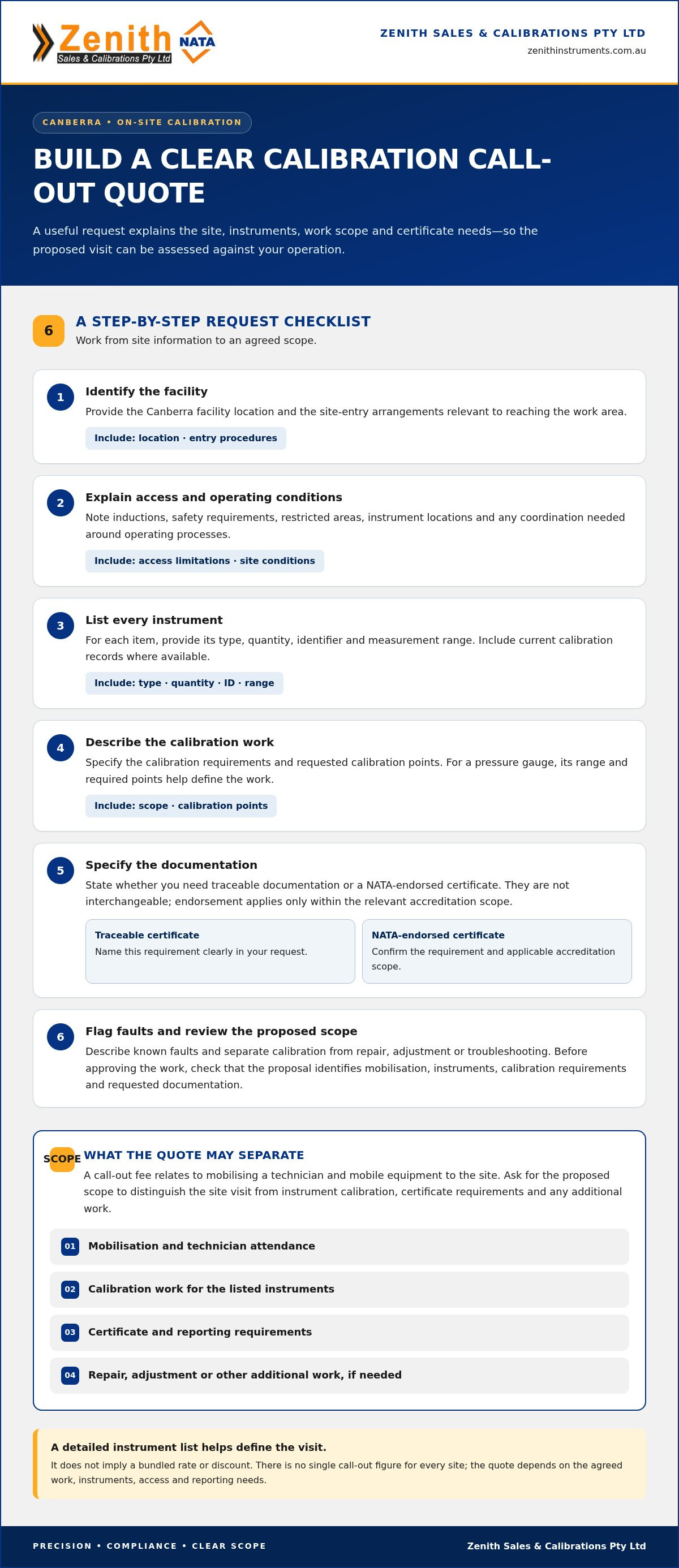
How can Canberra businesses prepare for an on-site calibration visit?
A well-prepared request helps define the work before a technician attends your Canberra site. Clear instrument and access information supports a more accurate service proposal and practical visit planning. It doesn’t guarantee a fixed fee, but it reduces uncertainty about what needs calibration, where the work will take place and what records are required.
Use this checklist to prepare:
- 1. Create an instrument inventory. Record each instrument type, quantity, make and model where available, asset or serial number, measurement range and site location. Include required calibration points if your procedures specify them.
- 2. Gather supporting records. Provide current or previous calibration certificates, relevant manuals and service history. Note known faults or changes that could affect the work.
- 3. State the required scope and documentation. Describe the calibration required, certificate format and any relevant quality-system requirements. If you need traceable or NATA-endorsed documentation, say so clearly. The certificate requirement can then be considered against the applicable scope.
- 4. Map access and safety arrangements. Identify entry procedures, inductions, restricted areas, site-specific safety requirements and how technicians can reach each instrument. Flag equipment in hard-to-access or controlled operating areas.
- 5. Identify operational constraints. Note when instruments can be made available and which equipment can’t be removed from service during normal operations. This helps align visit planning with production, monitoring or routine work.
What information should you include in a Canberra calibration request?
For each instrument, provide its type, quantity, identifier, range, location and requested calibration points. Add the certificate format and any relevant quality-system requirements. Include practical details too, such as preferred operating windows, access conditions and site induction arrangements. A complete request gives the service team the information needed to scope the instruments and plan mobilisation rather than relying on assumptions.
How should you prepare instruments and records?
Before the visit, make the instruments accessible and have relevant manuals, previous certificates and service history ready. Identify equipment that must remain in operation so its availability can be planned around your site’s needs. For pressure-instrument background, see our pressure gauge calibration service.
These details are especially useful when requesting on-site call out fees for calibration in Canberra. They help distinguish mobilisation needs from instrument workload and reporting scope. Prepare your instrument inventory and site requirements, then request an on-site calibration proposal from Zenith Sales & Calibrations Pty Ltd.
How to arrange Zenith on-site calibration in Canberra
Zenith Sales & Calibrations provides on-site calibration at your Canberra facility, helping limit equipment removal and support planned operational continuity. A clear request allows us to understand the instruments, site arrangements and documentation required before preparing a proposed scope. It also helps you assess what the on-site call out fees for calibration in Canberra cover, rather than relying on a generic estimate that may not reflect your work.
What should a clear on-site calibration proposal explain?
A useful proposal should set out the requested instruments and calibration work, site visit and mobilisation requirements, and certificate deliverables. Check that the instrument list and requested scope match your operational and quality-system needs. If you require traceable or NATA-endorsed certificates, specify this in your request. Endorsement applies where relevant to the work and applicable accreditation scope.
Keep calibration distinct from repair or maintenance. If an instrument also needs adjustment, troubleshooting or other service work, describe that separately so the proposed scope identifies it clearly. This makes it easier to understand which tasks relate to calibration and which require additional assessment or work. The scope should reflect your requirements rather than assume that every instrument needs the same checks or documentation.
How can Canberra teams plan the next step?
Bring together the information from your preparation checklist before submitting a request. Include:
- Instrument type, quantity, identifiers, ranges and site locations.
- Required calibration points, certificate type and relevant quality-system requirements.
- Site access, induction and safety arrangements.
- Operational constraints, including equipment that must remain available during routine work.
- Current calibration records, manuals, service history and any known faults.
With these details, Zenith can plan the proposed work around your facility and the instruments involved. On-site calibration keeps equipment at your premises, which can reduce handling and help you coordinate the visit with operational needs. The actual scope depends on the instruments and requirements, so include all relevant details rather than assuming a set fee, quantity or turnaround.
Ready to plan calibration at your Canberra site? Request an on-site calibration quote with your instrument inventory, site details and certificate requirements.
Plan your Canberra calibration visit with confidence
A clear quote starts with a defined scope. Mobilisation, instrument type and quantity, site access, calibration requirements and certificate needs all shape the proposed work, so provide these details upfront. Compare on-site and laboratory calibration against your operational needs: on-site service can reduce equipment removal, while the appropriate option depends on the instruments and required scope.
Zenith Sales & Calibrations provides on-site calibration in Canberra and other Australian cities, including Sydney, Melbourne, Newcastle and Brisbane. Our services include pressure gauge and other instrument calibration. We use NATA-certified standards and ISO-compliant processes. Certificate options, including NATA-endorsed or traceable certificates, apply according to the work and relevant scope.
With your instrument inventory, site arrangements and documentation requirements ready, you can request a proposal that reflects the work your facility needs. For tailored on-site call out fees for calibration in Canberra, request an on-site calibration quote from Zenith. A well-planned visit is a practical step towards maintaining measurement confidence while managing disruption to your operation.
Frequently Asked Questions
What determines on-site call-out fees for calibration in Canberra?
The fee depends on mobilisation, the instruments to be calibrated, the required scope, site access and certificate requirements. To understand on-site call out fees for calibration in Canberra, provide an instrument list with quantities, identifiers and ranges, along with the Canberra site location and access arrangements. Include any required calibration points and documentation. These details help define the work and support a proposal tailored to your facility.
Does an on-site calibration call-out fee include calibration and certification?
Not necessarily. A call-out or mobilisation charge relates to attending your site, while calibration and certification are determined by the agreed service scope. A proposal should make clear which instruments will be calibrated and what documentation is required. State whether you need traceable or NATA-endorsed certificates. NATA endorsement applies only where relevant to the work and applicable accreditation scope, so describe certificate requirements precisely.
Is on-site calibration more cost-effective than laboratory calibration?
Not automatically. On-site calibration can reduce equipment removal and transport, which may help limit operational disruption. Laboratory calibration may suit instruments that can be taken out of service or work requiring a particular setting. Compare the full scope and practical impact of each option, including mobilisation, transport, site access, downtime and certificate requirements. The appropriate choice depends on the instrument and your operational needs, not on a universal cost advantage.
Can several instruments be calibrated during one Canberra site visit?
Yes, multiple instruments can be included in a planned Canberra site visit. The number and type of instruments help determine the workload, equipment requirements and visit arrangements. Compile a list with each instrument’s identifier, range and location, and note its calibration and certificate needs. A mixed group may involve different procedures and reporting requirements. Listing several instruments supports planning, but doesn’t mean a bundled rate or discount applies.
What information should I provide to request an on-site calibration quote?
Provide your site location, instrument types and quantities, identifiers, measurement ranges and instrument locations within the facility. Include required calibration points, certificate format and relevant quality-system requirements. Note site entry procedures, induction or safety requirements, access constraints and operating windows. Previous certificates, manuals, service history and known faults can also help clarify the requested work. Complete information supports a more accurate proposed scope, but doesn’t guarantee a fixed fee.
Are NATA-endorsed certificates available for on-site calibration?
NATA-endorsed or traceable certificates may be provided where applicable to the calibration work and relevant scope. These terms describe different documentation requirements, so specify which certificate your quality system needs rather than simply requesting a “certified” result. The endorsement must relate to the applicable accreditation scope; it should not be assumed to cover every instrument or calibration performed on-site. Zenith uses NATA-certified standards and ISO-compliant processes.
Can pressure gauges be calibrated at my Canberra facility?
Yes. Zenith provides pressure gauge calibration, including on-site service at client facilities in Canberra. Share each gauge’s identifier, measurement range, location and any required calibration points when arranging the work. Also provide access and certificate requirements, plus relevant current calibration records if available. Zenith provides calibration services in Canberra and other Australian cities, including Sydney, Melbourne, Newcastle and Brisbane, with the proposed scope based on the instruments and site requirements.