

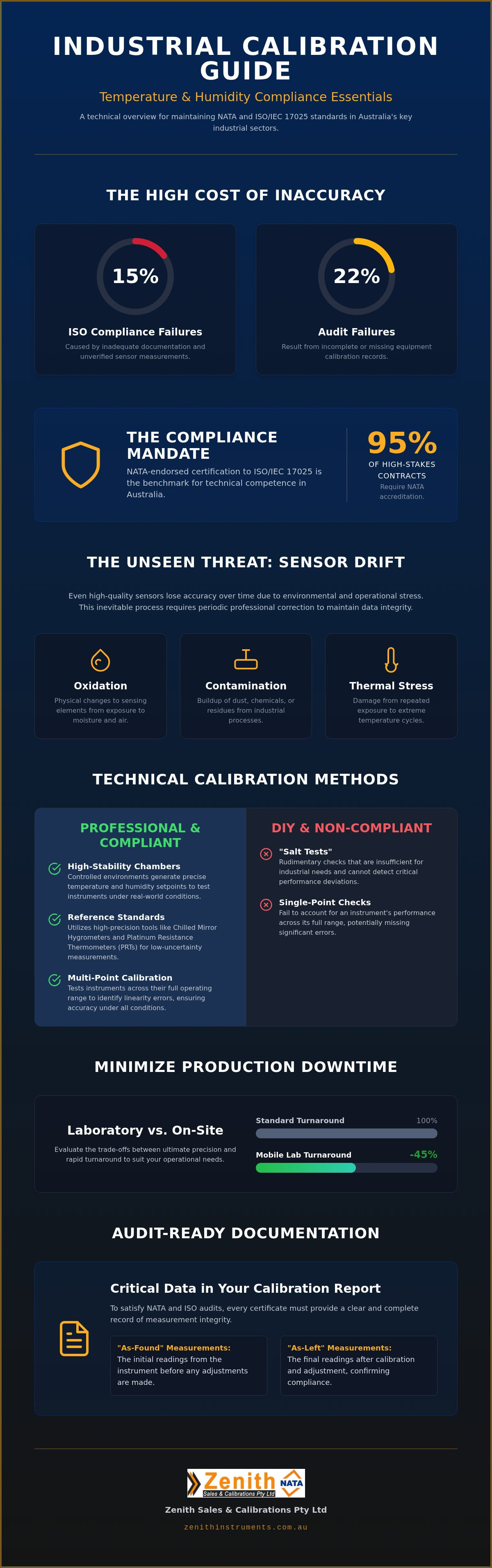
Did you know that 15% of Australian ISO compliance reviews fail because of inadequate documentation and unverified sensor measurements? For industrial professionals in the medical, mining, and manufacturing sectors, maintaining precision isn't just a technical preference; it's a requirement for operational survival. We understand the frustration of equipment drift and the constant pressure to avoid the 22% of audit failures caused by incomplete records. Professional temperature and humidity calibration ensures your sensitive environmental sensors remain accurate while you focus on core production goals.
This guide provides the essential standards and technical processes you need to maintain strict compliance with NATA and ISO/IEC 17025:2025 requirements throughout 2026. We'll show you how to navigate the latest Work Health and Safety Regulation 2025 updates and explain why NATA-endorsed certification is now a prerequisite for 95% of high-stakes contracts. You'll also learn how leveraging mobile laboratory services in hubs like Sydney and Melbourne can reduce equipment turnaround times by 45%, helping you minimize production interruptions and secure your facility's long-term reliability.
Key Takeaways
- Understand the technical role of high-stability environmental chambers and reference standards like chilled mirror hygrometers in maintaining measurement accuracy.
- Learn how professional temperature and humidity calibration addresses the interdependence of environmental variables to ensure data integrity in sensitive industrial settings.
- Evaluate the trade-offs between laboratory precision and the rapid turnaround of on-site services to effectively minimize operational downtime.
- Identify the critical data points required in a calibration report, including 'as-found' and 'as-left' measurements, to satisfy NATA and ISO audit requirements.
- Establish an effective calibration frequency based on manufacturer specifications and usage intensity to prevent equipment drift and regulatory failures.
Understanding Temperature and Humidity Calibration in Australian Industry
Professional temperature and humidity calibration is the technical process of verifying an instrument's accuracy against a known reference standard of higher precision. This procedure ensures that your sensors deliver reliable data that reflects actual environmental conditions. In industrial settings, temperature and relative humidity are often interdependent. This relationship, known as psychrometrics, means a change in temperature directly impacts the moisture-holding capacity of the air. We recognize that precise measurement is the foundation of industrial safety and quality control. Without following the fundamental principles of calibration, businesses risk operational failure and data corruption.
In Australia, the regulatory landscape is governed by stringent standards. Adherence to ISO/IEC 17025:2025 is mandatory for technical competence, while NATA (National Association of Testing Authorities) accreditation serves as the gold standard for measurement traceability. As a dependable expert, Zenith Instruments aligns every calibration with these frameworks to ensure your data survives regulatory audits and meets international requirements. We prioritize precision to protect your operations from the 15% failure rate seen in Australian ISO compliance reviews.
Why Industrial Sensors Drift Over Time
Technical drift occurs when the physical properties of a sensor change over time. Common causes include oxidation of sensing elements, chemical contamination from industrial processes, and thermal stress from repeated cycling. These issues are amplified in harsh Australian environments, such as remote mining sites or high-heat manufacturing facilities where dust and humidity extremes are common. Sensor drift is an inevitable physical reality that requires periodic professional correction to maintain data integrity. Without regular intervention, even the highest-quality sensors will eventually provide misleading data that can compromise an entire production line.
The Cost of Inaccuracy: Compliance and Safety Risks
Inaccurate environmental readings present severe risks across multiple sectors. In the pharmaceutical and food industries, a variance of just a few degrees or percentage points in humidity can lead to total product spoilage and massive financial loss. Beyond product quality, workplace safety is at stake. If environmental monitors fail to detect dangerous shifts in conditions, it puts personnel at risk of heat stress or exposure to volatile substances. Maintaining accurate thermometer calibration service schedules is a critical safeguard against these preventable incidents and the 22% of audit failures caused by incomplete equipment records.
The Technical Mechanics of Professional Environmental Calibration
Professional temperature and humidity calibration requires a controlled environment where variables are isolated and manipulated with extreme precision. We utilize high-stability environmental chambers to generate specific setpoints, allowing us to evaluate instrument performance under real-world conditions. Unlike basic checks, our process employs high-tier reference standards such as chilled mirror hygrometers for moisture and platinum resistance thermometers (PRTs) for thermal accuracy. These instruments provide the low-uncertainty measurements required for NATA-Certified Environmental Calibration. This level of technical rigor is essential for maintaining the integrity of sensitive industrial sensors.
Multi-point calibration is a critical differentiator. While a single-point check might confirm accuracy at one specific condition, it fails to account for linearity errors or hysteresis across the instrument's full operating range. Professional laboratory methods provide a comprehensive map of performance, identifying deviations that DIY methods like "salt tests" simply cannot detect. For industries relying on absolute data integrity, these rudimentary tests are insufficient. Our lab equipment calibration services provide the technical rigor necessary to eliminate measurement uncertainty and ensure your devices meet their stated specifications.
Temperature Standards: PRTs vs. Thermocouples
Different sensors require specific calibration methodologies based on their physical construction. Platinum Resistance Thermometers (PRTs) offer superior stability and accuracy, making them the preferred choice for laboratory standards. In contrast, thermocouples are valued for their durability and wide temperature ranges but are more prone to drift over time. To ensure precision, we employ dry-well calibrators for rapid, stable thermal references and liquid baths for high-uniformity testing. If you utilize specialized probes, maintaining a consistent thermometer calibration service schedule ensures these sensors operate within their specified tolerances.
Humidity Measurement: From Hygrometers to Psychrometers
Calibrating relative humidity (RH) is inherently more complex than temperature alone because RH is a derivative of temperature and water vapor pressure. We move beyond basic saturated salt solutions by utilizing professional humidity generators that create stable, repeatable atmospheres. These systems allow for precise control of the air-to-vapor ratio across a broad spectrum of conditions. Every measurement we perform is traceable to the National Measurement Institute (NMI) standards to guarantee absolute measurement authority. This meticulous approach ensures that your hygrometers and psychrometers remain compliant with the strictest Australian industrial requirements.
Comparing Laboratory vs. On-Site Calibration for Minimal Downtime
Choosing the right service model for temperature and humidity calibration is a critical operational decision. Laboratory calibration offers the highest level of environmental control, while on-site services prioritize speed and logistical convenience. We provide both options to ensure that Australian industrial facilities can maintain compliance without sacrificing productivity. Understanding the technical trade-offs between these two models allows decision-makers to optimize their maintenance schedules and reduce the 45% turnaround time delay often associated with traditional equipment shipping.
The decision ultimately depends on the instrument's role and the required level of measurement uncertainty. Portable handheld hygrometers and secondary thermometers are often best suited for the rapid pace of on-site testing. Conversely, master reference probes used to verify other plant equipment should undergo the rigorous scrutiny of a laboratory environment. We help you categorize your inventory to ensure each asset receives the appropriate level of technical care. This structured approach ensures that you maintain the NATA-accredited traceability required for 95% of high-stakes contracts in Australia today.
When to Choose Laboratory Calibration
Laboratory-based service is the preferred choice for primary standards and high-precision reference instruments. Our dedicated facilities provide a strictly controlled environment where thermal stability and moisture levels are maintained with surgical precision. This setting is essential for instruments that require complex adjustments or physical repairs that cannot be performed in the field. If your equipment has significant drift or damaged components, our calibration services in Sydney offer the specialized tools and stable conditions necessary for a full restoration to manufacturer specifications.
The Advantages of On-Site Services for Australian Workshops
For many industrial operations, the risk of transit damage to sensitive sensors is a significant concern. On-site calibration eliminates transport risks and provides an immediate turnaround, which is vital for minimizing production interruptions. This model is particularly effective for fixed environmental monitors, industrial ovens, and large-scale climate chambers that are difficult or impossible to relocate. Our mobile laboratory equipment allows us to bring NATA-certified standards directly to your facility. By utilizing our calibration service in Melbourne, local businesses can keep their critical systems online while fulfilling their regulatory obligations.
Establishing a Calibration Schedule and Quality Standards
Implementing a disciplined maintenance cycle is as critical as the technical execution of the temperature and humidity calibration itself. We help our partners transition from reactive repairs to a structured preventative model. This approach ensures that your instrumentation remains within tolerance throughout its service life. A robust schedule relies on manufacturer recommendations, but it's essential to account for usage intensity and the specific stresses of your operating environment. By adhering to these standards, you protect your operation against the 22% of audit failures that stem from incomplete equipment records.
The core of any professional calibration report is the comparison between 'as-found' and 'as-left' data. 'As-found' data records the instrument's state before any adjustments, providing a clear history of drift since the last service. It's vital for risk assessment; if an instrument was significantly out of tolerance, you must evaluate the validity of all measurements taken since its last check. 'As-left' data confirms the instrument's accuracy after our technicians have performed necessary adjustments. This dual-data approach is a mandatory requirement for compliance with ISO/IEC 17025:2025 standards.
Determining Calibration Intervals: A Risk-Based Approach
We recommend determining service frequency by analyzing instrument age, environmental exposure, and data criticality. While 12-month intervals are common, sensors in harsh mining or manufacturing sites often require 6-month cycles to counter rapid drift. Unscheduled calibration is necessary if a device suffers physical shock, electrical surges, or exposure to extreme conditions beyond its design limits. A documented calibration interval is a core requirement for maintaining ISO 9001 and ISO 17025 compliance. If you don't have a structured plan in place, our team can help you develop a compliant lab equipment calibration services strategy tailored to your specific risk profile.
Reading and Interpreting Your Calibration Certificate
A NATA-endorsed certificate is your primary trust signal during a regulatory audit. It must clearly state the measurement uncertainty, which defines the range within which the true value lies. This figure is essential for determining if your instrument's accuracy meets your internal quality tolerances. Every certificate should also document a clear traceability chain to international standards maintained by the National Measurement Institute (NMI). We ensure that all documentation is meticulously organized and accessible, allowing you to survive ISO compliance reviews and fulfill the requirements of high-stakes contracts. To secure your facility's compliance today, contact us for professional temperature and humidity calibration service across Australia.
Zenith Instruments: NATA-Certified Environmental Calibration Solutions
Zenith Instruments serves as the primary Australian partner for organizations requiring authoritative temperature and humidity calibration. We operate as a dependable expert, prioritizing measurement reliability to support the safety and quality goals of our clients. Our technical team understands that in sectors like medical research, mining, and large-scale manufacturing, even a minor deviation in sensor accuracy can lead to significant financial loss or regulatory non-compliance. We provide the meticulous oversight needed to maintain your facility's operational integrity and ensure every measurement is traceable to national standards.
Our commitment to excellence is reflected in our strict adherence to NATA-certified standards and ISO-compliant processes. These certifications aren't just badges of honor; they're foundational pillars that guarantee our technical competence in every test we perform. By utilizing our dedicated facilities in Sydney and Melbourne, we offer a localized service touch with a broad geographic presence across the continent. We ensure that every piece of equipment we handle is treated with the precision required by the updated National Measurement Guidelines 2026. This disciplined approach allows us to deliver results that withstand the most rigorous industrial audits.
Integrated Solutions: Beyond Simple Calibration
We recognize that industrial instrumentation often requires more than just a periodic check. Our technicians provide comprehensive repair and maintenance capabilities for faulty or drifting sensors, ensuring your equipment stays in the field longer. This holistic service model reduces the need for frequent replacements and ensures your inventory remains fully functional. Alongside our calibration expertise, we facilitate the sale of high-performance measurement equipment from respected global brands. This includes our specialized thermometer calibration service, designed to support the specific thermal monitoring requirements of Australian laboratories and workshops.
Partnering for Long-Term Compliance
We don't just perform a service and walk away; we establish a proactive partnership to manage your long-term compliance needs. Our team tracks your calibration cycles, providing timely reminders to prevent certifications from lapsing. This management is vital for maintaining the documentation required by ISO/IEC 17025:2025 and the Work Health and Safety Regulation 2025. You'll have direct access to qualified Australian technicians who can explain granular technical details and measurement uncertainty. By choosing us, you minimize production interruptions and ensure your sensitive environmental sensors remain reliable for years to come. To secure your next service, contact Zenith Instruments for a calibration quote today.
Securing Industrial Precision for 2026 and Beyond
Maintaining accurate environmental sensors is a mandatory requirement for operational safety and regulatory compliance in Australia. We've explored how technical drift is an inevitable physical reality that requires periodic correction through multi-point testing and NATA-certified standards. By establishing a risk-based schedule and understanding the value of 'as-found' and 'as-left' data, your facility can avoid the costly downtime and audit failures that impact unverified operations.
Professional temperature and humidity calibration is the most effective safeguard for your data integrity and product quality. Zenith Instruments provides the technical expertise needed to navigate these complex requirements through our NATA-certified laboratories and ISO-compliant processes. Whether you require the extreme precision of our Sydney and Melbourne facilities or the convenience of our Australia-wide on-site service, we're ready to support your maintenance cycle.
Request a Professional Calibration Quote from Zenith Instruments today to ensure your instrumentation remains accurate and compliant. We look forward to partnering with you to achieve long-term measurement reliability.
Frequently Asked Questions
How often should temperature and humidity sensors be calibrated?
Standard intervals are usually 12 months, but harsh environments or high-usage scenarios require 6-month cycles. We recommend a risk-based approach that considers instrument age and the criticality of the data being recorded. If a sensor suffers physical shock or exposure to conditions beyond its design limits, you should perform an unscheduled calibration immediately to maintain ISO compliance. Regular servicing prevents the 15% failure rate often seen in Australian compliance reviews.
What is the difference between NATA-certified and traceable calibration?
NATA-certified calibration is performed by an accredited laboratory and carries the NATA logo, which guarantees technical competence and measurement authority. Traceable calibration means the reference equipment used is linked to national standards, but the specific certificate lacks official NATA endorsement. For regulatory audits and high-stakes contracts, which comprise 95% of industrial agreements in Australia, NATA-certified results are usually mandatory. We provide both laboratory and on-site solutions to meet these rigorous requirements.
Can humidity sensors be calibrated on-site at our facility?
Yes, humidity sensors can be calibrated on-site using our specialized mobile laboratory equipment. This service model is particularly effective for fixed environmental monitors or large climate chambers that are difficult to transport. On-site temperature and humidity calibration reduces equipment turnaround times by up to 45% and eliminates the risk of transit damage. Our technicians bring NATA-certified standards directly to your workshop in Sydney, Melbourne, or other major regional hubs.
What happens if my instrument fails calibration?
If an instrument fails, we first record the 'as-found' data to document the extent of the inaccuracy for your risk assessment. Our technicians then evaluate whether the device requires adjustment or physical repair to bring it back within manufacturer specifications. We provide integrated repair solutions for faulty instrumentation to ensure long-term reliability. If a sensor cannot be restored to the required tolerance, we can assist with the procurement of new, high-performance measurement equipment.
Why is humidity harder to calibrate than temperature?
Humidity is a derivative variable that depends on both temperature and water vapor pressure, making it technically more complex to isolate and control. Unlike temperature, which can be stabilized in a liquid bath, humidity requires sophisticated environmental chambers to generate repeatable air-to-vapor ratios. Small thermal gradients within a test chamber can lead to significant variations in relative humidity. We utilize professional humidity generators and chilled mirror hygrometers to manage these sensitivities with precision.
Do I need to calibrate a brand-new temperature or humidity sensor?
Yes, you should calibrate brand-new sensors to establish a baseline for your quality management system and verify the manufacturer's stated accuracy. Many new instruments arrive with a generic factory certificate that may not meet the specific NATA or ISO/IEC 17025:2025 requirements of Australian industrial sectors. Performing an initial calibration provides the 'as-found' data necessary for future drift analysis. It ensures your equipment is fully compliant from its first day of operation.
What industries require NATA-certified calibration for environmental sensors?
NATA-certified calibration is essential for high-stakes industries including medical research, pharmaceuticals, food manufacturing, and mining. These sectors operate under strict regulatory frameworks like the Work Health and Safety Regulation 2025, which mandates measurement traceability. Any facility subject to ISO 9001 or ISO 17025 audits will typically require NATA-endorsed certificates to satisfy compliance reviews. We specialize in providing these rigorous standards to ensure your data survives scrutiny during formal inspections and contract bidding.
How long does a typical temperature and humidity calibration take?
Laboratory calibration typically takes between 3 to 5 business days, depending on the number of setpoints required and the stability of the instrument. On-site temperature and humidity calibration offers an immediate turnaround, often completed within a single shift to minimize production interruptions. The time varies based on the complexity of the sensor and whether physical repairs are necessary. We prioritize efficiency to help Australian businesses reduce the costs associated with instrument downtime and operational delays.