

What if your instruments are calibrated on time, but the records still can’t show whether each certificate suits its intended use? For Australian operations, managing industrial instrumentation calibration services australia means more than tracking due dates. It requires usable asset records, appropriate intervals and confidence in measurement traceability. If certificates are scattered across sites or planned work interrupts production, your calibration process may need a more practical structure.
It’s understandable that teams want a clear view of what’s due, what needs to be available for service and which provider can handle their instruments. This guide compares software, internal management and external service support, with practical criteria for assessing records, scheduling, certificate requirements and provider capability. We’ll also explain why accreditation scope matters, when to confirm traceability requirements, and how to review calibration intervals without treating a single schedule as suitable for every instrument. Zenith Sales & Calibrations provides in-house laboratory and on-site options, with facilities in Sydney and Melbourne and stated Australia-wide support. Instrument coverage, location availability and certificate suitability should be confirmed for each job.
Key Takeaways
- Separate calibration records and scheduling from the technical work performed on each instrument.
- Compare spreadsheets, calibration software, internal teams and external providers against your operational and evidence requirements.
- Assess provider capability by instrument scope, certificate suitability, traceability, logistics and communication.
- Build a workflow for assigning instrument owners, planning calibration and managing overdue, unavailable or failed assets.
- Use a practical scorecard to compare industrial instrumentation calibration services australia, then confirm each provider’s suitability for your instruments and locations.
What calibration asset management solutions in Australia need to control
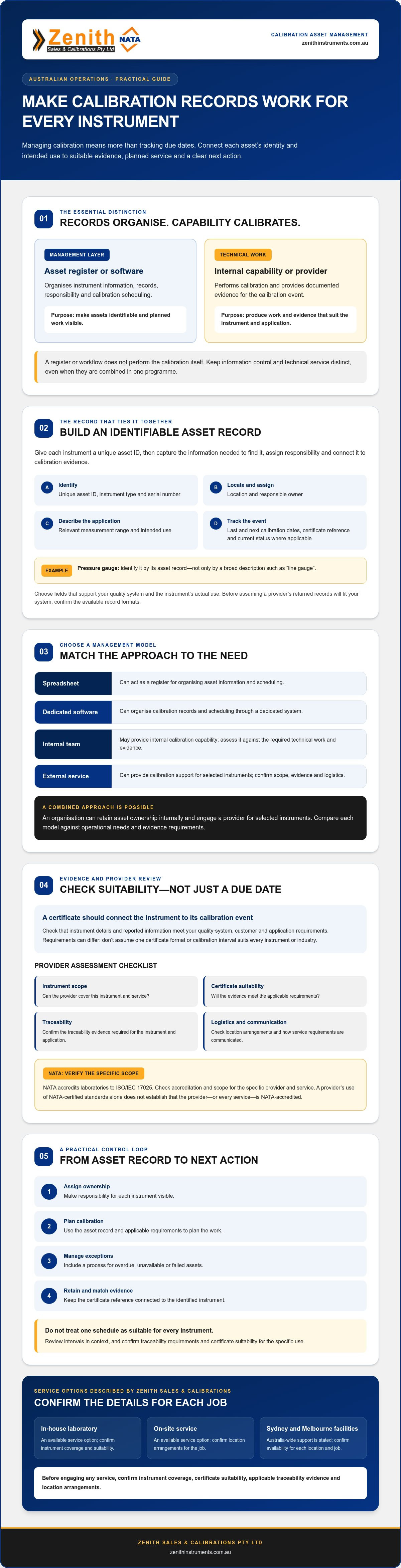
Calibration asset management is the coordinated control of instruments, calibration due dates, records and service activities. It gives teams a consistent way to identify which instruments need attention, who is responsible and where evidence is retained. A register or software workflow organises these controls; it doesn’t perform the calibration itself. That work is carried out by an internal capability or an external service provider.
Calibration compares an instrument’s measurement with a reference standard. For a foundational explanation, see What is calibration? In practice, a reliable process connects the instrument’s identity and intended use to its calibration evidence and next planned action. A missed date or certificate that can’t be matched to an asset may leave staff unable to confirm whether a measurement is suitable for a quality decision. It can also make audit preparation slower and less certain.
Which instrument information should an asset register capture?
Give each instrument a unique asset ID, then record its type, location, responsible owner, serial number and relevant measurement range. Include the last and next calibration dates, certificate reference and current status where these fields apply. For example, a pressure gauge should be identifiable by its asset record, not just by a general description such as “line gauge”.
Choose fields that support your organisation’s quality system and the instrument’s actual use. A register may be a spreadsheet or a dedicated system, but it should make it practical to find the current record and identify what is due. Confirm which record formats a provider can return before assuming they will fit your system.
Why calibration records and traceability matter
A calibration certificate links an identified instrument to documented results from a particular calibration event. Check that its instrument details and reported information meet your own quality-system, customer and application requirements. Requirements can differ, so don’t assume one certificate format or calibration interval is appropriate for every instrument or industry.
Be precise about NATA-related claims. NATA accredits laboratories to ISO/IEC 17025, but accreditation and scope must be checked for the specific provider and service. A provider’s use of NATA-certified standards alone doesn’t establish that the provider or every service is NATA-accredited. Confirm the applicable evidence and scope for your instrument before engaging a service.
When reviewing electrical equipment calibration services, or any other service, confirm instrument coverage, certificate suitability and location arrangements directly. Zenith Sales & Calibrations describes in-house laboratory and on-site options; suitability and availability should be checked for each job. A clear record system paired with appropriately scoped service helps keep instruments identifiable, evidence accessible and planned work visible.
Compare calibration management models: software, internal teams and external services
Calibration management can sit in a spreadsheet, dedicated software, an internal calibration function or an external service arrangement. These models address different needs: a register controls information and scheduling, while calibration work requires appropriate technical capability and documented evidence. Some organisations combine approaches, retaining asset ownership internally and engaging a provider for selected instruments.
For foundational Australian context, the National Measurement Institute (NMI) maintains national measurement standards. A practical guide to instrument calibrations in Australia should help you connect those measurement principles with the records, service scope and evidence your operation needs.
| Model | Ownership | Record control | Scheduling | Technical work and evidence |
|---|---|---|---|---|
| Spreadsheet | Assigned internal owner | Manually maintained file | Reminders managed by users | Doesn’t calibrate instruments; evidence must be filed and matched manually |
| Dedicated software | Internal system owner and users | Central workflow, subject to configuration | May support due-date tracking; verify functions | Organises records, but technical work and certificates still come from a competent internal team or provider |
| Internal capability | Organisation | Controlled through internal procedures | Planned by the team | Technical work and evidence depend on the team’s capability and applicable requirements |
| External provider | Organisation retains asset oversight | Agree how records and certificates are returned | Coordinate dates and instrument access | Provider performs the agreed work and supplies specified evidence |
When internal tracking or dedicated software may fit
Choose a tracking method after reviewing instrument numbers, sites, users, approval controls and reporting needs. Test whether data can be exported and whether the workflow fits existing quality or maintenance processes. Ask vendors to demonstrate relevant functions rather than relying on general claims. The supplied business information for Zenith Sales & Calibrations Pty Ltd describes calibration services, not a standalone asset-management software product or system integration.
When an external calibration provider adds value
Compare laboratory and on-site options against the instrument type, access constraints and acceptable downtime. Before booking, ask how each instrument will be identified and how certificates and service records will be returned, including any format requirements. For pressure instruments, review the scope of the pressure gauge calibration service and confirm its suitability for your application.
Zenith Sales & Calibrations Pty Ltd describes in-house laboratory and on-site options, with facilities in Sydney and Melbourne. Confirm instrument coverage, scheduling, location availability and certificate requirements for each job. To learn more about the company’s calibration support, visit Zenith Sales & Calibrations Pty Ltd.
How to assess Australian calibration providers and their evidence
Evaluate a provider against the instruments you use and the evidence your organisation needs, rather than relying on broad claims about capability. For industrial instrumentation calibration services australia, compare the service scope, instrument type and range, certificate requirements, logistics and communication before arranging work. Ask for details relevant to your application, and record the answers so sites and purchasing teams can assess providers consistently.
- Service scope: Can the provider calibrate the specific instrument type and measurement range?
- Technical evidence: What calibration method, standards and certificate details apply?
- Logistics: Is laboratory or on-site service suitable, and how will instrument access be coordinated?
- Records and communication: How are instruments identified, results returned and exceptions reported?
Separate verified facts from items that need confirmation. For example, a provider may describe its facilities or service options, but you still need to check whether they cover your instrument, location, required certificate and schedule.
What to check on accreditation, standards and certificates
Ask which standards, methods and measurement ranges apply to the requested calibration. Confirm with your quality representative what certificate type, reported results and traceability evidence are needed for the instrument’s use. NATA accredits laboratories to ISO/IEC 17025, but claims must match the provider, service and applicable scope. Check current details through NATA accreditation information, and verify claims directly before relying on them. An organisation’s sector, customer specifications and quality system may set different evidence expectations, so don’t assume a single certificate or accreditation claim suits every job.
Also ask how the provider handles instruments that are damaged, outside tolerance or otherwise require follow-up. Agree how findings will be communicated and documented before work begins. These details help your team decide how to manage affected equipment under its own procedures.
How to compare local service access across Australia
Check whether in-house laboratory or on-site service is appropriate for each instrument and site. Ask about collection or access arrangements, scheduling, and how completed instruments and records will be returned. Confirm current coverage and arrangements separately for Sydney, Melbourne, Newcastle, Canberra and Brisbane; don’t infer availability for a city from a general Australia-wide statement.
Zenith Sales & Calibrations Pty Ltd describes facilities in Sydney and Melbourne, along with in-house laboratory and on-site options. Confirm instrument coverage, location availability and scheduling for your specific job. For Sydney enquiries, review its Sydney calibration services and verify that the required service and arrangements suit your site.
Build a calibration asset management workflow that reduces avoidable disruption
A reliable workflow makes each instrument’s next action visible before it becomes an operational problem. Use a consistent sequence across sites, then adapt the controls to your quality procedures and equipment use. For organisations coordinating industrial instrumentation calibration services australia, planning also means agreeing access dates with production teams and confirming provider arrangements in advance, without assuming a particular turnaround time.
- Inventory assets: Identify each instrument and record its location, use and relevant calibration details.
- Assign ownership: Name who maintains asset data, reviews due dates, arranges service and files returned evidence.
- Assess requirements: Confirm applicable quality, customer and operational needs for each instrument.
- Schedule work: Coordinate due dates with production plans, site access, instrument availability and the selected service model.
- Retain evidence: Link certificates and service records to the correct asset and update its status after work.
Consider instruments that are shared between teams, kept in storage or moved off-site. Assign an owner who can verify their location and availability before booking service. Review calibration intervals using applicable requirements, instrument history and the consequences of measurement error. Don’t apply one interval automatically to every instrument. Any change to an interval should be supported and approved through your organisation’s procedures.
Set up a usable calibration schedule and ownership model
Define status labels such as due soon, overdue, unavailable and under review, then document what each label means and who acts on it. For example, an overdue instrument might trigger escalation to its owner and a review under internal quality procedures. Set reminders early enough for your team to arrange access and coordinate planned production or maintenance windows.
Manage nonconforming results and changes to equipment
If a result falls outside your organisation’s acceptance criteria, flag the instrument and notify the authorised personnel responsible for deciding its use. Follow internal procedures to assess affected measurements; don’t assume an asset register alone determines whether work or product is acceptable. Record repair, adjustment and follow-up calibration as distinct events so the instrument history remains clear.
Keep continuity when equipment changes hands or status. Record transfers between sites or teams, replacements, retirement and any change to an instrument’s approved status. A replacement should have its own asset identity and history rather than inheriting the previous instrument’s records.
Zenith Sales & Calibrations Pty Ltd describes in-house laboratory and on-site calibration options. Confirm the instrument, location and scheduling suitability for your job, then discuss calibration service options with Zenith.
Choosing a calibration partner for your Australian instrumentation programme
Use a consistent scorecard to compare providers against the needs of your instruments and sites. For industrial instrumentation calibration services australia, a suitable partner should be able to explain the requested service scope, evidence, logistics and record return process clearly. No single service model suits every instrument, so confirm details for each job before making a selection.
- Instrument scope: Confirm instrument types, measurement ranges and any relevant limitations.
- Evidence: Check certificate wording, applicable scope and the results or traceability information your organisation requires.
- Service model: Ask whether in-house laboratory or on-site work may suit the instrument and site conditions.
- Locations: Verify coverage and arrangements for every site, rather than assuming they’re the same across regions.
- Records: Agree how instruments will be identified and how certificates and service records will be returned.
A clear response to these questions helps you compare providers on relevant criteria rather than general claims. Confirm booking requirements and access arrangements directly, and don’t assume a service option or schedule is available until it’s confirmed.
Questions to ask before appointing a provider
Ask which instruments and ranges the provider can support at your location. Request clarification on the certificate type, wording, applicable scope, record delivery and any exclusions. Also confirm what information is needed to arrange the work and how instruments should be made available. Check any accreditation or standards claims against your requirements and verify their wording and scope before relying on them.
Match Zenith’s calibration services to your instrument mix
Zenith Sales & Calibrations describes in-house laboratory and on-site options, facilities in Sydney and Melbourne, and Australia-wide coverage. These are capabilities to discuss, not a guarantee that a particular instrument or site can be accommodated. Confirm the service scope and arrangements for each location. For pressure gauge requirements, review the pressure gauge calibration service. For electrical instruments, ask about the relevant electrical equipment calibration services and confirm that the specific instrument is covered.
Before proceeding, align certificate and documentation needs with your quality requirements, then confirm booking and service logistics directly. To discuss your instrument types, locations and evidence requirements, contact Zenith Sales & Calibrations.
Put a clear calibration plan into action
Effective calibration asset management depends on more than a list of due dates. Keep instrument records identifiable, assign responsibility for scheduling and certificate control, and choose a service model that fits each instrument and site. Review calibration intervals against applicable requirements, instrument history and operational risk rather than applying one schedule across the board.
As you assess industrial instrumentation calibration services australia, verify the provider’s instrument scope, certificate suitability, service arrangements and record delivery. These checks help you plan work with fewer surprises and maintain evidence your team can use.
Zenith Sales & Calibrations states it has operated since 2004, with in-house laboratory and on-site calibration options, facilities in Sydney and Melbourne, and Australia-wide coverage. Confirm that the instrument, location, schedule and documentation requirements for your job can be supported. Discuss your instrumentation calibration requirements with Zenith and take the next step toward a traceable, well-managed programme.
Frequently Asked Questions
What are calibration asset management solutions?
Calibration asset management solutions combine instrument identification, calibration schedules, service coordination and retained evidence in a controlled process. A register or software system helps organise assets and due dates; it doesn’t perform the technical calibration. The right arrangement depends on how instruments are used, your internal quality processes and customer or sector requirements. Australian organisations may need different combinations of software, internal capability and external services to manage their instruments effectively.
Does Zenith Sales & Calibrations Pty Ltd provide calibration asset management software?
Zenith Sales & Calibrations Pty Ltd’s supplied business information describes calibration, repair, service, measurement equipment sales, and in-house laboratory and on-site calibration options. It doesn’t confirm a standalone asset-management software product. If you’re considering Zenith Sales & Calibrations Pty Ltd as a service provider, ask whether its record and service processes suit your workflow. Confirm available record formats and any system integrations directly before assuming they’re supported.
How do I choose an industrial calibration provider in Australia?
Compare providers on instrument capability, applicable service scope, certificate evidence, service location, laboratory or on-site suitability, record handling and communication. Ask about the specific instruments, ranges and sites you need covered, rather than relying on broad claims. Check whether any accreditation statement applies to the actual service and scope. Confirm regional arrangements directly, particularly if coordinating instruments across Sydney, Melbourne, Newcastle, Canberra or Brisbane.
What should a calibration asset register include?
A useful register commonly identifies each instrument, its location, responsible owner, calibration history, next due date and certificate reference. Include status and technical details, such as instrument type or relevant range, where they support your process. Select fields to suit the organisation’s quality system and instrument use. A generic register isn’t a legal requirement or a replacement for controlled procedures; your team should define and maintain the records it needs.
How often should industrial instruments be calibrated?
There isn’t one calibration interval that should be applied automatically to every instrument. Consider applicable standards or customer requirements, how the instrument is used, measurement risk, calibration history and documented procedures. Ask your quality or technical authority to approve the interval, and confirm relevant service considerations with the provider. Don’t assume an annual schedule is suitable for every instrument or that a provider sets intervals without assessing the instrument and its use.
Is on-site calibration better than laboratory calibration?
Neither option is automatically better. On-site service may suit equipment that’s difficult to remove or where access and downtime need careful planning. Laboratory service may be appropriate for instruments that can be sent to a facility. The choice depends on instrument capability, method, site conditions and service scope. Ask the provider to confirm suitability, logistics, scheduling and documentation for the requested calibration before choosing an approach.
What should I check on a calibration certificate?
Check that the certificate identifies the correct instrument and includes the service date, reported results and relevant standards or traceability statements. Compare its details with your organisation’s quality and customer requirements, since content can vary by service and method. Verify any claimed accreditation status and applicable scope rather than assuming every certificate carries the same endorsement. If you’re unsure whether the evidence is acceptable, consult your organisation’s quality authority before relying on it.