

Your next industrial audit won't be won with a stack of paper; it'll be won through the technical integrity of your digital traceability chain. While many facilities focus on simply acquiring a sticker, the real challenge lies in maintaining calibration records for quality audits australia that withstand deep technical scrutiny. We understand the pressure of managing complex equipment registers across active sites in Sydney, Melbourne, and Brisbane while preparing for the December 15, 2026, AUASB standard updates.
It's common to feel concerned about the technical distinction between NATA accreditation and basic traceable standards, especially when a single non-conformance can trigger costly operational downtime. We'll help you master the technical requirements for your documentation to ensure your next Australian industrial audit is seamless and successful. This guide provides a direct roadmap for achieving zero major non-conformances, implementing a streamlined calibration schedule, and establishing total confidence in your technical traceability across every asset in your inventory.
Key Takeaways
- Distinguish between ISO 9001 management frameworks and ISO/IEC 17025 technical competence to ensure your QMS aligns with specific Australian industrial standards.
- Establish technical traceability through NATA-accredited laboratories to verify that your calibration records for quality audits australia meet National Measurement Institute (NMI) requirements.
- Centralise your document control within a robust Quality Management System to prevent the use of obsolete procedures and ensure data integrity during high-pressure audits.
- Implement a proactive pre-audit checklist that verifies physical calibration stickers against your digital register to eliminate minor non-conformances.
- Leverage nationwide onsite services to maintain a comprehensive calibration schedule across your pressure, electrical, and thermal instrumentation assets.
Defining Quality Audits in the Australian Industrial Sector
A Quality audit isn't a mere administrative hurdle; it's a rigorous, systematic evaluation of a Quality Management System (QMS) against established Australian standards. In 2026, the industrial sector operates under heightened scrutiny, where auditors demand evidence-based proof of instrument accuracy. We see firms across Australia shift their focus toward two primary pillars: ISO 9001 for management oversight and ISO/IEC 17025 for technical competence. The core objective remains the same: verifying that every measurement process aligns with regulatory requirements and customer safety protocols. Maintaining meticulous calibration records for quality audits australia is the only way to prove this alignment during a high-stakes inspection.
Distinguishing between an internal gap analysis and an external certification audit is vital for your preparation strategy. An internal review identifies technical weaknesses before they become liabilities. Conversely, an external audit, conducted by bodies like JAS-ANZ accredited registrars, determines your ability to maintain your certification status. We've found that companies treat these events as a pass-fail test, but they're actually an opportunity to validate the precision of your entire production line.
Common Audit Frameworks for AU Businesses
Most Australian manufacturing and engineering firms adhere to a specific hierarchy of standards. ISO 9001:2015 (and the upcoming 2026 revision) provides the global baseline for general quality management. It's the framework used by the 24,466+ organizations currently certified in Australia. For those operating laboratories or high-precision facilities, ISO/IEC 17025 is the gold standard. It goes beyond management to assess actual technical competence. NATA accreditation sits at the top of this hierarchy, representing the highest level of technical recognition for Australian facilities. It confirms that a laboratory's results are reliable, repeatable, and internationally recognized.
Why Sydney and Melbourne Firms Fail Technical Audits
Failure to demonstrate a clear chain of traceability to national standards via the National Measurement Institute (NMI) remains a top reason for non-conformance. Many businesses seeking calibration services Sydney or calibration service Melbourne struggle with inadequate record-keeping regarding "out-of-tolerance" equipment. If an instrument fails its check, you must have a documented impact assessment showing how that error affected past production batches. We also see inconsistent calibration intervals that don't align with manufacturer recommendations or actual usage frequency. Auditors look for a logical, data-driven schedule, not just a random date on a sticker. If your records can't tell the story of an instrument's accuracy over time, you're at risk of a major non-conformance.
Building a Robust Quality Management System (QMS)
A robust QMS functions as the definitive source of truth for your facility's measurement data. Precision requires active oversight. It doesn't just store files; it maintains the integrity of every instrument's accuracy over its entire lifecycle. Preparing for the December 15, 2026, AUASB standard updates requires a QMS that is both agile and technically rigorous. For the 24,466 ISO 9001 certified organizations in Australia, centralizing document control is a technical necessity that prevents technicians from using obsolete procedures during high-pressure audits. Data integrity is non-negotiable. Implementing a Corrective and Preventive Action (CAPA) system allows you to address previous audit findings with permanent technical solutions rather than temporary fixes. Management review meetings must yield documented, actionable outcomes for equipment maintenance to prove that leadership actively supports the metrology framework.
Document Control and Record Keeping
Standard Operating Procedures (SOPs) must be readily accessible to technicians on the workshop floor to ensure consistency in measurement. We require a strict version control protocol where digital timestamps and unique identifiers automatically retire outdated calibration certificates to prevent administrative overlap. While many Australian facilities still rely on paper, digital records provide superior data backup and integrity. Ensuring your measurements are traceable to Australia's National Measurement Institute (NMI) is a fundamental requirement for valid calibration records for quality audits australia.
The Role of Internal Mock Audits
Scheduling regular internal reviews identifies gaps in your calibration register before an external auditor arrives. These sessions should foster a culture of technical excellence, focusing on precision rather than blame. When you discover an internal non-conformance, documenting a thorough Root Cause Analysis (RCA) proves to auditors that your QMS is self-correcting. For example, if a multimeter is found out of tolerance, your records must show the investigation into how this affected production. If you need to strengthen your technical documentation, our electrical calibration services include comprehensive reporting designed for audit success.
Ensuring Equipment Accuracy and NATA Traceability
Calibration records for quality audits australia are the most scrutinized technical documents during an industrial inspection. Auditors don't just look for a valid date; they examine the specific "as-found" and "as-left" data to determine if an instrument was operating outside of its tolerance before the calibration took place. If an "as-found" reading shows a significant deviation, it suggests that every measurement taken since the last service is suspect. This technical detail is where many firms fail, as they don't have a documented process for assessing the impact of out-of-tolerance equipment on previous production batches. A single faulty gauge can invalidate an entire month of manufacturing, leading to expensive rework or product recalls.
Traceability is the backbone of this process. It's the documented "pedigree" proving that your measurements align with national standards maintained by the National Measurement Institute (NMI). We help clients establish this chain of evidence through meticulous reporting that stands up to the December 15, 2026, AUASB standard updates. For facilities in high-pressure environments, utilizing on-site services in Sydney or Melbourne is a strategic advantage. It allows us to verify your instrumentation within its actual operating environment, maintaining compliance without the downtime associated with shipping equipment to a laboratory.
NATA vs. Traceable Calibration
Understanding when your industry requires NATA-endorsed certification versus standard traceable calibration is a critical compliance decision. While traceable calibration is often sufficient for general commercial use, NATA traceability is the essential requirement for Australian regulatory compliance in 2026 within the medical, aerospace, and defense sectors. Choosing NATA ensures your certificates carry the symbol of the highest technical authority in the country. Our professional NATA thermometer calibration services provide the rigorous data needed for cold-chain and laboratory environments where precision is a safety mandate.
Managing Your Calibration Register
A live, dynamic register is far more effective than a static spreadsheet. It should track every instrument's serial number, physical location, and its next scheduled service date. We recommend categorizing your equipment into "critical" and "non-critical" assets. Critical instruments, such as those used for final quality checks or safety shut-offs, require more frequent intervals and higher-tier certification. This tiered approach optimizes your maintenance budget while ensuring you're never caught with an expired sticker during an audit. Implementing NATA pressure gauge calibration for industrial compliance ensures your most vital pressure systems remain within their specified accuracy limits, providing a clear trail of evidence for any external auditor.
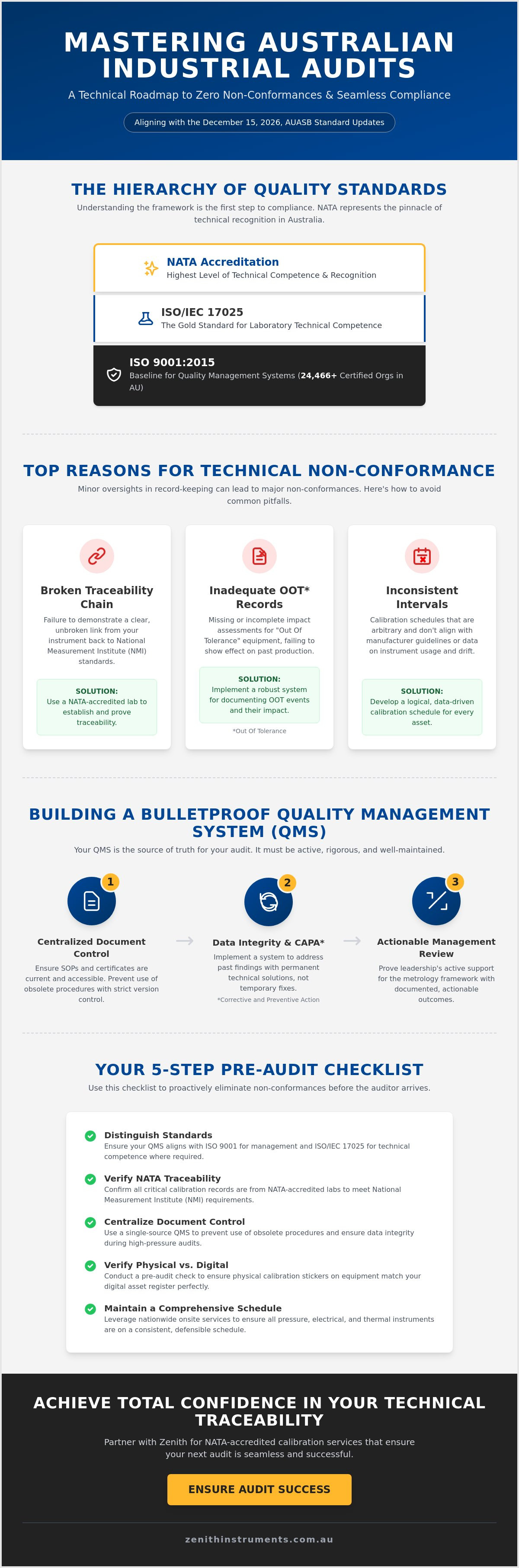
Your 5-Step Pre-Audit Checklist for Success
Preparation for an Australian industrial audit requires moving beyond the digital register to the workshop floor. We've developed a rigorous 5-step checklist to ensure your facility is technically sound before the auditor arrives:
- Step 1: Audit your calibration register to ensure no instrument has an expired "due date." This is the primary target for auditors seeking quick non-conformances.
- Step 2: Verify that all physical equipment has legible calibration stickers that match your calibration records for quality audits australia exactly.
- Step 3: Review your training matrix to ensure staff certifications for specialized tools are current and documented.
- Step 4: Conduct a physical site walk-through to identify uncalibrated or "rogue" tools that may have bypassed the Quality Management System.
- Step 5: Brief your team on how to answer questions using the "professional scepticism" framework, which prioritizes factual, evidence-based responses over assumptions.
The Physical Site Inspection
A common failure point in Australian manufacturing is the presence of "rogue" tools. These are uncalibrated multimeters, torque wrenches, or calipers hidden in personal toolboxes or drawers that haven't been entered into the central register. During your walk-through, you must ensure every measurement device on-site is either calibrated or clearly marked as "Out of Service." Our electrical equipment calibration services in Australia provide the comprehensive tagging and documentation needed to eliminate these gaps. Additionally, verify that environmental storage conditions for sensitive standards, such as temperature and humidity levels, comply with the ISO 9001:2015/Amd 1:2024 amendment regarding climate action and storage integrity.
Staff Preparation and Auditor Interviews
Auditors don't just inspect tools; they interview the people using them. We recommend training operators to provide concise, factual answers based strictly on your documented SOPs. A technician should be able to demonstrate exactly where to find the calibration certificate for the specific tool they're using, whether it's in a digital database or a physical folder. Empower your team to admit if they don't know a specific technical answer, provided they can quickly navigate to the correct record. This transparency builds trust and demonstrates that your calibration records for quality audits australia are part of a living system, not just a facade for the audit. If you're concerned about your current documentation levels, contact our technical team to schedule a comprehensive equipment review across your sites.
Maintaining Compliance with Zenith Sales & Calibrations Pty Ltd
Zenith Sales & Calibrations Pty Ltd provides the technical infrastructure required for total audit readiness across Australia. We deliver precision through comprehensive calibration across pressure, electrical, temperature, and dimensional instrumentation. To ensure you never miss a compliance deadline, we maintain fast turnaround times across our primary service hubs in Sydney, Melbourne, and Brisbane. Our NATA-certified standards satisfy the most rigorous ISO and regulatory auditors, providing the high-fidelity calibration records for quality audits australia that industrial decision-makers require. We understand that a certificate is only as valuable as the technical competence behind it. Our team prioritizes the accuracy of every data point to ensure your equipment registers are beyond reproach.
We work as a proactive partner to eliminate the fear of audit failure. By integrating our services into your Quality Management System, you gain access to a disciplined calibration schedule that aligns with current national standards. We don't just check your tools; we verify their performance against national standards, ensuring that every measurement taken in your facility is legally and technically defensible. This commitment to quality infrastructure is what allows our clients to achieve zero major non-conformances during external inspections.
On-Site Calibration for Minimal Disruption
Our mobile laboratories provide full-service calibration in Newcastle, Canberra, and other regional hubs, reducing the logistical burden on your internal teams. We specialize in NATA calibration services in Melbourne and provide expert calibration support in Sydney for rapid onsite verification. This localized approach ensures your equipment remains operational while we verify its accuracy within its actual working environment. Onsite service eliminates the risks associated with shipping sensitive instruments and provides immediate access to your updated records.
The Zenith Sales & Calibrations Pty Ltd Advantage: Beyond the Sticker
The Zenith Sales & Calibrations Pty Ltd advantage extends far beyond a physical calibration sticker. We provide full technical documentation that stands up to the highest levels of scrutiny from NATA and JAS-ANZ auditors. Our engineers offer specialized technical support to help your team interpret calibration results, including complex uncertainty measurements required for your final audit report. We help you understand the "as-found" and "as-left" data to manage your equipment's lifecycle effectively. Partnering with a dependable expert allows you to de-risk your compliance journey, turning a complex regulatory requirement into a streamlined operational advantage.
Securing Your Technical Compliance for 2026
Success in an Australian industrial audit requires shifting from passive record-keeping to active technical oversight. As regulatory standards evolve, your documentation must prove a continuous chain of traceability. Maintaining precise calibration records for quality audits australia is the only way to avoid the operational risks of out-of-tolerance equipment. By centralising your Quality Management System and conducting regular site walk-throughs, you build a culture of precision that satisfies the most meticulous auditors. This disciplined approach ensures your facility remains safe, productive, and fully compliant.
Zenith Sales & Calibrations Pty Ltd stands ready to support your compliance journey through our NATA Accredited Laboratories and ISO 9001 compliant processes. We provide comprehensive coverage across Sydney, Melbourne, Brisbane, Newcastle, and Canberra, ensuring your instrumentation remains a verified asset rather than a liability. Our fast turnaround times and onsite capabilities mean you don't have to sacrifice productivity for precision. Ensure your equipment is audit-ready with Zenith Sales & Calibrations Pty Ltd and our NATA-certified services. You've already taken the first step by mastering these technical requirements, and we're here to help you execute the rest with absolute accuracy.
Frequently Asked Questions
What is the most common reason for failing a technical quality audit in Australia?
The primary reason for failure is the inability to demonstrate a continuous chain of traceability to national standards via the NMI. Auditors frequently find that while a tool has a sticker, the corresponding calibration records for quality audits australia lack the "as-found" data necessary to prove past measurements were accurate. Without this data, you can't verify the integrity of production batches processed since the previous service.
How often should I calibrate my industrial instruments to stay audit-compliant?
Calibration intervals are determined by your specific risk profile, manufacturer specifications, and instrument stability. While a 12 month interval is the industry baseline for most electrical and pressure instrumentation, high usage or harsh environments may require 6 month cycles. Your QMS must document the justification for these intervals to satisfy ISO 9001:2015 requirements for evidence-based decision making.
Does NATA accreditation guarantee I will pass my ISO 9001 audit?
NATA accreditation confirms technical competence under ISO/IEC 17025 but doesn't guarantee an ISO 9001 pass. ISO 9001 focuses on your management system's broader framework, while NATA focuses on the precision and reliability of specific laboratory results. Using NATA-certified providers significantly reduces technical risk by ensuring your measurement data is internationally recognized and technically defensible.
What is the difference between a major and a minor non-conformance in a measurement audit?
A major non-conformance represents a systemic breakdown, such as using uncalibrated multimeters for final safety testing across an entire site. A minor non-conformance is typically an isolated lapse, like a single missing calibration sticker on a secondary tool where the digital record remains valid. Systemic failures often lead to immediate certification suspension, whereas minor issues require a documented CAPA plan within a specific timeframe.
Can I perform my own internal audits for ISO 17025 compliance?
You can perform internal audits provided the auditor is independent of the laboratory operations being reviewed. To meet ISO/IEC 17025 standards, the auditor must possess the technical knowledge to evaluate measurement uncertainty and calibration methodologies. Many Australian firms engage external experts for these reviews to ensure a truly objective gap analysis before a formal NATA assessment.
What equipment is most likely to be scrutinized during a technical audit in Sydney or Melbourne?
Critical process control instruments, such as pressure gauges, thermometers, and multimeters, receive the highest scrutiny in Sydney and Melbourne industrial hubs. Auditors prioritize tools that directly impact product safety or regulatory compliance. For instance, in medical manufacturing, an uncalibrated thermometer in a cold-chain storage unit is considered a high-risk failure point that requires immediate rectification and documented impact analysis.
Is on-site calibration as accurate as laboratory calibration for quality audit purposes?
On-site calibration is just as accurate as laboratory service when performed by technicians using NATA-certified reference standards and strict environmental monitoring. We utilize mobile laboratories that replicate laboratory conditions to ensure calibration records for quality audits australia remain valid. This approach allows for the verification of instruments within their actual operating environment, which can often lead to more representative accuracy data.
What should I do if an auditor finds an uncalibrated tool on my workshop floor?
You must immediately quarantine the instrument and tag it as "Out of Service" to prevent further use. Your next step is to conduct a formal impact assessment to determine if measurements taken with that tool have compromised product quality. Documenting this proactive response proves to the auditor that your QMS is functioning correctly and that you prioritize data integrity over administrative convenience.