

An uncalibrated carbon monoxide detector isn't just a compliance risk; it's a silent failure point that provides a false sense of security while electrochemical sensors naturally drift toward inaccuracy. You likely recognize that maintaining site safety is paramount, yet the technical nuances of NATA-traceable requirements and the fear of operational downtime often make scheduling a carbon monoxide detector calibration feel like a complex logistical hurdle. We understand the pressure of balancing rigorous safety protocols with the need for continuous productivity in specialized industrial environments.
This 2026 industry guide clarifies the exact technical requirements and Australian safety standards you must follow to ensure your equipment remains life-saving and fully compliant. We'll examine professional calibration methods, the distinction between AS/NZS 60079-17 and AS 1668.2, and how to secure valid certification for insurance purposes without halting your business operations. Our technical overview prioritizes precision and adherence to ISO/IEC 17025 standards, ensuring your facility meets every audit requirement with minimal disruption to your daily workflow.
Key Takeaways
- Understand why electrochemical cells lose sensitivity and how regular calibration counteracts sensor drift to prevent undetected gas leaks.
- Learn the technical steps of zeroing and spanning involved in professional carbon monoxide detector calibration to maintain instrument accuracy.
- Identify when to utilize on-site mobile services for fixed monitors versus laboratory calibration for high-precision handheld devices.
- Ensure compliance with AS/NZS 1668.2 and Australian WHS regulations to secure valid certification for insurance and safety audits.
- Discover how NATA-traceable standards and ISO-compliant processes provide the technical defensibility required for industrial operations.
Why is Carbon Monoxide Detector Calibration Essential?
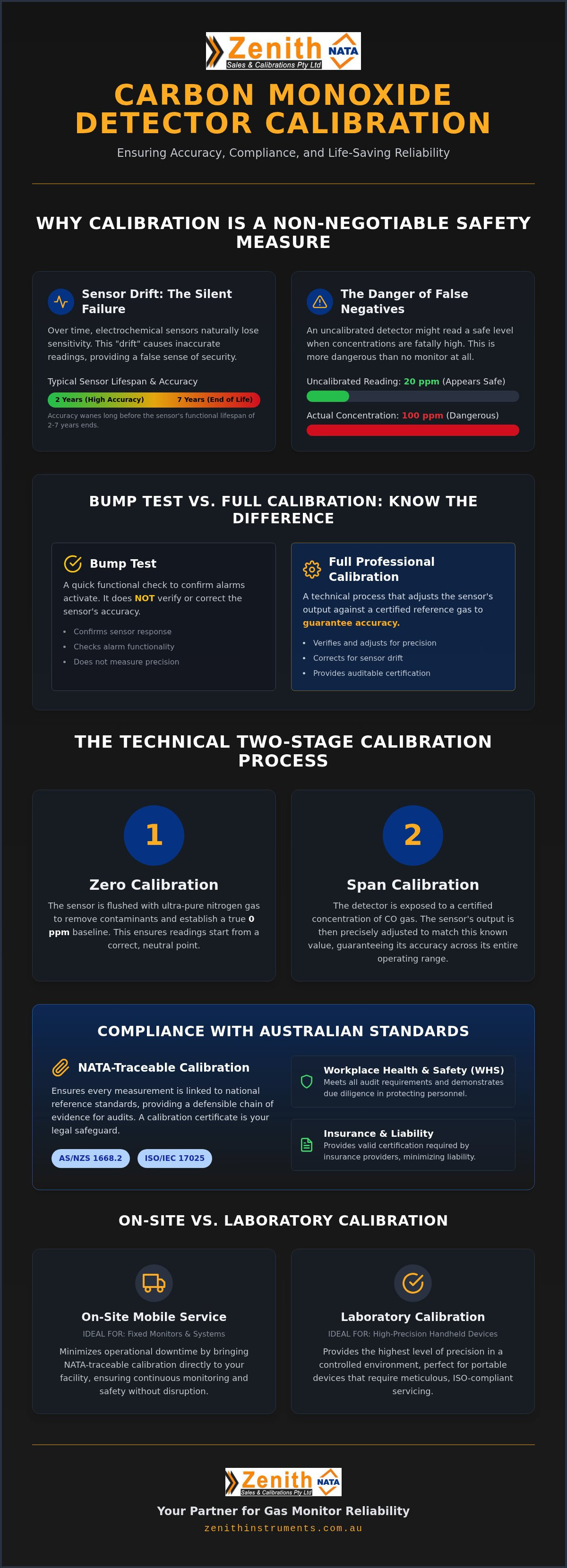
Carbon monoxide detector calibration is the specialized process of verifying and adjusting a sensor's output against a known, certified reference gas. It's a technical necessity, not an optional maintenance task. This procedure ensures that the monitor's readings remain accurate over time, providing a reliable baseline for safety decisions. Without regular intervention, the electrochemical cells that power these detectors lose their ability to produce an accurate electrical signal in response to gas exposure. We call this phenomenon sensor drift, and it's a fundamental reality of gas detection technology.
The science of sensor drift is rooted in the gradual depletion of the electrolyte and the degradation of the electrodes within the sensor cell. Most industrial electrochemical sensors have a functional lifespan of 2 to 7 years, but their accuracy begins to wane much sooner. Factors like high humidity, chemical cross-sensitivity, and even prolonged storage can compromise the cell's integrity. When a monitor drifts, it often fails on the side of danger, providing "false negatives" where it under-reports gas concentrations. In a life-threatening environment, a monitor that reads 20 ppm when the actual concentration is 100 ppm is worse than no monitor at all; it provides a false sense of security that can lead to fatal exposure.
It's vital to distinguish between a "bump test" and a full professional calibration. A bump test is a quick functional check. You expose the sensor to gas to ensure the alarms activate and the display reacts. However, it doesn't verify if the reading is precise. Only a full carbon monoxide detector calibration, utilizing a certified calibration gas with a known concentration, can adjust the internal circuitry to correct for drift. This ensures the device meets the exactness required for industrial safety protocols.
The Danger of "Odorless" Risks
Carbon monoxide is famously known as the silent killer because it lacks any sensory warning signs. In enclosed car parks, warehouses, and manufacturing facilities, CO can accumulate to toxic levels before occupants realize there's a problem. Safety monitors in these zones are often integrated into mechanical ventilation systems, such as those governed by AS 1668.2. These systems rely on the monitor to detect 1ppm increments to trigger fans or alarms. If the calibration is off by even a small margin, the ventilation may fail to activate in time, leading to dangerous CO buildup in confined spaces.
NATA Traceability vs. Generic Testing
In Australia, the distinction between generic testing and NATA-traceable calibration is significant for liability and compliance. NATA-traceable standards ensure that every measurement is linked back to a national reference standard, providing a chain of evidence that holds up during workplace health and safety (WHS) audits. A formal calibration certificate isn't just paperwork; it's a legal safeguard. It proves that your equipment was serviced by experts using meticulous, ISO-compliant processes. For businesses looking to maintain these high standards, our gas detector calibration service provides the technical precision and documentation required to satisfy both insurance providers and regulatory bodies.
The Technical Calibration Process: Zeroing and Spanning
Carbon monoxide detector calibration requires a meticulous two-stage approach to ensure the instrument's electrochemical sensor responds correctly to environmental changes. The first stage, zero calibration, establishes a true 0 ppm baseline. Technicians utilize ultra-pure nitrogen to flush the sensor, removing any trace contaminants or residual gases that might skew the initial reading. Once the baseline is stabilized, the process moves to span calibration. This involves exposing the detector to a certified concentration of CO gas, typically sourced from a NATA-traceable cylinder with a specific, known parts-per-million (ppm) value.
During the spanning phase, we observe the sensor's electrical output against the expected value. If the reading deviates from the certified gas concentration, technicians perform a precise internal adjustment to the device's circuitry or software. Linearity checks follow this adjustment, verifying that the detector reads accurately at multiple points across its entire operating range. This step is critical; a monitor must be as reliable when detecting a low-level 30 ppm leak as it is during a high-concentration emergency. Our technical team documents these adjustments to provide a clear audit trail of the instrument's performance and accuracy.
Why Fresh Air Zeroing Can Be Unreliable
While some basic manuals suggest "fresh air" zeroing, this method is often insufficient for industrial compliance in major Australian hubs. In dense urban environments like Sydney or Melbourne, ambient CO levels from vehicle emissions and industrial exhaust can hover between 2 and 5 ppm, which compromises the 0 ppm baseline. Cross-sensitivity is a technical condition where non-target gases, such as hydrogen or nitrogen dioxide, interfere with the electrochemical cell and produce a false reading. Utilizing professional nitrogen tanks eliminates these variables, providing the exactness required for a high-quality gas monitor calibration service.
Sensor Health and Replacement Indicators
Even with rigorous maintenance, the electrochemical cells within CO detectors have a finite lifespan. While some sensors last up to 7 years, most industrial-grade cells show significant sensitivity loss after 2 to 3 years of active service. During the carbon monoxide detector calibration process, technicians monitor the "reserve gain" or sensor output current. If a sensor requires excessive adjustment to reach the span value, it indicates that the internal electrolyte is depleted. Signs that hardware replacement is necessary include sluggish response times, an inability to hold a zero baseline, or a "sensor fail" error during the spanning process. Our detailed calibration reports track these sensitivity levels over time, allowing you to proactively manage equipment lifecycle costs.
Laboratory vs. On-Site Calibration: Choosing the Right Service
Deciding between laboratory and on-site carbon monoxide detector calibration requires a strategic assessment of your facility's infrastructure and the specific accuracy requirements of your gas detection hardware. For large-scale facilities with fixed monitoring systems, such as underground car parks or industrial warehouses, on-site calibration is the standard choice. Conversely, portable monitors and high-precision handheld devices often yield better results when serviced within a controlled laboratory environment. We provide both options to ensure your safety protocols remain robust and uninterrupted.
Logistical factors play a significant role in this decision. On-site services incur mobilisation fees but eliminate the risk of equipment damage during transit. Laboratory services, while requiring shipping costs, offer access to specialized diagnostic equipment that mobile units cannot always accommodate. We maintain a broad geographic presence to address these needs, deploying mobile labs to service major hubs like Brisbane and Canberra. This dual-service model ensures we provide minimal downtime regardless of your location or equipment type. We weigh the mobilisation costs against the potential loss of productivity to help you select the most efficient service route.
Benefits of Mobile Calibration Services
Mobile calibration services offer the distinct advantage of keeping your safety systems operational. You don't need to decommission sensors or leave zones unmonitored during transport. Our technicians perform the work in real-time, allowing for the immediate issuance of calibration certificates on-site. This is vital for maintaining continuous compliance with Australian safety audits. For businesses operating in Victoria, our calibration service in Melbourne provides on-site solutions that integrate seamlessly with your maintenance schedule, identifying system-wide issues like faulty relays or ventilation triggers.
When Laboratory Precision is Non-Negotiable
When your operations demand the highest level of precision, laboratory calibration is non-negotiable. Medical-grade or scientific CO detectors require the stable environmental conditions only a NATA-certified facility can provide. These laboratories utilize advanced diagnostic tools to identify subtle sensor failures that might be missed in the field. Our calibration service in Sydney operates under these rigorous standards, ensuring that every instrument returned to the field meets ISO/IEC 17025 technical requirements. This controlled environment is essential for devices used in high-stakes research or clinical settings where 1ppm accuracy is a strict mandate.
Australian Standards and Compliance for CO Monitoring
Regulatory compliance in Australia is governed by a combination of Australian Standards and state-based Workplace Health and Safety (WHS) legislation. For facility managers and industrial operators, AS/NZS 1668.2 is the primary benchmark. It dictates the design and maintenance of mechanical ventilation systems in car parks and other enclosed spaces. This standard requires that CO sensors are not only present but functionally accurate to trigger ventilation when gas levels exceed specific thresholds. Professional carbon monoxide detector calibration is the mechanism that validates this accuracy, ensuring your facility remains on the right side of the law.
Under the WHS Act, employers have a non-delegable duty of care to provide a safe working environment. This includes the rigorous maintenance of all safety-critical equipment. If a CO leak occurs and the monitoring system fails because it wasn't calibrated, the legal and financial repercussions are severe. Insurance providers often include clauses requiring equipment to be maintained according to manufacturer specifications and relevant Australian Standards. Failure to produce a valid calibration certificate can lead to the immediate voiding of liability coverage following an incident. We emphasize that a valid certificate is your primary defense during a post-incident investigation.
While some residential guidelines are less stringent, the industrial industry minimum for calibration is an annual check. However, for high-risk environments or those governed by AS/NZS 60079-17, a 6-month interval is the recommended standard to account for inevitable sensor drift. Regular servicing ensures that your safety systems are "fit for purpose," a key requirement during any regulatory inspection or ISO 9001 audit.
Compliance in Car Parks and Enclosed Spaces
Australian workplaces must adhere to strict legal thresholds for CO exposure to prevent chronic and acute poisoning. Calibrated sensors serve as the "brain" of your ventilation system; they detect rising ppm levels and trigger emergency fans to cycle in fresh air. Effective facility management relies on gas detector calibration to ensure these triggers occur at the exact levels mandated by AS/NZS 1668.2. Without this precision, you risk either excessive energy costs from fans running unnecessarily or, more dangerously, a failure to ventilate during a peak emission event.
Ensure your facility meets the latest safety mandates by booking a professional gas detector calibration today.
Audit-Ready Documentation
A professional calibration report is more than a receipt; it's a technical document that proves compliance. Each report should include the instrument’s serial number, the certified gas concentration used, the "as-found" and "as-left" readings, and a clear pass/fail status. Regulatory inspectors and ISO auditors look for a historical log of these documents to verify a consistent maintenance regime. We recommend maintaining these records for the life of the instrument to ensure technical defensibility. For more detailed insights into meeting these obligations, refer to our gas monitor guide for workplace safety.
Zenith Sales & Calibrations Pty Ltd: Your Partner for Gas Monitor Reliability
We position Zenith Sales & Calibrations Pty Ltd as a meticulous partner for specialized industrial, scientific, and manufacturing sectors. Our gas detector calibration services encompass comprehensive sales and support for leading global brands, ensuring your facility utilizes only the most reliable hardware. We utilize NATA-traceable standards as the foundational pillar of our service model, which guarantees that your equipment meets every ISO compliance requirement. Our technical footprint extends across Australia, providing expert support to regional hubs such as Newcastle and Brisbane, alongside our primary facilities in Sydney and Melbourne.
The team at Zenith Sales & Calibrations Pty Ltd consists of highly disciplined technicians who possess the dual capability of performing complex electronic repairs and precise mechanical calibrations. This integrated approach means we don't just identify a failure; we resolve it. Whether you require a routine carbon monoxide detector calibration or a complete sensor overhaul, we provide a proactive service model that prioritizes your operational uptime. We recognize the logistical needs of regional industries and act as a wide-reaching partner that brings laboratory-grade exactness directly to your site or through our dedicated service centers.
Our Multi-Point Calibration Process
Our structured workflow moves efficiently from identification to solution. Every instrument undergoes a multi-point verification process, beginning with an initial diagnostic to assess battery health, pump flow, and sensor response. If our technicians discover a depleted electrochemical cell or a circuit fault, we handle the necessary repairs during the calibration window. This prevents the frustration of a failed test and ensures the device returns to you in peak condition. We utilize certified gases to perform the final spanning, followed by the issuance of a formal certificate. Our commitment to efficiency is reflected in our standard 3 to 5 business day turnaround for laboratory services, helping you minimize equipment downtime.
Booking Your 2026 Calibration Service
Securing your 2026 compliance is a streamlined process designed for professional convenience. We offer on-site service call-outs for facilities with fixed monitoring systems, allowing our mobile labs to perform calibrations without disrupting your daily operations. For businesses with portable fleets, we provide custom maintenance schedules that automate your service reminders, ensuring you never miss a mandatory safety audit or insurance deadline. This organized approach reflects the disciplined nature of the technical services we provide. To secure your facility's safety and regulatory standing, contact Zenith Sales & Calibrations Pty Ltd for a calibration quote and experience the reliability of a high-performance service provider.
Securing Your Industrial Safety and Regulatory Compliance
Refining your approach to safety means moving beyond basic checks toward a rigorous, documented maintenance regime. By prioritizing carbon monoxide detector calibration, you address the inevitable reality of sensor decay while meeting the stringent requirements of Australian workplace safety audits. Zenith Sales & Calibrations Pty Ltd brings over 20 years of technical expertise to every engagement, ensuring your facility operates with the highest level of precision.
We offer NATA-traceable standards and versatile on-site mobile service throughout Sydney, Melbourne, and Brisbane to reduce your operational downtime. Our commitment to quality and international standards provides the liability protection and peace of mind necessary for modern industrial operations. Request a Professional CO Calibration Quote Today and let our meticulous experts manage your compliance requirements. We look forward to supporting your ongoing commitment to occupant safety.
Frequently Asked Questions
How often should a carbon monoxide detector be calibrated in Australia?
For industrial and commercial applications, a minimum calibration frequency of every 6 months is recommended. In high-risk or harsh environments, a more frequent 3-month interval is advised to maintain safety margins. This frequency aligns with AS/NZS 60079-17 requirements for hazardous areas and ensures that sensor drift does not compromise the accuracy of your monitoring system during peak emission events in enclosed spaces.
What is the difference between a bump test and a calibration?
A bump test is a quick functional check performed to ensure that the sensors respond to gas and the alarms activate correctly. However, it does not verify the accuracy of the reading. Only a full carbon monoxide detector calibration adjusts the internal circuitry against a certified reference gas to ensure the ppm readings are precise and technically defensible for your safety audits.
Can I calibrate my own CO monitor using fresh air?
We advise against using "fresh air" for establishing a zero baseline in urban environments like Sydney or Melbourne. Ambient pollutants and vehicle exhaust often contain trace amounts of CO that prevent a true 0 ppm reading. Our technicians utilize ultra-pure nitrogen tanks to ensure an exact baseline, eliminating the risk of cross-sensitivity from other gases that might be present in a standard workplace environment.
Does Zenith Sales & Calibrations Pty Ltd provide NATA-traceable calibration certificates for CO sensors?
Yes, Zenith Sales & Calibrations Pty Ltd provides NATA-traceable certificates that serve as a primary trust signal for ISO compliance and workplace safety audits. Each certificate documents the "as-found" and "as-left" data, providing a clear chain of evidence that your equipment meets national measurement standards. This documentation is essential for liability protection and meeting the rigorous requirements of your insurance provider following an incident.
What happens if my carbon monoxide sensor fails calibration?
If a sensor fails to meet the required accuracy during spanning, our technicians will assess whether it requires a technical adjustment or a complete hardware replacement. Most failures are caused by a depleted electrochemical cell that can no longer produce a sufficient electrical signal. In these cases, we perform the necessary sensor replacement and recalibration to ensure the device is returned to service in a fully compliant state.
Are on-site calibration services available in Brisbane and Canberra?
We provide mobile on-site calibration services across major regional hubs, including Brisbane, Canberra, and Newcastle. This service model is designed to minimize your operational downtime by allowing our technicians to service fixed monitors and portable detectors directly at your facility. Our mobile labs carry the necessary certified gases and diagnostic equipment to perform high-precision work without the need to ship your equipment to a laboratory.
What is the lifespan of a typical electrochemical CO sensor?
The electrochemical cells used in a carbon monoxide detector calibration typically have a functional lifespan of 2 to 7 years. However, in industrial settings, sensitivity often begins to degrade significantly after 2 to 3 years. We monitor the reserve gain of your sensors during every service to provide early warnings for replacement, ensuring you avoid sudden equipment failure and maintain continuous protection for your occupants.
Which Australian Standards govern the use of CO monitors in car parks?
The primary standard for mechanical ventilation and CO monitoring in car parks is AS/NZS 1668.2. This standard mandates the specific ppm thresholds that must trigger ventilation fans to ensure safe indoor air quality. Additionally, AS/NZS 60079-17 governs the inspection and maintenance of gas detection equipment in hazardous areas. Adhering to these standards is a critical component of your legal duty of care under Australian WHS legislation.