

In 2024, Safe Work Australia identified that over 50% of industrial gas exposure incidents were directly linked to inadequate equipment maintenance. We understand the technical burden of aligning complex WHS exposure limits with the logistical reality of managing detector reliability across diverse Australian sites. Precision is non-negotiable. It's difficult to maintain total confidence in your safety protocols when maintenance schedules are fragmented and your co monoxide sensors lack recent, traceable validation.
We've designed this guide to help you mitigate these critical risks through professional instrumentation and NATA-certified calibration that adheres to the latest 2026 standards. We'll provide a clear framework for achieving zero workplace incidents and maintaining reliable monitoring equipment. This article details the technical requirements for industrial safety and explains how our onsite calibration services in Sydney, Melbourne, Brisbane, and Perth ensure your facility stays compliant without the downtime of laboratory-bound testing.
Key Takeaways
- Identify the specific industrial risks associated with carbon monoxide and learn how to mitigate the dangers of this "silent killer" in high-risk environments like mines and warehouses.
- Evaluate the performance differences between portable personal monitors and fixed detection systems to implement a comprehensive safety strategy tailored to your facility's needs.
- Ensure full compliance with Safe Work Australia’s 2026 workplace exposure standards, including the critical 30 ppm TWA limit and evolving regulatory thresholds.
- Understand the necessity of regular NATA-certified calibration to address sensor drift and maintain the absolute accuracy of your co monoxide monitoring equipment.
- Access professional onsite calibration services across Sydney, Melbourne, and Brisbane to minimize operational downtime while upholding international precision standards.
Understanding Carbon Monoxide (CO) Risks in Australian Workplaces
Carbon monoxide is a colourless, odourless, and tasteless gas that presents a severe risk to personnel because it is impossible to detect using human senses alone. Often referred to as co monoxide in technical safety briefings, this gas is a byproduct of incomplete combustion from carbon-based fuels. It's known as the "silent killer" in industrial settings like warehouses and mines where internal combustion engines operate in confined or poorly ventilated areas. We regularly encounter high-risk scenarios in Sydney and Melbourne facilities that utilise LPG-powered forklifts, diesel generators, and large-scale industrial boilers.
The physiological danger of CO lies in its ability to displace oxygen. When inhaled, the gas binds to haemoglobin in the red blood cells with an affinity 210 times greater than oxygen. This chemical bond creates carboxyhaemoglobin, a substance that prevents the blood from transporting life-sustaining oxygen to the brain and heart. Without functional gas detection systems, workers may experience Carbon monoxide poisoning, which leads to dizziness, loss of consciousness, or fatality. Our technical team prioritises sensor accuracy to ensure these physiological shifts are caught before they become life-threatening.
- Source: Forklifts, pressure washers, and space heaters.
- Risk Factor: CO is slightly lighter than air and can accumulate in ceiling pockets or spread evenly through a room.
- Detection: Only NATA-calibrated sensors provide the reliability needed for industrial compliance.
The Dangers of CO Accumulation in Enclosed Spaces
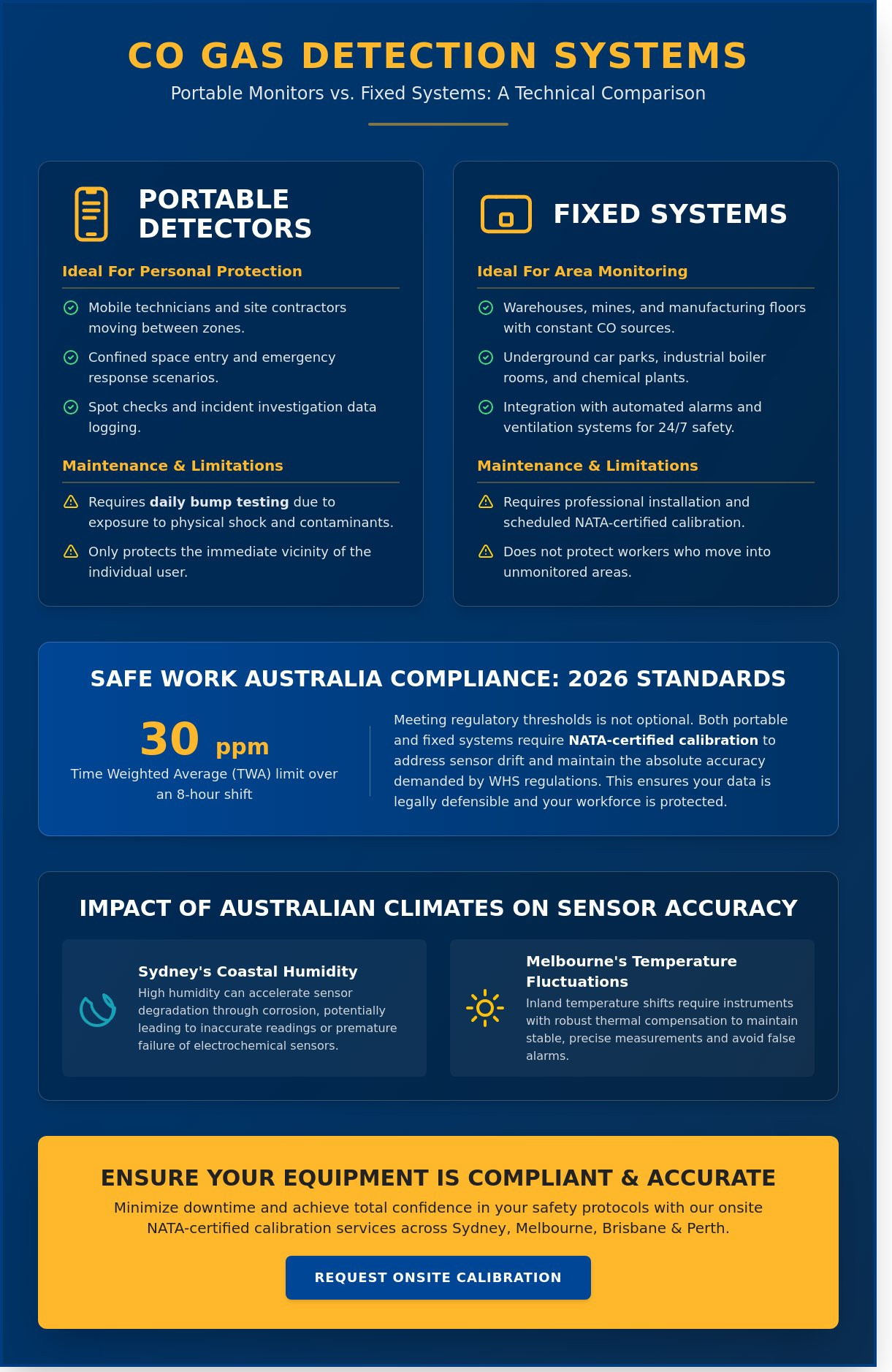
Sydney workshops often face rapid gas buildup when ventilation systems fail or are blocked during cold winter months. We distinguish between acute poisoning, which involves high concentrations over short periods, and chronic low-level exposure that can cause long-term heart and lung issues. For regulatory compliance, the Time Weighted Average (TWA) for carbon monoxide in Australia is 30 parts per million (ppm) over an eight-hour working shift.
Identifying High-Risk Industries in Melbourne and Brisbane
Manufacturing and chemical processing sectors in Melbourne require robust monitoring to manage furnace emissions and chemical reactions. In Brisbane, multi-level facilities and underground car parks must maintain functional ventilation and detection to mitigate exhaust fumes from high traffic volumes. Medical laboratories also rely on these systems to monitor cryogenic and combustion-based equipment. We offer professional gas detector calibration to ensure your hardware maintains a high level of precision, protecting your workforce and your facility's operational integrity.
Comparing Gas Detection Technologies: Portable vs. Fixed Monitors
Selecting the correct monitoring strategy depends on your specific operational environment and the safety protocols required for your personnel. For detecting co monoxide, electrochemical sensors are the industry standard because of their high sensitivity and linear output. These sensors utilize a chemical reaction to produce an electrical current proportional to gas concentration. In contrast, Metal Oxide Semiconductors (MOS) offer greater durability in harsh industrial environments but require higher power and are susceptible to humidity shifts. This technical distinction is critical when operating across Australia's diverse climates. Sydney's coastal humidity can accelerate sensor degradation through corrosion, whereas Melbourne's inland temperature fluctuations require instruments with robust thermal compensation to maintain accuracy.
Portable CO Detectors: Benefits and Limitations
Portable units provide essential personal protection for mobile technicians and contractors moving between various industrial sites. These devices offer immediate local alerts, ensuring individual safety in confined spaces or during spot checks. Modern units include sophisticated data logging features. This allows safety officers to export detailed incident reports to comply with Work Health and Safety (WHS) Regulations 2011. Because these sensors are exposed to varying contaminants and physical shocks, they require daily bump testing. We recommend regular professional gas detector calibration to ensure the electrochemical cells haven't drifted beyond the ±5% accuracy threshold required for NATA-accredited reporting.
- Immediate local alarms for individual worker safety.
- Lightweight designs suitable for belt or lapel mounting.
- Rechargeable battery systems optimized for 12-hour shifts.
Fixed Monitoring Systems for Large-Scale Facilities
Fixed systems provide 24/7 surveillance for manufacturing plants and underground car parks. We integrate these monitors directly into HVAC systems to trigger ventilation or fire alarms when co monoxide levels exceed 30 ppm, the current 8-hour Time Weighted Average (TWA) limit set by Safe Work Australia. Proper placement is vital. Since CO has a vapor density of 0.967, it's slightly lighter than air and tends to rise with warm air currents. Sensors should be installed at breathing zone height, typically 1.5 metres from the floor, and away from direct drafts. While fixed systems require less frequent physical handling than portables, they still need scheduled maintenance to check relay logic and system integrity. Our team at Zenith Instruments ensures your fixed infrastructure remains compliant with Australian Standards through meticulous onsite testing.
- Seamless integration with Building Management Systems (BMS).
- Reduced risk of human error compared to portable device management.
- Hard-wired power sources for uninterrupted facility protection.
Australian Standards and WHS Compliance for CO Exposure
Maintaining a safe industrial environment requires strict adherence to Safe Work Australia standards. For co monoxide, the regulatory framework defines clear boundaries to prevent both chronic and acute poisoning. Business owners in Newcastle and Canberra operate under the WHS Act, which mandates that Persons Conducting a Business or Undertaking (PCBUs) eliminate or minimize risks associated with hazardous gases. We recognize that compliance isn't just about safety; it's a legal obligation that protects your workforce and your commercial reputation. Failure to monitor these levels accurately can result in substantial penalties and legal liability under state-based safety regulators like SafeWork NSW or WorkSafe ACT.
Safe Work Australia Exposure Limits (TWA and STEL)
Safe Work Australia defines the Time Weighted Average (TWA) as the maximum average airborne concentration of a substance permitted over an eight-hour working day. Currently, the TWA for co monoxide is 30 ppm. However, following a comprehensive review, the workplace exposure standard is transitioning to a lower threshold of 20 ppm, with full implementation required by 2026. The Short Term Exposure Limit (STEL) acts as a 15-minute ceiling for peak exposures to prevent immediate health effects. When managing 12-hour mining or manufacturing shifts, we use the Brief and Scala model to adjust these limits. This calculation reduces the allowable TWA to account for the shorter recovery periods workers have between extended shifts, ensuring continuous protection in high-demand environments.
Documentation and Record Keeping for Audit Readiness
Regulatory compliance isn't achieved through a simple "pass" sticker on the side of a device. In Melbourne's industrial precincts, auditors demand comprehensive, traceable evidence of instrument accuracy. A basic pass/fail result doesn't provide the data depth required during a WorkSafe investigation or a high-risk safety audit. We provide NATA-endorsed reports that offer a complete audit trail, linking your equipment's performance back to national standards. These documents prove that your gas detector calibration was performed by a competent, accredited laboratory. Our technical team ensures every certificate includes specific uncertainty of measurement data, giving you the precision needed to satisfy rigorous state-based safety regulators. Detailed record-keeping ensures you're always prepared for unannounced inspections or annual safety reviews.
- Current TWA: 30 ppm (Transitioning to 20 ppm by 2026).
- STEL: 15-minute peak exposure limit to prevent acute symptoms.
- Shift Adjustments: Mandatory recalculations for shifts exceeding 8 hours.
- NATA Traceability: Essential for legal defense and regulatory audits.
The Critical Necessity of Gas Monitor Calibration and Maintenance
Precision in gas detection isn't a static state; it's a continuous process of verification. Many industrial operators fall into the trap of believing that a digital reading of zero ppm for co monoxide ensures a safe environment. This assumption is dangerous. A digital display only reflects what the sensor perceives, and if that sensor has lost its sensitivity, the display remains blind to lethal hazards. Reliability depends entirely on the physical state of the internal components, which degrade regardless of whether the device is actively detecting gas.
Sensor Drift and Environmental Interference
Electrochemical sensors used to detect co monoxide operate through a chemical reaction that consumes internal electrolytes over time. This leads to "drift," a gradual shift in the sensor's baseline and sensitivity that occurs even during storage. Environmental contaminants such as silicone vapours, lead compounds, or high concentrations of sulfur can "poison" the sensor, effectively rendering it inert without any visible external signs. High humidity levels in Australian coastal regions or excessive dust in mining operations further accelerate this degradation. Uncalibrated equipment often results in "false negatives," where the device fails to alarm despite the presence of toxic gas. Our technical team provides a comprehensive gas monitor calibration service to eliminate these blind spots and ensure your hardware meets rigorous safety standards.
Calibration Intervals: How Often is Enough?
While manufacturer guidelines typically suggest a six-month interval, Australian industry best practices often dictate more frequent testing for high-impact environments. Facilities operating in extreme heat or corrosive atmospheres should consider quarterly checks. A critical distinction must be made between a bump test and a full calibration. A bump test is a brief exposure to a known gas concentration to verify that the sensors respond and the alarms activate; it doesn't check for accuracy. Conversely, a full calibration adjusts the instrument's internal settings to match a certified reference gas, ensuring the numerical output is precise.
- Bump Test: A daily functional check to ensure the sensor isn't blocked and the alarm sounds.
- Full Calibration: A periodic adjustment performed by technicians to reset the sensor's accuracy.
- Compliance: Adherence to AS/NZS 60079.29.2:2016 for explosive and toxic gas atmospheres.
Data from 2022 safety audits indicates that 15% of gas detectors that hadn't been calibrated within 12 months failed to trigger alarms at the required legal thresholds. Zenith Instruments maintains NATA accredited laboratories in Sydney and Melbourne to support your compliance needs. We offer onsite services across Australia to minimize your downtime while ensuring every device operates within the tight tolerance ranges required for worker safety.
Ensure your team's safety with certified precision. Book your professional gas detector calibration today.
Zenith Instruments: Australia's Partner for Precision CO Monitoring
Effective monitoring of co monoxide levels is a critical safety requirement for any facility using combustion-based equipment or enclosed parking structures. Zenith Sales & Calibrations Pty Ltd operates as a premier technical partner, providing NATA-accredited laboratory services in Sydney, Melbourne, and Brisbane. We don't just offer basic checks; we provide deep technical analysis to ensure your sensors respond correctly to specific gas concentrations. Our capabilities extend across a broad range of industrial needs, from pressure gauge calibration to the maintenance of sophisticated multi-gas detection systems.
Industrial operations in Australia face strict regulatory oversight. Maintaining accuracy in your gas detection fleet is a legal necessity under various state-based WHS frameworks. We've built our reputation on providing the precision required to meet these standards, ensuring that every piece of equipment we touch performs to its original manufacturer specifications. Our fast turnaround times mean your safety equipment spends less time in the lab and more time protecting your workforce.
On-Site Calibration Services Across Major Australian Hubs
Our mobile calibration units are designed to bring the laboratory to your doorstep. We regularly service major industrial hubs, including Newcastle and Canberra, to provide onsite support where it's needed most. This approach reduces the logistical burden on your maintenance teams and keeps your critical safety infrastructure online. We follow ISO 17025 compliant processes for all onsite work, providing the same level of certification you'd expect from our permanent facilities. This localized service model ensures that regional Australian businesses have access to world-class calibration without the delays of interstate shipping.
Why Industrial Leaders Trust Zenith Sales & Calibrations Pty Ltd for Safety Compliance
For over 20 years, leaders in the medical, mining, and manufacturing sectors have relied on Zenith Sales & Calibrations Pty Ltd because we prioritize technical integrity. We understand the specific risks associated with co monoxide in underground mines and industrial boiler rooms. Our technicians are trained to identify drift and sensor fatigue before they lead to safety breaches. Beyond calibration, our retail partnerships allow us to supply the latest gas detection hardware when your existing systems reach the end of their service life. We provide a comprehensive service that covers the entire lifecycle of your instrumentation.
Don't leave your site safety to chance. Contact Zenith Sales & Calibrations Pty Ltd today for a NATA-certified calibration quote and ensure your facility remains compliant with Australian safety standards.
Prioritise Precision in Your 2026 CO Safety Strategy
Maintaining rigorous safety standards for co monoxide detection isn't just about ticking a regulatory box. It's a critical operational requirement for protecting lives in high-risk industrial environments. Australian WHS regulations demand that monitoring equipment adheres to strict AS/NZS standards to ensure worker safety. Without regular calibration, even the most advanced portable or fixed sensors lose their accuracy. We provide the technical certainty your operations require through our NATA accredited laboratories and ISO-compliant processes. Our technicians deliver expert on-site calibration services in Sydney, Melbourne, and Brisbane to ensure your equipment remains accurate without causing unnecessary downtime. We're here to help you maintain a proactive safety model that meets the latest 2026 industry benchmarks. Trusting your calibration to meticulous experts ensures your facility remains compliant and your personnel stay protected from invisible hazards. We're ready to support your ongoing commitment to workplace safety.
Book Your NATA-Certified Gas Monitor Calibration with Zenith Instruments
Frequently Asked Questions
What are the first signs of carbon monoxide poisoning in a workplace?
Early symptoms of carbon monoxide poisoning typically include tension headaches, dizziness, and nausea. These signs often mirror the flu without a fever, which makes detection difficult without calibrated equipment. If multiple employees report similar symptoms in an enclosed workspace, you must evacuate the area immediately and check for sources of incomplete combustion or exhaust leaks.
How often should industrial gas monitors be calibrated in Australia?
Most industrial gas monitors require calibration every six months to maintain compliance with Australian Standards such as AS/NZS 60079.29.2. Some high-risk environments or specific site protocols necessitate quarterly testing to ensure sensor accuracy. We recommend following the manufacturer's specific guidelines and keeping a detailed calibration log for safety audits and insurance purposes.
Is a domestic CO alarm sufficient for a commercial warehouse in Sydney?
No, domestic CO alarms aren't sufficient for commercial warehouses in Sydney because they lack the sensitivity and durability required by industrial safety regulations. Commercial facilities must use heavy-duty monitors that comply with AS 1668.2 for ventilation control and worker safety. Zenith Instruments provides NATA accredited calibration for these industrial-grade devices to ensure they meet strict Australian compliance benchmarks and survive harsh environments.
What is the difference between a bump test and a calibration for CO monitors?
A bump test is a daily functional check that confirms the sensor responds to gas, while calibration is a rigorous adjustment process. During calibration, technicians use certified reference gases to reset the instrument's accuracy to zero and span points. This process ensures the unit provides a precise measurement of gas concentration rather than just a simple pass or fail response.
What are the current Safe Work Australia exposure limits for CO in 2026?
Safe Work Australia mandates a Time Weighted Average (TWA) exposure limit of 15 parts per million (ppm) for carbon monoxide over an eight-hour shift. This 15 ppm limit, which was reduced from 30 ppm, is the enforced standard for the 2026 period to prevent chronic health issues. Employers must ensure their detection systems are calibrated to trigger alerts at these lower thresholds to maintain legal compliance.
Can Zenith Instruments perform on-site gas monitor calibration in Melbourne?
Yes, Zenith Instruments provides comprehensive onsite gas monitor calibration services across Melbourne and regional Victoria. Our technicians arrive with mobile NATA accredited equipment to minimize your operational downtime. This proactive service model ensures your facility remains compliant with national safety standards without the need to ship sensitive instruments offsite for extended periods.
What happens if my gas monitor fails its NATA calibration test?
If a monitor fails its NATA calibration test, the instrument is tagged as out of service and requires immediate repair or sensor replacement. We provide a detailed failure report that identifies the specific technical discrepancy or sensor exhaustion. Our team can often perform these repairs onsite to restore your equipment to ISO standards quickly, ensuring your workplace safety isn't compromised.
Why does my CO monitor show a reading in a clean environment?
Cross-sensitivity to other gases or sensor drift often causes a co monoxide monitor to show readings in seemingly clean air. Substances like hydrogen or certain cleaning chemicals can trigger a false positive on electrochemical sensors. Regular calibration by a NATA accredited laboratory eliminates these inaccuracies and ensures your co monoxide detection levels remain reliable and precise during daily operations.