

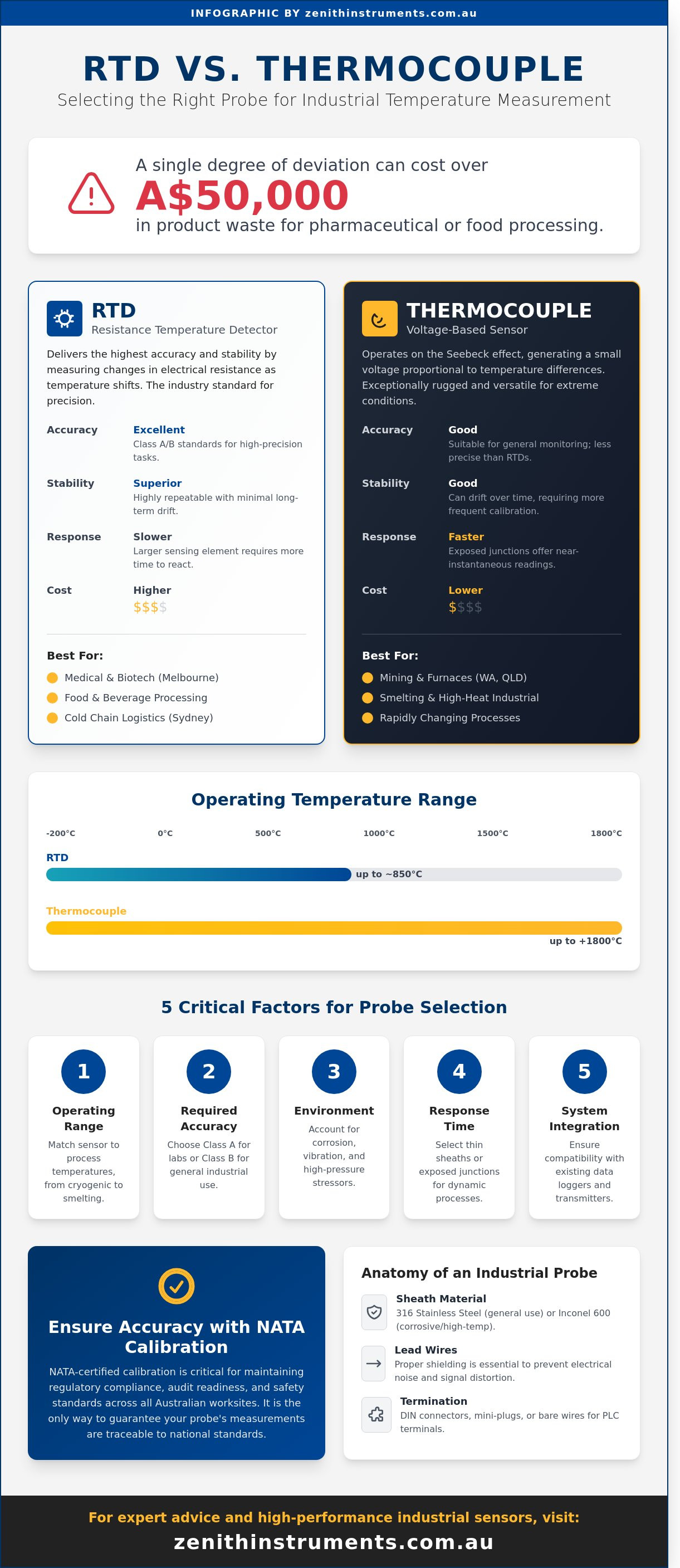
A single degree of deviation in a high-volume pharmaceutical batch or industrial food processing line often results in over A$50,000 in immediate product waste. This reality makes selecting the right probe for temperature measurement a high-stakes decision for any Australian facility manager. We recognize that the technical distinction between an RTD and a thermocouple remains a common source of confusion that compromises site precision and leads to costly downtime.
You'll discover how to identify the specific sensor type required for your thermal environment and how to maintain strict compliance with ISO standards. We provide the technical criteria needed to ensure your equipment delivers NATA-certified accuracy across Sydney, Melbourne, and our other national service centers. This guide examines the critical performance factors, response times, and local calibration cycles necessary to protect your production output and satisfy rigorous audit requirements.
Key Takeaways
- Identify the optimal sensor configuration by evaluating your specific industrial medium, ensuring maximum efficiency in air, liquid, or surface contact applications.
- Compare the long-term precision of RTDs against the cost-effectiveness of thermocouples to select the most reliable technology for your thermal management needs.
- Understand the critical role of NATA-certified calibration in maintaining regulatory compliance and safety for every probe for temperature used across Australian worksites.
- Learn to define precise technical requirements, including temperature ranges from -200°C to +1800°C and the distinction between Class A and Class B accuracy levels.
- Leverage Zenith Sales & Calibrations Pty Ltd’s technical expertise to specify and source high-performance industrial sensors backed by comprehensive local support and fast turnaround times.
Understanding the Role of a Probe for Temperature Measurement
A probe for temperature acts as the primary sensory interface between a physical process and your monitoring instrumentation. It's the critical first link in the chain of industrial thermal management. Precision starts here. We categorize these sensors based on the medium they measure: air, liquid, or solid surface contact. Choosing the wrong configuration leads to measurement lag and thermal shunting. In Australian manufacturing, a deviation of just 1.5°C can result in a 4% increase in energy consumption or, even worse, a total batch failure in chemical processing. Selecting the correct sensor technology is non-negotiable for maintaining safety and operational efficiency.
We typically deploy three primary sensor categories across Australian industries. Resistance Temperature Detectors (RTDs) provide the highest levels of stability and accuracy for mid-range applications. Thermocouples offer the ruggedness required for extreme heat; thermistors excel in high-sensitivity, narrow-range environments. Each serves a specific purpose in your calibration and measurement strategy. Reliability depends on matching the sensor's electrical characteristics to the environment's thermal dynamics.
Common Industrial Applications in Australia
Our team frequently implements specialized temperature solutions across the country's diverse economic hubs. In Brisbane and Sydney, cold chain logistics rely on high-precision probes to ensure food safety and regulatory compliance during transport. Regional mining operations in Western Australia and Queensland require heavy-duty furnace monitoring where temperatures often exceed 1,200°C. Meanwhile, Melbourne’s medical and biotechnology sectors demand the rigorous climate control provided by NATA-accredited instrumentation to protect sensitive laboratory samples and maintain sterile environments.
The Anatomy of an Industrial Probe
The physical build of a probe for temperature determines its longevity and response time. We utilize 316 Stainless Steel for general food and chemical use, but switch to Inconel 600 for corrosive, high-temperature environments. Electrical noise can distort signals, so lead wire configuration and shielding are essential for maintaining integrity in high-interference zones. Termination options vary based on the receiving unit. We provide several configurations to suit your needs:
- DIN connectors: Standard for many European-designed industrial machines.
- Mini-plugs: Ideal for handheld thermometers and quick-swap laboratory setups.
- Bare wires: Best for permanent installation into PLC screw terminals.
Proper termination ensures that the transition from the probe to the controller doesn't introduce parasitic resistance or measurement errors. We focus on these granular details to ensure your facility meets every relevant Australian standard.
Key Factors for Selecting a Temperature Probe in 2026
Selecting the correct probe for temperature requires a systematic assessment of your operational environment and precision requirements. We've identified five critical steps to ensure your instrumentation meets 2026 industrial standards.- Step 1: Define your absolute operating range. Industrial processes in Australia often span from cryogenic storage at -200°C to specialized smelting at +1800°C.
- Step 2: Determine the required accuracy. For high-precision laboratory work, Class A RTDs are essential, whereas Class B RTDs suffice for general industrial monitoring.
- Step 3: Evaluate environmental stressors. You must account for corrosive chemicals, high-pressure lines, or constant mechanical vibration.
- Step 4: Analyze response time. Dynamic processes require thin-wall sheaths or exposed junctions to capture rapid thermal shifts.
- Step 5: Check system integration. Ensure your probe for temperature is compatible with your current 4-20mA transmitters or NATA-certified digital data loggers.
We align our calibration protocols with Australia's national standards for temperature measurement to ensure every instrument we deploy maintains its rated precision. If your hardware doesn't match these rigorous benchmarks, your compliance documentation remains at risk during audits.
Operating Range and Sensitivity
Thermocouples dominate high-heat applications above 600°C because their rugged construction withstands extreme thermal expansion. Conversely, RTDs provide superior stability and repeatability for precision measurements under 500°C, making them the preferred choice for food safety and pharmaceutical storage. Thermal lag is the time delay between an ambient temperature change and the probe reaching equilibrium, which directly impacts the accuracy of real-time process control. Minimizing this lag is vital for 98% of automated manufacturing lines to prevent batch spoilage.
Environmental Durability
Probes used in wash-down areas must feature Ingress Protection (IP) ratings of IP67 or higher to prevent moisture ingress. For heavy machinery operators in Newcastle, we recommend vibration-resistant mineral insulated (MI) probes to prevent internal wire fatigue. Pharmaceutical labs in Sydney often require 316L stainless steel or PTFE-coated sheaths to resist chemical degradation during aggressive sterilization cycles. Selecting the wrong sheath material can lead to sensor failure within 14 days of deployment. Our team provides specialised onsite assessments to help you identify the most durable probe configuration for your specific site conditions.
RTD vs. Thermocouple: Which Probe Type is Best?
Selecting the right probe for temperature measurement requires a precise balance between accuracy and environmental durability. RTDs provide superior stability, often maintaining a drift rate below 0.05°C per year. Thermocouples offer a wider operating range up to 1,700°C and generally involve lower initial costs. Our technical team prioritizes RTDs for high-repeatability tasks. Thermocouples survive the vibration and extreme heat common in Australian industrial sites, making them a staple for heavy machinery and smelting operations.
RTD (Resistance Temperature Detectors) Breakdown
Pt100 sensors, which have a resistance of 100 ohms at 0°C, represent the gold standard for modern instrumentation. They're the preferred choice for NATA-certified reference standards because of their highly linear response and long-term precision. Pt1000 sensors are also common in battery-powered devices where higher resistance reduces power consumption. To manage lead resistance errors, we employ 3-wire or 4-wire configurations. A 4-wire setup delivers the highest lead resistance compensation, keeping accuracy within ±0.1°C for critical laboratory environments where compliance is non-negotiable.
Thermocouple Types and Use Cases
These sensors operate using the Seebeck effect to generate a millivolt signal. They're rugged, fast-responding, and versatile across different sectors. Choosing the correct alloy combination is essential for longevity.
- Type K (Nickel-Chromium / Nickel-Alumel): The universal industrial probe for temperature tasks in Melbourne's manufacturing sector, covering -200°C to +1,260°C.
- Type J (Iron / Constantan): Specifically utilized for vacuum applications and plastics manufacturing where high sensitivity in a reducing atmosphere is required.
- Type T (Copper / Constantan): The benchmark for sub-zero cryogenics and food storage in Australia, performing reliably down to -250°C.
For specialized medical and HVAC applications, thermistors offer extreme sensitivity over a narrow range, typically -40°C to 150°C. They're essential when a system must detect a 0.02°C shift instantly to maintain patient safety or server room integrity. While they lack the range of a thermocouple, their precision in climate-controlled environments provides a significant advantage for localized monitoring. Zenith Instruments ensures all probe types are calibrated to meet rigorous ISO standards, providing the documented evidence your auditors require.
Ensuring Accuracy with NATA Calibration in Sydney and Melbourne
A probe for temperature is only as reliable as its most recent calibration. Industrial environments cause sensors to drift, often by as much as 0.5°C within 6 months of continuous operation. We ensure your instrumentation meets Australian safety standards through NATA-accredited certification. This isn't just a best practice; it's a legal requirement for many medical and food processing sectors under the National Measurement Act 1960. Utilizing local Sydney and Melbourne labs cuts transit times by 48 hours compared to interstate shipping, keeping your operations active.
Distinguishing between "traceable" and "NATA-endorsed" certificates is vital for risk management. Traceable certificates confirm a link to national standards, yet they lack the rigorous external auditing that NATA endorsement provides. For high-risk applications, only NATA-endorsed documentation guarantees full compliance during a WorkSafe inspection. We provide these detailed reports to protect your business from the legal liabilities of inaccurate measurement.
Adhering to ISO/IEC 17025 Standards
Auditors look for specific data points including measurement uncertainty, environmental conditions, and technician competency. Zenith Instruments maintains these national standards to ensure your facility avoids the 20% failure rate often seen in unmonitored equipment. We recommend a 12-month calibration cycle for most industrial probes. High-accuracy medical sensors or laboratory equipment often require 6-month intervals to maintain strict compliance with ISO/IEC 17025.
On-Site vs. Laboratory Calibration
Our mobile teams in Brisbane and Canberra service fixed instrumentation directly on your production line, preventing costly shutdowns. This eliminates the need to dismantle complex systems or risk damaging sensitive gear during transport. When you send a specialized probe for temperature to our facility, we utilize primary standards to verify every data point. We reduce mobilisation fees by 15% through scheduled service runs, allowing multiple clients in one region to share the logistical costs.
Temperature Instrumentation Solutions at Zenith Instruments
We supply an extensive inventory of industrial sensors designed for the most rigorous Australian environments. Finding the correct probe for temperature measurement is critical for maintaining process integrity and site safety. Our technical team provides the deep expertise needed to specify hardware that aligns with your specific operational parameters. We've built our reputation on delivering the precision that engineers and site managers trust for their most sensitive applications.
Our service model focuses on efficiency without compromising on technical rigor. We provide the following advantages to our partners:
- Fast 48-hour turnaround for standard laboratory calibrations to keep your operations moving.
- NATA-certified accuracy for audit-ready compliance and detailed reporting.
- Onsite service options to minimize facility downtime across regional and metropolitan hubs.
- Expert technical consultation for bespoke sensor configurations and complex thermal challenges.
Our NATA-Accredited Calibration Laboratory
Our laboratories in Sydney and Melbourne are NATA-accredited, ensuring every measurement is traceable to national and international standards. We calibrate a diverse range of thermal instruments, including RTDs, thermocouples, and sophisticated data loggers. This focus on meticulous testing supports Australian industry safety standards and ensures your business remains 100% compliant with ISO 9001 and ISO/IEC 17025 requirements. We provide the certified assurance that your equipment performs within its specified tolerances every time.
Partnering with Zenith for Australia-Wide Coverage
We partner with industrial leaders from Brisbane to Perth to provide reliable technical support and high-performance equipment. In August 2023, we assisted a major manufacturing plant in Newcastle to resolve recurring thermal drift issues in their processing line. By implementing our high-precision sensors and a regular calibration schedule, the facility achieved a 12% reduction in energy waste caused by inaccurate readings. We're ready to support your next measurement project with the same level of discipline. Contact Zenith Instruments today to request a quote for new hardware or our NATA calibration services to secure your facility's accuracy.
Achieving Measurement Excellence in Australian Industry
Selecting the correct probe for temperature measurement is a technical decision that impacts your facility's operational safety and regulatory compliance throughout 2026. Whether your process requires the high-precision stability of an RTD or the rugged thermal range of a thermocouple, your equipment must meet rigorous Australian standards to remain effective. We maintain ISO 9001:2015 compliant processes to ensure every measurement device operates within its specified tolerances. Our expert technicians in Sydney and Melbourne operate a NATA Accredited Laboratory. This facility provides the certified validation necessary for high-stakes engineering and manufacturing sectors. Don't risk costly downtime or audit failures by using uncalibrated instrumentation. We've built our reputation on delivering meticulous technical support and rapid turnaround times across Australia's major industrial hubs. Our team is ready to help you maintain the highest levels of precision and safety. Request a Quote for Temperature Probes & NATA Calibration today. We look forward to optimizing your measurement accuracy.
Frequently Asked Questions
What is the most accurate probe for temperature measurement?
For high-precision requirements, the Platinum Resistance Thermometer (PRT) is the most accurate probe for temperature measurement. Specifically, a PT100 Class 1/10 DIN probe provides a precision accuracy of ±0.03°C at 0°C. While thermocouples offer faster response times, PRTs provide superior stability. We recommend these for laboratories where meeting ISO 17025 standards is critical for your operational compliance.
Can I use a thermocouple probe with any digital thermometer?
You can't use a thermocouple probe with just any digital thermometer because the device's internal cold-junction compensation must match the probe's specific metal alloys. A Type K probe requires a Type K meter to ensure accurate voltage conversion. Using incompatible hardware leads to measurement errors exceeding 10°C. Always verify that the miniature flat-pin connectors are colour-coded correctly according to IEC 60584-3 standards before you attempt any connection.
How often should I calibrate my industrial temperature probes?
Most industrial facilities should calibrate their temperature probes every 12 months to maintain measurement integrity. If your equipment operates in harsh environments, a 6-month interval is often required. Zenith Instruments tracks these cycles for clients to ensure no probe drifts beyond its specified tolerance. Regular calibration reduces the risk of batch failures and regulatory non-compliance. It's the best way to ensure safety.
Is NATA calibration mandatory for food safety in Australia?
NATA calibration isn't strictly mandatory under every Australian food safety regulation, but it's the gold standard for meeting Food Standards Australia New Zealand (FSANZ) requirements. Major retailers like Coles and Woolworths often mandate NATA-certified reports from their suppliers to guarantee cold chain integrity. We provide these accredited services to ensure your records withstand any audit. Investing in NATA certification protects your business against legal liabilities.
What is the difference between a Type K and Type J thermocouple?
The primary differences lie in their temperature ranges and material compositions. A Type K thermocouple uses Nickel-Chromium and Nickel-Alumel to measure from -200°C to 1260°C. In contrast, a Type J thermocouple utilizes Iron and Constantan, covering a narrower range of 0°C to 750°C. Type K is more common. It offers better oxidation resistance, while Type J is often chosen for specific vacuum applications.
How do I know if my temperature probe is failing?
You'll know a probe for temperature is failing if you observe erratic readings, slow response times, or physical degradation like frayed lead wires. A common technical sign is drift, where the probe's accuracy shifts by more than 1.5°C over a single month. If your instrument fails to return to 0°C in an ice point check, it's time for professional service. We suggest immediate replacement.
Does Zenith Instruments provide on-site calibration in Brisbane?
Yes, Zenith Instruments provides comprehensive on-site calibration services across Brisbane and the greater Queensland region. Our mobile technicians bring NATA-traceable equipment directly to your facility. This eliminates the downtime associated with shipping sensitive instruments. We service hospitals, manufacturing plants, and cold storage hubs. This proactive model ensures your operations remain compliant without the 5-day delay typically seen with laboratory-only providers in the industry.
What is the typical turnaround time for probe calibration in Sydney?
Our standard turnaround time for probe calibration at our Sydney laboratory is 3 to 5 business days. We offer express 24-hour service. Each instrument undergoes a meticulous testing process before we issue a detailed calibration certificate. Our streamlined logistics ensure that Sydney-based clients receive their certified equipment back promptly, maintaining the high-performance rhythm of your technical operations.