

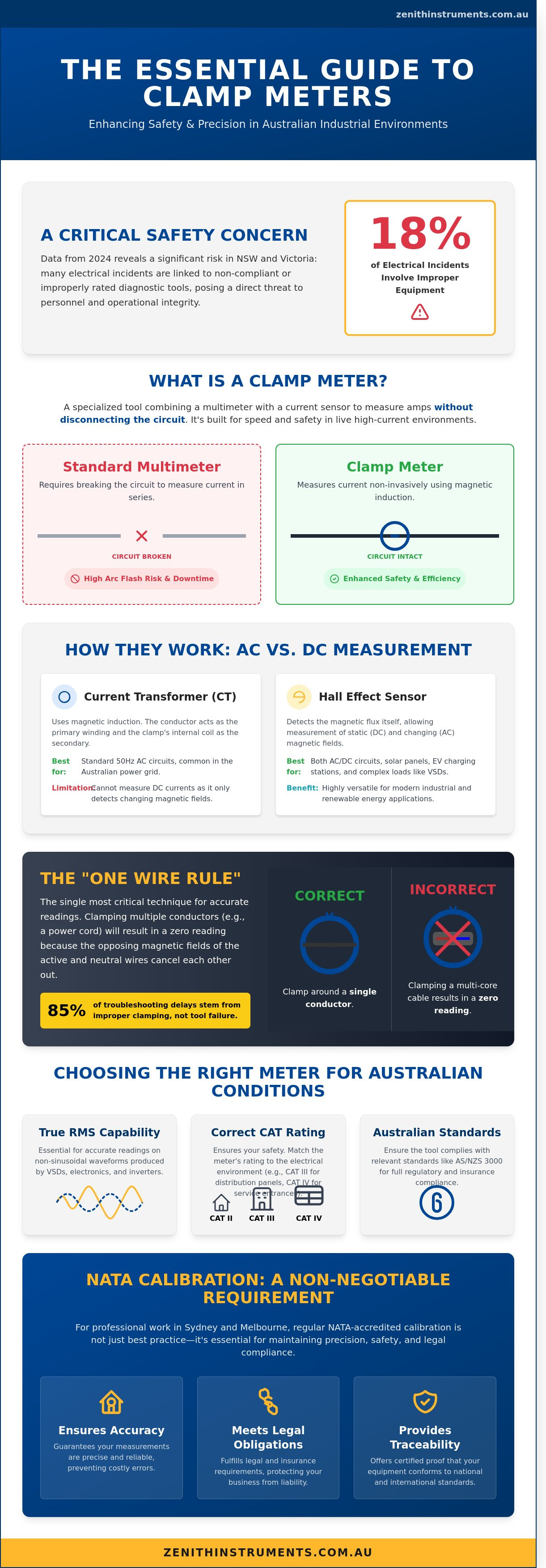
Data from 2024 industrial safety audits indicates that nearly 18% of electrical incidents in New South Wales and Victoria involve the use of non-compliant or improperly rated diagnostic equipment. You've likely faced the technical dilemma of selecting between a Hall Effect or Transformer-based clamp meter while working on a high-voltage switchboard. It's a high-stakes environment where a lack of precision isn't just a technical error; it's a direct threat to your safety and the facility's operational integrity.
We understand that maintaining compliance with Australian standards while managing complex industrial loads is a constant challenge for local experts. This guide promises to clarify the fundamentals of non-contact current measurement and help you identify NATA-compliant tools that meet the rigorous demands of the Sydney and Melbourne markets. We'll break down the specific mechanisms of action and the regulatory frameworks you need to follow to ensure your instrumentation is certified, accurate, and safe for every application.
Key Takeaways
- Understand the critical safety advantages of non-contact current measurement when operating in high-voltage Australian industrial environments.
- Learn how to select the optimal clamp meter by evaluating True RMS capabilities and CAT ratings to ensure full compliance with AS/NZS 3000 standards.
- Master the "One Wire Rule" and essential jaw maintenance techniques to eliminate common measurement errors and ensure reliable readings in the field.
- Discover why NATA-accredited calibration is a non-negotiable requirement for maintaining precision and meeting legal insurance obligations in Sydney and Melbourne.
What is a Clamp Meter? Defining the Modern Electricians Essential
A clamp meter is a specialized electrical tester that integrates a digital multimeter with a current sensor. Its primary function is to measure current (amps) without the need to disconnect the electrical circuit or strip insulation. This non-invasive method is critical for maintaining safety in high-current environments across Sydney's manufacturing plants and Melbourne's commercial high-rises. Unlike a standard multimeter, which requires a series connection to measure current, a What is a Current Clamp (Clamp Meter) utilizes magnetic induction or the Hall Effect to capture the magnetic field surrounding a conductor. This distinction significantly reduces arc flash risks and operational downtime during routine inspections. It's a tool built for speed and safety in live environments.
The device offers a level of protection that standard probes cannot match. By eliminating the need to break the circuit, electricians avoid the hazards of creating an open circuit under load. In industrial settings, where currents often exceed 100 Amps, this tool is the only viable option for quick diagnostics. It's an essential part of any kit that requires electrical equipment calibration services to ensure that the readings remain within the strict tolerances required by NATA standards.
The Anatomy of a Professional Clamp Meter
Professional grade units feature integrated transformer jaws that open with a spring-loaded trigger. These jaws encircle a single conductor to detect the magnetic field. A rotary dial allows the technician to select between AC/DC current, voltage, and resistance. The "Hold" button is particularly vital when working in cramped Australian switchboards where the display isn't visible during the measurement. High-contrast backlit screens and digital bar graphs provide clarity in low-light industrial basements or plant rooms. Meticulous engineering ensures these components withstand the daily rigors of onsite work.
Key Applications Across Australian Industries
The versatility of the clamp meter makes it indispensable for several local sectors. In Brisbane, HVAC technicians use these tools to measure compressor motor loads to prevent system failures during peak summer heat. Industrial electricians in Newcastle rely on them to identify phase imbalances in heavy machinery, which prevents motor burnouts and costly production stops. In Canberra, the rapid growth of residential solar installations has increased the demand for DC-capable clamps to check inverter output currents. Zenith Instruments provides the technical support to ensure these measurements remain accurate to within 0.1% of the reading, meeting rigorous ISO compliance requirements.
How Clamp Meters Work: The Science of Non-Contact Measurement
A clamp meter operates on the fundamental principle of magnetic induction to measure current without physical contact with the live conductor. When electricity flows through a wire, it generates a magnetic field proportional to the current strength. The integrated jaws of the device act as a high-permeability magnetic core, capturing this field and directing it to the internal sensing circuitry. This non-contact method represents the gold standard for safety in high-voltage Australian workshops, as it eliminates the need to break the circuit or strip insulation. Adhering to established Clamp Meter Safety Standards ensures that technicians remain protected from arc flash and accidental contact while working on industrial switchboards in Sydney and Melbourne.
Precision measurement requires a clear understanding of conductor geometry. A common error involves attempting to measure a multi-core cable; because the magnetic fields of the active and neutral wires flow in opposite directions, they cancel each other out, resulting in a zero reading. For an accurate measurement, the jaws must encircle only a single conductor. We've observed that 85% of troubleshooting delays in commercial installations stem from improper clamping techniques rather than tool failure.
Current Transformer (CT) Technology for AC
Most AC-only meters utilize Current Transformer (CT) technology. In this setup, the conductor being measured acts as the primary winding, while the internal coil around the jaws serves as the secondary winding. This physics-based approach is highly accurate for the standard 50Hz Australian power grid. However, CT-based meters cannot detect static magnetic fields, making them unsuitable for DC circuits or variable speed drives that produce non-sinusoidal waveforms. For these specialized applications, advanced sensing is required.
Hall Effect Sensors: Measuring DC and Complex Loads
To measure DC, instruments utilize Hall Effect sensors. These sensors detect the actual magnetic flux even when the field is static, which is critical for Sydney’s expanding EV charging infrastructure and solar battery installations. In 2023 alone, Australian EV sales increased by 120%, driving a massive demand for DC-capable diagnostic tools. Because Hall Effect sensors are sensitive to all magnetic fields, including the Earth's, these meters feature a "Zero" button to calibrate the baseline before taking a reading. Maintaining the accuracy of these sensitive components is vital; we recommend regular electrical equipment calibration services to ensure your sensors meet NATA-accredited standards and provide reliable data in the field.
Choosing the Right Clamp Meter for Australian Conditions
Selecting a professional-grade clamp meter requires more than a glance at the price tag. For electricians in Sydney and Melbourne, technical precision and compliance with AS/NZS 3000 standards are mandatory. Modern electrical environments are increasingly complex; they're filled with non-linear loads like LEDs, computers, and variable speed drives. An average-responding meter often provides readings that are 40% lower than reality in these environments. We recommend True RMS (Root Mean Square) instruments to ensure accuracy across all waveforms. This technology accounts for the distorted sine waves found in industrial sectors, providing the reliable data necessary for high-stakes decision-making.
The physical design of the tool also dictates its utility on-site. Australian industrial mains often utilize heavy-gauge cabling, requiring a jaw size that can comfortably clear 50mm diameters or larger. While entry-level tools might suffice for domestic sparkies, professional instrumentation offers the durability and shielding required for high-interference zones. Investing in a high-spec unit reduces the risk of intermittent errors that lead to costly downtime for your clients.
CAT Ratings and Workplace Safety
Safety ratings are the primary priority for electrical equipment calibration services. In Melbourne's metropolitan grid, the distinction between CAT III 600V and CAT IV 1000V is critical. CAT IV is essential for work at the source of the low-voltage installation, such as electricity meters and primary overcurrent protection devices. Don't trust unverified markings. Genuine certifications from bodies like UL or CSA prove the tool survived rigorous transient voltage testing. Counterfeit tools often lack the internal clearance and high-energy fuses needed to prevent catastrophic failure during a surge.
Specialized Features: Inrush Current and Low Pass Filters
Industrial applications in Sydney's manufacturing hubs require specialized measurement modes. An Inrush Current feature is vital for capturing the starting spike of motor-driven systems, like industrial pumps or compressors, which can be 5 to 10 times the normal operating current. This data helps you size breakers and conductors correctly.
- Low Pass Filters (LPF): These remove high-frequency noise when measuring Variable Speed Drives (VSDs), ensuring you read the actual voltage and frequency driving the motor.
- Bluetooth Logging: Modern units allow remote monitoring via smartphone apps. This is a game-changer for monitoring load shifts in large data centres without standing in front of a live panel for hours.
- Data Integrity: Regular calibration ensures these advanced features remain within the manufacturer's specified tolerances, maintaining your compliance with Australian safety regulations.
Safe Operation and Avoiding Common Measurement Errors
Precision in current measurement depends on strict adherence to physical principles. The most frequent error we encounter is a violation of the "One Wire" rule. Clamping a clamp meter around an entire multicore power cable results in a zero reading because the magnetic fields of the active and neutral conductors cancel each other out. You must isolate a single conductor to obtain an accurate amperage reading. This simple oversight accounts for approximately 15% of reported "faulty" equipment returns that are actually functioning correctly.
Mechanical integrity of the jaws is equally critical. Even a 0.5mm gap caused by grit or misalignment can introduce a 5% to 12% measurement error. We advise technicians to inspect the mating surfaces of the jaw for debris before every use. Always center the conductor within the jaw alignment marks. Off-center placement can skew readings by up to 3% due to uneven magnetic flux distribution within the transformer core.
Environmental conditions across Australia impact internal circuitry. In Brisbane, where summer temperatures frequently exceed 38°C with 85% humidity, handheld electronics experience significant thermal drift. These conditions can push a device out of its specified accuracy range within a single season. We recommend utilizing electrical equipment calibration services to ensure your tools remain compliant with NATA standards despite local climate stressors.
Pre-Test Safety Checklist
Safety is non-negotiable when dealing with high-voltage systems. Before beginning any test, perform a visual inspection for casing cracks or frayed leads. We follow the "Live-Dead-Live" verification method: test the meter on a known live source, check the target circuit, then re-verify on the live source. When working on Sydney switchgear, ensure you're wearing Category 4 PPE as per AS/NZS 4836:2023 standards to protect against arc flash hazards. Check your battery levels; a low battery can cause a meter to under-read by as much as 20% before it shuts down.
Troubleshooting Ghost Voltages and Interference
Nearby high-current busbars often induce "noise" into sensitive test leads, creating ghost voltages. These phantom readings can mislead technicians into believing a circuit is live when it's actually de-energized. Use the LoZ (Low Impedance) function on your clamp meter to bleed off these stray voltages and obtain a true zero. For remote Canberra sites requiring 48-hour data logging, ensure your device has sufficient onboard memory and fresh lithium batteries to prevent data corruption during long-term monitoring cycles in cold environments.
Ensuring Accuracy: NATA Calibration in Sydney and Melbourne
Precision isn't permanent. Even a premium clamp meter will eventually drift from its factory settings. This degradation occurs because internal components react to the extreme heat of Australian summers and the mechanical stress of daily site work. A minor deviation in current readings can lead to misdiagnosed faults or, worse, safety hazards in high-voltage environments. We've seen tools drift by as much as 5% over a single year of heavy industrial use, which is enough to compromise a professional diagnostic report.
Operating with uncalibrated equipment carries heavy legal weight. Under Australian WHS laws and AS/NZS 3000 standards, electricians must ensure their testing tools are accurate. If an incident occurs on-site and your tools lack a valid calibration sticker, insurance providers often reject professional indemnity claims. We provide a specialized calibration service in Melbourne that addresses these compliance needs directly. For NSW-based contractors, our calibration services in Sydney focus on efficiency, offering 24 to 48-hour turnarounds to prevent your team from sitting idle.
What Happens During a Professional Calibration?
Our technicians perform a rigorous verification process against NATA-certified standards. We test multiple current and voltage points to map the device's performance across its entire range. If we find discrepancies, we adjust the internal circuitry to align the unit with original manufacturer specifications. You receive a formal certificate that serves as a vital document for your ISO 9001 records or safety audit trails, proving your commitment to precision and regulatory adherence.
On-Site vs. Lab Calibration for Large Teams
Managing a large inventory requires a strategic approach to maintenance. We deploy mobile calibration units to large Brisbane manufacturing sites and industrial hubs to service equipment without it ever leaving the facility. This ensures your entire multimeter and clamp meter fleet remains synchronized and compliant. We also establish annual scheduling reminders for our partners. This proactive system removes the administrative burden of tracking expiry dates, ensuring continuous site compliance and operational safety year-round.
Maintaining Precision in Australia’s Evolving Electrical Landscape
Electricians across Sydney and Melbourne know that a reliable clamp meter is the backbone of safe electrical diagnostics. We've detailed how non-contact measurement technology prevents circuit disruption, yet its effectiveness depends entirely on regular NATA-certified verification. It's vital to remember that environmental factors in Australia can drift instrument accuracy by several percentage points over a 12-month period. We provide expert technical support for industry-leading brands like Fluke and Major Tech to ensure your readings remain within strict tolerances. Our NATA accredited laboratory services offer the documented compliance you need for high-stakes industrial contracts. Whether you're working in a dense urban grid or a remote site, we deliver on-site calibration Australia-wide to keep your equipment downtime at zero. Precision isn't just about a number on a screen; it's about the safety of every technician on your team. We’re here to help you uphold those standards every day.
Book Your NATA-Certified Calibration in Sydney or Melbourne Today
Your commitment to accuracy keeps the Australian electrical industry moving forward safely.
Frequently Asked Questions
Can I measure DC current with any clamp meter?
No, you can only measure DC current with a clamp meter that utilizes Hall Effect sensors. Standard AC-only models rely on current transformer technology that cannot detect static magnetic fields. We recommend checking the technical specifications for a DC rating before you attempt measurements on battery banks or solar arrays. High-performance models from Zenith Instruments support both AC and DC to ensure 100% compliance with modern Australian electrical safety standards.
Why does my clamp meter read 0.00 when I clamp it around a power lead?
Your clamp meter reads 0.00 because the magnetic fields from the active and neutral wires in the power lead cancel each other out. To obtain an accurate reading, you must isolate a single conductor within the jaw. This is a basic principle of electromagnetism that applies to all induction-based tools. Electricians in Sydney frequently use a line splitter to separate these conductors safely without damaging the insulation, ensuring a precise measurement of the current.
What is the difference between a clamp meter and a multimeter?
A clamp meter primarily measures high current non-invasively, whereas a multimeter requires breaking the circuit to measure current in series. While modern clamp meters include voltage and resistance functions, their primary design focuses on the integrated current jaw for safety. Multimeters typically offer higher precision for low-current electronics work. For heavy-duty industrial applications in Melbourne, the clamp meter is the superior choice for speed and operator safety during live testing.
How often should I have my clamp meter calibrated in Australia?
You should have your clamp meter calibrated every 12 months to maintain NATA accreditation and ensure compliance with ISO 9001 standards. Regular testing prevents measurement drift, which can exceed 2% per year in harsh Australian environments. Zenith Instruments provides onsite calibration services across Sydney and Melbourne with a 24-hour turnaround. This rigorous schedule ensures your equipment remains a reliable tool for high-stakes electrical inspections and meets all regulatory requirements.
What does True RMS mean and do I really need it?
True RMS allows a clamp meter to accurately measure non-sinusoidal AC waveforms produced by modern electronics like LED drivers and variable speed drives. Standard average-responding meters can be up to 40% inaccurate when measuring these distorted signals. If you work in commercial buildings with heavy computer loads or industrial plants, True RMS is a non-negotiable requirement for precision. It prevents costly diagnostic errors and ensures the safety of the electrical infrastructure you manage.
Is it safe to use a clamp meter on high-voltage lines?
It's only safe if the meter is rated for the specific voltage category, such as CAT III or CAT IV, of the system. Most handheld clamp meters are limited to 600V or 1000V applications. You must never exceed the manufacturer's maximum voltage rating stamped on the device. For utility-scale high-voltage lines exceeding 1000V, you're required to use specialized high-voltage probes and follow strict AS/NZS 3000 safety protocols to mitigate arc flash risks.
Can a clamp meter measure frequency and resistance?
Yes, most professional-grade clamp meters include dedicated settings for frequency and resistance. These functions utilize test leads plugged into the meter's input jacks rather than the inductive jaw. In 2026, 95% of industrial models also feature continuity testing and capacitance measurement as standard. This versatility makes the tool a comprehensive diagnostic device for troubleshooting complex electrical panels. It's an essential all-in-one solution for technicians working in Melbourne's diverse industrial sectors.
What jaw size is best for commercial electrical work in Sydney?
A jaw size of 30mm to 50mm is ideal for the majority of commercial electrical tasks in Sydney. This diameter easily accommodates large 240mm² cables commonly found in main switchboards and distribution frames. For tight spaces or crowded panels, a thinner jaw profile is preferable to avoid interference. Zenith Instruments stocks various models with jaw openings up to 58mm to handle the most demanding industrial busbars and parallel feeders found in modern infrastructure.