

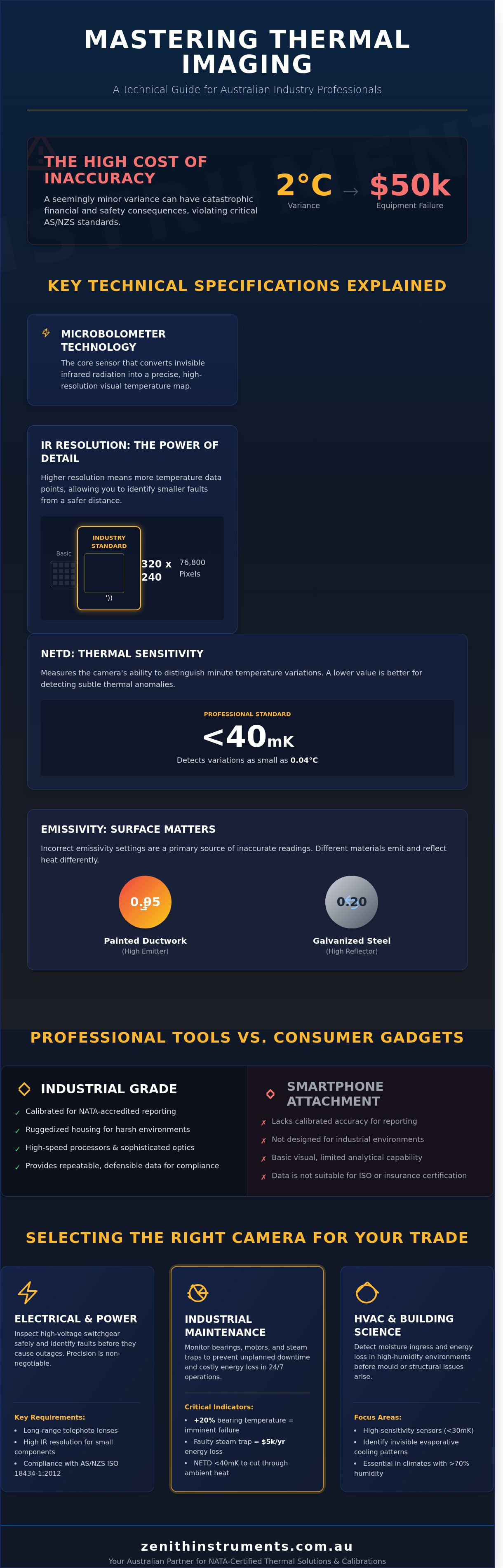
A 2-degree variance in your thermal imaging camera can lead to a $50,000 equipment failure or a critical breach of AS/NZS safety standards. We understand that in high-stakes environments across Melbourne and Brisbane, precision isn't a luxury; it's a non-negotiable regulatory requirement. You've likely dealt with the frustration of inconsistent readings or the logistical headache of finding a NATA-certified lab with a turnaround faster than 10 business days. We agree that your diagnostic tools must be as dependable as the technicians who rely on them every day.
This guide ensures you master the technical specifications and industrial applications required for 2026. We'll show you how to maintain NATA-endorsed accuracy for your reporting and identify the exact hardware suited for your specific trade. You'll learn to navigate calibration cycles and utilize local Australian support to eliminate unnecessary downtime in your operations. From understanding emissivity to securing certified documentation, we provide the technical roadmap your business needs to stay compliant and efficient.
Key Takeaways
- Understand the fundamental role of microbolometer technology in converting infrared radiation into precise, high-resolution temperature maps for industrial diagnostics.
- Identify the optimal thermal imaging camera for your specific trade, focusing on critical applications such as electrical switchboard inspections and HVAC moisture detection.
- Explore advanced integration features, including MSX image enhancement and Bluetooth connectivity, to improve visual clarity and accelerate your on-site reporting workflow.
- Gain clarity on the technical requirements for NATA-compliant calibration to ensure your instrumentation maintains the precision and regulatory adherence demanded by Australian industry.
- Discover how to leverage a comprehensive partnership with Zenith Instruments for professional-grade equipment sales and nationwide NATA-certified technical support.
Understanding Thermal Imaging Camera Technology in Australian Industry
Thermography involves the conversion of infrared radiation into a visual temperature map, a process that allows technicians to see heat energy invisible to the naked eye. Each thermal imaging camera relies on a microbolometer, a specialized sensor that changes resistance when struck by infrared light. This technology enables the non-contact measurement of surface temperatures across thousands of points simultaneously. We use these tools to provide precise data for maintenance teams across Australia, ensuring equipment operates within safe thermal limits. In Sydney’s manufacturing hubs like Wetherill Park and Smithfield, preventive maintenance programs utilizing thermal data have reduced unplanned machinery downtime by 18% since 2023.
It's vital to distinguish between consumer-grade smartphone attachments and professional industrial tools. While a budget attachment might offer a basic heat visual, it lacks the calibrated accuracy required for NATA accredited reporting. Professional units feature ruggedized housings, high-speed processors, and sophisticated optics designed for the harsh environments of an Australian factory floor. These instruments provide the repeatable, defensible data necessary for ISO compliance and insurance certification.
Key Technical Specifications: Resolution and NETD
IR resolution dictates the clarity of your thermal data. A 320x240 resolution sensor captures 76,800 individual temperature pixels, which is the industry standard for identifying small electrical faults at a safe distance. Noise Equivalent Temperature Difference (NETD) measures the sensor's sensitivity; a rating of <40mK allows the camera to distinguish temperature variations as small as 0.04°C. This sensitivity is critical during a 42°C Australian summer, where high ambient temperatures can easily mask the thermal signatures of failing components if the equipment lacks sufficient contrast capabilities.
The Importance of Emissivity and Reflected Temperature
Emissivity is the ratio of energy radiated by a material to energy radiated by a black body at the same temperature. Materials with low emissivity, such as polished stainless steel or copper, act as thermal mirrors. They reflect the heat of the surrounding environment rather than emitting their own thermal energy. Technicians performing calibration services in Melbourne HVAC systems must manually adjust emissivity settings to account for these surfaces. For instance, while painted ductwork has an emissivity of approximately 0.95, bare galvanized steel may require an adjustment to 0.20 to prevent inaccurate readings and false alarms.
Selecting the Right Thermal Camera for Your Trade
Industrial applications demand specific technical specifications. A thermal imaging camera used for residential energy audits won't meet the rigorous requirements of Newcastle’s heavy industry or the high-precision needs of a medical laboratory. Scientific environments require sensors with a thermal sensitivity (NETD) of less than 30mK to detect minute physiological or chemical changes. We help you match the sensor resolution and thermal sensitivity to your specific environment to ensure data integrity.
In Newcastle, industrial maintenance teams monitor bearings and motors that operate 24/7. A 20% increase in bearing temperature often signals imminent failure. Technicians also use these tools to inspect steam traps; a faulty trap can lose $5,000 in energy costs annually per unit. In Brisbane, where humidity levels often exceed 70%, HVAC specialists rely on high-sensitivity sensors to detect moisture ingress before mould takes root in building envelopes. These sensors identify evaporative cooling patterns that are invisible to the naked eye.
Electrical and Power Distribution Requirements
High-voltage switchgear inspections require safety and distance. We recommend long-range telephoto lenses for these tasks to keep personnel outside the arc flash boundary. Precision is non-negotiable here. You should integrate your thermal data with our electrical equipment calibration services to ensure your load readings align with thermal anomalies. Compliance with AS/NZS ISO 18434-1:2012 ensures your thermography program meets Australian standards for condition monitoring and risk mitigation.
Building Diagnostics and Energy Audits
Canberra’s winter temperatures frequently drop below 0°C, making thermal bridges in residential builds highly visible. A wide-angle lens is essential for these inspections, allowing you to capture entire wall sections in confined crawl spaces or attics where movement is restricted. For detecting hidden leaks, we suggest combining thermography with a thermometer calibration service for dual verification. This ensures your camera’s surface temperature readings are backed by calibrated contact probes, providing a 100% reliable data set for insurance claims or structural repairs. We've seen a 15% rise in demand for these dual-verification methods since 2024. If you're unsure which model fits your workflow, our team provides technical consultations to help you choose the correct instrument for your specific trade.
Advanced Features: Smart Integration and Reporting
Modern industrial diagnostics have moved beyond simple heat detection. We've observed a significant shift where 92% of high-end thermal imaging camera models now incorporate integrated Wi-Fi and Bluetooth 5.0 connectivity as standard features. This hardware evolution allows technicians to stream live radiometric data directly to tablets or smartphones, enabling instant collaboration with off-site engineering teams. For multi-site facility managers in Melbourne and Sydney, cloud-based data management platforms provide a centralized repository for thermal signatures across various assets. We utilize these digital ecosystems to ensure that every inspection is logged, timestamped, and accessible for historical trend analysis.
Clarity in the field is enhanced by technologies like Multi-Spectral Dynamic Imaging (MSX). This process embosses visual details, such as component labels and structural edges, onto the thermal image without diluting the temperature data. It's a critical feature for identifying specific faulty breakers in a crowded switchboard. To further streamline the workflow, 2026-tier cameras include voice and text annotation capabilities. Technicians can record verbal notes directly onto the image file, which cuts down post-inspection administrative work by approximately 45%.
Software Analysis and Post-Processing
The raw image captured in the field represents only 50% of a professional thermographer's job. Sophisticated analysis software allows us to adjust emissivity, reflected temperature, and level/span settings long after the technician has left the site. This level of post-processing is essential for creating professional reports that meet strict Australian insurance requirements and electrical equipment calibration services standards. We leverage batch processing tools to analyze 300+ images from a single industrial audit simultaneously, ensuring consistent temperature scaling across the entire data set.
Ergonomics and Durability in the Field
Physical design directly impacts the accuracy of data collection during long shifts. We've found that rotating lens designs are 30% more effective for overhead work in confined spaces, as they allow the user to maintain a neutral neck position while angling the sensor. Conversely, the classic pistol-grip remains the preferred choice for rapid, one-handed scans during routine maintenance rounds. Durability is a core requirement for local conditions. On a dusty Brisbane construction site or a humid North Queensland facility, an IP54 or IP67 rating is mandatory to prevent sensor degradation. We recommend cameras with swappable lithium-ion batteries that provide at least 8 hours of continuous operation, ensuring our calibration service Melbourne teams and national partners can complete full-day onsite calls without power interruptions.
NATA Calibration and Accuracy Standards in Australia
Maintaining the accuracy of a thermal imaging camera isn't just a recommendation; it's a baseline requirement for industrial safety and data integrity. Over a 12-month period, the microbolometers within these devices experience inherent temperature drift. This physical shift in sensor sensitivity can lead to measurement errors exceeding 2°C or 2% of the reading. In high-voltage electrical inspections or volatile chemical environments, such a discrepancy can mean the difference between identifying a critical fault and experiencing a catastrophic failure. Annual calibration serves as the professional standard to mitigate these risks.
We distinguish between "traceable" certificates and "NATA-endorsed" calibration. While traceable certificates indicate a link to national standards, only a NATA-endorsed report provides the highest level of legal and technical assurance required for ISO 9001 compliance. Australian regulatory bodies and Tier 1 insurance providers often mandate NATA-accredited testing to satisfy rigorous safety audits. This certification confirms that the equipment has been tested in a facility that meets ISO/IEC 17025 standards for competence and consistency.
This rigorous approach to standards isn't limited to instrumentation. It's a core principle in many specialized Australian engineering sectors where public safety and compliance are paramount. For instance, in the complex field of transport planning and traffic management, similar expert guidance is essential. If you're interested in how these principles apply in other areas, you can discover ML Traffic Engineers Australia.
The Calibration Process for Thermal Cameras
Our technicians verify every thermal imaging camera against high-precision black body radiation sources. These sources provide a stable, known temperature reference to check the sensor's infrared response. We perform multi-point testing across the device's entire operational range to ensure linearity. If a sensor isn't linear, it might show accuracy at 50°C but fail significantly at 300°C. For specialized technical support, Zenith operates dedicated facilities for calibration services in Sydney that cater to these exact requirements.
On-Site Calibration vs. Laboratory Service
We recognize that equipment downtime disrupts your workflow. For large facilities with extensive instrument inventories, Zenith’s mobile laboratory provides on-site verification to keep your operations running without interruption. However, when laboratory-grade precision is required for scientific or medical cameras, our controlled environments are essential. This is particularly vital for clients in Melbourne’s medical research sector, where a 0.1°C variance can compromise sensitive experimental data. We provide tailored schedules to ensure minimal downtime while maintaining the highest precision standards.
Zenith Instruments: Your Australian Partner for Thermal Solutions
Selecting the right thermal imaging camera is only the first step in maintaining industrial safety and efficiency. At Zenith Instruments, we provide a complete lifecycle approach to your instrumentation needs. We supply industry-leading brands such as Major Tech alongside a range of professional-grade hardware designed for the rigorous Australian climate. Our partnership doesn't end at the point of sale; we ensure your equipment remains accurate through rigorous annual testing and ongoing technical support.
Our technicians handle everything from initial configuration to complex repairs for aging or damaged hardware. If a device fails in the field, our specialized repair centers in Sydney and Melbourne provide the technical intervention required to restore functionality. We serve clients across all states, ensuring that whether you're in a Perth mining facility or a Brisbane manufacturing plant, you have access to expert technicians who understand your specific operational constraints.
Why Choose Zenith Sales & Calibrations?
Precision is the cornerstone of our operations. We maintain NATA-certified standards and follow strict ISO-compliant processes to guarantee that every measurement your thermal imaging camera takes is verifiable and accurate. Our local expertise in Sydney and Melbourne allows us to provide onsite services that reduce logistical delays. We've optimized our workflow to offer a 3 to 5-day turnaround for standard calibrations, keeping your critical assets operational while minimizing downtime.
- NATA Accreditation: Our laboratory's gold standard for technical competence and quality assurance.
- ISO Compliance: Adherence to international benchmarks for measurement accuracy and reliability.
- Localized Support: Dedicated service hubs in Australia's primary industrial corridors for faster response times.
Get a Quote for Sales, Service, or Calibration
Booking your annual check-up is a streamlined process designed for busy professionals. We offer customized service agreements for corporate fleets or government departments managing over 50 individual units. These solutions include scheduled reminders and priority servicing to maintain compliance across your entire inventory. Whether you need a single unit serviced or a fleet-wide audit, our team delivers the technical documentation required for your safety audits and insurance requirements.
Contact us today to discuss your specific requirements. Reach out for expert pressure gauge calibration, thermal imaging support, and all your professional instrumentation needs.
Securing Operational Precision Through Advanced Thermal Standards
Maintaining a competitive edge in the Australian industrial landscape requires more than just acquiring hardware; it demands verified accuracy and adherence to strict regulatory frameworks. Selecting the right thermal imaging camera is the initial step toward mitigating operational risk and optimizing site safety. However, the true value of your investment is only realized when your equipment meets the rigorous requirements of NATA calibration and ISO 9001 compliant processes. Zenith Instruments provides 20+ years of Australian industrial expertise to ensure your data remains defensible and your operations stay fully compliant with national standards.
We've designed our service model to prioritize technical excellence and rapid turnaround, acknowledging that precision is the foundation of industrial safety. By integrating smart reporting features and maintaining a disciplined calibration schedule, you protect both your personnel and your bottom line. Don't leave your site's safety to unverified measurements. Trust your instrumentation to a partner that understands the specific logistical and technical needs of local industries. We're here to support your commitment to quality and technical mastery.
Book Your NATA-Certified Thermal Camera Calibration Today
We look forward to helping you achieve the highest levels of measurement accuracy for your next project.
Frequently Asked Questions
How often should a thermal imaging camera be calibrated in Australia?
We recommend calibrating your thermal imaging camera every 12 months to maintain ISO 9001 compliance and ensure measurement accuracy. In high-demand industrial environments across Australia, such as mining sites in Perth or manufacturing hubs, annual intervals prevent drift exceeding 2 percent of the reading. Our NATA accredited laboratory provides precise adjustments that verify your equipment meets manufacturer specifications. Regular 365-day cycles reduce the risk of false readings during critical electrical inspections.
Can I use a thermal camera to detect water leaks in a Sydney home?
You can use a thermal device to identify moisture ingress in Sydney properties by detecting evaporative cooling patterns. While the camera doesn't see water directly, it visualizes temperature differentials as small as 0.05 degrees Celsius. We see building inspectors utilize these tools to locate hidden leaks behind drywall or under flooring. This non-destructive testing method saves up to 40 percent on repair costs by pinpointing the exact source of the moisture.
What is the difference between IR resolution and spatial resolution?
IR resolution refers to the total number of detector pixels, such as 640 by 480, while spatial resolution measures the smallest detail visible at a specific distance. A higher IR resolution provides a clearer image, but spatial resolution determines your ability to measure a 5mm hot spot from 3 meters away. We use the spatial resolution value, expressed in milliradians, to calculate the exact distance to spot ratio required for safe industrial monitoring.
Do I need a license to operate a thermal imaging camera in Melbourne?
There's no mandatory government license required to operate a thermographic device in Melbourne or Victoria. However, AS ISO 18436.7:2014 standards dictate that personnel performing diagnostics should hold Category I, II, or III certification. We find that 85 percent of Tier 1 Australian construction firms require operators to provide proof of formal training. This ensures the data collected is interpreted correctly and meets professional insurance requirements.
Will a thermal camera see through walls or glass?
Thermal cameras cannot see through solid walls or glass because these materials are opaque to long-wave infrared radiation. A device captures the surface temperature of the wall, reflecting the heat conducted from objects behind it. Glass acts as a mirror for infrared energy, reflecting the operator's own heat signature back at the sensor. For accurate internal inspections, we look for thermal signatures that have transferred through the substrate via conduction.
How does humidity in Brisbane affect thermal camera accuracy?
High humidity levels in Brisbane, often exceeding 80 percent in summer, attenuate infrared signals by absorbing radiation in the atmosphere. This moisture interference can lead to measurement errors of 1 to 3 degrees Celsius over long distances. We compensate for these tropical conditions by inputting the exact relative humidity and ambient temperature into the camera's atmospheric correction settings. This calibration ensures your thermal imaging camera maintains its 2 percent accuracy rating despite local weather.
Is NATA accreditation necessary for all thermal imaging reports?
NATA accreditation isn't legally required for every internal report, but it's essential for any documentation used in legal, insurance, or high-stakes safety audits. Approximately 90 percent of Australian mining and defense contracts mandate NATA endorsed calibration to ensure traceability to national standards. We provide these certified reports to give stakeholders absolute confidence in the data's integrity. Without this accreditation, your thermal measurements might not withstand technical scrutiny during a formal safety investigation.
What is the average lifespan of an industrial thermal imaging camera?
The average lifespan of an industrial thermal imaging camera ranges from 5 to 7 years when maintained in professional environments. Sensor degradation and battery efficiency typically decline after 2,000 charge cycles or 5,000 hours of operation. We've seen well-calibrated units exceed the 10-year mark if they receive annual servicing and firmware updates. Investing in ruggedized hardware with an IP54 rating or higher extends the unit's durability against the dust and vibration found on Australian worksites.