

In high-stakes industrial environments, a 'fixed' digital thermometer that hasn't undergone NATA-accredited calibration is not a tool; it's a liability. You likely understand the frustration of unexpected production downtime when a critical sensor fails. It's often difficult to determine if a device requires a simple digital thermometer repair or if the entire unit has reached its end of life. This uncertainty can lead to significant operational risks or the unnecessary replacement of expensive equipment.
This 2026 guide will help you accurately diagnose common equipment failures and explain why professional servicing is essential for maintaining Australian regulatory compliance under ISO/IEC 17025. We'll examine the technical differences between basic repairs and precision calibration, the risks of non-certified maintenance, and how our specialized laboratories in Sydney and Melbourne restore your instrumentation to peak accuracy. By the end of this article, you'll know how to secure a valid calibration certificate and minimize your facility's risk profile through disciplined maintenance protocols.
Key Takeaways
- Distinguish between temporary environmental interference and permanent sensor degradation to identify when your equipment requires professional intervention.
- Understand why manual 'offset' adjustments often mask systemic errors and how a professional digital thermometer repair restores genuine baseline accuracy.
- Identify the specific regulatory risks under FSANZ and TGA frameworks when DIY maintenance attempts void your NATA-traceable calibration certificates.
- Discover how laboratory-grade diagnostic testing against master standards serves as a cost-effective alternative to the premature replacement of industrial units.
- Leverage specialized technical expertise and rapid turnaround capabilities through NATA-certified laboratories located in Sydney and Melbourne.
Common Digital Thermometer Failures in Industrial Environments
Industrial temperature monitoring requires absolute precision. When a device begins to drift or fails entirely, the first step is determining if the issue stems from environmental interference or a genuine hardware breakdown. Electromagnetic interference (EMI) from heavy machinery or high-voltage cables can often cause erratic readings that mimic a sensor fault. However, persistent inaccuracies usually signal that a professional digital thermometer repair is necessary to restore the unit's technical integrity.
Reliability starts with understanding the fundamental principles of thermometry. Sensors don't remain static; they're subject to physical and chemical changes that compromise their output over time. In many Australian manufacturing facilities, equipment is pushed to its thermal limits, which accelerates the natural aging process of internal components. We've seen that ignoring these subtle shifts leads to broader production failures and regulatory non-compliance.
Probe and Sensor Issues: RTDs vs. Thermocouples
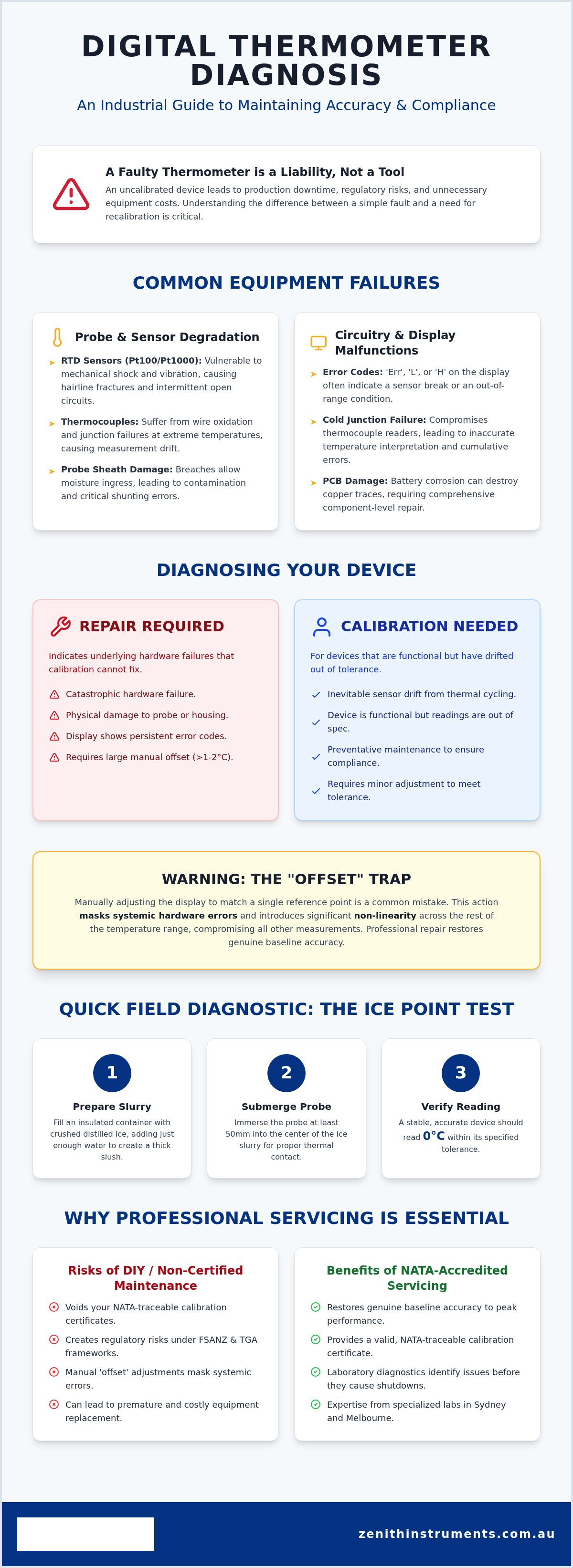
Precision RTD sensors like the Pt100 or Pt1000 are prized for their stability, yet they're vulnerable to mechanical shock and vibration. A hairline fracture in the ceramic substrate of an RTD element will cause intermittent open circuits or drastic resistance spikes. Thermocouples face different challenges. Their wires often suffer from oxidation or junction failures when exposed to extreme temperatures for long periods, shifting the voltage output and creating significant measurement drift. Physical damage to the protective probe sheath is another common failure point. If the sheath is breached, moisture ingress can contaminate the internal insulation. This leads to shunting errors that make the probe a liability rather than a reliable tool.
Circuitry and Display Malfunctions
Electronic failures often manifest as cryptic 'Err', 'L', or 'H' codes on the digital display. These messages typically indicate a sensor break or an out-of-range condition that requires diagnostic testing in a controlled laboratory environment. Within the instrument's housing, the cold junction compensation circuit is a critical failure point for thermocouple readers. If this component fails, the device cannot accurately interpret the temperature at the connection point, resulting in cumulative errors that compromise your data. We also frequently observe internal PCB damage caused by battery corrosion in portable units. Electrolyte leakage can eat through copper traces, necessitating a comprehensive digital thermometer repair to salvage the device. Maintaining regular thermometer calibration service schedules helps our technicians catch these electronic drifts before they result in a total system shutdown.
Diagnosing Your Device: Is Repair or Calibration Required?
Determining whether an instrument requires a digital thermometer repair or a standard recalibration is a critical decision for any maintenance supervisor. Industrial thermometers often drift due to thermal cycling or physical stress; however, a device that has drifted out of tolerance isn't necessarily broken. You must distinguish between a sensor that needs a professional adjustment and one that has suffered a catastrophic hardware failure. Sensor drift is inevitable. High-end industrial RTDs and thermocouples are precision-engineered instruments that often justify the cost of professional servicing over outright replacement.
The most common mistake we observe in the field is falling into the 'Offset' trap. Many modern digital units allow users to manually adjust the reading to match a reference point. While this might fix the display at a single temperature, it often introduces significant non-linearity across the rest of the range. If your device requires more than a 1 or 2-degree adjustment to meet its specifications, it's a clear indicator of underlying hardware issues. These issues require professional digital thermometer repair rather than a temporary software patch. We provide comprehensive thermometer calibration service solutions to ensure your diagnostics are backed by NATA-traceable data.
The Ice Point and Boiling Point Field Tests
To verify baseline accuracy, conduct a proper ice-slurry test. Fill a vacuum-insulated container with crushed distilled ice and just enough water to create a thick slush. Submerge the probe at least 50mm to ensure proper thermal contact. In an Australian workshop, this should yield a reading of 0°C within the device's specified tolerance. If the reading is erratic or significantly off, document the deviation. These field tests have limitations compared to laboratory-grade dry wells, but they provide essential data for your repair technician. If the unit fails at both the ice point and boiling point, the sensor is likely compromised beyond user-level fixes.
Software Errors vs. Hardware Faults
Identifying the root cause of a failure prevents wasted maintenance hours. Firmware glitches in high-end data loggers can sometimes be resolved with a factory reset, but this won't fix a degraded A/D converter.
- Broken Lead Wires: Often manifest as 'out of range' or 'open' readings that fluctuate when the cable is moved.
- Faulty A/D Converters: Result in consistent readings that are wildly inaccurate regardless of the temperature source.
- Sensor Degradation: Shows up as a slow, predictable drift that eventually exceeds the manufacturer's allowable error margin.
The Risks of DIY Repair in Regulated AU Industries
Attempting a DIY digital thermometer repair in an industrial setting often creates a false sense of security. While a technician might successfully restore a display or replace a damaged lead, they cannot verify the instrument's accuracy without specialized laboratory equipment. In regulated Australian sectors, a device that appears functional but lacks a valid calibration certificate is a significant liability. Opening a sealed unit almost always voids its current NATA-traceable status, immediately rendering the equipment non-compliant for use in audited processes.
We've observed that many businesses underestimate the precision required for modern sensors. A minor soldering error or the use of non-standard replacement parts can alter the resistance characteristics of the circuit. This leads to measurement drift that is invisible to the naked eye but devastating to data integrity. Professional servicing ensures that every component meets the original manufacturer's specifications and complies with ISO/IEC 17025 standards.
Regulatory Impact: FSANZ and NATA Standards
Industries governed by Food Standards Australia New Zealand (FSANZ) or the Therapeutic Goods Administration (TGA) face strict mandates regarding temperature monitoring. Using uncertified equipment in food production or pharmaceutical storage can lead to immediate audit failures and potential legal action. Auditors require documented evidence that your instrumentation is accurate and traceable. Any digital thermometer repair performed outside of an accredited facility breaks this chain of evidence. To maintain your compliance standing, you should always follow a repair with a comprehensive thermometer calibration service to re-establish its technical credentials.
The Cost of Inaccuracy
The financial risks of using inaccurate thermometers far outweigh the initial savings of a DIY fix. In cold-chain logistics or medical refrigeration, a deviation of just 0.5°C can result in the total loss of high-value inventory, such as vaccines or specialized biological products. We recommend calculating the ROI of professional maintenance by weighing the service cost against the price of a spoiled production batch. Precision is the only way to mitigate these operational risks.
Traceability is the unbroken chain of documented comparisons linking your local measurement back to a national or international standard, ensuring every reading is verifiable and legally defensible. Without this link, your data holds no weight during a regulatory inspection or a quality control dispute. Relying on professional experts ensures your equipment remains a tool for safety rather than a source of risk.
The Professional Repair and Calibration Process
Professional digital thermometer repair requires a controlled environment and a structured technical workflow. We don't just replace parts; we restore the instrument's ability to provide legally defensible data. Every device that enters our laboratory undergoes a rigorous intake process where we compare its current performance against national master standards. This initial diagnostic phase is essential to identify whether the fault lies in the sensor probe, the internal A/D converter, or the display circuitry.
A meticulous approach ensures that your equipment returns to service with the same reliability as a new unit. We prioritize technical excellence over quick fixes because we understand the cost of a measurement failure in your facility. Our process is designed to meet the stringent requirements of Australian industrial, scientific, and manufacturing sectors. If your instrumentation is currently underperforming, you can book a professional calibration and repair assessment at our Sydney or Melbourne facilities.
Laboratory Diagnostics and Component Replacement
Our technicians use high-precision stirred liquid baths and dry well calibrators to conduct multi-point verification across the instrument's entire range. We identify failures by stressing the instrument under real-world conditions. When a component fails, we source OEM-standard replacement parts to ensure full compatibility with high-end industrial brands. After hardware changes, we perform specific tests for hysteresis and repeatability. These tests confirm that the new sensors or leads respond consistently to temperature changes without lagging or showing memory effects. For a deeper look at equipment selection and standards, read our Digital Thermometers: A Professional Guide (2026).
Post-Repair Calibration and Certification
A digital thermometer repair is technically incomplete until the device has passed a full calibration cycle. Any physical intervention, such as replacing a thermocouple junction or resoldering a PCB trace, alters the electrical resistance of the circuit. We ensure ISO 17025 compliance by recalibrating the device post-repair to verify it still meets its manufacturer-stated accuracy.
The final step is issuing the appropriate documentation for your compliance records. We offer two distinct reporting levels:
- NATA-Endorsed Certificates: Required for high-compliance industries where absolute traceability to national standards is a legal mandate.
- Traceable Reporting: Suitable for general industrial applications that require documented accuracy without the full NATA-certified scope.
Zenith Sales & Calibrations Pty Ltd: Australia's Experts in Thermometer Repair
We understand that precision instrumentation is the backbone of your operational safety and regulatory compliance. When an instrument fails, the impact on your production timeline can be severe. Zenith Sales & Calibrations Pty Ltd operates as a high-performance service partner, providing the technical expertise necessary to restore your equipment to its original specifications. Our approach to digital thermometer repair combines deep industry knowledge with a commitment to international standards, ensuring that every device we service meets the rigorous demands of the Australian industrial landscape.
Our capabilities extend across the entire spectrum of temperature measurement technology. We service and repair digital handhelds, infrared pyrometers, and complex multi-channel data loggers used in pharmaceutical and food processing environments. By maintaining specialized laboratories in major regional hubs, we offer a localized service touch backed by national-scale resources. We don't just fix hardware; we provide the formal certification required to satisfy stringent audit trails and quality management systems.
Sydney and Melbourne Laboratory Capabilities
Our presence in Australia's primary industrial centers allows us to provide rapid turnaround times that minimize your operational downtime. We've designed our calibration services in Sydney and Melbourne to act as a one-stop shop for technical maintenance and NATA-endorsed reporting. For facilities with high-volume instrumentation requirements, we offer on-site mobilization. Our technicians can travel to your site to conduct comprehensive audits and calibrations, reducing the logistical risks associated with transporting sensitive equipment. For regional clients, we provide secure courier options to ensure your digital thermometer repair is handled with professional care from intake to return delivery.
Why Choose Zenith Sales & Calibrations Pty Ltd for Your Instrumentation Needs?
With over 20 years of experience in the Australian market, we've built a reputation as a dependable expert in measurement science. Our technicians are meticulously trained to handle both electronic and mechanical failures, ensuring that no diagnostic detail is overlooked. We prioritize ISO-compliant processes and high-accuracy standards because we know that 'close enough' isn't an option in regulated industries. We view every service as a partnership aimed at maximizing your equipment's lifespan and reducing your overall operational risk.
If your facility is facing equipment failures or if your current calibration certificates are nearing expiry, our team is ready to assist. We provide clear, technical solutions backed by formal documentation to keep your business moving forward. Contact Zenith Sales & Calibrations Pty Ltd for a Repair Quote and ensure your instrumentation remains a reliable asset for your facility.
Securing Operational Precision for 2026 and Beyond
Maintaining measurement integrity requires a disciplined approach to equipment maintenance. We've established that a successful digital thermometer repair is only the first step in a larger compliance framework. Without NATA-certified standards and ISO-compliant laboratory verification, your instrumentation remains a potential source of operational risk. Professional servicing ensures your facility avoids the high costs of product spoilage and regulatory audit failures; it's a proactive investment in your facility's long-term safety and efficiency.
The experts at Zenith Sales & Calibrations Pty Ltd in Sydney and Melbourne provide the technical capability to restore your devices to peak accuracy. We combine rapid turnaround times with meticulous diagnostic procedures to keep your production lines moving safely. Whether you're managing cold-chain logistics or high-precision manufacturing, reliable data is your most valuable asset. Don't leave your compliance to chance. Our team provides the formal certification your industry demands to maintain technical excellence. We look forward to helping you achieve total measurement confidence across your entire instrumentation inventory.
Request a Professional Thermometer Repair Quote today to secure your facility's technical performance.
Frequently Asked Questions
Can a digital thermometer be recalibrated if it is reading incorrectly?
Recalibration is the standard method for correcting measurement drift in industrial instruments. If the internal sensor remains functional, our technicians adjust the device's electronics to match national master standards. This process restores the unit to its original manufacturer-specified accuracy levels and is a fundamental component of professional maintenance for Australian industry compliance.
How much does it cost to repair an industrial digital thermometer?
Repair and calibration costs are determined through a quote-based system rather than fixed pricing. Factors influencing the final cost include the instrument type, the number of calibration points required, and whether specific component replacements are necessary. We focus on providing cost-effective alternatives to the expensive replacement of high-end industrial measurement units.
What is the typical turnaround time for professional thermometer repair in Australia?
Most professional thermometer repairs in Australia are completed within 3 to 7 business days. We leverage our technical laboratories in Sydney and Melbourne to maintain rapid turnaround times for both metropolitan and regional clients. This structured workflow ensures your equipment returns to service quickly, significantly reducing the risk of extended production downtime.
Does Zenith Sales & Calibrations Pty Ltd offer on-site thermometer repair and calibration?
Yes, Zenith Sales & Calibrations Pty Ltd offers on-site calibration services for industrial facilities that require large-scale equipment audits. Our mobile service teams can verify accuracy across your entire inventory without the logistics of shipping sensitive tools. However, complex hardware issues identified during an audit may require laboratory intake for a comprehensive digital thermometer repair.
What is the difference between a traceable certificate and a NATA-endorsed certificate?
A NATA-endorsed certificate provides formal recognition that the laboratory meets ISO/IEC 17025 standards for technical competence. While a traceable certificate confirms an instrument's accuracy against national standards, NATA accreditation serves as the highest level of trust and is often a mandatory requirement for highly regulated Australian industries like pharmaceuticals and food production.
Why is my digital thermometer showing an 'Err' message after a battery change?
An 'Err' message post-battery change often signals a sensor open-circuit or a loss of internal configuration data. This interruption can occur if the internal circuitry experiences a voltage spike or drop during the swap. If a factory reset doesn't resolve the issue, a professional digital thermometer repair is required to inspect the probe leads and PCB integrity.
How often should industrial thermometers be sent for professional maintenance?
We recommend a professional maintenance and calibration interval of 6 to 12 months for most industrial thermometers. Facilities operating under strict FSANZ or TGA regulations often require more frequent verification to ensure ongoing compliance. Regular servicing catches sensor drift early, preventing costly data errors in critical temperature-controlled environments.
Can you repair infrared (IR) thermometers as well as probe types?
Yes, our technical expertise covers infrared (IR) pyrometers, contact probe thermometers, and data loggers. We utilize specialized blackbody radiation sources to verify IR accuracy and high-precision liquid baths for probe-type sensors. This dual capability ensures that all your temperature monitoring assets remain accurate and compliant with Australian industrial standards.