

What if a tester’s readings look plausible but no longer reflect its actual performance? For Brisbane businesses, that gap can affect work quality, safety decisions and audit readiness. A sound plan for “electrical testing equipment maintenance brisbane” brings routine care and calibration together, rather than treating them as interchangeable.
Test and tag is easy to confuse with instrument calibration, but each serves a different purpose. Test and tag assesses the in-service safety of electrical equipment; calibration checks whether an instrument measures accurately against recognised standards. Both matter, and neither replaces repairing faulty equipment.
This guide explains the maintenance, testing and calibration electrical testers may need, and how to plan each response around equipment condition and operational demands. You’ll learn how to manage downtime, keep useful records and distinguish calibration needs across multimeters, clamp meters, insulation testers and appliance testers. We’ll also cover laboratory and on-site calibration, including services supported by NATA-certified standards and ISO-compliant processes, to help Brisbane teams build a dependable programme.
Key Takeaways
- Build an electrical testing equipment maintenance brisbane programme around each instrument’s condition, use and operating environment.
- Use warning signs such as damage, unstable readings or failed checks to decide whether equipment should be removed from use or scheduled for service.
- Choose repair, calibration or test and tag according to the issue. A calibration result doesn’t repair faulty equipment.
- Keep an equipment register and record checks, service outcomes and calibration results to support maintenance planning and quality systems.
- Plan laboratory or on-site calibration around operational needs to help manage equipment downtime.
Electrical testing equipment maintenance in Brisbane: what it covers
Reliable electrical measurements depend on more than a current calibration sticker. A practical maintenance plan combines planned inspection, functional checks, appropriate cleaning and storage, repair when faults are found, and calibration when measurement accuracy needs verification. For Brisbane workplaces, electrical testing equipment maintenance brisbane should reflect each instrument’s purpose and use, rather than applying one routine to every item.
Electrical measurement instruments and portable appliances do different jobs. A multimeter, clamp meter or insulation tester measures electrical values; a portable appliance is the equipment being checked for in-service electrical safety. Confusing the two can leave gaps: an appliance test doesn’t establish that a meter reads accurately, and calibrating a meter doesn’t confirm that an appliance is safe to use.
Reliable readings support safety decisions, quality checks and operational records. If a tester’s output drifts or behaves inconsistently, workers may make decisions based on measurements that don’t reflect actual conditions. Planned checks and clear records help teams identify issues, track equipment status and support maintenance and quality systems.
Which electrical testing equipment needs a maintenance plan?
Include multimeters, clamp meters, insulation testers and appliance testers in your equipment register. Their maintenance needs depend on frequency of use, handling, storage, operating environment and the manufacturer’s guidance. A tester exposed to rough handling or demanding site conditions may need closer attention than one used occasionally in a controlled setting. Zenith Sales & Calibrations Pty Ltd provides electrical equipment calibration services for measurement equipment.
Maintenance, calibration and test and tag: what’s the difference?
Maintenance keeps equipment serviceable through inspection, care and repair; calibration compares an instrument’s measurement performance with known standards; test and tag addresses the in-service safety inspection and testing of applicable electrical equipment. These activities complement one another, but they aren’t interchangeable. A calibration result doesn’t repair damaged equipment, and maintenance alone doesn’t establish measurement accuracy.
In Queensland, the Electrical Safety Regulation 2026 commenced on 1 September 2026, and AS/NZS 3760:2022 is the current standard for in-service safety inspection and testing of electrical equipment. Apply the requirements relevant to the equipment and workplace, using current Queensland guidance and the standard’s scope. For an overview of the appliance-safety process, see Portable Appliance Testing (PAT) in Australia.
How Brisbane teams can spot maintenance and calibration needs
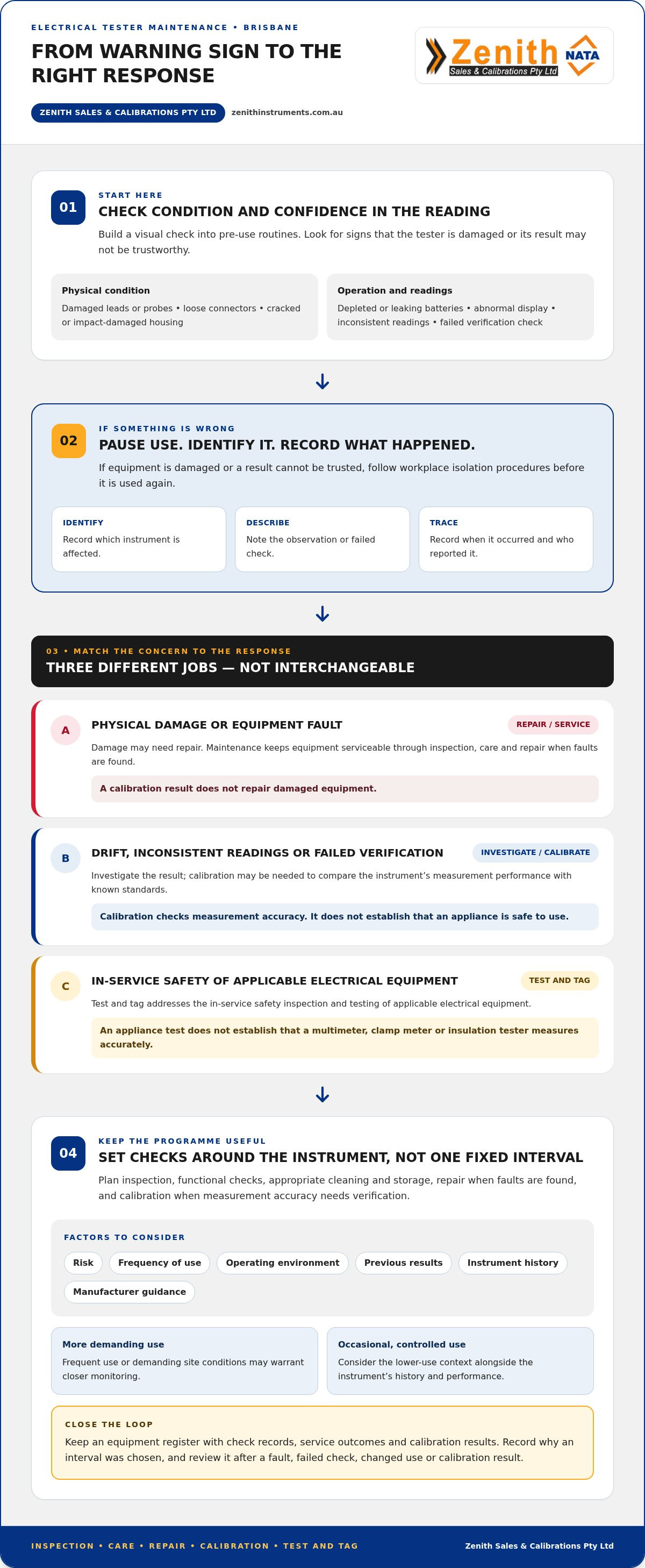
A tester can remain in service for years, but its condition and measurement performance can change through use, handling, storage or exposure to site conditions. Build a quick visual check into pre-use routines and make it easy for staff to report faults. A damaged lead or inconsistent display can undermine confidence in results and may create a safety risk.
What signs suggest an electrical tester needs attention?
Inspect leads and probes for damage, connectors for looseness, and the housing for cracks or impact damage. Check for depleted or leaking batteries, an abnormal display, inconsistent readings or a failed verification check. If equipment is damaged or produces a result that can’t be trusted, document the issue, identify the instrument and follow workplace isolation procedures before it is used again.
Separate urgent defects from planned servicing. Take suspect equipment out of use according to site procedures, and record what was observed, when it occurred and who reported it. A failed check or unexplained measurement drift may call for investigation or calibration; physical damage may need repair. A new calibration result is not a substitute for resolving a fault.
How often should electrical testing equipment be checked?
Set inspection and calibration intervals according to risk, frequency of use, operating environment, previous results and instrument history. A frequently used tester in demanding site conditions may warrant closer monitoring than one used occasionally in a controlled area. Start with manufacturer recommendations, then apply relevant workplace quality procedures and review the schedule when equipment use or performance changes.
One fixed interval can’t suit every instrument, because operating conditions, use and performance history affect the risk of unreliable results. Keep interval decisions traceable in the equipment register, including the reason for the schedule and any changes after a fault, failed check or calibration result. This helps teams plan service before an instrument’s status becomes uncertain, without assuming every device needs the same response.
For Brisbane operations, clear records also help maintenance teams coordinate equipment availability and plan calibration around site needs. Zenith Sales & Calibrations Pty Ltd provides electrical calibration support across Australia, including on-site calibration to help manage downtime. Read about Zenith Sales & Calibrations Pty Ltd’s instrument service and calibration support.
Repair, calibration or test and tag: choose the right response
Choose the service that addresses the actual problem. A meter that has been dropped and now behaves intermittently needs a different response from an intact meter due for an accuracy check. Test and tag is different again: it concerns the in-service safety inspection and testing of applicable electrical equipment, not the measurement accuracy of a multimeter or insulation tester.
| Service | Purpose | Typical trigger | Output | Next action |
|---|---|---|---|---|
| Repair | Address a fault or restore equipment function. | Physical damage, intermittent operation or failed functional checks. | Service findings and repair work details. | Assess function, then arrange calibration if measurement performance needs verification. |
| Calibration | Compare an instrument’s measurement performance with known standards. | Scheduled accuracy review, unexplained drift or a need for documented results. | Calibration results and applicable documentation. | Review results against workplace quality requirements and determine whether adjustment or further action is needed. |
| Test and tag | Inspect and test applicable electrical equipment for in-service safety. | A workplace inspection and testing schedule or a change in equipment status. | Test outcome and associated equipment record. | Follow applicable Queensland requirements, AS/NZS 3760:2022 and workplace procedures. |
When does an electrical tester need repair rather than calibration?
Repair is the appropriate first response if an instrument has a cracked housing, damaged lead, loose connection, intermittent operation or failed functional check. Calibration can assess measurement performance, but it won’t fix physical damage or restore a faulty circuit. Repair may need to come first; once the instrument functions correctly, calibration can establish its measurement performance. The outcome and any further work depend on the equipment’s condition.
When is calibration appropriate for electrical test equipment?
Calibration is appropriate when a business needs to assess or document how accurately an instrument measures. Traceable results help connect measurements to recognised standards, while the certificate and its scope should suit the instrument and the organisation’s quality requirements. For further reading, see this multimeter calibration guide and instrument calibration guide.
For example, a multimeter used for recorded maintenance checks may need documented calibration under the site’s quality procedures. A portable appliance instead follows the relevant in-service safety inspection and testing process. Keep the distinction clear in equipment records: a calibration result doesn’t certify an appliance as safe, and a test-and-tag outcome doesn’t verify a measurement instrument’s accuracy. This decision framework makes electrical testing equipment maintenance brisbane more precise by matching each issue to the right service response.
Build a practical electrical equipment maintenance programme in Brisbane
A workable programme makes equipment status visible and service decisions repeatable. For electrical testing equipment maintenance brisbane, use a workflow that connects each asset to its risk, service history and next review date.
- Register equipment. Record an asset ID, instrument type, location, responsible team and current status.
- Assess risk. Consider how the instrument is used, how critical its readings are, and the consequences of failure or unavailability.
- Schedule checks. Set inspection and calibration reviews using risk, usage, manufacturer recommendations and internal procedures.
- Record outcomes. Keep service history, check results, calibration certificates and the next review date with the asset record.
- Review the programme. Update priorities after equipment moves, usage changes, faults, failed checks or calibration results.
Create an equipment register and service schedule
Make each record specific enough to identify the instrument and track its history. Include its serial or asset number, type, site location, accountable team, service dates, results, certificates and next review. Flag critical instruments whose absence could interrupt Brisbane operations, so scheduling can account for suitable cover or a planned maintenance window.
Set review dates to reflect actual conditions rather than applying one interval to every asset. Consider frequency of use, manufacturer guidance, previous results and workplace quality procedures. Where relevant to the site, account for exposure to heat, humidity, dust, vibration, transport or moisture, along with access restrictions and operating schedules.
Reduce disruption during Brisbane servicing
Group instruments by location, team or maintenance window to coordinate service and reduce repeated handling. Choose laboratory or on-site calibration based on operational needs. Zenith Sales & Calibrations Pty Ltd has in-house laboratories in Sydney and Melbourne, and on-site calibration can help manage downtime. Its electrical equipment calibration services use NATA-certified standards and ISO-compliant processes.
Keep compliance activities distinct in the schedule. AS/NZS 3760:2022 relates to in-service safety inspection and testing of applicable electrical equipment; it isn’t a universal calibration interval for measurement instruments. Determine whether it applies to the specific appliance-testing activity, and use current Queensland guidance and workplace procedures to define the relevant scope.
See Zenith Sales & Calibrations Pty Ltd calibration and service support for Brisbane operations.
Electrical testing equipment maintenance support for Brisbane businesses
Brisbane teams can access Zenith Sales & Calibrations Pty Ltd’s Australia-wide instrument service, repair and calibration support. For electrical testing equipment maintenance brisbane, the right service approach depends on the instrument, its condition, site priorities and the records your quality system requires.
Calibration can form part of a broader equipment-care plan, alongside service and repair when needed. Zenith Sales & Calibrations Pty Ltd uses NATA-certified standards and ISO-compliant processes. Certificate wording and scope should accurately reflect the calibration performed and the applicable requirements for that instrument. Clear records support maintenance planning and audits.
What to prepare before arranging calibration or repair
Gather the instrument type, asset or serial number, reported symptoms and relevant service or calibration history. Include site constraints, operational priorities and any quality-system requirements for certificates or records. This information helps plan the service and identify equipment requiring repair before its measurement performance is assessed.
How Zenith supports electrical equipment calibration
Zenith Sales & Calibrations Pty Ltd provides electrical equipment calibration for Brisbane customers, with in-house laboratory facilities in Sydney and Melbourne, as well as on-site calibration. On-site service can reduce the need to remove equipment from a workplace, while laboratory service provides another option for planning around operational demands. Explore electrical equipment calibration services.
Sharing an instrument’s intended use and your documentation needs helps align the service with your maintenance programme. Calibration results can support confidence in measurements, while repair addresses faults; one doesn’t replace the other. Keep service information with the relevant asset record so teams can track equipment status and schedule future reviews.
Put a dependable maintenance plan into action
Reliable electrical testing equipment maintenance brisbane starts with matching the response to the instrument: inspect and repair faults, calibrate measurement equipment when accuracy needs checking, and keep appliance test-and-tag activities distinct. A risk-based schedule, supported by equipment histories and clear service records, helps teams plan reviews and manage operational interruptions.
Zenith Instruments supports Brisbane businesses through Australia-wide service coverage, with on-site calibration and in-house laboratory facilities in Sydney and Melbourne. Calibration uses NATA-certified standards and ISO-compliant processes; certificate wording and scope should reflect the specific calibration performed and your organisation’s requirements.
Build a programme your team can maintain, then align service options with your equipment and site priorities. Discuss electrical equipment calibration with our team and take the next step towards dependable measurements and better-planned maintenance.
Frequently Asked Questions
How often should electrical testing equipment be calibrated?
There’s no universal calibration interval for every instrument. Set a schedule using manufacturer recommendations, frequency of use, operating conditions, risk, previous results and your organisation’s quality system. Keep calibration intervals separate from any electrical safety testing schedule, as these activities serve different purposes. Document why each interval was selected, then review it if an instrument’s performance, use or site conditions change. This gives your maintenance plan a clear, traceable basis.
What is the difference between calibration and test and tag?
Calibration assesses an instrument’s measurement performance against known standards, while test and tag concerns specified electrical safety checks for applicable equipment. They have different purposes and generate different records, so one activity doesn’t automatically replace the other. The relevant standard and Queensland requirements depend on the equipment and work context. Avoid applying a single rule to every asset; define the applicable process for each equipment type and workplace.
Can I keep using a multimeter that gives inconsistent readings?
Remove a multimeter with questionable readings from service according to your workplace procedures until it has been assessed. Inconsistency may result from damaged leads, battery problems, an internal fault or measurement drift. Record the symptoms, including when they occur and any relevant checks, then arrange an appropriate functional assessment, repair or calibration. Don’t rely on uncertain readings for safety-critical decisions. Return the instrument to use only in line with site procedures and assessment findings.
What records should a business keep for electrical testing equipment maintenance?
Maintain an equipment register that identifies each asset and records its location, service history, inspection findings, repair details, calibration results and relevant certificates. Include the responsible person and planned review date where your organisation’s procedures require them. Accurate records help teams track equipment status, understand its service history and plan future maintenance. Recordkeeping supports your organisation’s maintenance process, but no single format should be assumed to satisfy every legal, quality or audit requirement.
Is calibration the same as repairing electrical test equipment?
No. Calibration determines how an instrument performs compared with reference standards; it doesn’t necessarily correct a fault. Repair addresses a defect, damaged component or functional problem. If an instrument fails checks or needs adjustment, service may be required before its measurement performance can be assessed and documented. The appropriate sequence depends on the instrument’s condition and service findings. Keep repair details and calibration results distinct in the equipment record so its status is clear.
Can electrical testing equipment be calibrated on site in Brisbane?
Yes, on-site calibration can help reduce equipment removal and disruption where the instrument and service requirements are suitable. Zenith Instruments provides Australia-wide support, including Brisbane, and on-site calibration as part of its service model. Support also covers Sydney, Melbourne, Newcastle and Canberra. To plan the service, prepare instrument types, asset identifiers, site constraints, operational priorities and certificate requirements. The appropriate service approach depends on the equipment and its calibration needs.