

The easiest calibration option on paper can become the most disruptive choice on a production floor. A sound plan for food processing plant calibration melbourne starts with the instruments’ roles in product quality and process control, then considers how to maintain production access while obtaining useful records.
It can be difficult to decide which instruments need formal calibration, how often to schedule it or whether on-site or off-site service will fit maintenance windows. Certificate scope and traceability matter too: documentation should support your plant’s quality system and make results clear to the people responsible for audits and equipment.
This guide explains how to identify relevant instruments, organise a practical calibration schedule and compare service approaches for a Melbourne plant. It also covers what to review in calibration documentation and service capability. Zenith Sales & Calibrations provides on-site calibration and instrument services in Melbourne, supported by a computerised closed-loop software system, an ISO 17024 NATA-accredited calibration service and an ISO 17025-compliant laboratory. Zenith also serves Sydney, Newcastle, Canberra and Brisbane, as well as customers across Australia. The aim is a clear, low-disruption approach that matches instrument risk, evidence needs and production access.
Key Takeaways
- Start with an instrument register that captures identifiers, locations, measurement ranges, owners and current calibration status.
- Match calibration methods and certificate details to each instrument’s use and your plant’s quality requirements.
- Compare on-site, in-house and off-site options by production access, instrument scope and recordkeeping needs.
- Use a prioritised schedule to coordinate service around maintenance windows and keep calibration records organised.
- Plan food processing plant calibration melbourne around instrument risk, documentation needs and operational fit, with Zenith’s on-site and laboratory capabilities in view.
Why food processing plant calibration matters for Melbourne operations
Calibration compares an instrument’s readings with known standards and records the results. It helps a plant understand how an instrument performs at the time of assessment, including whether its readings fall within the limits set for its use. A practical plan for food processing plant calibration melbourne operations starts by identifying where measurements influence process decisions, rather than treating every instrument as equally important.
Reliable measurements give production teams a stronger basis for monitoring conditions, maintaining product consistency and investigating variation. For example, a pressure gauge can help operators monitor a process condition, while a thermometer can support temperature checks at relevant stages. If readings drift, documented results can also inform maintenance decisions and help teams decide whether an instrument needs attention.
Calibration evidence supports control and review. It is not a blanket guarantee of product safety, which depends on the wider system of practices and controls, as outlined in this Food Safety Principles and Regulations overview.
Which production measurements should a plant review?
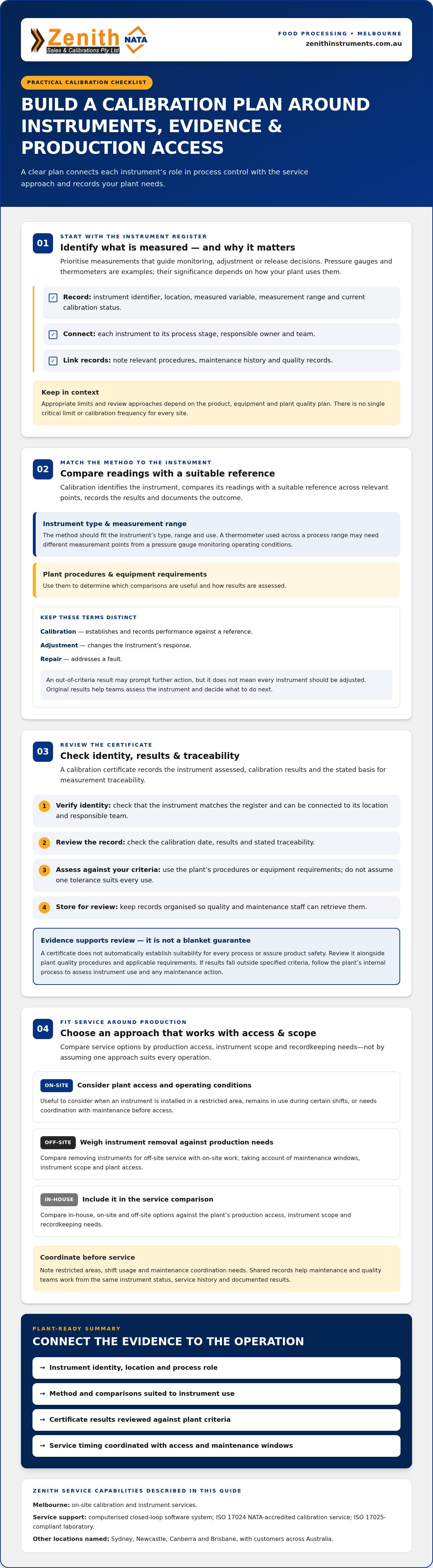
Begin with process stages where measured conditions guide monitoring, adjustment or release decisions. Pressure gauges and thermometers are practical examples, but their significance depends on how the plant uses them. Map each instrument to its process stage, responsible owner and existing quality records so teams can see what is measured, why it matters and where the evidence is kept.
- Record each instrument’s identifier, location and measured variable.
- Note the process stage and team responsible for its readings.
- Link it to relevant procedures, maintenance notes and quality records.
Consider temperature and pressure readings in context. The appropriate limits and review approach depend on the product, equipment and plant’s own quality plan. There is no single critical limit or calibration frequency that applies to every site.
Why Melbourne plants need a service plan that fits operations
Calibration planning must account for production access as well as technical scope. An instrument may be installed in a restricted area, remain in use during certain shifts or require coordination with maintenance before it can be accessed. These details help a plant weigh on-site work against removing instruments for off-site service, without assuming one option suits every operation.
Shared records help maintenance and quality teams work from the same instrument status, service history and documented results. This can reduce confusion when scheduling work or reviewing an instrument’s role in a process. Zenith provides calibration service in Melbourne, including on-site calibration. Aligning the service plan with plant access and existing records gives teams a practical starting point.
How calibration methods and certificates apply to food plant instruments
A calibration process identifies the instrument, compares its readings with a suitable reference across relevant points, records the results and documents the outcome. The method should fit the instrument’s type, measurement range and use. A thermometer used across a particular process range may need different measurement points from a pressure gauge used to monitor operating conditions. Plant procedures and equipment requirements help determine which comparisons are useful and how results are assessed.
Calibration is not the same as adjustment or repair. Calibration establishes and records how an instrument performs against a reference; adjustment changes its response, while repair addresses a fault. A result outside the plant’s acceptance criteria may prompt further action, but that does not mean every instrument should be adjusted. Clear original results help teams understand the instrument’s condition and decide what to do next.
A calibration certificate records the instrument assessed, the calibration results and the stated basis for measurement traceability. It provides evidence for review, not an automatic statement that the instrument is suitable for every process or that product safety is assured. In Australian food processing, assess the certificate alongside the plant’s quality procedures and applicable requirements to determine whether the documented results meet its needs.
What to review in a calibration certificate
Check that the instrument identity matches your register, then review the calibration date, results and stated traceability. Compare results with acceptance criteria set by your plant’s procedures or equipment requirements, rather than assuming one tolerance suits every use. Zenith’s thermometer calibration service supports plants reviewing how temperature readings are assessed and documented.
Make sure the record can also be connected to the instrument’s location and responsible team. If the report notes a result outside your specified criteria, follow your internal process for assessing the instrument’s use and any necessary maintenance action. Store records so quality and maintenance staff can retrieve them during routine review.
How accreditation and laboratory compliance differ
Read credentials precisely. Zenith provides an ISO 17024 NATA-accredited calibration service, and its laboratory is ISO 17025-compliant. These are distinct statements: the first describes the accredited service, while the second describes the laboratory’s compliance. “Compliant” and “accredited” are not interchangeable. Assess each credential against the particular service, instrument scope and documentation your plant requires.
For food processing plant calibration melbourne, this distinction helps procurement, quality and maintenance teams align technical evidence with their procedures. Zenith uses a computerised closed-loop software system for instrument calibration, designed to eliminate human error in the calibration process. If you are mapping certificate needs across instruments, the Zenith calibration team can help connect the required scope with your plant’s instrument register.
How to compare Melbourne calibration services for a food plant
Compare service options against the instruments you need assessed and the practical demands of your production schedule. A nearby service can still be a poor operational fit if its scope does not match your measurement range or if equipment removal creates a bottleneck. For food processing plant calibration melbourne, assess service location, instrument coverage, records, production access and scheduling communication together.
| Service approach | Operational fit | Points to compare |
|---|---|---|
| On-site | Can suit instruments that are difficult to remove or access during production. | Site access, work areas, production coordination, covered instrument types and resulting records. |
| In-house | Uses plant staff and resources where these are suitable for the task. | Available reference equipment, staff capability, documented method and records against plant procedures. |
| Off-site | Can suit instruments that can be removed and sent away without disrupting operations. | Transport and scheduling, instrument scope, certificate details and expected turnaround communication. |
These approaches are not universally better or worse. An instrument fixed in a production area may favour an on-site assessment, while a spare instrument that can leave the floor may be easier to manage off-site. In-house work can fit established plant processes when the required resources and documented method are available. The right arrangement depends on the instrument, site requirements and timing.
When on-site or off-site calibration may suit the plant
Consider whether removal affects process availability, whether the instrument can be isolated safely and how its location shapes access. Shift patterns and maintenance windows matter too. Zenith provides on-site calibration in Melbourne; its Melbourne calibration service can be planned around the plant’s access needs.
How to assess technical scope and service evidence
Compare the service’s technical scope with each instrument type and measurement range, not just its broad category. A temperature instrument used across a particular operating range needs an assessment that matches the plant’s intended use. Review the calibration method and ensure the resulting certificate and stated traceability support your documented quality requirements.
Consider accreditation in relation to the service and evidence required. Zenith provides an ISO 17024 NATA-accredited calibration service and operates an ISO 17025-compliant laboratory. These are distinct credentials, so evaluate them in their correct context. For Australian food standards information, consult Food Standards Australia New Zealand; the plant’s procedures establish how relevant requirements apply to its instruments.
Turnaround communication is another practical comparison point. Zenith’s fastest stated calibration service is as fast as 24 hours, not a universal turnaround promise. Plan around the actual instrument list and production access. Zenith’s calibration services provide a local starting point for aligning service scope with plant operations.
How to prepare a food processing plant calibration schedule
A useful schedule turns instrument records into planned work, rather than a list of dates nobody can action. For food processing plant calibration melbourne, begin with the instruments in use, then set priorities and service timing around documented requirements and production access. Review the schedule as equipment, processes and instrument history change.
- Build the inventory. Record each instrument’s type, unique identifier, location, measurement range, process owner and current status.
- Review history and requirements. Capture previous calibration records and the next review or due date set by plant procedures.
- Prioritise instruments. Use operational risk, process role, instrument history and quality requirements to guide sequence. Document why an instrument receives its review interval; do not apply one frequency automatically across the plant.
- Choose the service approach. Identify instruments that can be removed and those where access or production needs favour on-site attention.
- Complete and review the work. Record service outcomes, update status and due dates, then review results with the relevant quality and maintenance teams.
Build an instrument register that supports planning
Keep the register practical enough for teams to maintain. Group pressure gauges, temperature instruments and other measurement devices so you can prepare a clear service scope without losing instrument-level detail. For each entry, link its identifier to the process owner, location, range, calibration history and next review date. This makes it easier to spot missing records, overdue reviews or instruments that need access planning.
Coordinate calibration around production access
Mark which instruments can be removed without affecting operations and which need attention at their installed location. Agree access windows with production, maintenance and quality teams before scheduling service, especially where equipment is difficult to reach or production runs across shifts. Share the current instrument list and planned work so each team can prepare for the same schedule.
Before the service, check:
- Instrument identifiers and locations match the register.
- Equipment is available, accessible and ready for the agreed work.
- Production and maintenance teams know the access window and any planned removal.
- Quality staff know how results and updated records will be reviewed.
After calibration, reconcile the records against the register. Update status and next review dates in line with plant procedures, and assign follow-up for results that need assessment. This closes the loop between service, maintenance planning and quality documentation.
Once your register and access priorities are set, review Zenith’s calibration support to align the service scope with your schedule.
Arrange food processing plant calibration in Melbourne with Zenith
A well-prepared instrument register gives calibration work a clear starting point. Zenith serves the food industry and operates in Melbourne, providing instrument calibration, on-site calibration, repair, service and installation. Share your instrument scope and operational priorities so the work can be planned around the equipment involved and your plant’s access requirements.
For food processing plant calibration melbourne, the service arrangement should reflect what each instrument measures, where it is installed and how its results are used. Zenith’s on-site calibration is carried out by trained engineers, and the company also provides Australia-wide service, including Sydney, Melbourne, Newcastle, Canberra and Brisbane. Instruments that can be removed may suit a different arrangement from equipment that needs attention at its installed location. The Melbourne calibration service provides a local point of reference for coordinating plant requirements.
What Zenith brings to Melbourne plant calibration
Zenith uses a computerised closed-loop software system for instrument calibration, eliminating human error in the process. Its stated credentials are an ISO 17024 NATA-accredited calibration service and an ISO 17025-compliant laboratory. These are separate descriptions and should be considered in relation to the service and records relevant to your plant. The fastest stated calibration service is as fast as 24 hours; this is not a standard or guaranteed turnaround for every instrument or request.
Zenith also provides repair, service and installation. These capabilities allow calibration needs to be considered alongside equipment condition and plant requirements, without assuming every instrument needs the same work. A clear instrument list helps define a relevant scope and supports coordination with production, maintenance and quality staff.
What to include when requesting calibration support
Prepare concise, instrument-level information before discussing the work. A clear scope and description of access conditions make it easier to plan the service and organise your plant’s internal review of results.
- Instrument type, unique identifier and measurement range.
- Location, process owner and current calibration status.
- Relevant calibration history or next review date from your register.
- Whether each instrument can be removed or needs on-site attention.
- Production access requirements, preferred scheduling windows and any site coordination needs.
- The certificate or record format your plant procedures require.
Include instrument-specific priorities, such as equipment that supports a key process check or has a documented maintenance concern. Keep acceptance criteria grounded in your plant’s procedures and equipment requirements. For broader calibration context, consult an instrument calibration guide and relate its general principles to the instruments and records your site manages.
With your instrument scope and access priorities ready, contact Zenith about Melbourne calibration to discuss support for your plant.
Make calibration planning part of continuous improvement
A calibration schedule works best when it stays connected to the way your plant changes. New equipment, process adjustments and shifts in instrument ownership can all affect whether your records and review dates remain useful. Build a regular register review into your quality or maintenance planning so gaps are identified before the next service cycle, not during an urgent production decision.
For food processing plant calibration melbourne, turn your priorities into a workable scope: identify the instruments, describe their operating context and outline the access your team can provide. That gives the service discussion a practical foundation and helps keep technical needs aligned with production planning.
Start a conversation about your plant’s calibration scope with Zenith. A clear instrument list is a strong first step toward a reliable plan that can adapt as your operation evolves.
Frequently Asked Questions
What instruments in a food processing plant should be calibrated?
The relevant instruments depend on your plant’s processes and documented quality procedures. Pressure gauges may support monitoring equipment conditions, while thermometers may be used to check temperatures at selected stages. Maintain a register that connects each instrument to its process, owner and current status. Record why it is included in the programme, using your site’s own rationale rather than assuming there is one universal instrument list or legally mandated calibration frequency.
How often should food processing equipment be calibrated?
Set intervals according to each instrument’s use, history, operational risk and documented plant procedures. Review previous results for drift or repeated issues, and consider whether equipment, products or processes have changed. For example, a process change may prompt a review of whether an instrument’s range and interval remain suitable. Document the reasons for your schedule and revise it when evidence or operating conditions change, rather than applying one interval across all equipment.
Can calibration be carried out on-site at a Melbourne food plant?
Yes. Zenith provides on-site calibration, which can suit equipment that is difficult to remove or sites where removal would complicate operations. For example, a plant may prefer an on-site assessment for an installed instrument that is awkward to transport. The suitable method depends on the instrument, its requirements and site conditions. For food processing plant calibration melbourne planning, include access constraints and production timing when defining the service scope.
What should a food plant calibration certificate include?
Review whether the certificate identifies the instrument clearly and records the calibration date, results and stated traceability. Match the instrument’s identifier to your register so the document can be tied to the correct equipment and location. Acceptance criteria and recordkeeping needs should follow your plant’s own procedures. A certificate supports technical review, but it is not a universal template or, by itself, proof that every quality or compliance requirement has been met.
Does food processing plant calibration need to be NATA-accredited?
Determine the required accreditation by comparing your plant’s quality-system and customer requirements with the calibration scope and certificate needed for each instrument. Zenith provides an ISO 17024 NATA-accredited calibration service. Align the evidence required by your procedures with the relevant service scope when planning food processing plant calibration in Melbourne.
How can a plant reduce downtime during calibration?
Start with an up-to-date instrument register, then coordinate access with production and maintenance before service is scheduled. Identify equipment that can be removed and plan it around operational windows; flag installed instruments that may need attention on-site. Comparing on-site and off-site options for each instrument can help teams plan around practical constraints. Build in time for record review and any follow-up, but do not assume calibration will guarantee uninterrupted production.
How quickly can calibration be completed in Melbourne?
Zenith describes its fastest calibration service as as fast as 24 hours, but this is not a standard guarantee for every instrument or job. Timing depends on the instrument scope, site access and scheduling requirements. A clear register can help define the work, while identifying priority instruments and production constraints supports practical planning. Share those details early so the service arrangement can be planned around the plant’s operational needs, without relying on an assumed turnaround.