

If your gas detection equipment is still calibrated to outdated standards, are you prepared for the mandatory legal shift occurring on December 1, 2026? With over 10% of Australian workers regularly exposed to hazardous airborne substances, the transition from Workplace Exposure Standards to the new, legally enforceable Workplace Exposure Limits (WELs) demands absolute precision in your safety protocols. Many site managers in Victoria struggle with the logistical burden of equipment downtime and the technical ambiguity surrounding AS/NZS 60079.29.2:2016. We understand that maintaining a rigorous schedule for gas detector bump test and calibration melbourne can feel like a conflict between operational efficiency and regulatory necessity.
We've developed this 2026 guide to help you master the critical differences between daily functional verification and formal periodic adjustment. You'll gain a clear maintenance framework that eliminates confusion over manufacturer recommendations versus Australian Standards. We'll examine how to ensure your sensors remain accurate against reduced limits for substances like Ammonia and Sulphur dioxide. This technical overview provides the path to maintaining Victorian compliance while ensuring your personnel remain secure against the risks of sensor drift.
Key Takeaways
- Distinguish between the rapid "pass/fail" check of a bump test and the precision adjustments required during a full calibration to ensure quantitative sensor accuracy.
- Implement a structured maintenance schedule that adheres to AS/NZS 60079.29.2:2016 and manufacturer-specified six-month intervals for a gas detector bump test and calibration melbourne.
- Evaluate the logistical benefits of mobile on-site calibration for fixed systems versus comprehensive laboratory-based maintenance for portable monitoring equipment.
- Leverage authorized service expertise for RKI and Riken instruments, alongside technical support for industry-leading brands including BW, MSA, and Honeywell.
Essential Gas Detection for Melbourne Workplaces
Atmospheric hazards are often invisible, making gas detection the primary line of defense in industrial settings. These systems utilize sensitive electrochemical or infrared sensors to identify toxic and combustible gases before they reach life-threatening concentrations. A gas detector is a life-saving instrument that requires regular verification to ensure it functions as intended in hazardous environments. Without a rigorous maintenance protocol, workers are left vulnerable to sensor failure. Relying on local Melbourne expertise for instrument servicing is essential for achieving rapid turnaround times. We prioritize efficiency to minimize your operational downtime while ensuring all equipment meets stringent safety benchmarks. Maintaining a strict schedule for gas detector bump test and calibration melbourne ensures that these sensors provide the necessary early warning before exposure limits are exceeded. To understand the fundamental technology involved, one might ask, What is a Gas Detector? and how does it differentiate between various atmospheric threats?
The Risk of Sensor Drift in Industrial Environments
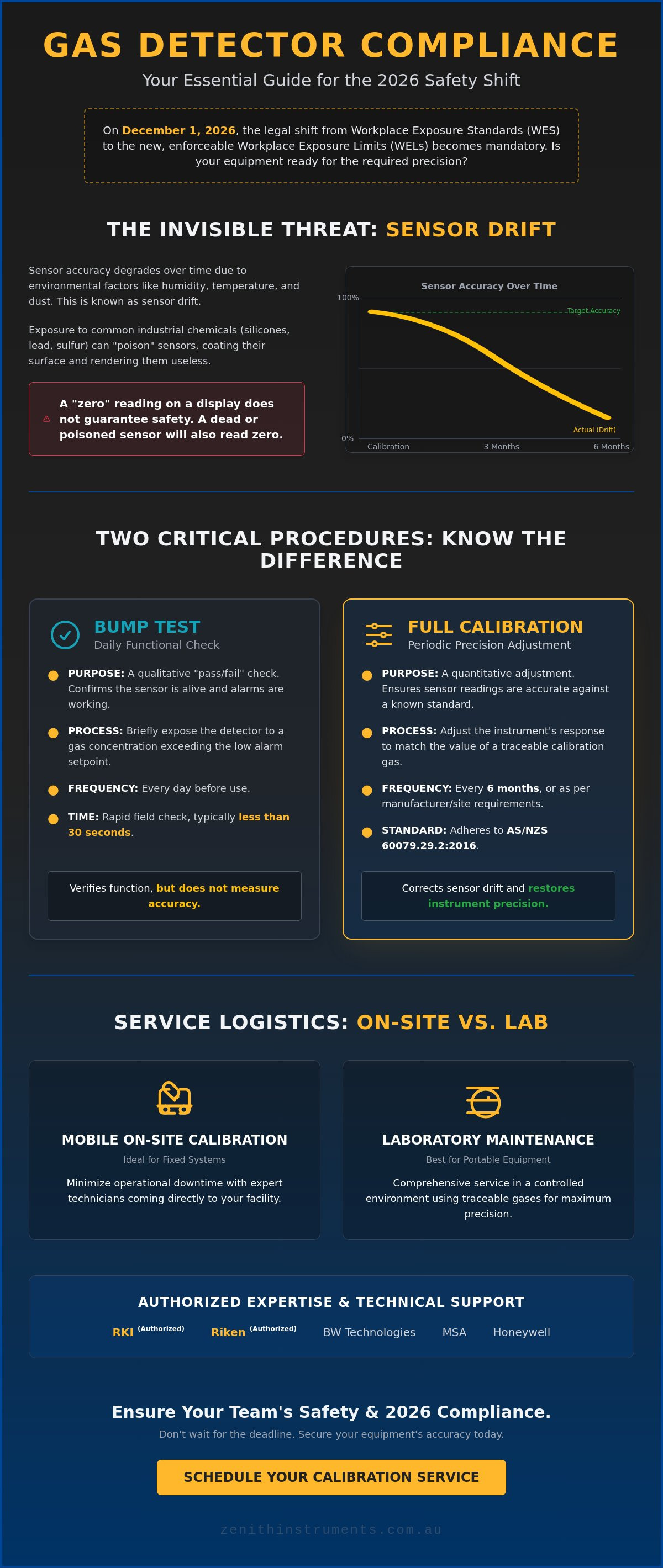
Sensor drift is an inevitable reality in technical measurement. Environmental factors such as high humidity, extreme temperature fluctuations, and heavy dust accumulation can degrade sensor sensitivity over time. Beyond natural wear, sensors often suffer from "poisoning" when exposed to common industrial chemicals like silicones, lead, or sulfur compounds. These contaminants coat the sensor surface, effectively blinding the unit. It is a dangerous misconception to assume a "zero" reading on a display indicates safety. A dead sensor will also read zero. Only a controlled gas application can verify that the device is actually sensing. We provide professional Gas Monitor Calibration Service to correct this drift and restore instrument precision.
Melbourne Industries Requiring Rigorous Gas Monitoring
Several Victorian sectors face high-risk atmospheric conditions daily. Wastewater treatment facilities must monitor for Hydrogen Sulphide (H2S), a byproduct of organic decomposition prevalent in Melbourne’s extensive sewer networks. Cold storage warehouses require precise detection of ammonia or CO2 to prevent leaks that threaten both staff and inventory. Manufacturing plants often deal with volatile organic compounds (VOCs) and combustible gases during production. Under the Victorian Occupational Health and Safety Act, employers have a legal obligation to provide a safe workplace. We assist these businesses through our specialized calibration service melbourne, ensuring all portable and fixed monitors remain compliant with state regulations and Victorian safety standards.
Bump Test vs. Full Calibration: Understanding the Difference
Precision in gas detection relies on two distinct yet complementary procedures. A bump test serves as a qualitative functional check. It confirms the sensor is active and the alarms are audible and visible when exposed to a known gas concentration. Full calibration, however, is a quantitative adjustment that ensures the instrument's readings are accurate and linear. Understanding this distinction is vital for maintaining a compliant gas detector bump test and calibration melbourne schedule.
Efficiency is key in Melbourne’s industrial sectors. A bump test is a rapid field check taking less than 30 seconds. Professional calibration is a more intensive process requiring a controlled environment and traceable gases. We often see confusion where operators believe a successful bump test negates the need for periodic calibration. This isn't the case. While the bump test verifies the sensor isn't "poisoned" or dead, only full calibration corrects the sensor drift discussed previously. Compliance is non-negotiable. Safe Work Australia's "Confined Spaces" Code of Practice mandates that monitoring equipment must be maintained and used according to strict manufacturer and regulatory guidelines.
When to Perform a Bump Test
Perform a bump test every day before the instrument is used. This pre-shift challenge is the only way to confirm that the gas path isn't blocked by debris or that the sensor hasn't failed since the last use. The process involves exposing the detector to a high enough gas concentration to trigger the set alarm points. If a unit fails to alarm within the manufacturer's specified tolerance, it must be withdrawn from service immediately. Having a calibrated backup unit on-site in Melbourne prevents work stoppages when a primary detector fails its functional check.
The Full Calibration Process Explained
During a professional service, technicians perform a multi-point verification against traceable standards. This involves zeroing the sensor in a contaminant-free environment and then applying a precise span gas. We adjust the internal electronics so the digital readout exactly matches the known concentration. This meticulous process guarantees that the "0.25 ppm" shown on your screen for Sulphur dioxide is an absolute, reliable measurement. For professional support with your fleet, consider our Gas Monitor Calibration Service to maintain peak instrument integrity and site safety.
Maintenance Frequency and Australian Standards
Adherence to AS/NZS 60079.29.2:2016 is the benchmark for gas detection safety across Australia. This standard provides the regulatory framework for the selection, installation, use, and maintenance of apparatus for the detection and measurement of flammable gases or oxygen. For Victorian site managers, compliance isn't merely a recommendation; it's a legal necessity under the Occupational Health and Safety Act. While the standard provides general oversight, most industrial manufacturers like Riken, MSA, and Honeywell specify a maximum six-month interval for full calibration. As we approach the December 1, 2026, transition to new Workplace Exposure Limits (WELs), the precision of your gas detector bump test and calibration melbourne becomes even more critical. The reduction of limits for substances like Sulphur dioxide from 2 ppm down to 0.25 ppm means that even minor sensor drift can lead to non-compliance or undetected hazardous exposure.
We emphasize that these intervals represent the minimum requirement. A robust safety culture involves a dual-track approach where daily functional checks complement periodic professional adjustments. Maintaining a detailed calibration log is mandatory for Victorian worksites to demonstrate due diligence during WorkSafe inspections. These records must verify that the equipment was tested against traceable standards and performed within the manufacturer's specified tolerances. We provide a comprehensive Gas Monitor Calibration Service that ensures your fleet remains compliant with these evolving 2026 requirements.
Factors Influencing Your Calibration Schedule
Operational conditions often dictate a more frequent service rhythm than the standard six-month window. High-frequency use in Melbourne’s construction and mining sectors subjects sensors to physical vibration, extreme humidity, and high dust concentrations. These "harsh environment" factors accelerate sensor fatigue and drift. If your detectors are used in confined spaces daily or exposed to high concentrations of target gases, we recommend moving to a quarterly calibration schedule. This proactive approach identifies sensor "poisoning" before it compromises worker safety. You should evaluate your site-specific risks to determine if biannual servicing is sufficient for your technical requirements.
Documentation and Compliance Audits
A valid calibration certificate is your primary defense during a safety audit. These documents must include NATA traceability, ensuring that the reference gases used are linked to national measurement standards. Digital record-keeping significantly simplifies Victorian OH&S inspections by providing instant access to instrument history and serial-number-specific data. We assist our partners by providing meticulous documentation with every calibration service melbourne, ensuring your business is prepared for any regulatory scrutiny. Our structured reporting confirms that your instruments are not just functional, but precise enough to meet the rigorous new 2026 exposure limits.
Melbourne Service Logistics: On-Site vs. Laboratory Calibration
Efficient logistics are essential for maintaining a compliant safety schedule without disrupting your core operations. We offer a dual-service model designed to meet the technical demands of Victorian industries. Our central facility provides a streamlined calibration service melbourne that caters to both high-volume portable fleets and complex fixed-point detection systems. Determining whether your equipment requires on-site attention or laboratory-grade maintenance depends on the installation type and the depth of service required.
We understand that equipment downtime represents a significant operational cost. Professional management of a gas detector bump test and calibration melbourne schedule requires a partner who can adapt to your site's physical constraints. For many businesses, the choice between mobile service and laboratory adjustment is a balance of speed and technical complexity. We provide the expertise to guide this decision, ensuring your atmospheric monitoring remains uninterrupted and legally compliant with Victorian safety regulations. Our Melbourne facility is positioned to handle local drop-offs and pick-ups, providing a reliable point of contact for regional and metropolitan clients.
On-Site Calibration for Melbourne Industrial Hubs
Mobile calibration is the preferred solution for fixed gas systems integrated into critical infrastructure. Our technicians regularly service major industrial hubs, including Dandenong, Campbellfield, and Port Melbourne. This on-site approach eliminates the transport risk associated with sensitive sensors and ensures immediate equipment availability upon completion. It's particularly effective for car park emission monitors and fixed plant sensors where removing the unit would compromise the entire safety system. We conduct these services with minimal disruption to your daily workflow.
Laboratory Services for Complex Instrumentation
Portable detectors and specialized monitors often require the controlled environment of a professional laboratory. When a unit fails a bump test or requires a full sensor replacement, we move it to our facility for intensive diagnostics. This lab equipment calibration environment allows for high-precision adjustments using traceable gas concentrations that aren't practical for mobile transport. Victorian businesses relying on courier services benefit from our structured turnaround times, ensuring that life-saving instrumentation is back in service as quickly as possible. If your fleet requires professional adjustment, contact us today for a technical consultation.
The Zenith Advantage for Gas Safety in 2026
We provide a definitive solution for businesses navigating the complexities of Victorian safety regulations. As an authorised service centre for RKI and Riken, we possess the specialized technical knowledge required to maintain these high-precision instruments to factory specifications. Our capabilities extend across the industry's leading manufacturers, including BW, MSA, and Honeywell. This broad expertise ensures that your entire fleet receives uniform, high-standard care regardless of the brand mix. For high-risk industrial sites in Melbourne, our commitment to NATA-traceable standards provides the ultimate trust signal. It confirms that every measurement is accurate, reliable, and legally defensible under the scrutiny of Victorian safety audits.
Our technical team understands that reliability is built on meticulous attention to detail. We manage your equipment with a proactive service model that identifies potential sensor failures before they become safety incidents. Professional management of a gas detector bump test and calibration melbourne schedule ensures that your site remains compliant with the new 2026 Workplace Exposure Limits. We don't just offer a service; we establish a partnership with our clients to ensure their safety infrastructure is robust, disciplined, and highly organized.
Expertise Across All Gas Types
Monitoring for standard gases like Oxygen (O2), Carbon Monoxide (CO), and Hydrogen Sulphide (H2S) is a fundamental requirement, but our technical team also specializes in detecting Lower Explosive Limits (LEL) and exotic toxic gases. We don't just verify basic function. We proactively replace depleted or poisoned sensors using genuine manufacturer parts to guarantee the instrument's longevity and response time. This meticulous approach prevents the catastrophic failure of life-critical equipment in confined spaces or hazardous production zones. Maintaining this level of exactness is what separates a functional tool from a truly life-saving device. You can explore our full range of technical measurement and Gas Monitor Calibration Service solutions on the Zenith homepage.
Ensuring Accuracy for Melbourne’s Future
Precision is the primary safeguard against operational downtime. Incorrectly calibrated sensors frequently trigger false alarms, leading to unnecessary site evacuations and costly production shutdowns in Melbourne’s manufacturing corridors. Since 2004, we've served the Melbourne industrial community by providing meticulous maintenance that prioritizes both worker safety and equipment uptime. Our structured approach moves efficiently from identifying a technical problem to providing a solution backed by formal certification. As the 2026 regulatory shift approaches, having a dependable expert partner is essential for maintaining compliance. We invite you to contact our technical team for a tailored maintenance quote that addresses the specific needs of your Melbourne fleet. Book your Melbourne gas detector calibration today to secure your facility's safety and operational integrity.
Securing Your Melbourne Site for the 2026 Regulatory Shift
Maintaining rigorous safety protocols requires more than just functional equipment; it demands a disciplined approach to technical maintenance. Precision is a non-negotiable standard in hazardous environments. By distinguishing between daily functional verification and professional periodic adjustments, you protect both your personnel and your operational continuity. Adhering to AS/NZS 60079.29.2 ensures your facility remains compliant as industrial standards evolve. Integrating a structured gas detector bump test and calibration melbourne schedule into your workflow is the most effective way to eliminate the risks of sensor drift.
Our status as an Authorised RKI and Riken Service Centre ensures your instrumentation receives manufacturer-grade care. We've served Melbourne industries since 2004, utilizing NATA traceable standards to provide the exactness your high-risk site requires. Whether you manage a portable fleet or fixed plant sensors, our technical team is ready to support your safety goals. We look forward to helping you achieve total confidence in your atmospheric monitoring systems.
Request a Quote for Melbourne Gas Detector Calibration
Frequently Asked Questions
How often should I bump test my gas detector in a Melbourne workplace?
You should bump test your gas detector every day before use or before the start of each shift. This functional check ensures the sensors respond to gas and that all audible and visual alarms activate correctly. It's a critical safety step that identifies sensor poisoning or blockage before a worker enters a hazardous environment. While a bump test doesn't replace formal calibration, it's the only way to verify instrument integrity on a daily basis.
What is the difference between a bump test and a full calibration?
A bump test is a qualitative pass/fail check, whereas a full calibration is a quantitative adjustment of the instrument’s accuracy. During a bump test, you expose the sensor to a known gas concentration just to trigger the alarms. Full calibration involves adjusting the sensor's response to match a traceable standard precisely. This distinction is vital for a comprehensive gas detector bump test and calibration melbourne program.
Is on-site gas detector calibration available in Melbourne industrial areas?
On-site calibration is available for fixed gas detection systems across Melbourne’s industrial corridors, including Dandenong, Campbellfield, and Port Melbourne. This service is designed for integrated sensors where removal would cause significant operational downtime. Our technicians bring traceable gases and equipment directly to your facility to perform the necessary adjustments. For portable units, laboratory-based servicing remains the standard for deep maintenance and sensor replacement.
Which Australian Standards govern gas detector calibration in 2026?
The primary standard governing these procedures is AS/NZS 60079.29.2:2016. This document outlines the requirements for the selection, installation, use, and maintenance of gas detection equipment. Compliance with this standard is essential for meeting Victorian Occupational Health and Safety obligations. It provides the technical framework for ensuring that atmospheric monitoring remains reliable and legally defensible during workplace safety audits.
Can I perform my own gas detector calibration on-site?
While site personnel can be trained to perform daily bump tests, full calibration requires specialized equipment and traceable gas cylinders. To ensure legal compliance and sensor accuracy, professional technicians should perform the six-monthly adjustments. This ensures that the instrument is verified against national standards and that a valid certificate is issued for your safety records. Attempting DIY calibration without the correct span gases can lead to dangerous measurement errors.
What happens if my gas detector fails a bump test?
If a detector fails its bump test, you must immediately remove it from service and tag it for repair. A failure indicates that the sensors are either dead, poisoned, or drifted beyond acceptable tolerances. The unit cannot be used for life-safety monitoring until it has undergone a successful full calibration or sensor replacement. We recommend keeping a calibrated spare on-site to prevent work stoppages when a unit fails its pre-shift check.
How long does a professional gas detector calibration take in Melbourne?
Laboratory calibration typically takes between two and five business days depending on the complexity of the instrument and sensor availability. On-site services for fixed systems are completed within the same day, providing immediate verification for your plant. We prioritize efficient turnaround times to minimize the period your team is without critical safety equipment. Courier services are often used to streamline the transport of portable units to our Melbourne facility.
Do I get a certificate of compliance after a gas monitor service?
Every professional service includes a formal calibration certificate that documents the instrument's performance and NATA traceability. This certificate serves as your primary evidence of compliance during Victorian OH&S inspections. It lists the serial numbers, test results, and the specific gases used during the procedure. Maintaining these records is a mandatory requirement for any business managing a gas detector bump test and calibration melbourne schedule.