

Relying on a gas detector that hasn't undergone professional testing in over six months is more than a compliance risk; it's a direct threat to your operational safety. We recognize the logistical frustration of shipping critical safety equipment interstate and the resulting downtime that stalls your projects. Navigating the technical nuances of AS/NZS 60079.29.2:2016 requires a meticulous approach that many busy facility managers struggle to maintain alongside their primary responsibilities. Our team understands that for professionals in the ACT, the priority is precision without the delay.
Our 2026 guide provides the technical roadmap you need to secure expert gas monitor calibration canberra services that keep your site compliant and your workers protected. We promise to show you how to streamline your maintenance schedule to meet rigorous Australian Standards while avoiding the common pitfalls of sensor drift in harsh local environments. You'll learn about the necessity of NATA-traceable certification for your audit trails and gain expert insights into maximizing sensor longevity through proactive service models. We're here to ensure your equipment remains a reliable line of defense.
Key Takeaways
- Ensure full compliance with AS/NZS 60079.29.1 by implementing a rigorous calibration schedule that meets 2026 Australian safety requirements.
- Mitigate the risks of natural sensor degradation by understanding how ACT environmental factors accelerate drift in electrochemical and catalytic bead sensors.
- Determine whether on-site or lab-based gas monitor calibration canberra services offer the most efficient turnaround for your specific industrial application.
- Secure NATA-traceable certification to maintain precise audit trails, providing essential documentation for regulatory compliance and workplace safety audits.
- Optimize the lifespan of your gas detection equipment through technical support tailored for major industrial brands, including Honeywell, MSA, and BW Technologies.
The Importance of Gas Monitor Calibration for Canberra Workplaces
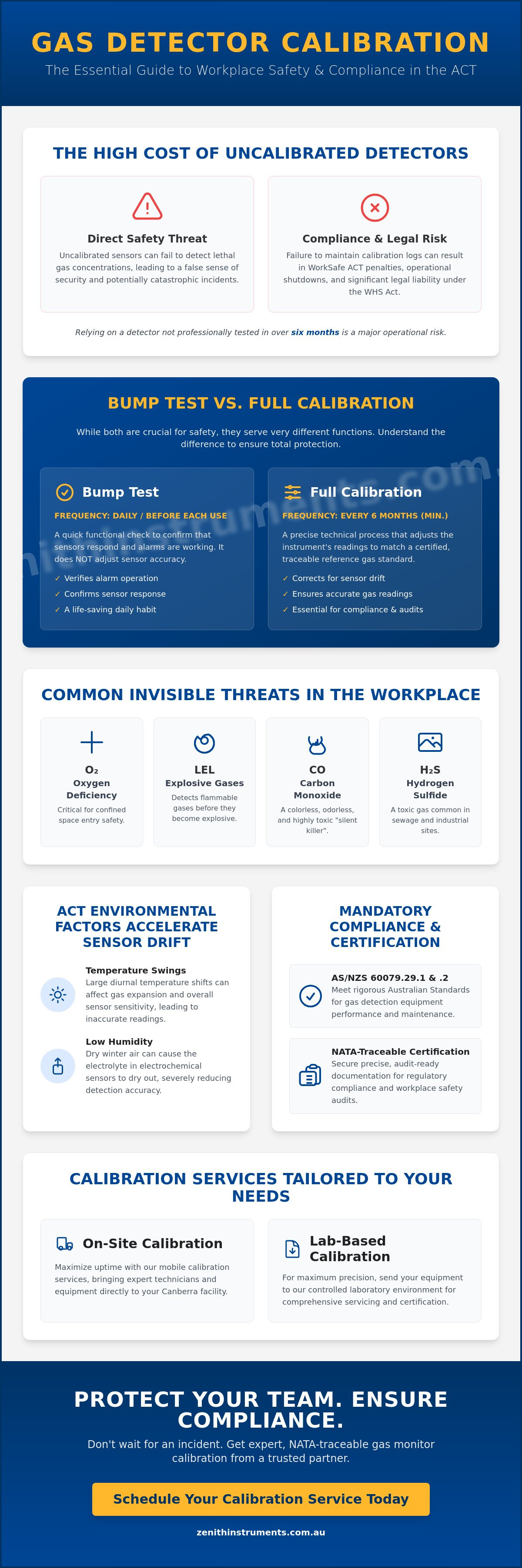
Gas monitor calibration is a technical verification process that ensures a sensor’s readings accurately reflect the actual concentration of hazardous gases in the atmosphere. To understand what is a gas detector and its operational limits, one must recognize that these instruments are precision tools rather than passive alarms. In the ACT, where high-stakes research facilities, government infrastructure projects, and complex HVAC operations are standard, gas monitor calibration canberra services provide the necessary assurance that life-saving equipment will trigger alarms at correct thresholds. Relying on an uncalibrated device creates a dangerous "false sense of security." This complacency often leads to catastrophic workplace incidents when sensors fail to respond to lethal concentrations.
Why Gas Detection is a Life-Saving Requirement
Industrial environments often harbor invisible threats that bypass human perception. A calibrated monitor is the only reliable defense against these hazards, which include:
- Carbon Monoxide (CO): A colorless, odorless toxic gas.
- Hydrogen Sulfide (H2S): Highly toxic gas often found in sewage and industrial processes.
- Oxygen Deficiency: Critical for confined space safety.
- Lower Explosive Limit (LEL): Detecting flammable gas concentrations before they reach explosive levels.
We emphasize the distinction between a functional bump test and a technical calibration. While a daily bump test confirms that sensors respond to a challenge gas, only a full Gas Monitor Calibration Service adjusts the internal electronics to match a certified reference standard. This technical precision is critical for confined space entry permits. In these high-risk areas, a slight margin of error in oxygen readings can lead to immediate respiratory failure. Regular service ensures your team never enters a hazardous zone with compromised equipment.
Regulatory Landscape in the ACT
The Work Health and Safety (WHS) Act in Canberra mandates that employers provide a safe working environment through rigorous maintenance protocols. This duty of care requires the maintenance and verification of all safety-critical equipment. Failing to provide an audit-ready calibration log during a WorkSafe ACT inspection can result in significant legal liability and operational shutdowns. Calibration certificates act as vital legal documentation. They prove that your business has taken proactive steps to comply with Australian Standards like AS/NZS 60079.29.2. We provide NATA-traceable certification that serves as a cornerstone for your safety management system. Engaging in regular gas monitor calibration canberra ensures that your facility remains compliant with national frameworks while protecting your personnel. It's a shield against litigation and a fundamental pillar of industrial safety, and for those looking to bolster their compliance through staff education, you can visit Guardian Safety to explore online safety training options.
Technical Factors Affecting Gas Sensor Accuracy in the ACT
Gas sensors are not static components; they are dynamic chemical and physical detectors that react constantly to their environment. Even premium monitors experience drift, which is a gradual shift in sensor response over time. In the Australian Capital Territory, these shifts are often accelerated by localized atmospheric conditions. Professional gas monitor calibration canberra services are essential to correct these deviations before they compromise your safety thresholds. We've seen that neglecting these technical adjustments leads to inaccurate readings that either trigger false alarms or, more dangerously, fail to alert personnel to real hazards.
Environmental Impact on Measurement Precision
Canberra's distinct climate presents specific challenges for sensor stability. Humidity levels often drop significantly during our dry winters. This low-moisture environment can cause the electrolyte in electrochemical sensors to "dry out," which reduces the sensor's ability to generate the necessary current for accurate detection. Additionally, large diurnal temperature swings affect gas expansion and sensor sensitivity. While many modern monitors include internal temperature compensation, extreme shifts can still lead to transient inaccuracies. Construction sites across the ACT also introduce high levels of dust and particulates. If these particles clog the sensor's flame arrestor, gas cannot reach the sensor, leading to dangerously low readings. Following Safe Work Australia's code of practice is vital here, as it emphasizes the need for equipment to be maintained in accordance with manufacturer specifications to handle these environmental stressors. Engaging in routine gas monitor calibration canberra ensures that these environmental variables don't compromise your safety data.
The Science of Sensor Degradation
Sensor failure isn't always immediate; it's often a slow degradation of chemical components. Electrochemical sensors, used for oxygen and toxic gases like CO or H2S, rely on a finite amount of electrolyte. As this chemical is consumed or evaporates, the sensor's sensitivity naturally diminishes. Catalytic bead sensors, which detect explosive gases (LEL), are particularly vulnerable to "poisoning." Exposure to common industrial chemicals, such as silicones found in lubricants or cleaners, can permanently coat the active bead. This coating prevents the combustible gas from reacting, effectively blinding the monitor. We often see technicians attempt to "zero" their monitors in clean air to fix these issues. However, zeroing only resets the baseline; it doesn't verify sensitivity. Only a full Gas Monitor Calibration Service using certified span gas can confirm if a sensor is still capable of detecting life-threatening concentrations. If you've noticed your readings fluctuating during seasonal transitions, it's likely time to consult with a calibration specialist to verify your equipment's integrity.
Lab-Based vs. On-Site Calibration Services in Canberra
Choosing the optimal service model is a strategic decision that impacts both your safety margins and your operational budget. For portable detectors, lab-based service is often the default; however, fixed systems in Canberra industrial precincts like Fyshwick or Hume often benefit from mobile solutions. We offer a structured approach to gas monitor calibration canberra that balances technical precision with logistical efficiency. Whether you manage a fleet of handheld monitors or a complex network of fixed sensors, understanding the technical advantages of each model is essential for maintaining a robust safety framework.
Laboratory Calibration: Precision and Depth
Our laboratory environments eliminate the external variables, such as Canberra's fluctuating humidity and temperature mentioned previously, that can interfere with sensitive sensor adjustments. These controlled settings allow for the highest degree of measurement accuracy. We utilize high-purity span gases and precision flow regulators to perform comprehensive multi-point testing across the sensor's entire range. Key benefits of the laboratory model include:
- Controlled Atmospheric Conditions: Stable environments prevent transient sensor drift during the calibration process.
- Advanced Diagnostics: Access to specialized bench tools for deep-level electronic troubleshooting and firmware updates.
- Component Availability: Immediate access to an extensive inventory of replacement sensors and filters for major brands.
For Canberra clients, our logistics network facilitates a streamlined "mail-in" service to our calibration services sydney or calibration service melbourne hubs. This ensures your instruments receive the highest level of technical scrutiny before being returned with full certification.
On-Site Services: Convenience and Continuity
Removing fixed gas detectors from a production line often requires significant downtime and specialized electrical work. Our on-site gas monitor calibration canberra model addresses this by bringing the laboratory capabilities directly to your facility. Our technicians carry portable calibration stations to service fixed detection arrays where they are installed. This proactive service model allows your operations to continue without the need for hardware removal or complex re-installations. We provide immediate, on-the-spot certification and can perform minor repairs or sensor swaps during the site visit. It's an efficient way to maintain safety compliance for large-scale facilities or government infrastructure projects where equipment downtime is not an option. We also recommend scheduled service rotations. This ensures a rolling inventory of calibrated backups is always available, effectively eliminating the risk of operating with unverified equipment while primary units are being serviced.
Compliance and Standards: Meeting Australian Safety Requirements
Compliance in the ACT is governed by a strict hierarchy of Australian Standards and regulatory frameworks. Adhering to these is not optional for high-risk industrial sectors. The primary technical benchmark for explosive gas atmospheres is AS/NZS 60079.29.1, while AS/NZS 60079.29.2:2016 dictates the selection, installation, use, and maintenance of these devices. When we perform gas monitor calibration canberra, we ensure your equipment meets these specific metrics. We also align our processes with ISO 9001 quality management systems. This ensures that every measurement is documented, repeatable, and accurate. A compliant calibration certificate must include the instrument serial number, the specific gas concentrations used, the "as found" and "as left" data, and the expiration date. Checking these details in the fine print is your final verification of a job done correctly. You'll also want to see the technician's signature and the laboratory's accreditation details to ensure the document holds weight during a WorkSafe ACT audit.
Ensure your safety logs are audit-ready by booking a professional Gas Monitor Calibration Service that meets all Australian Standards.
NATA Traceability Explained
NATA traceability is the essential link between your device and international measurement standards. A standard "calibration" might simply involve a functional check, but NATA-traceable service ensures the reference gas used is verified against national primary standards. This chain of traceability is the "gold standard" for high-risk sectors like mining and government research. It provides a legally defensible audit trail. If you're operating in a regulated environment, you don't just need a sticker; you need the technical certainty that only traceable certification provides. This level of exactness is what separates professional laboratories from basic service providers. It guarantees that a reading of 20.9% oxygen in Canberra is identical to the same reading in any NATA-accredited facility worldwide.
Frequency Recommendations for Gas Monitors
While manufacturer guidelines vary, the industry-accepted standard for gas monitor calibration canberra is every six months. This interval is considered best practice across Australia for maintaining safety and compliance. However, your specific "risk-based" interval might differ depending on the sensor's exposure to the environmental factors we discussed earlier. Consider these typical schedules:
- 3 Months: For units used daily in harsh, corrosive, or high-dust environments common in heavy construction.
- 6 Months: The standard requirement for most industrial, HVAC, and commercial applications.
- 12 Months: Only for low-frequency use in clean, stable environments where daily bump testing is strictly enforced.
Bump testing remains the most critical daily check. It doesn't replace calibration, but it extends your confidence in the sensor's response between professional service dates. If a bump test fails, the unit must be removed from service immediately for full technical calibration regardless of its last service date. We provide the expert advice needed to determine the correct interval for your specific Canberra-based operation.
Zenith Instruments: Your Partner for Gas Monitor Calibration in Canberra
Zenith Instruments has established a reputation for technical excellence across Australia. For businesses operating within the ACT, we offer specialized expertise that addresses the local environmental challenges and regulatory requirements discussed in this guide. Our technicians undergo rigorous training to handle complex gas measurement instruments, ensuring that every gas monitor calibration canberra project we undertake meets the highest safety standards. We provide a single point of contact for the maintenance of major brands, including Honeywell, MSA, and BW Technologies, which streamlines your procurement and servicing workflows. We don't just test equipment; we provide the technical assurance required for high-stakes industrial environments.
Our Canberra Service Capabilities
Our technical team provides dedicated support for both portable handheld units and fixed gas detection arrays. We utilize state-of-the-art calibration gases and high-precision delivery systems to verify sensor accuracy across multiple points. This meticulous approach ensures that your safety systems are not just functional but optimized for local conditions. To provide a comprehensive compliance solution, we offer natural integration with our electrical calibration services. This allows facility managers to manage site-wide compliance, including appliance testers and multimeters, through a single, dependable partner. We focus on minimizing your administrative burden while maximizing your safety outcomes.
Why Canberra Professionals Trust Zenith
With over 20 years of experience in the Australian instrumentation industry, we've developed a proactive service model that prioritizes your operational continuity. We understand that precision is non-negotiable in high-risk sectors. Our commitment to being a "Dependable Expert" means we provide more than just a certificate; we deliver technical certainty backed by formal documentation. We've simplified the booking process for gas detector calibration to ensure rapid response times for clients in Canberra, Queanbeyan, and the broader ACT region. Whether you require laboratory precision or on-site convenience, our integrated solutions cover the full lifecycle of your equipment from initial sales to NATA-traceable calibrations and expert repairs. Our presence in major regional hubs ensures we remain an accessible partner for your ongoing maintenance needs.
Request a Quote for Canberra Gas Monitor Calibration today to secure your workplace safety and maintain full regulatory compliance.
Securing Your Operational Safety for 2026 and Beyond
Maintaining a rigorous maintenance schedule is the only way to ensure your gas detection fleet remains a reliable line of defense against invisible hazards. We've explored how Canberra's specific climate accelerates sensor degradation and why relying on unverified equipment compromises both worker safety and legal standing. By prioritizing NATA-certified standards and adhering to the six-month service intervals recommended by Australian Standards, you protect your team from the dangers of sensor drift and poisoning. This commitment to safety is further strengthened when organisations foster a culture of transparency and accountability with the help of Core Integrity.
Our team of qualified factory-trained technicians provides the precision required for high-risk industrial and research sectors. We offer comprehensive Australia-wide coverage with a localized focus on the ACT to ensure your operations never stall due to equipment downtime. Securing professional gas monitor calibration canberra services means you can approach your next safety audit with total technical confidence. We're ready to partner with you to maintain a meticulous standard of precision across your facility.
Book Your Canberra Gas Monitor Calibration Today and ensure your site stays compliant and secure.
Frequently Asked Questions
How often should gas monitors be calibrated in Canberra?
The industry-accepted standard for most applications in Australia is every six months. This interval aligns with manufacturer recommendations and ensures compliance with WHS duty of care obligations. For units operating in harsh environments like Canberra construction sites or high-dust industrial zones, more frequent testing every three months may be necessary to account for accelerated sensor drift.
What is the difference between a bump test and a full calibration?
A bump test is a functional check to ensure sensors and alarms respond to gas, while a full calibration adjusts the instrument's internal electronics to a certified reference standard. Bump tests should be performed before each use to verify immediate safety. Full calibration requires specialized equipment and span gases to correct the accuracy of the readings across the sensor's entire detection range.
Can Zenith Instruments calibrate fixed gas detection systems on-site in Canberra?
Yes, we provide mobile on-site services for fixed gas detection arrays across the Canberra region. Our technicians travel to your facility with portable calibration stations to service sensors exactly where they're installed. This approach eliminates the need for hardware removal and avoids the significant operational downtime associated with decommissioning fixed safety systems for laboratory transport.
How long does the calibration process take for portable gas detectors?
The technical procedure for a standard portable multi-gas monitor typically takes between 30 and 60 minutes once the unit is on the bench. This timeframe allows for sensor stabilization, multi-point gas exposure, and the generation of compliance documentation. For Canberra clients utilizing our mail-in service, we prioritize efficient turnaround to ensure your equipment is returned to service as quickly as possible.
What specific gas types can Zenith Instruments calibrate for?
We calibrate for a wide spectrum of atmospheric hazards including Oxygen (O2), Carbon Monoxide (CO), Hydrogen Sulfide (H2S), and Lower Explosive Limits (LEL). Our laboratory maintains a comprehensive inventory of certified span gases for specialized toxic gases such as Sulfur Dioxide, Ammonia, and Chlorine. This breadth of capability ensures we can support diverse gas monitor calibration canberra requirements across research, HVAC, and industrial sectors.
Does Zenith provide NATA-traceable certificates for gas monitors?
Yes, all calibration services we perform result in the issuance of NATA-traceable certificates. These documents provide a legally defensible audit trail by linking your instrument's performance to national primary measurement standards. This level of certification is essential for meeting the rigorous compliance demands of government agencies and high-risk industrial operations within the ACT.
What happens if my gas monitor fails calibration during testing?
If a monitor fails to meet the required accuracy thresholds, our technicians perform a diagnostic assessment to identify the cause, such as sensor depletion or poisoning. We'll consult with you regarding the necessary repairs or sensor replacements required to restore the unit to a compliant state. We maintain a stock of genuine parts for major brands to facilitate rapid repairs and minimize equipment downtime.
Are there specific Australian Standards I need to follow for gas detection in the ACT?
The primary standards for gas detection in Canberra are AS/NZS 60079.29.1 for explosive atmospheres and AS/NZS 60079.29.2:2016 for general maintenance. Adhering to these standards is a fundamental requirement under the Work Health and Safety Act to demonstrate a proactive approach to risk management. Our gas monitor calibration canberra services are specifically designed to ensure your equipment and documentation align with these national safety frameworks.