

How can you maintain confidence in measurements without taking more equipment out of service than necessary? For teams searching for hospital instrument calibration sydney, the practical challenge is balancing reliable results with clinical and technical workflows. Start by identifying which instruments need calibration, choosing a suitable on-site or laboratory arrangement, and planning equipment access around the work.
Calibration is different from medical equipment safety testing, clinical performance validation and regulatory approval. Each addresses a different question, so define the required work and documentation before arranging a service. This guide covers building an instrument list, planning calibration in Sydney, and reviewing and retaining records within your facility’s quality processes. It also explains how to consider intervals and service logistics without assuming one schedule or method suits every instrument. Zenith Sales & Calibrations provides instrument calibration through on-site and laboratory workflows, using a computerised closed-loop system to support consistent, documented processes.
Key Takeaways
- Plan hospital instrument calibration sydney around measurement needs and clinical workflows to help limit avoidable equipment downtime.
- Start with an asset list, define the required calibration scope, coordinate access, then review the service documentation.
- Distinguish calibration from adjustment, verification and medical equipment testing, as each describes a different activity.
- Read accreditation claims against the specific instrument and measurement activity. NATA accreditation applies within an approved scope.
- Compare on-site and off-site arrangements against equipment access and operational needs, then retain results within your facility’s quality processes.
Why hospital instrument calibration in Sydney needs a planned approach
Instrument calibration compares an instrument’s measurements with known standards under defined conditions. Adjustment may also be made where applicable. In practical terms, calibration records how an instrument measures against a reference under stated conditions, including any adjustment made. The general principle is explained in What is Calibration?
For hospital laboratories, biomedical teams and facilities staff, dependable measurements help inform technical decisions and support consistent records. A thermometer measures temperature, while an electrical tester measures electrical quantities. Documented results can help teams assess an instrument’s measurement performance over time and plan maintenance or further investigation.
Calibration is not the same as clinical performance validation, a safety inspection or regulatory approval. Those activities have different purposes and requirements. For hospital instrument calibration sydney, the appropriate method depends on the instrument, its intended use and the measurement activity required. A broad equipment category alone does not establish that one method or accreditation scope applies.
Which hospital instruments may need calibration planning?
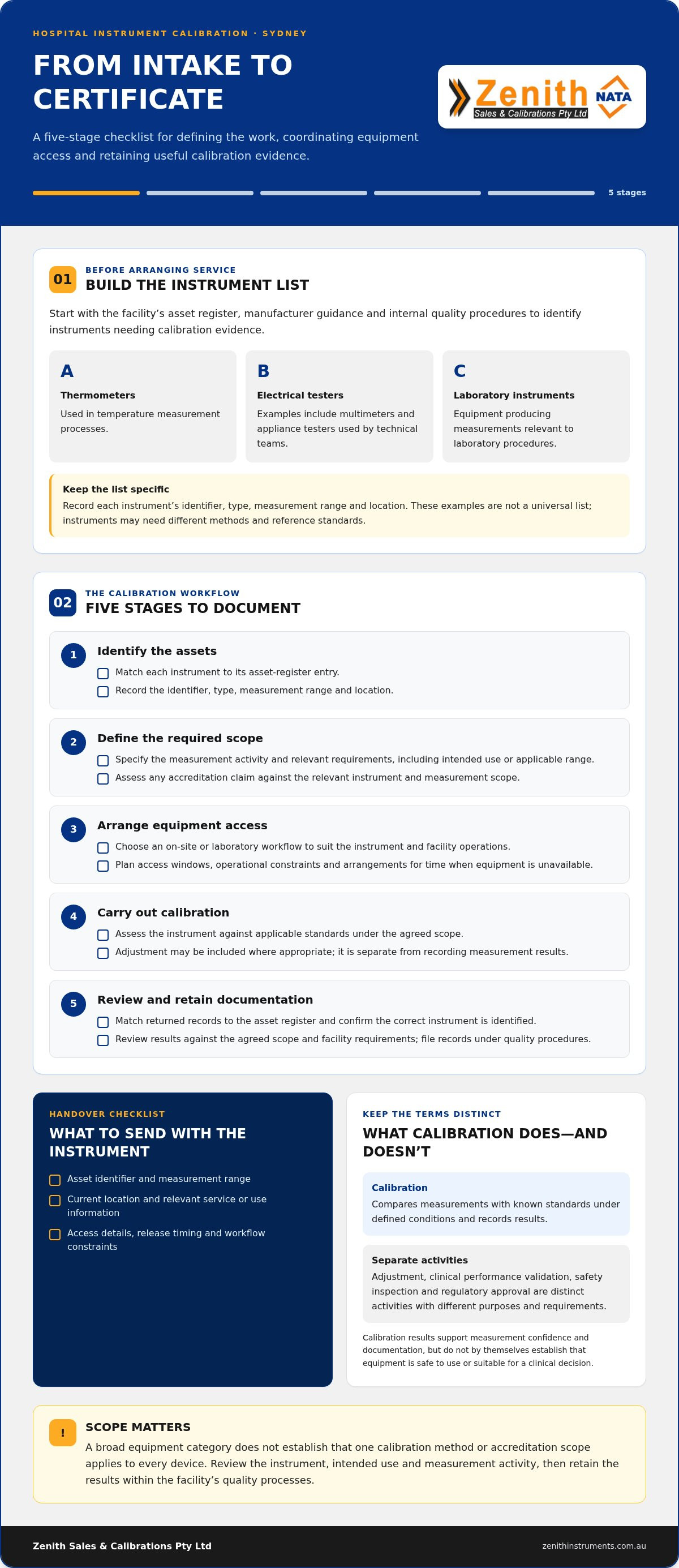
Start with the facility’s asset register, manufacturer guidance and internal quality procedures. Use them to identify instruments that require calibration evidence and record practical details such as asset identification, location and use.
- Thermometers: used in temperature measurement processes.
- Electrical testers: such as multimeters or appliance testers used by technical teams.
- Laboratory instruments: equipment that produces measurements relevant to laboratory procedures.
These examples are not a universal list. Instruments differ in function, measurement range and intended use, so they may require different methods and reference standards. Do not assume a single accreditation scope covers every device or measurement activity.
What does calibration support in a healthcare facility?
Calibration results provide evidence of an instrument’s measurement performance under the conditions stated in the record. They can support measurement confidence, maintenance planning and quality documentation, but do not by themselves establish that equipment is safe to use or suitable for a clinical decision.
Review results alongside the facility’s procedures and the instrument’s intended use. Good records help teams see what was assessed and inform decisions about follow-up, service or continued use. Zenith’s calibration services in Sydney support local planning through on-site and laboratory workflows, matched to the instrument and operational requirements.
How hospital instrument calibration works from intake to certificate
A clear workflow helps hospital teams define what needs measuring, coordinate access and retain useful evidence. For hospital instrument calibration sydney, organise the work into five stages, with the service arrangement shaped around the instrument and facility operations.
- Identify the assets. Match each instrument to its asset-register entry. Record its identifier, type, measurement range and location to reduce ambiguity at handover and when results are returned.
- Define the required scope. Specify the measurement activity and relevant requirements, including intended use or applicable range. Keep facility instructions distinct from the calibration results, and assess accreditation claims against the relevant scope.
- Arrange access. Decide whether the instrument can be calibrated on-site or should go through an in-house laboratory or off-site workflow. Plan access windows, operational constraints and any arrangements needed while equipment is unavailable.
- Carry out calibration. The instrument is assessed against applicable standards under the agreed scope. Adjustment may be part of the work where appropriate, but it is separate from recording measurement results.
- Review and retain documentation. Match returned records to the asset register, review the reported results and file the documentation according to the facility’s quality procedures.
Zenith uses computerised closed-loop software in its calibration process to support controlled, repeatable data handling. This describes a process feature, not a guarantee that errors cannot occur or that an instrument will meet a particular clinical requirement. Local teams can consider Sydney calibration services when planning an on-site or laboratory workflow.
What information should accompany an instrument?
Prepare a handover record that links the instrument to its asset-register details. Include its identifier, measurement range, current location and relevant service or use information. Note practical constraints: whether the instrument is accessible, when it can be released and whether the team needs it for a particular workflow. Clear intake information helps distinguish the requested work from findings recorded during calibration.
What should teams review in calibration results?
When the instrument returns, check that the documentation identifies the correct asset. Review the reported results against the agreed scope and facility requirements, and confirm that the record meets your quality process. Certificate contents can vary, so check the information your process requires. If results raise a concern, follow the facility’s established procedure for assessment and next steps.
Keep customer requirements, provider-recorded results and resulting decisions distinguishable in the asset history. This makes it easier for future reviews to establish what was requested, what the calibration documented and how the facility responded. For broader context on planning a local service arrangement, explore Zenith’s calibration information.
How to assess accreditation, traceability and calibration evidence
Calibration records are most useful when they show what was assessed and how the evidence relates to the instrument’s intended measurement task. Accreditation, traceability and the type of technical activity are related considerations, but they are not interchangeable. For hospital instrument calibration sydney, review the service scope as well as the wording on a certificate or service description.
| Activity | What it means |
|---|---|
| Calibration | Compares an instrument’s measurement with known standards under stated conditions and records the results. |
| Adjustment | Changes an instrument to bring its response closer to a specified value or requirement. It may accompany calibration, but it is a separate action. |
| Verification | Assesses whether stated requirements have been met, based on defined evidence or criteria. |
| Medical equipment testing | A broad term for other assessment activities, which may include safety testing or performance validation. These are not automatically part of calibration. |
These activities answer different technical questions. A calibration result describes measurement performance under its stated conditions. By itself, it does not establish clinical performance, confirm electrical safety or grant regulatory approval. Keep each record linked to the activity it documents, and use facility procedures to determine how that evidence informs equipment decisions.
How should a hospital interpret NATA accreditation claims?
Read an accreditation statement against the approved scope, including the relevant instrument type and measurement activity. A general claim does not establish that every instrument or calibration task is covered. The key question is whether the required work falls within the specific scope, not simply whether a provider or laboratory refers to accreditation.
Zenith’s calibration service is NATA-accredited to ISO 17024, and its laboratory is ISO 17025-compliant. These are distinct statements. They do not mean that every hospital instrument or calibration activity falls within an accredited scope. Accreditation evidence is relevant when it applies to the calibration activity the facility requires.
Calibration records versus medical equipment testing records
A calibration certificate and a medical equipment test record may support different decisions. Calibration documents measurement results under defined conditions. Performance validation addresses whether equipment performs against specified functional criteria, while safety testing considers safety-related requirements. Do not treat one record as a substitute for another unless its documented scope supports that conclusion.
Hospitals should align records with their own quality procedures and equipment-management processes rather than assume one standard or policy applies identically to every instrument and facility. Zenith provides biomedical equipment calibration services. Review the requested activity and applicable scope together so the retained evidence matches the technical question being addressed.
How Sydney hospital teams can prepare without disrupting operations
Plan equipment access as part of the calibration service, not as an afterthought. Before scheduling, list the assets, their locations and when they can be made available. This helps biomedical, laboratory, facilities and procurement staff coordinate handovers, transport and temporary workflow changes.
Preparing an instrument list and service schedule
Group assets by department, instrument type, operational importance and availability window. Use manufacturer guidance and internal procedures to set timing rather than applying one interval to every instrument. Identify equipment with limited substitutes early so the team can plan access around its use.
- Asset identification: record the asset number, instrument description and department or location.
- Availability: note preferred access windows, operational constraints and whether the instrument can leave the site.
- Service information: gather relevant asset-register details, previous records and calibration requirements for the requested work.
- Coordination: assign handover responsibilities and involve teams whose work overlaps, including biomedical, laboratory, facilities and procurement staff.
Keep the list current as equipment moves between rooms or departments. Recording a precise location and responsible contact can reduce time spent locating an asset and help ensure it is available at handover.
Choosing on-site or off-site calibration for a Sydney facility
On-site calibration can reduce equipment movement when the instrument and required service are suitable for work at the facility. It lets teams coordinate access in place, although the instrument still needs to be available during the agreed service window. An in-house laboratory or off-site workflow may better suit other instruments or service requirements. Include transport and temporary unavailability in the plan. Neither approach suits every instrument.
Zenith provides on-site calibration and laboratory workflows, with a Sydney service presence. Its calibration services in Sydney give facilities a local option for organising this work. Zenith also serves customers in Melbourne, Newcastle, Canberra and Brisbane, as well as Australia-wide.
Allow time to coordinate access and review results before returning assets to their usual workflow. Zenith states that its fastest calibration service can be as quick as 24 hours, depending on the work required. This is not a standard or guaranteed timeframe. Include the agreed schedule in your plan, then let relevant staff know when the instrument is expected back.
For hospital instrument calibration sydney, link each asset to its location, availability and service needs. Plan your Sydney calibration service with Zenith to organise an on-site or laboratory workflow.
Arrange hospital instrument calibration with Zenith in Sydney
A well-scoped request gives calibration a clear starting point. Identify the instruments and measurement requirements, choose a suitable service arrangement, then review the results and retain the records within your facility’s quality processes. This helps biomedical, laboratory and facilities teams coordinate the work without confusing calibration evidence with safety testing or clinical validation.
Zenith Sales & Calibrations Pty Ltd provides instrument calibration, repair, service and installation, with on-site, in-house laboratory and off-site workflows. For calibration services in Sydney, plan the arrangement around the instruments, requested work and operational constraints.
What to include when requesting a calibration service
Prepare a concise instrument schedule so the scope and logistics are clear from the outset. Include asset identifiers, quantities, locations and access or availability constraints. Note the measurement activity and relevant ranges, where known, and describe the documentation your facility needs for its internal quality procedures.
- Instrument details: asset ID, description, quantity and location.
- Service requirements: requested calibration activity, relevant measurement range and specific scope needs.
- Operational planning: access windows, instrument availability and constraints on movement or temporary removal.
- Records: relevant asset-register information and internal procedures that guide how results are reviewed and retained.
Clear requirements distinguish information supplied by the facility from results recorded during the service. They also give the team a practical basis for planning access, grouping instruments and selecting a workflow that fits the site.
How Zenith supports calibration planning
Zenith Sales & Calibrations Pty Ltd uses a computerised closed-loop software system in its calibration process to support consistent, documented work. Its calibration service is NATA-accredited to ISO 17024, and its laboratory is ISO 17025-compliant. Interpret these credentials in relation to the requested instrument and activity; they do not mean every hospital instrument or calibration task is covered by an accredited scope.
On-site calibration suits work that can be carried out at the facility for the instrument and service scope. In-house laboratory or off-site arrangements can suit other requirements. Repair, service and installation are related support options, but distinct from calibration, so describe them separately in the request. Scope and turnaround depend on the instruments and work involved. Zenith Sales & Calibrations Pty Ltd states that its fastest available calibration service can be as quick as 24 hours, not a standard or guaranteed timeframe.
For hospital instrument calibration sydney, a complete request connects measurement requirements with a workable service plan. Discuss your facility’s calibration requirements with the Zenith Sales & Calibrations Pty Ltd service team.
Turn calibration planning into a maintainable process
Reliable hospital instrument calibration sydney depends not only on the service event but also on how the facility manages the work over time. Assign responsibility for keeping asset records current, tracking service documentation and reviewing results through the appropriate quality process. Clear ownership helps teams carry information forward when instruments change location, enter maintenance or return to use.
Turn asset information into a working plan. Identify which instruments need attention, note the operational constraints affecting access, and decide how results will be reviewed and retained. Keep the process flexible: instruments, use patterns and facility procedures differ, so a consistent planning framework is more useful than a one-size-fits-all schedule.
Zenith’s Sydney team supports facilities with calibration and related technical services. Plan your Sydney hospital instrument calibration with Zenith.
Frequently Asked Questions
Is hospital instrument calibration mandatory in Australia?
There is no single blanket rule requiring every hospital instrument to be calibrated on the same schedule. Applicable standards, facility policies, manufacturer guidance and the instrument’s intended use all inform what evidence is needed. AS/NZS 3551 provides a framework for medical equipment management, but teams should interpret it alongside requirements relevant to their facility and equipment, rather than treating it as a universal calibration instruction.
How often should hospital instruments be calibrated?
There is no universal interval for every instrument. Consider manufacturer recommendations, frequency and intensity of use, measurement stability and the consequences of unreliable results. For example, a facility might review an instrument’s calibration history and use pattern when setting or revising its schedule. Record the rationale and follow internal quality procedures so interval decisions are consistent and can be reviewed.
What is the difference between calibration and medical equipment accreditation testing?
Calibration assesses an instrument’s measurement against known standards under stated conditions. Medical equipment testing may involve other assessments, such as safety testing or performance validation, which address different questions. A calibration record alone is not proof that a device has passed those assessments. If a facility needs both types of evidence, define each activity separately in its equipment-management records.
Can hospital instruments be calibrated on-site in Sydney?
Yes. Zenith provides on-site calibration in Sydney for suitable instruments and service requirements. This can help a team avoid moving equipment between departments or arranging transport, although the instrument still needs to be accessible for the agreed work. Plan an access window, identify the responsible staff member and coordinate any temporary impact on the instrument’s normal use.
How long does hospital instrument calibration take?
Timing depends on the instrument and requested service. Zenith states that its calibration service can be as quick as 24 hours, but this is the fastest available service, not a standard or guaranteed turnaround. Before scheduling, consider the number and type of instruments, the chosen service arrangement and the facility’s access constraints. Build review time into the plan before equipment returns to routine use.
Does NATA accreditation apply to every instrument a hospital uses?
No. Accreditation relates to a defined scope, so a general accreditation statement does not establish that every instrument or measurement activity is covered. Match the required work to the relevant scope, instrument type and measurement activity. Zenith’s calibration service is NATA-accredited to ISO 17024, and its laboratory is ISO 17025-compliant. These statements do not imply universal coverage of hospital equipment.
What information should a hospital provide when arranging calibration?
Provide enough detail to identify the work and plan access: asset identifiers, instrument types, quantities, locations and relevant measurement ranges. Include the requested calibration activity, documentation needs and applicable internal quality procedures. Note access restrictions, availability windows and other operational constraints. If the instrument has a service history or known issue relevant to the request, include that context to help plan the work.
Arrange hospital instrument calibration in Sydney with Zenith by preparing your instrument list and service requirements.