

A single misstep with an uncalibrated multimeter multimeter can result in more than just a blown 10A fuse; it can lead to catastrophic arc flashes that compromise site safety and NATA compliance. We know that for professionals across Sydney and Melbourne, the pressure to maintain 100% accuracy while managing complex electrical systems is immense. You've likely felt the hesitation that comes with confusing dial symbols or the uncertainty of whether your tool's calibration certificate is still valid under current ISO standards.
At Zenith Instruments, we're committed to your operational safety and technical precision. You'll learn to master every essential function of your device while ensuring your equipment meets the rigorous Australian industrial standards required for high-performance sectors. We provide a clear technical breakdown of CAT safety ratings, port selection, and the specific measurement protocols needed to maintain a 0.05% accuracy threshold. By following these professional standards, you'll eliminate guesswork and ensure your instrumentation remains a reliable asset in your diagnostic toolkit.
Key Takeaways
- Master the essential diagnostic procedures for measuring voltage, resistance, and continuity with your digital multimeter multimeter to ensure technical precision in the field.
- Navigate Australian safety standards by understanding the critical differences between CAT III and CAT IV ratings required for industrial work in Sydney and Melbourne.
- Learn to distinguish between basic functional checks and NATA-certified calibration to maintain regulatory compliance and prevent measurement drift.
- Gain actionable insights into proper parallel connection techniques and lead verification steps necessary for safe electrical troubleshooting in manufacturing and medical facilities.
Understanding Your Multimeter: The Essential Tool for AU Industries
A digital multimeter (DMM) serves as the primary diagnostic powerhouse for measuring voltage, current, and resistance. For technicians operating in Sydney manufacturing hubs or Melbourne medical facilities, this tool represents the first line of defense against electrical failure. We've observed that precise measurement protocols can reduce equipment failure rates by up to 18% in heavy industrial settings. Understanding what is a multimeter and how it functions allows professionals to maintain NATA accredited standards across all onsite operations. In 2026, predictive maintenance relies heavily on these devices to prevent the A$5,000-per-hour costs often associated with unplanned industrial downtime.
Professional applications require a choice between manual-ranging and auto-ranging models. Manual units require the operator to pre-select the expected value range, offering granular control for specific laboratory tests. Auto-ranging models automatically detect the magnitude of the signal, which accelerates troubleshooting during rapid onsite inspections. Using a high-quality multimeter multimeter setup ensures that your team remains compliant with Australian safety regulations while maintaining peak operational efficiency.
Core Components and Probe Basics
Every professional multimeter multimeter features a high-resolution display, a selection dial, and specific input jacks. The COM (common) port acts as the universal ground. We always insert the black lead into the COM jack first to establish a safe reference point. The mAVΩ jack handles most voltage and low-current tasks, while the 10A jack is dedicated to high-current circuit testing. Before starting any diagnostic work in Brisbane workshops, we perform a rigorous visual inspection of the leads. Any cracks in the insulation can lead to arc flash incidents. Ensuring your leads are intact is a foundational step in electrical equipment calibration services and workplace safety.
Common Symbols and What They Mean
Decoding the interface is vital for maintaining precision. AC Voltage is marked with a wavy line (V~), which is standard for testing mains power in commercial buildings. DC Voltage uses a straight line (V-) and is the primary setting for battery systems and electronic components. The sound wave symbol denotes the continuity test, used to verify complete circuit paths. We frequently see errors when technicians confuse Resistance (Ω) with Amperage (A) settings. Selecting the wrong dial position can blow internal fuses or damage sensitive medical equipment. Meticulous attention to these symbols ensures that every measurement meets the strict accuracy requirements of Australian industrial standards.
Step-by-Step Guide: How to Measure Voltage, Resistance, and Continuity
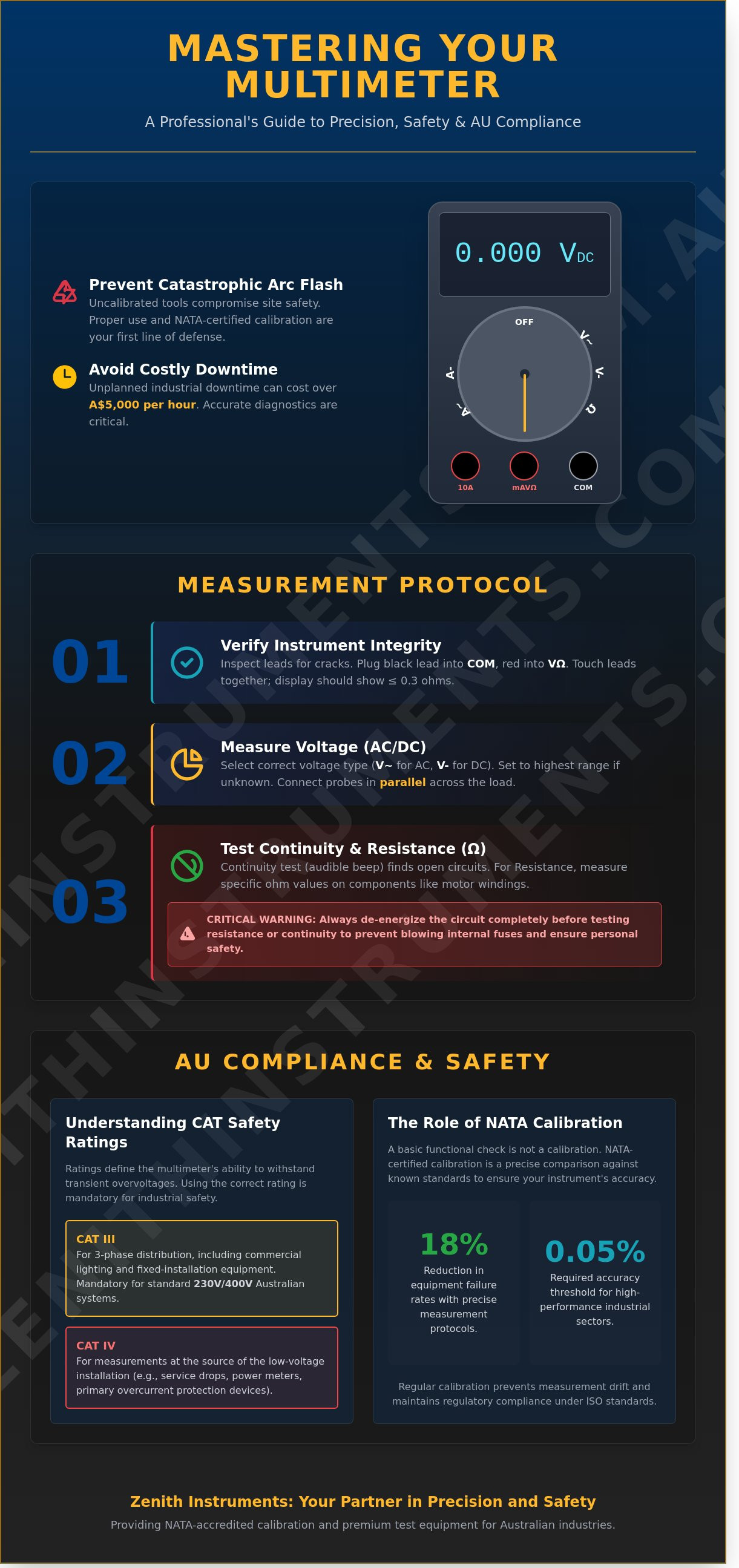
Before engaging with live components, verify the instrument's integrity. Plug the black lead into the COM port and the red lead into the VΩ terminal. Perform a lead-to-lead touch test; if the display shows 0.3 ohms or less, the circuit is ready. Using a reliable multimeter multimeter is the foundation of any industrial electrical audit in high-stakes environments like Sydney's manufacturing hubs.
Measuring AC and DC Voltage Safely
Set the selector dial to the highest available range if the circuit's voltage is unknown. For standard Australian 230V or 400V systems, a CAT III or CAT IV rated device is mandatory. Adhering to Australian multimeter safety standards ensures protection against transient overvoltages. Connect probes in parallel across the load or power source. If the display fluctuates rapidly between 10V and 80V on a disconnected wire, you're likely observing ghost voltages caused by capacitive coupling from adjacent live cables.
Testing for Continuity and Resistance
Testing for continuity is the fastest method to locate open circuits in complex Melbourne manufacturing machinery. The audible beep confirms a complete path, allowing the technician to focus on the wiring rather than the screen. When switching to resistance mode to check motor windings or heating elements, you must confirm the circuit is completely de-energized. Residual power will blow the meter's internal fuse or destroy the sensitive resistance circuitry.
- Zeroing Probes: Touch probe tips together to identify lead resistance, typically 0.1 to 0.5 ohms, and subtract this from your final reading.
- Audible Continuity: Use this for rapid-fire testing of fuses and switches in crowded Sydney electrical panels.
- Ohms Measurement: Check for specific resistance values in solenoids or sensors to identify partial shorts that continuity tests might miss.
Record all measurements and cross-reference them with the OEM maintenance manual. If readings deviate by more than 2% from specified tolerances, your device may require professional electrical equipment calibration services to ensure ongoing accuracy and NATA compliance. Precision in these initial steps prevents costly downtime and ensures that industrial assets operate within safe parameters.
Mastering Electrical Safety: CAT Ratings and AU Standards
Electrical safety isn't a suggestion; it's a regulatory mandate under AS/NZS 3000:2018, known as the Wiring Rules. When you select a multimeter multimeter, you're choosing the primary safety barrier between yourself and a potential arc flash. These instruments are categorized by Measurement Category (CAT) ratings, which define their ability to withstand transient overvoltages. These spikes, often caused by lightning or industrial switching, can reach thousands of volts in microseconds. If your meter isn't rated for the energy level of the circuit, the internal components can arc, leading to a catastrophic explosion.
Sydney technicians working on three-phase industrial systems must prioritize CAT III or CAT IV instruments. A high voltage reading doesn't tell the whole story. It's the available fault current that dictates the danger. We ensure all electrical equipment calibration services verify that safety components, like internal barriers and high-rupture capacity (HRC) fuses, remain intact and functional. Using a lower-rated CAT II meter on a Sydney distribution board is a direct violation of safety protocols and puts the operator at extreme risk.
Choosing the Right CAT Rating for the Job
CAT II ratings apply to local-level loads. This includes portable tools or office equipment plugged into standard power outlets. For Melbourne factories, CAT III is the standard for fixed installations. This covers distribution panels, short branch circuits, and polyphase motors. CAT IV represents the highest protection level. It's required for utility connections, service entrances, and any outdoor overhead lines where the highest transient risks exist.
Personal Protective Equipment (PPE) Requirements
Safety extends beyond the tool itself. Professionals must pair their multimeter multimeter with appropriate PPE to mitigate residual risks. This includes wearing Class 0 or 00 insulated gloves and arc-rated face shields when testing live high-energy circuits. We recommend following the one-hand rule during testing. By keeping one hand in your pocket or behind your back, you eliminate the path for current to travel through your heart if a probe slips.
- Verify your meter has HRC fuses rated for at least 10,000 Amps.
- Check leads for nicks or exposed insulation before every use.
- Ensure the meter is clean; conductive dust can cause internal tracking.
Adhering to these standards ensures compliance with Australian safety guidelines. Our teams in Sydney and Melbourne emphasize that a calibrated, correctly rated meter is your best defense against industrial accidents.
The Critical Role of Multimeter Calibration for AU Compliance
Every digital multimeter multimeter experiences "drift" over time. Internal components like voltage references and precision resistors shift due to thermal cycling, humidity, and component aging. These micro-changes result in measurement errors that often exceed manufacturer specifications within 365 days. A simple functional check only confirms the device powers on and reacts to a signal; it doesn't guarantee accuracy. Professionals in Canberra and Newcastle face strict liability under AS/NZS 3000 standards. Using uncalibrated tools can lead to insurance claim denials or WorkSafe penalties if an electrical incident occurs on a job site. Utilizing professional electrical equipment calibration services ensures your business remains compliant with ISO 9001 standards and maintains a traceable chain of measurement.
When Should You Calibrate Your Multimeter?
The 12-month cycle is the industry benchmark for 92% of Australian electrical contractors. You must schedule an immediate check if a meter falls from a height exceeding 1 metre or encounters a high-voltage surge that trips internal fuses. Industry-specific mandates also dictate frequency. Medical technicians must adhere to AS/NZS 3551:2012, which often requires rigorous 6-month intervals for biomedical testing. Conversely, mining operations in remote regions often mandate quarterly checks to account for the harsh vibration and dust typical of subterranean environments.
Onsite vs. Lab Calibration in Sydney and Melbourne
Local workshops benefit from calibration services in Sydney to maintain high-volume throughput and technical precision. For large-scale manufacturing facilities, calibration services in Melbourne offer onsite visits that reduce equipment downtime by 100% because tools never leave the production floor. When reviewing your documentation, ensure the certificate features the NATA logo, a unique report number, and clearly stated measurement uncertainties. This NATA endorsement is the only way to prove your equipment meets international metrology standards during a Tier 1 audit.
Don't risk your compliance on unverified readings. Book your NATA-certified calibration with Zenith Instruments today.
Zenith Instruments: Your Partner in Precision and Safety
Zenith Instruments operates with a singular focus on technical excellence and industrial safety. We maintain high-tier labs in Sydney and Melbourne to ensure your critical measurement tools meet rigorous NATA-certified standards. Our technicians provide expert support for a wide range of industry-standard brands:
- Fluke and Keysight high-performance meters.
- Hioki and Agilent technical instrumentation.
- Major Tech and Kyoritsu electrical testers.
If you own a multimeter multimeter that's displaying erratic readings or has suffered physical damage, our team performs component-level repairs to restore factory-spec accuracy. We understand that a faulty electrical tester isn't just a nuisance; it's a significant safety risk for onsite professionals. Our nationwide coverage ensures that whether you're working on a major infrastructure project in Sydney or a manufacturing plant in Melbourne, your equipment remains precise.
Our NATA Accredited Calibration Process
The electrical equipment calibration services provided by Zenith follow a strict protocol. We verify every single range and function against National Measurement Institute (NMI) standards to eliminate measurement drift. Our process involves testing voltage, current, and resistance across the full spectrum of the device's capability. Every unit we service receives a detailed certificate of calibration, providing the documented proof of compliance required for ISO audits and safety regulations. We also manage your compliance schedule by sending proactive reminders 30 days before your next service date, ensuring your business never falls behind on its regulatory obligations.
Get a Professional Quote Today
We prioritize efficiency to minimize your downtime. Most calibrations at our Sydney and Melbourne facilities are completed within 3 to 5 business days. For organizations with complex instrumentation needs, we offer a consultative approach to develop custom maintenance programs that suit specific industrial applications. Don't let an uncalibrated multimeter multimeter compromise your project safety or data integrity. Contact our expert team today to book your next service or to request a comprehensive quote tailored to your fleet of instruments.
Secure Your Technical Accuracy and Compliance
Mastering your multimeter multimeter is the first step toward maintaining safe, efficient electrical systems across Sydney and Melbourne. By correctly applying CAT ratings and following precise measurement protocols, you're upholding the rigorous AU standards required in modern engineering and manufacturing. Precision isn't just a goal; it's a regulatory necessity that protects your team and your reputation on every job site.
Reliable data starts with professional calibration. Zenith Instruments operates a NATA Accredited Laboratory that adheres to ISO 9001 compliant processes, ensuring your gear delivers 100% accurate results. We provide local support in Sydney and Melbourne, helping you meet strict compliance deadlines with industry-leading turnaround times. Don't let a 2% margin of error lead to a 100% safety failure.
Book Your NATA-Certified Multimeter Calibration Now
We're here to ensure your tools work as hard as you do.
Frequently Asked Questions
How do I know if my multimeter fuse is blown?
You'll know your multimeter fuse is blown if the device displays "OL" or fails to register any reading during a current measurement test. Set your meter to the continuity or lowest resistance setting and insert the red probe into the mA or A jack. If the display doesn't change from "OL" when you touch the probes together, the internal 440mA or 11A ceramic fuse has likely cleared to protect the circuitry.
What is the difference between AC and DC voltage on a multimeter dial?
AC voltage measures alternating current found in Australian 240V wall outlets, while DC voltage measures direct current from batteries and electronic components. You'll identify AC by the wavy line symbol and DC by the straight line with three dots underneath. Selecting the wrong mode leads to inaccurate data and potential equipment damage during high-stakes industrial diagnostics.
Can I use my multimeter to test a car battery in Melbourne?
You can use your multimeter to test a car battery in Melbourne by setting the dial to the 20V DC range. A fully charged 12V lead-acid battery should show a reading of 12.6V or higher. If your multimeter multimeter registers below 12.2V, the battery is only at 50% charge and requires immediate attention to prevent vehicle failure during cold Victorian winters.
Why does my multimeter show a small reading even when probes aren’t touching anything?
Your multimeter shows a small "ghost voltage" reading because high-impedance digital meters pick up electromagnetic interference from surrounding energized wires. This phenomenon occurs when the leads act as antennas for stray capacitance. Professionals in high-density Sydney workspaces often see readings between 0.1V and 3V; using a low-impedance (LoZ) setting eliminates these phantom values for better precision.
Is NATA calibration required for all industrial multimeters in Australia?
NATA calibration is mandatory for industrial multimeters used in 100% of medical, aerospace, and defense contracts where ISO 17025 compliance is required. While standard commercial work might only require manufacturer-traceable certificates, NATA-accredited testing provides the highest level of legal and technical defensibility in Australia. Our Sydney and Melbourne labs ensure your equipment meets these rigorous national standards.
What happens if I use a CAT II multimeter on a CAT III circuit?
Using a CAT II multimeter on a CAT III circuit risks a catastrophic arc flash or explosion if a voltage spike occurs. CAT III environments include three-phase distribution panels and industrial lighting systems where transient surges are 20% higher than in standard residential outlets. Always verify your tool's category rating before entering a Melbourne substation or industrial plant to ensure operator safety.
How often should a professional electrician calibrate their multimeter?
A professional electrician should calibrate their multimeter multimeter every 12 months to stay compliant with AS/NZS 3000:2018 standards. Regular intervals ensure that the ±0.5% accuracy tolerance hasn't drifted due to heat, humidity, or physical impact. We provide onsite calibration across Australia to minimize downtime, delivering certified results that satisfy safety auditors and insurance requirements.
What is continuity and why is it useful for troubleshooting?
Continuity is a quick resistance test that determines if a circuit is complete by emitting an audible beep. It's the most efficient way to find broken wires, blown fuses, or failed switches without constantly looking at the screen. If the resistance is below 30 ohms, the meter confirms a continuous path, allowing technicians to clear faults in complex wiring looms 40% faster.