

A single inaccurate reading on a pressure gauge can cost a Sydney manufacturing facility upwards of A$50,000 in lost production time or safety penalties before a single shift ends. You already know that equipment failure isn't just a technical glitch; it's a direct threat to your site's safety and your operational budget. When you're managing complex systems, knowing exactly when to schedule an industrial pressure gauge repair is vital to avoid these cascading costs and maintain strict NATA compliance across your facility.
We'll provide you with a definitive 2026 technical framework to streamline your equipment triage and maintain your competitive edge. You'll learn exactly when to authorize a professional repair, when to opt for rapid onsite recalibration, and when a full replacement is the only safe path forward. This comprehensive checklist covers the specific diagnostic steps required for Melbourne and Sydney site managers to ensure every instrument remains precise, certified, and ready for any regulatory audit.
Key Takeaways
- Identify if a non-zeroing needle indicates a simple vent adjustment or critical internal fatigue requiring professional intervention.
- Utilize our 5-point technical checklist to determine the economic feasibility of an industrial pressure gauge repair compared to the cost of a new unit.
- Understand the rigorous NATA-accredited calibration and decontamination procedures required to maintain compliance in Australian heavy industrial plants.
- Evaluate the logistical advantages of selecting a repair partner with on-site service capabilities across Sydney, Melbourne, and Brisbane.
- Learn how to reduce operational downtime by leveraging over 20 years of local instrumentation expertise and precision standards.
Identifying Common Failure Modes in Industrial Pressure Gauges
A non-zeroing needle often serves as the first indicator that industrial pressure gauge repair is required. Before assuming internal failure, our technicians verify if the atmospheric vent is obstructed. If the vent is clear and the needle remains off-set, it usually signals internal fatigue or a permanent set in the Bourdon tube. This component is central to pressure measurement principles, where mechanical deformation translates into a readable value. When the tube loses its elasticity, the accuracy of the entire system is compromised, and the instrument no longer provides a reliable safety baseline.
In high-vibration environments, such as Melbourne’s heavy manufacturing plants, mechanical wear is accelerated. Constant oscillation causes the teeth on the segment gear and pinion to grind down, leading to jumpy needle movement or total seizure. We've observed that gauges without liquid dampening in these settings fail approximately 40% faster than those filled with glycerin or silicone. Similarly, Sydney foundries present thermal challenges. Excessive heat leads to discolouration of the dial face and can cause the liquid fill to expand and leak through the seals. Identifying the need for industrial pressure gauge repair early prevents catastrophic system failures in high-pressure lines where a ruptured Bourdon tube could release hazardous media.
Environmental Factors in Sydney & Melbourne
Sydney's coastal location means average relative humidity often exceeds 65%, which rapidly accelerates corrosion in non-stainless steel casings. We frequently see rust-pitted housings in maritime and chemical facilities that haven't transitioned to 316 stainless steel. In Melbourne industrial zones like Campbellfield, temperature fluctuations of up to 15°C within a single shift can impact gauge accuracy by altering the density of the internal fluid. We also monitor for chemical ingress in mining and medical instrumentation, where aggressive media can degrade diaphragms if the wrong alloy is selected for the specific application.
Mechanical vs. Electronic Gauge Failure
Mechanical analog gauges primarily suffer from linkage friction and pivot wear. Over time, the internal moving parts lose their smooth operation, resulting in "stiction" where the needle moves in staggered increments. Conversely, digital pressure indicators face sensor drift and battery circuit failures. Electronic components are sensitive to electromagnetic interference and moisture ingress that can short-circuit the PCB. Hysteresis is the maximum difference in output at any pressure value within the specified range when the value is approached first with increasing and then with decreasing pressure. Maintaining regular pressure gauge calibration is the only way to quantify these errors and ensure your facility remains compliant with NATA and ISO standards.
The 5-Point Industrial Pressure Gauge Repairability Checklist
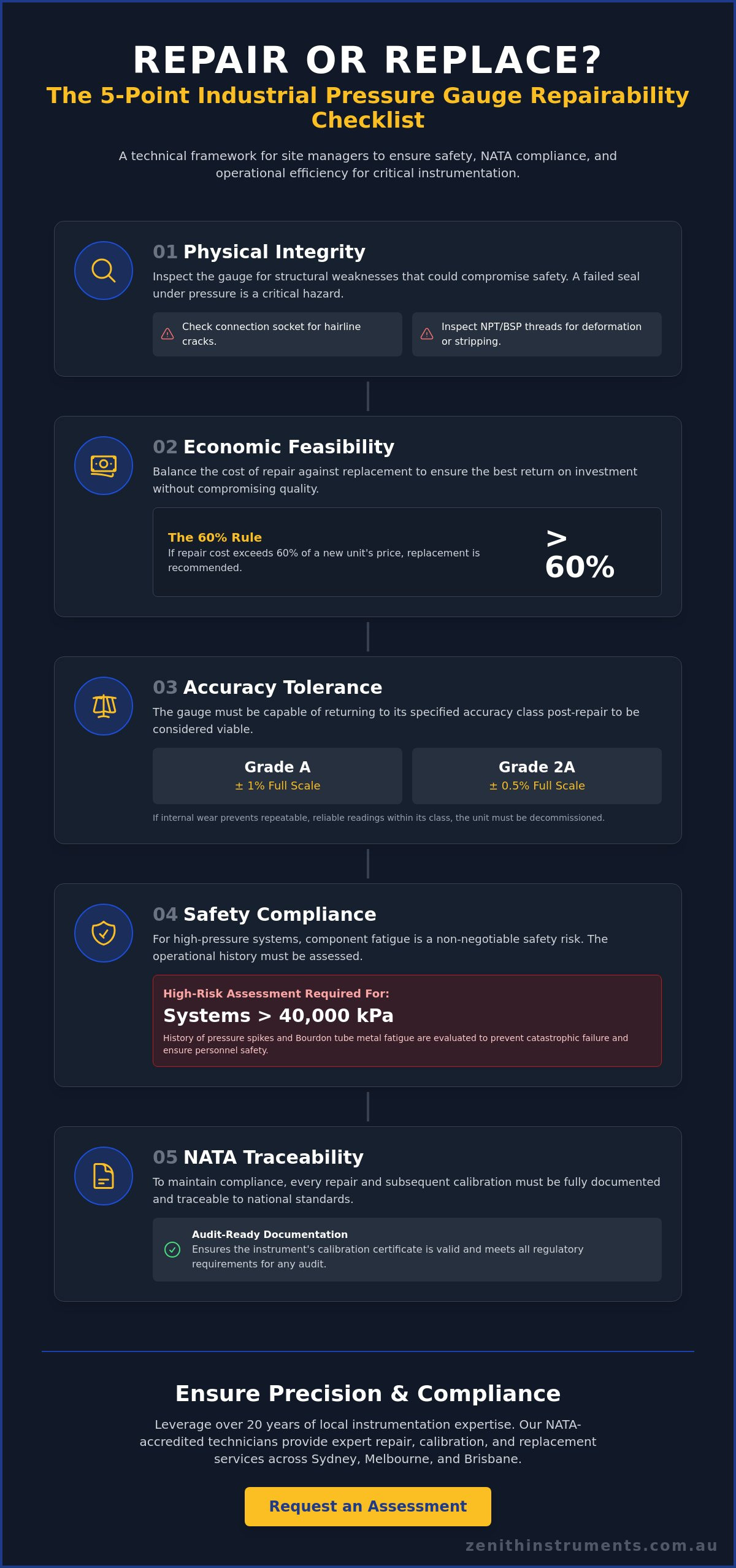
Deciding whether to proceed with an industrial pressure gauge repair or opt for a full replacement requires a technical assessment of the instrument’s current state. At Zenith Instruments, we follow a rigorous 5-point protocol to ensure every decision aligns with Australian safety standards and operational efficiency. This systematic approach prevents unnecessary spending while maintaining the integrity of your pressure systems.
- Physical Integrity: We inspect the connection socket for hairline cracks and check threads for deformation. Stripped NPT or BSP threads often compromise the seal, making repair unsafe for high-pressure applications where leak-free connections are critical.
- Economic Feasibility: Our technicians compare specialized labour rates in Sydney and Melbourne against the procurement cost of a new unit. If the estimated repair cost exceeds 60% of the replacement price, we generally recommend a new purchase to maximize your return on investment.
- Accuracy Tolerance: We evaluate if the gauge can return to its specified accuracy class, such as Grade A (1% full scale) or Grade 2A (0.5% full scale). If internal friction or mechanical wear prevents repeatable readings, the unit is decommissioned.
- Safety Compliance: For gauges used in systems exceeding 40,000 kPa, metal fatigue in the Bourdon tube is a significant risk. We assess the history of pressure spikes to prevent catastrophic failure in the field, ensuring the safety of your onsite personnel.
- Traceability: Every repair must be verifiable. We ensure the process concludes with a NATA-certified calibration, providing the documentation required for ISO compliance and rigorous site audits.
When to Repair: The Green Flags
Repair is the logical choice for high-value, large-diameter units (150mm or larger) experiencing minor calibration drift. If the internal movement shows no corrosion and the instrument belongs to a legacy system where modern alternatives require expensive piping modifications, restoration is the most efficient path. Our pressure gauge calibration services ensure these units meet original specifications without the lead times of custom orders.
When to Replace: The Red Flags
Replacement is mandatory when process media or glycerine filling leaks from the casing, as this indicates a breach in the pressure boundary. If the Bourdon tube has suffered permanent deformation, it cannot achieve linear adjustment across the scale. When the quote for a complex industrial pressure gauge repair nears the cost of a high-quality new pressure gauge, investing in new hardware provides better long-term reliability for your facility.
Technical Repair Process & NATA Calibration Standards
Precision industrial pressure gauge repair starts with a rigorous decontamination protocol. Before any mechanical work begins, we clean the pressure port and sensing element to remove process media, scale, or oxidation. This step is vital for gauges used in Melbourne’s chemical processing plants or Sydney’s hydraulic systems, where residue can compromise the internal mechanism. Once cleaned, our technicians disassemble the case to perform a microscopic inspection of the movement and geared segments. We look for "flat spots" on the teeth or signs of metal fatigue in the Bourdon tube. We apply specialized, non-migrating lubricants to the pivot points to ensure the movement remains fluid under fluctuating pressures.
The adjustment phase utilizes high-precision deadweight testers that provide a primary pressure reference. We don't rely on secondary digital gauges alone; we use physical weights to generate exact force, allowing for meticulous span and linearity corrections. If a gauge shows a 2% error at mid-scale but 5% at full scale, we recalibrate the linkage geometry to pull the device back into its designated accuracy class.
The Role of NATA Accreditation in Repair
A mechanical fix is only the first step. A simple repair remains incomplete without a professional pressure gauge calibration to verify the results. Our laboratories adhere to ISO/IEC 17025 requirements, which is the international benchmark for testing and calibration laboratories. This standard ensures that our equipment, environment, and personnel meet strict technical competencies. NATA-endorsed certificates act as a legal shield for your business during safety audits. In 2024, data from Australian industrial sectors indicated that 88% of site managers preferred NATA-accredited providers to mitigate the risk of heavy fines during WorkSafe inspections.
Advanced Adjustment Techniques
Our technicians focus on the fine details that define instrument longevity. We calibrate the hairspring tension to provide the necessary torque to the pointer, which eliminates needle flutter and "lag" during pressure drops. For gauges equipped with a micro-adjustable pointer, we perform precise zero-point settings without removing the needle, reducing the risk of bending the spindle. Traceability ensures that every measurement is linked back to national standards through an unbroken chain of comparisons. This technical rigour guarantees that your equipment performs reliably in the harshest Australian environments, from the humidity of Sydney’s coast to the industrial heat of Melbourne’s manufacturing hubs.
- Span Adjustment: Aligning the pointer travel with the full scale of the dial.
- Linearity Correction: Ensuring accuracy remains consistent at 25%, 50%, and 75% of the range.
- Hysteresis Testing: Checking that the gauge reads correctly during both increasing and decreasing pressure cycles.
Selecting a Repair Partner in Sydney, Melbourne, and Brisbane
Choosing an industrial pressure gauge repair provider requires a rigorous assessment of their technical infrastructure. Australian manufacturing and mining sectors lose an estimated A$460 million annually due to unplanned downtime caused by faulty instrumentation. You need a partner who understands the high-stakes environment of heavy industrial plants. We look for laboratories that provide more than just a simple fix. They must offer deep technical expertise across multiple disciplines to ensure your facility remains compliant with ISO 17025 standards. This level of precision is vital when dealing with high-pressure systems where a 1% margin of error can lead to catastrophic mechanical failure.
Sending equipment away isn't always feasible for fixed assets in Newcastle or Canberra. On-site capabilities ensure your plant remains operational while technicians perform precise adjustments, reducing the risk of damage during transport. A single provider capable of handling electrical calibration alongside pressure systems reduces the administrative burden and the number of contractors on your site. This holistic approach ensures that all interconnected systems, from sensors to control panels, function with synchronized accuracy. When evaluating a partner, prioritize those who offer:
- Documented history of servicing heavy industrial machinery in regional hubs.
- Proven ability to meet 24 to 48-hour turnaround windows for critical repairs.
- Technicians who possess specific training for varied pressure media, including oxygen and hydraulic fluids.
- Integrated logistics for secure instrument transport between sites.
Local Support in Major Australian Hubs
Proximity dictates the speed of your recovery after a gauge failure. Accessing a calibration service in Melbourne allows for rapid response times, which is essential for the city's bustling food and pharmaceutical sectors. For operations in New South Wales, utilizing calibration services in Sydney with integrated pick-up and delivery options removes logistical bottlenecks. A national provider with established offices in Brisbane and Canberra ensures consistent service standards across all your interstate facilities, providing a unified reporting structure for your entire fleet.
Quality Assurance & Certifications
Compliance is the foundation of industrial safety. You must verify a provider’s current NATA scope for both pressure and vacuum to ensure their results are legally defensible and technically accurate. Check their history with high-tier brands such as Major Tech to confirm they possess the specialized tools required for these instruments. A professional industrial pressure gauge repair always concludes with a comprehensive service report. This document details the "as-found" and "as-left" data, providing a clear audit trail that a standard calibration certificate might omit. It's the only way to guarantee that your equipment meets the rigorous safety demands of 2026 industrial regulations.
Contact Zenith Instruments for expert pressure gauge repair and calibration.
Zenith Instruments: Your Partner for Industrial Precision
Zenith Instruments has supported the Australian industrial landscape for over 20 years. We understand that precision isn't just a goal; it's a safety and compliance requirement. Our NATA-accredited laboratories serve as the backbone for nationwide repair and calibration services, delivering the technical rigour needed to maintain complex systems. We employ expert technicians who possess the specialized knowledge to handle both heavy mechanical instrumentation and sensitive biomedical equipment.
For facilities in Sydney and Melbourne, we prioritize fast turnaround times. We know that equipment downtime directly impacts your bottom line. By choosing Zenith for your industrial pressure gauge repair, you're opting for a proactive service model that minimizes disruptions. Our processes ensure your facility remains operational under strict regulatory frameworks, providing the peace of mind that comes with certified accuracy.
Our Comprehensive Calibration Scope
Our technical capabilities extend far beyond standard pressure gauges. We provide integrated solutions for a wide array of critical safety and measurement tools. This includes everything from standard pressure instrumentation to complex gas detectors. Our team also manages thermometer calibration and torque tool adjustments to ensure every aspect of your operation remains accurate.
We offer flexible service options to suit your logistical needs:
- NATA-certified laboratory repairs for high-precision requirements.
- On-site calibration services at your facility to reduce transit risks and downtime.
- Comprehensive technical assessments for aging or damaged equipment.
- Integrated management of torque, temperature, and pressure assets.
You can request a quote for on-site calibration at your facility today to see how we can streamline your maintenance schedule and keep your team focused on production.
The Zenith Advantage
We believe in empowering our clients with technical knowledge. To assist your team in making informed decisions, we encourage you to read our parent guide on pressure gauges. This resource provides a deep dive into selection and maintenance for the 2026 industrial environment. It's designed to help engineers and facility managers optimize their instrument lifecycles.
If your facility is based in New South Wales, you can learn more about our expert pressure gauge repair in Sydney. We maintain a disciplined approach to every project, ensuring that your industrial pressure gauge repair is handled by meticulous experts who value international standards. Contact our Sydney or Melbourne labs today for a technical assessment and experience the reliability of a NATA-accredited partner.
Securing Your Operational Precision for 2026
Maintaining system integrity requires a proactive approach to industrial pressure gauge repair. By implementing a 5-point repairability checklist and identifying failure modes early, you protect your infrastructure from costly downtime and safety risks. It's vital to ensure all instrumentation meets NATA Accredited Standards to maintain regulatory compliance and operational accuracy. We deliver technical expertise through our specialized facilities in Sydney, Melbourne, and Brisbane, focusing on rapid service delivery to support your production schedules. Our technicians follow a meticulous repair process that prioritizes international benchmarks over temporary fixes.
We provide on-site calibration options to reduce logistics hurdles, while our fast turnaround times ensure your critical assets are back in service without unnecessary delay. We understand the rigorous demands of the Australian manufacturing and engineering sectors. Reliability isn't just a goal; it's a requirement for your success. We're ready to help you maintain the highest levels of precision across your entire instrument inventory so your facility remains safe and efficient.
Get a Quote for Industrial Pressure Gauge Repair
Frequently Asked Questions
Can all industrial pressure gauges be repaired?
Not every instrument is a candidate for service; we typically recommend repairing high-quality, liquid-filled, or large-diameter process gauges. While high-precision stainless steel units are designed for maintenance, many entry-level dry gauges are sealed during manufacturing. It's often more cost-effective to replace these smaller, disposable units than to attempt a complex mechanical overhaul that exceeds the price of a new instrument.
How much does industrial pressure gauge repair cost in Australia?
Repair costs for industrial instrumentation in Australia vary based on the extent of damage and the specific components required for the fix. While we don't provide fixed prices without a technical inspection, industry data shows that repairing a high-specification gauge often costs 40% to 60% less than purchasing a new NATA-certified unit. This makes professional servicing a viable financial strategy for large-scale Melbourne and Sydney facilities.
What is the difference between gauge adjustment and calibration?
Calibration involves comparing your gauge's reading against a known reference standard to document its current accuracy levels. Adjustment is the physical process where our technicians correct the internal mechanism to bring it back within specified ISO 9001 or NATA tolerances. You'll receive a report showing the "as found" data before the adjustment and the "as left" data once the precision is restored.
How long does a professional pressure gauge repair typically take?
A standard industrial pressure gauge repair typically requires 3 to 5 business days in our Sydney or Melbourne laboratories. Our onsite technicians can often complete calibration and minor adjustments within a single shift for critical operations. This rapid turnaround helps your facility maintain its production schedule and avoids the 4-week lead times often associated with ordering specialized replacement parts from overseas manufacturers.
Is a repaired pressure gauge as accurate as a new one?
Yes, a professionally repaired gauge meets the exact same accuracy standards as a brand-new instrument from the factory. We verify every repair through a rigorous multi-point calibration process to ensure the device performs according to its original manufacturer specifications. Our team uses precision master gauges to guarantee that your equipment returns to service with the reliability required for high-stakes industrial environments.
Does my repaired gauge need a new NATA certificate?
Any repair that involves opening the gauge casing or adjusting the internal movement requires a new NATA certificate to remain compliant. This documentation proves the instrument meets Australian national standards and is essential for your annual safety audits. We provide these certificates to ensure your business maintains a clear chain of evidence for its quality management systems and regulatory obligations.
What are the risks of using an uncalibrated repaired gauge?
Using an uncalibrated gauge after an industrial pressure gauge repair poses significant safety risks, including potential over-pressurization and catastrophic equipment failure. Inaccurate readings can lead to a 15% increase in energy consumption and production waste. It also leaves your business vulnerable to legal liabilities and heavy fines under Australian Work Health and Safety (WHS) regulations if an incident occurs due to faulty instrumentation.
How often should I have my repaired gauges re-tested?
Most Australian industrial facilities adhere to a 12-month re-testing cycle for their pressure instrumentation to ensure ongoing compliance. However, if your equipment operates in harsh environments, high-vibration zones, or handles corrosive chemicals, we recommend a 6-month interval. Regular testing schedules prevent minor drifts in accuracy from becoming major safety hazards, keeping your Melbourne or Sydney plant running at peak efficiency levels.