

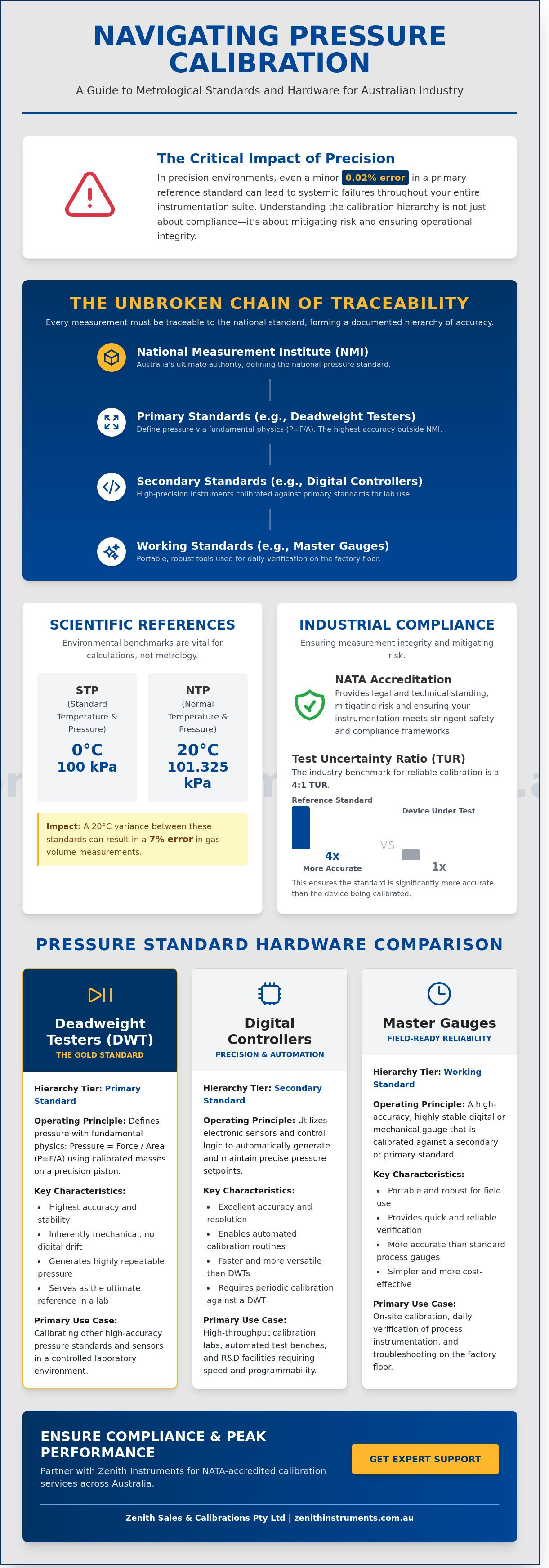
What if your facility’s next NATA audit failed because your team confused a scientific STP definition with a traceable primary pressure standard? In the precision-driven environment of 2026, many Australian laboratories still struggle to bridge the gap between theoretical physics and industrial compliance. You recognize that maintaining a rigorous calibration hierarchy isn't just about ticking a box; it’s about ensuring every measurement across your Sydney or Melbourne facility remains indisputable. Even a minor 0.02% error in a primary reference can lead to systemic failures throughout your entire instrumentation suite.
We'll help you resolve the technical complexities between environmental benchmarks and the NATA-accredited hardware required for primary calibration. You’ll gain a clear framework for evaluating the ROI of traditional deadweight testers versus modern digital controllers to ensure your capital investment aligns with your specific accuracy requirements. This guide breaks down the selection process for primary standards, providing the technical clarity needed to maintain peak operational performance and regulatory confidence across all major Australian industrial hubs.
Key Takeaways
- Distinguish between Standard Temperature and Pressure (STP) and the metrological rigor required by the NMI to establish a traceable Australian reference.
- Evaluate the performance metrics of deadweight testers versus digital controllers to select the optimal pressure standard for your laboratory’s specific accuracy requirements.
- Recognise the vital role of NATA accreditation in mitigating risk and ensuring your instrumentation meets stringent legal and safety compliance frameworks.
- Determine the precise Test Uncertainty Ratio (TUR) needed to maintain measurement integrity across diverse applications, from vacuum systems to high-pressure hydraulics.
- Access professional calibration insights and nationwide support from Zenith Instruments’ NATA-accredited facilities to streamline your facility's technical operations.
Understanding the Pressure Standard Hierarchy: From STP to Primary Metrology
Pressure measurement starts with a clear definition of reference points. The National Measurement Institute (NMI) serves as the ultimate authority for the Australian pressure standard, ensuring that a kilopascal measured in a Sydney laboratory is identical to one measured in a Melbourne manufacturing plant. This hierarchy isn't just a scientific formality. It's the backbone of industrial safety and trade. Without a unified reference, components manufactured in different states wouldn't fit, and safety valves might fail to trigger at critical thresholds.
Traceability is the most critical factor in this hierarchy. It's the documented "unbroken chain" of comparisons linking your factory floor gauge back to the NMI's primary references. For Sydney's pharmaceutical sector or Melbourne's aerospace engineers, traceability provides the legal and technical standing required for international compliance. We ensure this chain remains intact through NATA-accredited pressure gauge calibration, providing the certainty that your equipment operates within its specified tolerance. It's about more than just a sticker on a gauge; it's about mitigating risk in high-stakes environments.
Scientific Standards: STP vs. NTP Definitions
Scientists and engineers must distinguish between environmental reference conditions and metrological standards. The current IUPAC definition for Standard Temperature and Pressure (STP) is 0 °C and 100 kPa. This replaced the pre-1982 reference of 101.325 kPa. In contrast, many Brisbane engineering firms use Normal Temperature and Pressure (NTP), set at 20 °C and 101.325 kPa. These distinctions are vital for gas flow calculations, as a 20-degree variance can result in a 7% error in volume measurements.
Industrial Metrology: Primary vs. Secondary Standards
The metrological hierarchy dictates how we verify accuracy across different tiers of instrumentation. Primary standards define the pressure standard through fundamental physical measurements, such as mass applied over a known area. Deadweight testers are the primary tool here. Secondary standards are high-precision instruments, often electronic controllers, calibrated against these primary units. Finally, working standards are the portable tools used on factory floors in Newcastle and Brisbane to verify daily operations. Each level down the chain increases the uncertainty, making high-tier calibration essential for maintaining system integrity.
We see these standards applied daily in diverse ways. In Melbourne, automotive testing rigs require secondary standards to verify fuel injection pressures. Meanwhile, in Newcastle’s heavy industrial hubs, working standards ensure hydraulic systems don't exceed structural limits. Our role is to bridge the gap between these high-level metrological definitions and your practical operational needs. We provide the technical expertise to ensure your instruments meet ISO/IEC 17025 requirements, keeping your facility compliant and your workers safe.
Types of Pressure Calibration Standards: Hardware Comparison
Selecting the correct pressure standard requires a precise balance between laboratory-grade accuracy and operational mobility. We categorize these instruments into three primary groups: Deadweight Testers (DWT), Digital Pressure Controllers, and Master Gauges. Each hardware type serves a specific tier within the metrological hierarchy. For laboratories maintaining ISO 17025 compliance, the Uncertainty of Measurement (UoM) remains the critical metric. A Test Uncertainty Ratio (TUR) of 4:1 is the standard industry benchmark. This ratio ensures the reference standard is at least four times more accurate than the device under test, providing the necessary buffer for reliable results.
Deadweight Testers (DWT): The Gold Standard
The DWT remains the most reliable primary pressure standard available to modern engineers. It operates on the fundamental physical principle where Pressure equals Force divided by Area (P=F/A). By applying calibrated masses to a piston of a known cross-sectional area, the DWT generates a highly accurate, repeatable pressure. Many Sydney laboratories continue to rely on DWTs for their primary calibration benches because they offer unmatched long-term stability. While they provide precision levels as tight as 0.0015% of the reading, they lack portability. The requirement for a perfectly level, vibration-free surface and the physical weight of the mass sets makes them unsuitable for field applications. Maintenance involves meticulous cleaning of the piston-cylinder assembly and periodic recalibration of the masses to account for local gravity and environmental wear.
Digital Pressure Controllers and Indicators
Modern facilities, particularly high-volume Melbourne calibration centers, increasingly adopt digital controllers for their efficiency. These instruments utilize high-stability quartz or silicon resonant sensors to provide rapid, automated pressure generation. They excel in repeatability and minimize hysteresis, which are vital factors when testing sensors across multiple points. Brands like Major Tech have advanced the reliability of digital indicators for industrial use, offering rugged designs that don't compromise on resolution. Digital standards allow for seamless integration into automated workflows, which significantly reduces the risk of human error during data logging and certificate generation.
For onsite requirements, master gauges or digital calibrators are the preferred choice. While their UoM might be wider than a laboratory DWT, their ruggedness and ease of use in the field are indispensable for maintaining plant safety. We recommend regular verification against a NATA accredited standard to ensure these portable units maintain their accuracy over time. It's essential to factor in the environmental conditions of the site, as temperature fluctuations can impact the stability of silicon sensors. If you need to verify your equipment's performance against a certified reference, our team provides comprehensive pressure gauge calibration services to keep your operations compliant.
Compliance and NATA Accreditation in Australia
Operating without a certified pressure standard introduces severe legal and operational risks to your facility. In Australian industrial sectors, non-compliant measurements can lead to catastrophic equipment failure, voided insurance policies, and WorkSafe investigations. Precision isn't merely a technical goal; it's a regulatory mandate. We recognize that a measurement without accreditation is just a number. NATA accreditation differentiates a professional standard from a simple tool by providing independent verification of a laboratory's technical competence. This process ensures that every calibration performed by Zenith Instruments adheres to the rigorous ISO/IEC 17025:2017 requirements, which govern everything from staff training to equipment maintenance and uncertainty budgets.
Our role in maintaining the Australian pressure chain is vital for national infrastructure. We provide the technical bridge between the National Measurement Institute (NMI) and your local operations. By utilizing a high-precision pressure standard, we ensure that the accuracy of your onsite equipment remains within specified tolerances. This consistency is essential for maintaining safety and efficiency across Sydney, Melbourne, Brisbane, and Perth. We prioritize technical excellence to ensure your equipment meets the highest industrial benchmarks.
Why NATA Endorsement is Non-Negotiable
Risk mitigation is critical for the medical, mining, and aerospace sectors in Canberra and Brisbane. In these industries, a minor deviation in pressure can compromise patient safety or cause structural failures in high-altitude components. To verify a provider's status, you must check their NATA scope of accreditation for specific measurement ranges and uncertainties. While many providers claim to be "traceable to national standards," only a NATA-endorsed certificate proves the laboratory has undergone rigorous peer review. This endorsement confirms that the results are legally defensible and technically valid under the National Measurement Act.
Internal Audits and Regulatory Frameworks
Preparing your facility for an ISO audit requires meticulous documentation of your instrumentation. Auditors demand a complete history of every gauge, including its calibration frequency and any recorded drift. We recommend maintaining a centralized digital repository for all NATA certificates to streamline this process. You must also demonstrate a clear understanding of how your local measurements relate to national benchmarks. The hierarchy of traceability establishes an unbroken chain of comparisons from the work-site gauge through a secondary pressure standard to the primary standards maintained by the National Measurement Institute (NMI).
- Maintain a 12-month calibration cycle for all primary reference gauges.
- Log environmental conditions during onsite pressure gauge calibration to account for thermal expansion.
- Ensure all documentation includes the specific uncertainty of measurement for every test point.
- Verify that your calibration provider’s equipment is itself calibrated by a superior-tier laboratory.
Selecting the Right Pressure Standard for Your Facility
Selecting a pressure standard for your facility involves more than just matching a maximum scale. You must evaluate the full spectrum of your operations, from vacuum applications in research labs to high-pressure hydraulic systems reaching 1000 bar in heavy industry. Industrial data from 2024 indicates that 65% of calibration failures stem from selecting a standard with insufficient range or resolution for the specific workload.
Logistics also play a vital role. If your technicians provide onsite services in Newcastle or Canberra, a laboratory-grade deadweight tester is often too cumbersome. In these cases, portable digital pressure calibrators offer the necessary ruggedness without sacrificing the precision required for NATA-compliant reporting. You'll also need to weigh the initial capital expenditure against long-term maintenance. High-end primary standards often require more frequent, specialized calibration to maintain their accuracy class over a five-year cycle.
The 4:1 Rule in Pressure Calibration
The 4:1 Test Uncertainty Ratio (TUR) is the cornerstone of metrology. It dictates that your pressure standard must be at least four times more accurate than the device under test (DUT). This ratio ensures that the "Total Probable Error" remains within acceptable limits, accounting for variables like hysteresis and repeatability. Sydney engineers managing safety-critical gas lines or high-pressure boilers rely on this 4:1 TUR to guarantee that every gauge in the field performs exactly as specified. If your DUT has an accuracy of 1.0% of full scale, your standard must provide 0.25% or better to maintain compliance.
Environmental Factors and Media Compatibility
Media selection is critical to prevent cross-contamination and equipment damage. Pneumatic standards are ideal for low-pressure gas systems, while hydraulic standards utilize oil or water for high-force applications. Specialized sectors require even stricter controls. For instance, selecting standards for biomedical equipment or oxygen service necessitates oil-free systems to prevent combustion or patient risk.
Environmental variables can also skew results. High-precision standards are sensitive to local gravity and ambient temperature. A standard calibrated for a laboratory in Melbourne may show a measurable deviation when moved to a different altitude or a warmer climate. Temperature fluctuations of just 5 degrees Celsius can compromise the accuracy of high-precision piston gauges. Always check the manufacturer's temperature coefficients to ensure your readings stay within the required tolerance.
Ensure your facility meets the highest industrial benchmarks by exploring our comprehensive pressure gauge calibration services today.
Zenith Instruments: Your Partner for Pressure Standards in Australia
Zenith Instruments serves as the primary technical partner for Australian laboratories requiring precise calibration and instrumentation. Our NATA-accredited facilities in Sydney, Melbourne, and Brisbane provide the infrastructure necessary to maintain any industrial pressure standard to the highest degree of accuracy. We focus on delivering measurement certainty that exceeds standard regulatory requirements, supporting critical sectors where even a 0.1% deviation can compromise operational safety. Our technicians possess deep expertise in pneumatic and hydraulic systems, ensuring your instrumentation remains compliant with the latest 2026 industry benchmarks.
We've designed our service model to act as a seamless extension of your quality department. By utilizing deadweight testers and high-accuracy digital controllers, we provide traceability to national standards for a diverse range of equipment. Our team handles everything from digital pressure indicators to complex transducers and transmitters. We're a dependable expert that understands the specific environmental and regulatory challenges faced by local industries, providing meticulous service that mirrors the exactness of the instruments we calibrate.
Comprehensive Pressure Solutions
Our service range covers the entire pressure spectrum, from routine pressure gauge calibration to the high-precision certification of a primary pressure standard. We don't just test equipment; we provide a lifecycle management approach that includes technical support and expert repairs for all major instrumentation brands. To support your immediate operational needs, we maintain a robust inventory of new pressure gauges and digital indicators available for rapid dispatch. This ensures that if an instrument fails its verification, a replacement is ready to prevent a production halt.
- Rapid 3 to 5 day turnaround for laboratory calibrations to maintain project timelines.
- Detailed NATA-endorsed certification for every instrument to ensure audit readiness.
- Technical repair services for brands like Fluke, Budenberg, and Ashcroft to extend equipment lifespan.
- Direct access to senior metrologists for complex application queries and system integration.
Local Expertise, National Reach
We've built our reputation on being accessible to the Sydney, Melbourne, and Brisbane engineering communities. Our mobile calibration laboratories represent a significant investment in Australian industrial efficiency. By bringing NATA standards directly to your site, we eliminate the logistical delays and potential for transit damage associated with shipping sensitive instruments. This on-site model typically reduces equipment downtime by 75% or more, allowing your production lines to remain active while we verify your systems.
Our national network ensures that whether you operate in a metropolitan hub or a regional facility, you receive the same level of disciplined technical execution. We prioritize clear communication and a proactive service model, moving efficiently from identifying an instrumentation problem to providing a certified solution. Our goal is to keep your facility running at peak performance with minimal interruption to your daily workflows.
Future-Proofing Your Laboratory Pressure Measurements for 2026
Selecting the correct pressure standard for your facility isn't just a technical requirement; it's a commitment to operational safety and regulatory integrity. By 2026, Australian laboratories must align their hardware with a rigorous metrology hierarchy that prioritizes traceable accuracy from primary standards down to working gauges. We've established that compliance hinges on NATA accreditation and ISO 9001 compliant processes to eliminate measurement uncertainty. Zenith Instruments bridges the gap between complex instrumentation and practical field application. We offer Australia-wide on-site service across major hubs like Sydney, Melbourne, and Brisbane, ensuring your equipment meets international benchmarks without the downtime of traditional laboratory shipping. Our NATA accredited laboratories provide the technical foundation your engineering teams require for high-stakes manufacturing and medical environments. We're ready to support your facility's precision goals with meticulous attention to detail and disciplined service schedules. Let's ensure your instrumentation remains accurate and compliant for the years ahead.
Get a Quote for NATA-Accredited Pressure Calibration
Frequently Asked Questions
What is the standard pressure at sea level in Australia?
The standard pressure at sea level in Australia is 101.325 kPa, which is defined as one standard atmosphere. This value serves as the baseline for the Bureau of Meteorology when recording barometric data across our national weather stations. Maintaining this reference is vital for calibrating altimeters and environmental sensors. We ensure your local instruments align with this global benchmark to maintain site safety and measurement integrity.
How does STP differ from NTP in industrial applications?
STP utilizes a temperature of 0°C and a pressure of 100 kPa, while NTP typically uses 20°C and 101.325 kPa. These definitions come from IUPAC and NIST respectively. Industrial laboratories must distinguish between them to prevent calculation errors in gas flow and volume. Misapplying these standards can result in a 7% variance in mass flow readings, which directly impacts your process efficiency and regulatory reporting.
What is the most accurate pressure standard available?
A deadweight tester is the most accurate primary pressure standard available for industrial and laboratory use. These instruments achieve measurement uncertainties as low as 0.0015% of the reading by using calibrated masses and precision-machined pistons. Our technical team recommends these devices for calibrating secondary transfer standards. They provide the highest level of traceability required for NATA accredited facilities across Sydney and Melbourne.
How often should a primary pressure standard be calibrated?
You should calibrate a primary pressure standard every 12 to 24 months to comply with ISO/IEC 17025 requirements. High-use environments or laboratories with strict regulatory frameworks often require annual verification to mitigate sensor drift. We provide comprehensive NATA calibration services to ensure your primary instruments remain within their specified tolerance. Regular intervals prevent measurement errors that could compromise your laboratory's accreditation status.
Can I use a digital gauge as a pressure standard for my workshop?
You can use a high-precision digital gauge as a secondary standard if its accuracy is at least four times better than the equipment you're testing. Most workshop applications require a digital reference with 0.05% full-scale accuracy to be effective. We suggest regular NATA certification for these gauges to maintain a valid chain of traceability. This ensures your onsite measurements meet Australian industrial safety and quality requirements.
What units are used for pressure standards in Australian industry?
Australian industry primarily uses the kilopascal (kPa) and megapascal (MPa) as mandated by the National Measurement Act 1960. While SI units are the legal requirement, many facilities still utilize Bar or PSI for legacy pneumatic and hydraulic systems. We support all these units during our onsite calibration services. Clear unit conversion is critical for maintaining compliance across diverse engineering platforms in Perth and Brisbane.
Why is NATA accreditation important for pressure standards?
NATA accreditation is essential because it proves a laboratory meets the international ISO/IEC 17025 standard for technical competence. It's the only way to guarantee that your measurements are traceable to national standards held by the National Measurement Institute. We prioritize NATA certification to give our clients confidence in their equipment's performance. It's a non-negotiable requirement for high-stakes industries like aerospace and medical manufacturing.
What is the difference between gauge pressure and absolute pressure standards?
Gauge pressure standards measure the difference between the system and the current atmospheric pressure, while absolute pressure standards measure against a total vacuum. Gauge readings fluctuate with local weather changes and altitude; absolute readings remain constant regardless of your location. Most industrial applications use gauge pressure for safety valves. Absolute standards are vital for vacuum packaging and aerospace testing where atmospheric variables must be eliminated.