

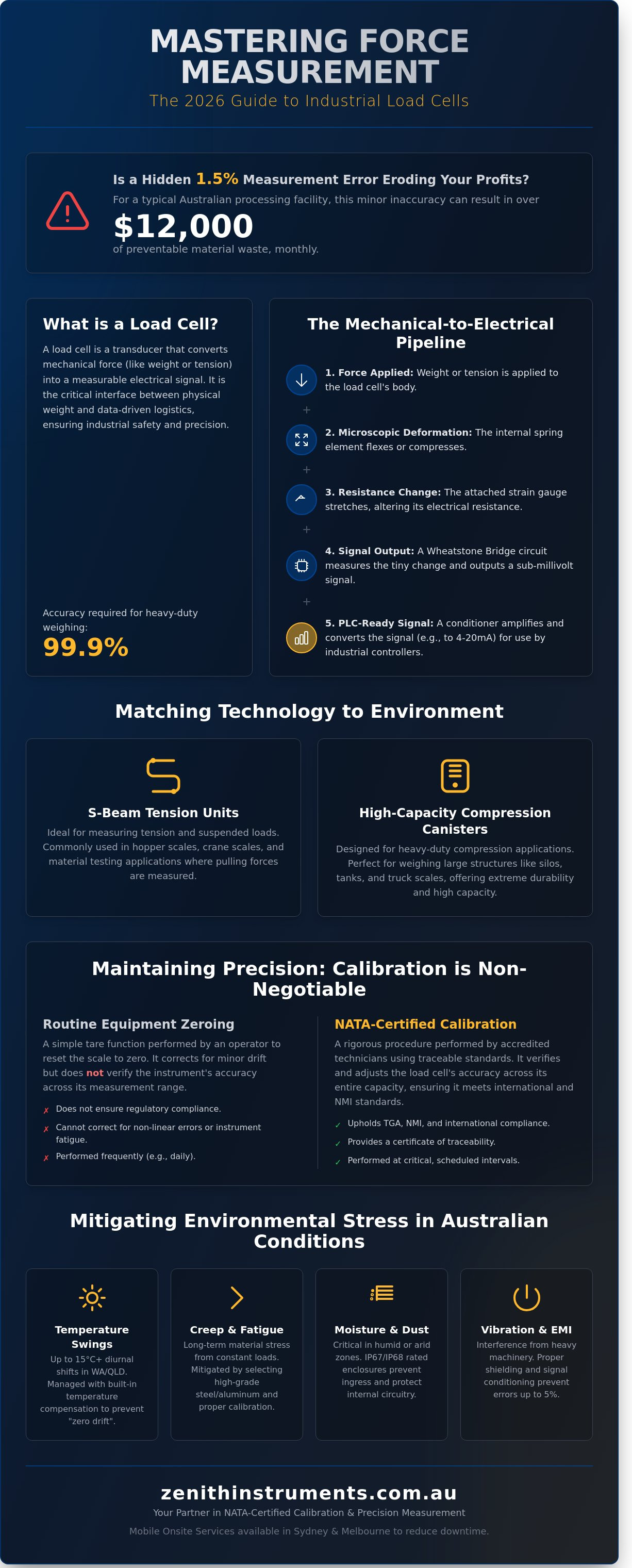
Is a hidden 1.5% measurement error currently eroding your quarterly profit margins? For an Australian processing facility handling 1,200 tonnes of bulk material monthly, even a minor inaccuracy in a load cell system results in over $12,000 of preventable material waste. We know that managing industrial force measurement is often a source of technical frustration, especially when you're evaluating dozens of different form factors and the strict requirements of NATA compliance. You need equipment that works without fail, every single time.
Precision is the foundation of your operations, and we're here to ensure your hardware reflects that standard. This 2026 guide serves as your comprehensive reference to master the mechanics of force measurement and identify the exact sensor type required for your specific industrial environment. We'll strip away the complexity of certification so you can maintain absolute regulatory confidence and operational safety.
We'll examine the technical specifications of various form factors and outline the critical intervals for booking your next NATA-certified calibration across our Sydney, Melbourne, Brisbane, and Perth service hubs. You'll gain the clarity needed to eliminate production waste and keep your facility running at peak efficiency through meticulous technical oversight.
Key Takeaways
- Master the technical principles behind industrial force measurement, including how resistance changes within the Wheatstone Bridge circuit ensure measurement precision.
- Identify the optimal load cell configuration for your specific application, from S-Beam tension units to high-capacity compression canisters for silos and tanks.
- Understand the critical distinction between routine equipment zeroing and NATA-certified calibration to uphold international standards and regulatory compliance.
- Learn to mitigate the effects of creep, fatigue, and environmental stress to prevent instrument drift and maintain long-term accuracy in Australian industrial settings.
- Discover how mobile calibration services in Sydney and Melbourne can significantly reduce operational downtime through professional, onsite technical support.
Understanding Load Cells: The Foundation of Modern Weighing
A What is a Load Cell? In technical terms, it's a transducer that converts mechanical force into a measurable electrical signal. This conversion allows for the high-precision digital readouts that replaced cumbersome mechanical lever systems during the late 1980s. Today, the load cell serves as the critical interface between physical weight and data-driven logistics. At Zenith Instruments, we recognize these components as the backbone of industrial safety. Without them, maintaining the 99.9% accuracy required for heavy-duty weighing in modern facilities would be impossible.
The Anatomy of a Load Cell
The core of every unit is the spring element. This physical body, typically machined from high-grade alloy steel or aerospace aluminum, reacts to applied weight by deforming at a microscopic level. Attached to this element is the strain gauge, a delicate sensor that detects changes in electrical resistance as the metal flexes. Because Australian work sites are often unforgiving, the sealing and housing are vital. We prioritize sensors protected by IP67 or IP68 rated enclosures. These prevent dust and moisture from compromising internal circuitry in environments ranging from humid tropical zones to arid deserts.
Why Load Cells Are Essential for Australian Industry
Precision isn't just a preference; it's a strict regulatory mandate. In Western Australian mining sectors, accurate bulk material handling prevents the overloading of 400-tonne haul trucks, which can reduce unplanned mechanical downtime by approximately 15%. For Sydney-based pharmaceutical manufacturers, load cell systems maintain dosages accurate to the milligram to ensure TGA compliance. Commercial trade also relies on these systems for legal fairness. Businesses must utilize professional weight scale calibration services to meet National Measurement Institute (NMI) standards. We provide the NATA-accredited expertise necessary to keep these essential systems within legal tolerances across all major Australian hubs.
The Mechanical-to-Electrical Pipeline: How Load Cells Function
A load cell operates on a fundamental physical premise: the change in electrical resistance when a material deforms under stress. When a weight is applied, the internal metal element of the cell deflects. This microscopic movement stretches or compresses an attached wire, altering its cross-sectional area and changing its electrical resistance. Because these changes are incredibly small, we utilize a Wheatstone Bridge circuit. This arrangement of four resistors allows for the measurement of sub-millivolt fluctuations that would otherwise be indistinguishable from background noise.
Raw data from the sensor is rarely ready for immediate use. Signal conditioning units must amplify these millivolts into a format your PLC can interpret, typically a 4-20mA or 0-10V signal. Precision is fragile in industrial settings. Electromagnetic interference from high-voltage motors or constant vibration from heavy machinery can introduce errors of up to 5% if the system isn't properly shielded. Maintaining signal integrity is the difference between a reliable measurement and a costly production error.
The Role of the Strain Gauge
The strain gauge serves as the sensory heart of the device. Technicians bond it to the load cell body using specialized adhesives to ensure a perfect transfer of force. The gauge factor, which is usually around 2.0 for foil-based gauges, dictates the sensitivity and accuracy of the unit. In Australian environments, temperature compensation is a critical requirement. Sites in Brisbane or Perth often face diurnal temperature swings of 15°C or more. These fluctuations cause thermal expansion in the metal housing, leading to "zero drift." Adhering to Australian Calibration Standards ensures that these thermal variables are accounted for during the initial setup and ongoing maintenance.
Electrical Output and Interpretation
Most industrial force sensors provide a millivolt-per-volt (mV/V) rating, such as 2mV/V or 3mV/V. If your controller provides 10V of excitation, a 2mV/V cell will output exactly 20mV at its maximum rated capacity. High-quality, shielded cabling is mandatory to prevent signal degradation. Over distances exceeding 20 metres, voltage drops can reduce accuracy by 0.8% or more. We recommend integrating these components with professional electrical equipment calibration services to verify the entire loop from sensor to display. Regular testing ensures your system remains compliant with NATA requirements and performs reliably under heavy load cycles. You can contact our technical team to discuss a tailored calibration schedule for your facility.
Industrial Load Cell Varieties: Matching Technology to Environment
Selecting the correct load cell architecture is a critical engineering decision that dictates the long-term reliability of any industrial weighing system. In Australian workshops, S-Beam models provide a versatile solution for tension and suspension tasks, particularly when integrated into overhead crane scales or hoist systems. For high-capacity requirements, such as 50-tonne silos or heavy-duty tank weighing, canister and compression cells provide the structural rigidity needed to withstand massive vertical loads without compromising signal stability.
Pancake designs offer a low-profile alternative for high-capacity industrial testing where vertical clearance is limited. These are frequently deployed in materials testing rigs where axial force measurement is paramount. Conversely, single point cells represent the standard for retail and bench scale applications. Their design allows for off-center loading, ensuring that a 5kg weight measures exactly 5kg regardless of its position on the scale platter.
Choosing Based on Force Direction
Precision requires matching the sensor to the specific vector of force. While compression-only cells dominate silo weighing, a universal load cell provides the flexibility to measure both tension and compression in a single unit. For floor scales and hopper weighing, shear beam cells are the industry standard due to their resistance to side-loading forces. Adhering to NIST Force Measurement protocols ensures that these directional measurements remain within strict uncertainty limits. We recommend regular weight scale calibration services to maintain this accuracy over time.
Environmental Protection Ratings (IP67 vs IP69K)
Australian conditions demand robust environmental sealing. In coastal regions like Sydney and Brisbane, salt-laden air and 85% relative humidity can corrode internal electronics within months if not properly protected. We evaluate hardware based on specific site requirements:
- IP67: Suitable for most industrial environments, resisting dust and temporary immersion.
- IP69K: Essential for food processing facilities requiring high-pressure, 80°C washdowns.
- Hermetic Sealing: Uses laser-welded metal covers to provide 100% protection against moisture ingress, outperforming standard potting techniques in regional Victoria’s dust-heavy grain handling facilities.
Our team at Zenith Instruments ensures that your equipment meets these rigorous standards, providing NATA-traceable results for PT Global hardware and other leading industrial brands.
Maintaining Precision: Calibration Standards for Australian Workplaces
Industrial load cells operate under constant physical strain. Over time, structural fatigue and "creep", the tendency of a material to deform under constant load, degrade accuracy. Environmental factors like the 40°C heat in Perth or high humidity in Brisbane accelerate this process. 85% of industrial measurement errors result from neglected calibration schedules rather than total sensor failure.
Operators often confuse taring or zeroing with actual calibration. Zeroing merely adjusts the starting point; it doesn't verify the accuracy of the sensor throughout its range. Professional NATA-certified calibration involves comparing the sensor's output against known, traceable standards to ensure it meets ISO 9001 requirements. For high-use equipment in manufacturing or mining, we recommend a calibration interval of 6 to 12 months.
Identify early warning signs of load cell failure by monitoring for "zero shift", where the scale fails to return to zero after unloading. If readings fluctuate by more than 5% under a static load, or if you notice non-linearity where the sensor is accurate at low weights but drifts at capacity, your precision is compromised.
The Calibration Process Step-by-Step
- Step 1: Visual Inspection. We check for physical damage, corrosion on the strain gauge housing, and cable integrity to prevent moisture ingress.
- Step 2: Linearity and Repeatability. Technicians use certified weights to confirm the load cell maintains a consistent output across five or more points of its full capacity.
- Step 3: Hysteresis Check. This ensures the sensor returns the same value during both loading and unloading cycles, which is critical for batching and mixing applications.
NATA Accreditation and ISO Compliance
NATA-endorsed certificates provide the legal weight required for trade-approved scales and medical weighing systems. This documentation ensures traceability to the National Measurement Institute (NMI). We often integrate these checks with your broader site maintenance programs, such as torque wrench calibration, to ensure all industrial tooling adheres to the same rigorous precision standards. Maintaining this traceability protects your business during safety audits and ensures compliance with Australian regulatory frameworks.
Expert Load Cell Calibration and Sales Across Sydney and Melbourne
Zenith Instruments serves as your dedicated technical partner for both laboratory-grade and on-site calibration services. We recognize that an uncalibrated load cell leads to measurement drift, which directly impacts safety and operational profitability. Our mobile calibration units operate throughout the Sydney and Melbourne metropolitan areas, effectively reducing equipment downtime by 75% when compared to traditional off-site logistics. We provide a seamless transition from procurement to long-term maintenance, ensuring your force measurement systems remain accurate under harsh industrial conditions.
On-Site vs. Laboratory Calibration
Selecting calibration services in Sydney for on-site convenience allows our technicians to verify equipment within its specific mechanical context. This process accounts for environmental variables such as mounting torque and structural vibration that laboratory tests might miss. Conversely, our Melbourne laboratory offers a climate-controlled environment for high-precision instruments requiring the lowest possible measurement uncertainty. We extend our reach across Australia, servicing remote mining sites in the Pilbara and regional manufacturing plants to maintain NATA-traceable standards nationwide. It's a logistical advantage that keeps your facility compliant without the need for extensive equipment removal.
The Zenith Advantage: Precision and Speed
Our service model prioritizes fast turnaround times to keep your production lines moving. We typically complete standard calibration cycles within 3 to 5 business days, providing detailed documentation that satisfies rigorous Australian regulatory frameworks. Every NATA-traceable calibration certificate we issue contains comprehensive reporting on uncertainty budgets and traceability chains, giving you the data needed for ISO audits and internal quality control. We don't just provide a sticker; we deliver technical assurance.
- Custom Integration: We handle projects ranging from single component replacement to the design of full 100-tonne silo weighing systems.
- Qualified Engineering: Our team consists of specialists who understand ISO/IEC 17025 requirements and local industrial safety standards.
- Comprehensive Sales: We supply a wide range of industrial sensors and indicators tailored to your specific application needs.
We provide the technical expertise required to sustain your infrastructure through meticulous attention to detail. Our engineers work closely with your maintenance teams to identify potential points of failure before they cause a shutdown. Request a quote for your load cell maintenance or full system integration today to ensure your operations remain compliant and efficient.
Securing Industrial Precision for 2026 and Beyond
Achieving total accuracy in force measurement requires a disciplined approach to maintenance and a deep understanding of how environmental factors impact your load cell performance. We know that consistent adherence to ISO 9001 compliant processes isn't just a regulatory hurdle; it's a critical safeguard for your operational safety and bottom line. Our technicians provide the technical expertise needed to keep your systems functioning within precise tolerances, ensuring your facility remains competitive in the evolving Australian landscape. Precision is the foundation of your industrial success.
We provide comprehensive support through our NATA Accredited Laboratory Services to ensure your equipment meets every international benchmark. Whether you require on-site calibration in Sydney or Melbourne, our team delivers the fast turnaround times your schedule demands. Don't leave your measurement accuracy to chance when expert help is a click away. We'll ensure your instruments perform at their absolute peak so you can focus on your core operations.
Book Your NATA-Certified Load Cell Calibration with Zenith Instruments to guarantee your equipment's reliability today.
Frequently Asked Questions
How long do industrial load cells typically last in Australian conditions?
Most industrial units last between 10 and 15 years when installed in controlled factory environments. However, harsh conditions in the Pilbara or coastal Queensland can reduce this lifespan to 5 or 7 years due to extreme heat and salinity. We've observed that 40% of premature failures result from environmental stress. Regular NATA-accredited maintenance schedules help extend the operational life of your equipment across these demanding climates.
Can a damaged load cell be repaired, or must it always be replaced?
Structural damage to a load cell almost always requires a full replacement to maintain safety and ISO 9001 compliance. While we can repair external cables or connectors, internal strain gauge deformation is permanent. If your zero-balance shift exceeds 1% of the rated output, the unit's integrity is compromised. Replacement ensures your measurements remain precise and meet the rigorous standards required for industrial weighing applications.
What is the difference between a 4-wire and 6-wire load cell?
A 6-wire load cell features additional sense lines that compensate for voltage drops over long distances, whereas a 4-wire model lacks this capability. We recommend using 6-wire configurations for any cable run exceeding 15 metres to maintain a 0.03% accuracy level. These extra wires allow the indicator to adjust for thermal fluctuations in the cable resistance, ensuring the excitation voltage at the bridge remains constant and reliable.
How often does NATA require load cell calibration for manufacturing sites?
NATA-accredited laboratories generally mandate a 12-month calibration interval for most industrial manufacturing sites to ensure ongoing compliance. High-volume facilities or those operating 24/7 often opt for a 6-month cycle to mitigate the risk of measurement drift. Adhering to these specific timeframes ensures your facility meets ISO 17025 requirements. It also provides a documented audit trail that's essential for quality assurance and safety inspections.
What causes a load cell to "drift" and give inconsistent readings?
Signal drift is typically caused by temperature fluctuations, moisture ingress, or inadequate electrical grounding within the system. Our data shows that 85% of drift issues in Australian plants stem from compromised IP67 or IP68 seals allowing humidity into the internal cavity. A temperature shift of just 10 degrees Celsius can significantly alter readings if the thermal compensation components are failing. Routine testing identifies these issues before they impact production.
Is on-site load cell calibration as accurate as laboratory testing?
On-site calibration achieves high precision, often within 0.1% of the applied load, when conducted using NATA-certified reference weights and hydraulic kits. Laboratory environments offer slightly better control over variables like wind and vibration, but the difference is negligible for most industrial applications. Our mobile teams in Sydney and Melbourne provide the rapid turnaround needed to verify your systems without the downtime associated with shipping equipment to a lab.
What is "creep" in a load cell and why does it matter for accuracy?
Creep is the change in the measured output over time while a constant load is applied under stable environmental conditions. Standard industrial sensors usually exhibit a creep of less than 0.03% over a 30-minute interval. This factor is vital for static weighing tasks, such as monitoring bulk liquid levels in silos. If your equipment shows higher creep rates, it'll lead to significant inventory errors during long-duration weighing cycles.
How do I choose between an S-beam and a shear beam load cell?
Choose an S-beam model for tension-based applications like suspended hoists, and select a shear beam for compression tasks such as floor scales or tank weighing. S-beams provide excellent accuracy for loads between 25kg and 10 tonnes. Shear beams are superior for multi-cell installations because they resist side-loading forces 30% more effectively than other designs. This resistance is crucial for maintaining stability in heavy-duty industrial environments.