

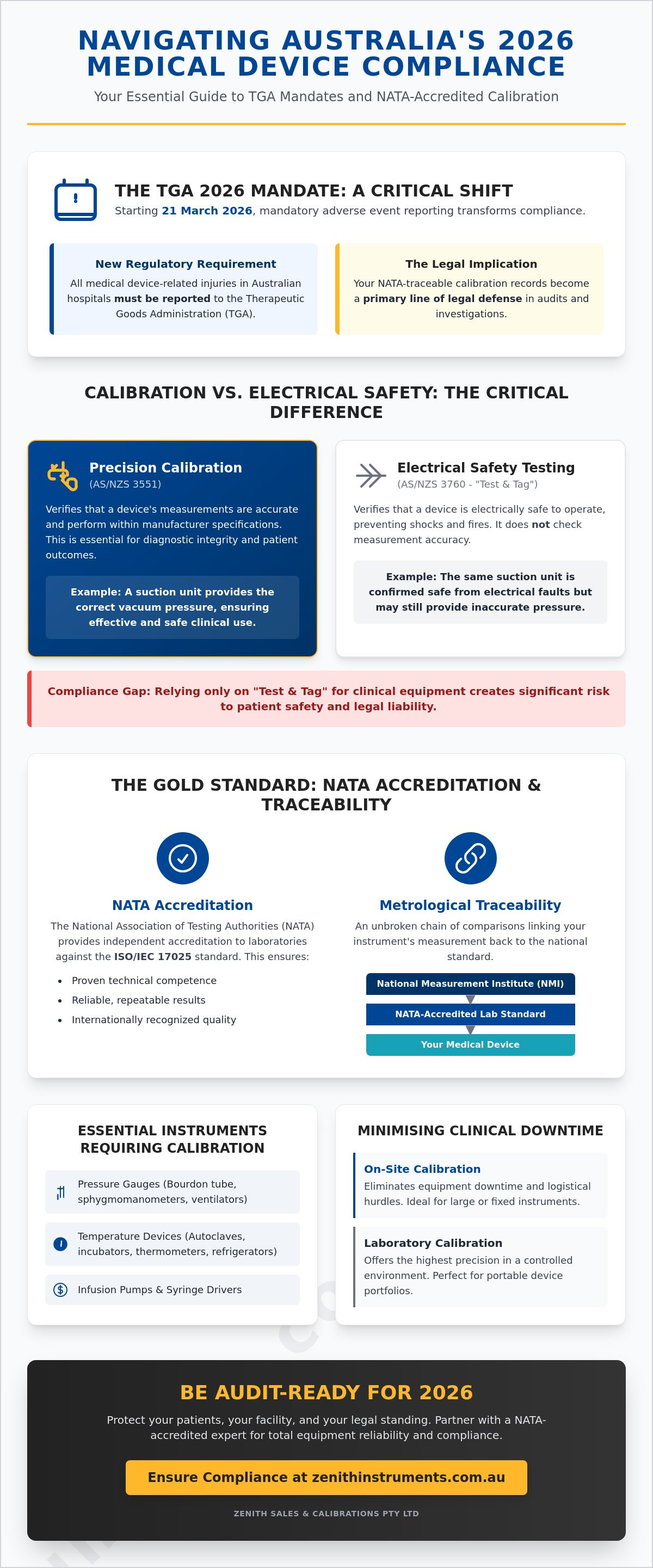
Starting 21 March 2026, the Therapeutic Goods Administration (TGA) mandates that all medical device-related injuries in Australian hospitals must be reported, effectively turning your calibration records into a primary line of legal defense. For healthcare administrators, the pressure to maintain absolute precision is no longer just about patient outcomes; it's a rigorous regulatory requirement that demands meticulous documentation. We understand that the fear of failing an accreditation audit often competes with the logistical nightmare of equipment downtime. Distinguishing between basic electrical safety checks and the high-precision requirements of medical pressure gauge calibration australia is often where compliance gaps begin to form.
This guide provides the technical clarity required to master Australian standards and ensure your facility remains fully compliant through 2026 and beyond. You'll gain a clear understanding of the mandatory Unique Device Identification (UDI) system and the specific requirements of AS 1349 for Bourdon tube gauges. We'll outline a proactive compliance schedule that prioritizes NATA-traceable certification while utilizing mobile service strategies to keep your clinical services running without interruption. From navigating ISO/IEC 17025 benchmarks to implementing a 4:1 Test Uncertainty Ratio, we provide the expert framework needed for total equipment reliability.
Key Takeaways
- Understand how TGA regulatory reforms for 2026, including mandatory adverse event reporting, impact your facility's compliance strategy and legal liability.
- Learn why NATA accreditation and metrological traceability to the National Measurement Institute are non-negotiable standards for maintaining technical integrity.
- Identify the critical pressure-based and temperature-sensitive instruments that require regular medical pressure gauge calibration australia to ensure precise patient diagnostics.
- Compare the efficiencies of on-site versus laboratory-based services to eliminate operational bottlenecks and maintain continuous clinical availability.
- Master the criteria for selecting a calibration partner with the technical breadth to manage complex multi-instrument portfolios under Australian standards.
Why Medical Equipment Calibration is Critical for Australian Healthcare Standards
Calibration is the formal process of verifying that a medical device performs within its specified tolerances by comparing it against a reference standard of known accuracy. In the Australian healthcare sector, the Therapeutic Goods Administration (TGA) maintains strict oversight to ensure that every instrument used in patient care meets rigorous safety and performance criteria. The TGA’s 2026 Compliance Principles emphasize that healthcare facilities must move toward proactive safety monitoring. We view this as a necessary shift from reactive repairs to a disciplined measurement culture where diagnostic integrity is the priority.
All technical equipment is susceptible to sensor drift. This phenomenon occurs when internal components lose accuracy due to environmental stressors like humidity, temperature fluctuations, or mechanical wear. This degradation often happens invisibly, making routine testing essential for clinical safety. If a facility fails to maintain its instruments, the stakes involve more than just technical errors. They include compromised patient safety, incorrect treatment paths, and significant legal liability. Providing audit-ready documentation is a core part of a proactive risk management strategy that protects both the patient and the provider.
The Core Mandate: AS/NZS 3551:2010
AS/NZS 3551:2010 serves as the primary framework for managing medical equipment throughout its lifecycle in Australia. This standard mandates performance verification to confirm a device meets its original manufacturer specifications. We distinguish this from preventative maintenance, which focuses on physical upkeep and repairs. Adherence to this standard requires strict record-keeping for every device, which is essential for meeting hospital accreditation requirements and ensuring full traceability during TGA audits. We provide comprehensive biomedical equipment calibration services to help facilities maintain these rigorous standards.
Calibration vs. Electrical Safety Testing (Test and Tag)
Many facilities mistakenly assume that a "test and tag" service under AS/NZS 3760 covers their clinical requirements. While electrical safety testing prevents shocks and fires, it does nothing to verify measurement accuracy. A suction unit might be electrically safe yet fail to provide the correct vacuum pressure. This is why medical pressure gauge calibration australia is a distinct, critical requirement. A comprehensive compliance program must address both the physical safety of the device and the precision of its output. By integrating specialized pressure gauge calibration into your maintenance cycle, we help you close the gap between basic electrical safety and true clinical excellence.
Understanding NATA Accreditation and Traceability in 2026
The National Association of Testing Authorities (NATA) serves as the cornerstone of technical measurement integrity in Australia. NATA provides independent accreditation for laboratories, ensuring they possess the specific technical competence required to deliver reliable results. For medical pressure gauge calibration australia, this means the laboratory has been rigorously audited against ISO/IEC 17025. This international standard is the global benchmark for calibration laboratories, governing everything from equipment maintenance and environmental control to the formal training of technical personnel. When a facility chooses a NATA-accredited partner, they're opting for a level of oversight that is recognized by both national and international regulatory bodies.
Metrological Traceability is another critical pillar of the 2026 compliance landscape. It refers to an unbroken chain of comparisons that links your local gauge back to the primary standards held by the National Measurement Institute (NMI). Without this chain, a measurement lacks legal and technical standing. NATA-endorsed certificates are the preferred currency for high-risk clinical audits because they provide a verified trust signal that regulators like the TGA recognize immediately. We prioritize these standards to ensure that every measurement we verify is backed by a disciplined, documented hierarchy of accuracy.
When is a NATA Certificate Mandatory?
While basic traceable calibration might suffice for some general-purpose tools, NATA-endorsed certificates are often mandatory in high-risk clinical environments. This includes surgical theatres, pathology laboratories, and intensive care units where measurement error can have immediate life-threatening consequences. In the event of a legal inquiry or a TGA investigation into a medical device-related injury, a NATA certificate significantly reduces the burden of proof for the healthcare facility. It demonstrates that the equipment was tested by a laboratory with verified technical authority. We maintain NATA-certified standards to provide our clients with total reassurance during these high-stakes audits. If you operate in a specialized clinical setting, our biomedical equipment calibration services ensure your facility meets these elite standards.
Reading and Validating Your Calibration Certificate
A compliant certificate is more than a simple "pass" or "fail" result. It must contain specific technical data to be valid for a 2026 audit. The most critical element is the "Uncertainty of Measurement". For a hospital practice manager, think of this as the "plus or minus" range. It defines the limits within which the true value of the measurement lies. If the uncertainty is too high, the device may not be fit for its intended clinical purpose. Use this 3-point checklist to verify your provider's status:
- Accreditation Number: Every NATA-accredited lab must display its unique accreditation number on the certificate.
- Scope of Accreditation: Verify on the NATA website that the provider is actually accredited for the specific instrument and pressure range they are testing.
- Traceability Statement: The document must explicitly state the reference standards used and their direct link to national or international standards.
Verification of these details ensures that your medical pressure gauge calibration australia program stands up to the most rigorous surveillance. By maintaining these records, you're not just checking a box; you're building a data-driven defense for your facility's clinical precision.
Essential Medical Instruments Requiring Regular Calibration
Maintaining a clinical environment requires more than just functional equipment; it demands verified accuracy across multiple measurement categories. While many providers focus solely on electrical safety, a robust compliance program covers the full spectrum of diagnostic and life-support tools. This includes pressure-based instruments like sphygmomanometers and suction gauges, temperature-sensitive medical refrigerators, and electrical diagnostics such as ECG machines and defibrillators. Precision in these areas is a core requirement of Australian healthcare standards for medical devices, which mandate that equipment remains safe and performs as intended throughout its service life. We provide the technical expertise to ensure these standards are met without compromise.
Sterilisation tools, specifically autoclaves, require both pressure vessel safety testing and validation of their internal sensors to ensure complete pathogen destruction. Similarly, precision patient scales and analytical balances in pathology labs must be calibrated to ensure accurate medication dosing and diagnostic results. Patient monitoring systems, including those tracking vitals in real-time, depend on the integrity of their internal sensors to provide clinicians with reliable data. Failure in any of these measurement categories can lead to systemic clinical errors and increased risk to patient safety.
Medical Pressure Gauge Calibration Australia
Precision in medical pressure gauge calibration australia is critical for anaesthesia machines and oxygen delivery systems where even a minor variance in flow or pressure can compromise patient stability. Inaccurate suction gauges present a high risk in neonatal and surgical environments, where excessive or insufficient vacuum levels can lead to tissue trauma or airway management failure. We possess the technical capability to calibrate both traditional mechanical Bourdon tube gauges and modern digital pressure sensors, ensuring your facility meets the AS 1349 standard. Our pressure gauge calibration services provide the documented evidence needed to satisfy the TGA’s Essential Principles and maintain operational readiness.
Temperature and Humidity Control for Pathology
The integrity of pharmaceuticals and biological samples depends entirely on stable thermal environments. Routine thermometer calibration is essential for vaccine storage refrigerators to prevent "cold chain" breaches that render expensive stock useless. Beyond temperature, humidity monitoring is a vital component of compliance for Sterile Supply Departments (SSD) and pharmaceutical clean rooms to prevent microbial growth and ensure the longevity of sterile packaging. For specialized diagnostic tools, our lab equipment calibration ensures that incubators and pathology ovens operate within the tight tolerances required for accurate testing and sample preservation. We deliver these services with a focus on precision and regulatory adherence, supporting the critical work of pathology professionals across Australia.
Laboratory vs. On-Site Calibration: Minimising Clinical Downtime
Choosing between laboratory and on-site calibration requires balancing technical precision with operational continuity. While a controlled lab environment is essential for the high-level reference standards discussed in previous chapters, the logistical convenience of on-site service is superior for most clinical instruments. Medical pressure gauge calibration australia often occurs at the point of care to eliminate the transport risks and extended downtime associated with shipping sensitive equipment across regional hubs. We recognize that an idle diagnostic tool represents a significant bottleneck in patient throughput and facility efficiency.
Zenith Sales & Calibrations Pty Ltd utilizes a proactive service model to meet diverse clinical needs. For regional healthcare providers, scheduled travel loops offer a cost-effective way to maintain compliance without the high cost of individual call-outs. For metropolitan clinics requiring immediate certification for an upcoming TGA audit, dedicated urgent call-outs ensure that critical theatre equipment remains available. While most digital and mechanical gauges are suited for on-site testing, certain instruments, such as high-precision analytical balances, must return to our laboratory to ensure that environmental fluctuations don't compromise the measurement uncertainty results.
The Zenith Sales & Calibrations Pty Ltd On-Site Advantage in Sydney and Melbourne
Zenith Sales & Calibrations Pty Ltd operates advanced mobile laboratories that deliver technical expertise directly to healthcare facilities. Our strategic presence in Sydney and Melbourne enables rapid response times, ensuring that your facility meets the 2026 compliance window without logistical delays. This on-site model allows for immediate adjustments if a gauge is found to be drifting, preventing the need for a secondary visit or equipment replacement. By performing these services in-situ, we maintain the chain of custody and minimize the physical handling of delicate sensors.
Preparing Your Facility for a Calibration Visit
Efficient preparation ensures a seamless on-site experience and further reduces clinical disruption. We recommend that practice managers have an updated asset register ready and provide a dedicated workspace with stable power for our testing rigs. Integrating these checks with your electrical equipment calibration cycle allows for a single, comprehensive safety event. This holistic approach ensures every device, from suction units to monitoring systems, is certified in one visit. Book your on-site compliance audit with Zenith Sales & Calibrations Pty Ltd to secure your facility's operational readiness and regulatory standing.
Choosing a Medical Calibration Partner in Australia
Selecting a partner for medical pressure gauge calibration australia requires more than a simple price comparison. You must verify the technical breadth of the provider before engagement. A partner capable of managing pressure, electrical, and thermal parameters allows you to consolidate your compliance program under a single technical authority. We recommend checking the provider's specific Scope of Accreditation on the NATA website to ensure they're formally authorized to calibrate your specific instrument models and pressure ranges. Technical support shouldn't end when the technician leaves; look for partners who offer post-calibration assistance and clear turnaround times to prevent clinical bottlenecks.
In a 2026 audit scenario, the speed of documentation retrieval is paramount. Zenith Sales & Calibrations Pty Ltd provides a secure digital portal that offers 24/7 access to your certificates and asset history. This eliminates the risk of lost paperwork during a TGA inspection and ensures you're always prepared for a surveillance visit. Accessing your records with a few clicks demonstrates a level of organizational discipline that auditors value. When your data is organized and accessible, you reduce the stress of compliance and focus on what matters most: patient care.
Why Zenith Sales & Calibrations Pty Ltd is the Trusted Choice for AU Healthcare
We've spent over 20 years refining our biomedical equipment calibration processes to meet the evolving needs of the Australian healthcare sector. With dual laboratory hubs in Sydney and Melbourne, we provide national coverage with a localized service touch. Zenith Sales & Calibrations Pty Ltd operates as a Dependable Expert; our technicians are meticulous, disciplined, and strictly ISO-compliant. This ensures that your facility's medical pressure gauge calibration australia is handled by specialists who understand the high-stakes nature of healthcare measurement and the necessity of precision.
Next Steps: Auditing Your Current Calibration Status
Start by reviewing your current asset labels and certificate expiry dates today. If your records are fragmented or labels are nearing their due dates, it's time for a systematic update of your asset register. We suggest setting up multi-year contracts to lock in your compliance schedule and protect your budget from future price fluctuations. This proactive approach ensures you never miss a calibration interval and maintains a steady state of audit readiness. Contact Zenith Sales & Calibrations Pty Ltd for a medical equipment audit today to secure your facility's regulatory standing and clinical integrity.
Securing Your Clinical Precision for 2026 and Beyond
The 2026 regulatory landscape in Australia is more demanding than ever, shifting the focus from simple maintenance to a comprehensive, data-driven safety strategy. With the TGA's updated Compliance Principles and the mandatory reporting of device-related injuries, your facility’s documentation is now a primary line of defense. Adopting a rigorous schedule for medical pressure gauge calibration australia is no longer just a technical recommendation; it's a fundamental commitment to diagnostic precision and institutional safety. We've established how NATA-traceable standards and metrological integrity provide the necessary certainty to withstand the most rigorous clinical audits.
Maintaining this level of excellence shouldn't come at the cost of your facility's operational efficiency. By leveraging the dual-lab presence of Zenith Sales & Calibrations Pty Ltd in Sydney and Melbourne, alongside our nation-wide mobile service, you can achieve full compliance with minimal disruption to your clinical services. We provide the technical expertise and disciplined asset management required to protect your facility’s regulatory standing. It's time to secure your equipment lifecycle with a partner that prioritizes reliability and international standards above all else. Book Your NATA-Compliant Medical Calibration with Zenith Sales & Calibrations Pty Ltd today and ensure your facility remains a leader in clinical excellence.
Frequently Asked Questions
How often does medical equipment need to be calibrated in Australia?
Most medical instruments require calibration every 12 months to remain compliant with manufacturer specifications and Australian healthcare standards. Critical care devices or high-use instruments may necessitate more frequent intervals to account for sensor drift. Primary pressure standards in laboratory environments typically follow a 12 to 24-month cycle as defined by ISO/IEC 17025 benchmarks to maintain technical integrity.
What is the difference between AS/NZS 3551 and AS/NZS 3760?
AS/NZS 3551:2010 is the specific standard for the management and performance verification of medical equipment, focusing on clinical precision and diagnostic accuracy. AS/NZS 3760 is a general electrical safety standard, often called "test and tag," which only prevents hazards like shocks or fires. While a device can pass an electrical safety test, it still requires 3551-compliant testing to ensure its measurements are accurate.
Can I calibrate my own medical pressure gauges in-house?
In-house calibration is technically possible but requires a substantial investment in NATA-traceable reference standards and specialized personnel training. As of June 2026, NATA training courses for internal auditing and ISO/IEC 17025 understanding cost between $919.00 and $1,652.00 per person. Most facilities find it more efficient to outsource medical pressure gauge calibration australia to a certified partner to avoid these high overhead costs and the complexities of maintaining accreditation.
What happens if a medical device fails its calibration test?
Any device that fails its calibration test must be immediately removed from service and tagged as "Out of Calibration" or "Do Not Use." The instrument requires technical adjustment or repair to bring it back within the manufacturer’s specified tolerances. After repairs are completed, the device must undergo a full re-calibration and receive a new certificate of compliance before it's legally permitted to return to the clinical environment.
Is NATA accreditation mandatory for all medical clinics in Australia?
NATA accreditation is not a universal legal mandate for every general practice, but it's often a requirement for hospital accreditation and high-risk environments like pathology labs and surgical theatres. Choosing a NATA-accredited provider ensures your facility meets the TGA’s 2026 Compliance Principles and provides a verified trust signal during audits. It offers the most robust legal defense in the event of a medical device-related incident or investigation.
How long does a typical on-site medical calibration visit take?
The duration of an on-site visit depends entirely on the volume of assets, but most small to medium clinics are completed within three to six hours. Larger hospital departments or specialized laboratories may require several days of testing to ensure every instrument is meticulously verified. We coordinate with your clinical staff to schedule these visits during periods of lower activity to ensure minimal disruption to patient care.
What documentation do I need to show an auditor for equipment compliance?
Auditors require a centralized asset register that tracks every piece of medical equipment and its current calibration status. You must present valid calibration certificates that include the date of test, the reference standards used, and the Uncertainty of Measurement. Providing secure, digital access to these records demonstrates a disciplined and organized approach to regulatory compliance, which is a primary focus for TGA surveillance in 2026.
Does Zenith Instruments provide calibration for all major medical brands?
We maintain the technical breadth to calibrate all major medical brands and models utilized within the Australian healthcare sector. Our expertise covers a wide array of mechanical and digital sensors, ensuring that your entire fleet, from sphygmomanometers to complex patient monitors, is managed by a single dependable expert. This holistic service model simplifies your medical pressure gauge calibration australia schedule and ensures consistent measurement standards across your entire facility.