

The most convenient calibration option isn’t always the right one. A mobile calibration laboratory sydney service can reduce the need to remove instruments and may limit disruption, but suitability depends on the equipment, calibration method and site conditions.
If taking instruments offline could interrupt production, maintenance or scheduled work, on-site calibration may be a practical option. The work still needs to meet your technical and documentation requirements. Match the service to each instrument, and understand what its certificate says about accreditation scope and measurement traceability.
This guide explains how to assess on-site calibration in Sydney, when laboratory service may be a better fit, and which records to retain. It also covers accreditation and traceability, plus steps for planning a visit and avoiding unnecessary delays. Zenith Sales & Calibrations provides on-site calibration using trained engineers and computerised closed-loop calibration software. With service across Sydney, Melbourne, Newcastle, Canberra and Brisbane, Zenith can help you plan an approach that supports measurement confidence and operational continuity.
Key Takeaways
- Assess whether a mobile calibration laboratory sydney service suits your instruments, required method and site conditions before deciding where calibration should take place.
- Understand the calibration sequence, from identifying instruments and comparing them with standards to recording results. Calibration is distinct from adjustment or repair.
- Compare on-site and laboratory service by downtime, instrument access, site conditions, calibration scope and documentation.
- Prepare an instrument list with make, model, serial number, range and calibration requirements where available, then coordinate access and availability.
- Read accreditation claims in context: NATA accreditation applies to the relevant scope, while an ISO 17025-compliant laboratory is a separate statement.
Why choose a mobile calibration laboratory in Sydney?
In a working facility, instruments can fall due for calibration while production, maintenance or scheduled tasks still depend on them. Removing equipment may mean arranging transport, finding a replacement or coordinating work around an instrument that is difficult to move. A mobile calibration laboratory in Sydney brings calibration work to the site, so suitable instruments can be assessed without unnecessary removal.
Mobile calibration is calibration performed at your site. It can reduce equipment transport and operational disruption when the instrument and method are suitable. Convenience alone doesn’t establish technical suitability. Consider the instrument, required method and scope, site conditions, and your quality or documentation requirements. Calibration sits within Metrology, the science of measurement, where reliable results depend on appropriate references and controlled procedures, not simply on where the work takes place.
When on-site calibration can reduce disruption
On-site work can be practical for instruments installed on a production line, used across a workshop or difficult to remove from a facility. Avoiding unnecessary transport can simplify logistics and help teams coordinate work around site operations. It doesn’t eliminate interruptions: equipment may still need to be available and out of use during calibration. Weigh that temporary downtime against the transport and scheduling involved in a laboratory service.
For example, a maintenance team might group accessible instruments for a planned visit rather than arrange separate removals. A facility with fixed or awkward-to-transport equipment may also avoid handling and transport steps. The benefit depends on access, instrument availability and the work required. If the method or conditions call for a laboratory environment, don’t let convenience take priority over the technical requirements.
Which Sydney workplaces may benefit?
Manufacturing plants, engineering workshops, mining operations, medical and laboratory facilities, and food-industry sites all rely on measurement equipment in different working conditions. On-site calibration can help teams coordinate instrument access with production windows, maintenance schedules, safety arrangements and facility procedures. The right approach still depends on the instrument and task.
Planning helps when multiple teams share equipment or access depends on a work area being available. Identify which instruments can be presented safely and conveniently, and whether they can be taken out of use at the same time. This gives calibration work a defined place in the site schedule and helps staff prepare for any access or coordination needs.
Zenith provides on-site calibration using trained engineers. For sites in Sydney and across Melbourne, Newcastle, Canberra and Brisbane, its calibration services in Sydney offer a starting point for planning site-based work. Match each instrument and its requirements to the service approach rather than assuming every calibration is best performed on-site.
How mobile calibration works: scope, traceability, and records
A reliable mobile calibration job starts with a clear definition of what needs to be measured and what evidence the site requires. Calibration compares an instrument’s indication with a suitable reference standard under stated conditions. It establishes measurement performance; it is not the same as adjusting an instrument or repairing a fault. If results show an instrument outside agreed limits, adjustment or repair may be a separate action.
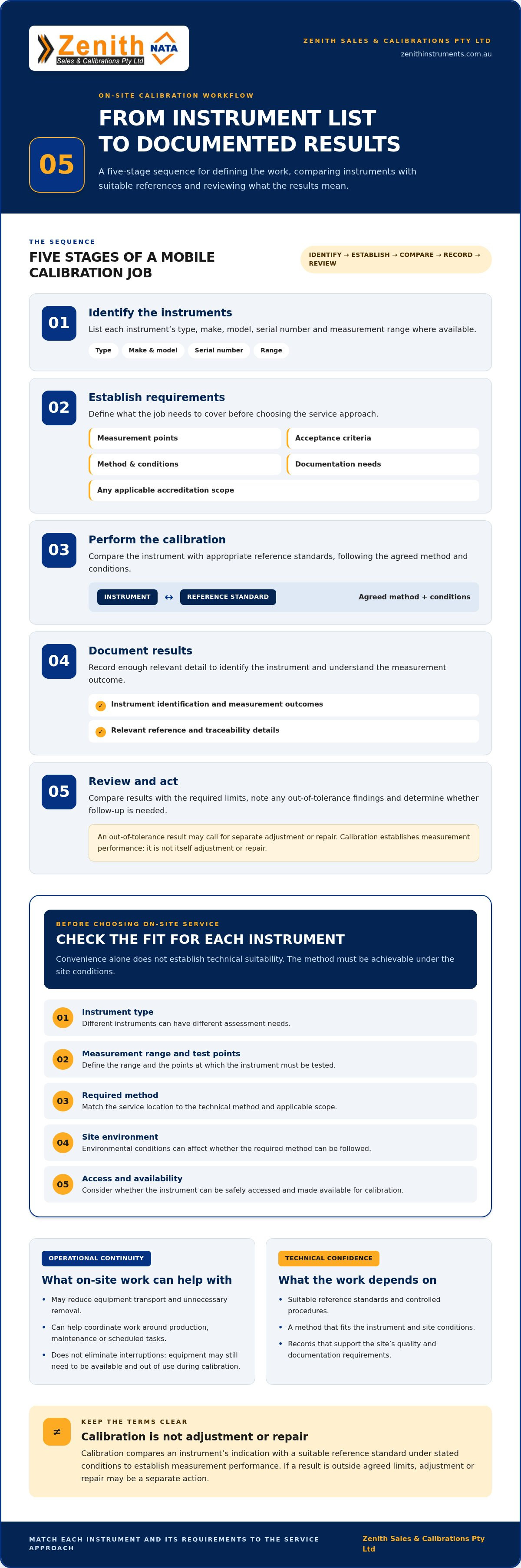
For a mobile calibration laboratory in Sydney, organise the workflow into these five stages:
- Identify the instruments. Record each instrument’s type, make, model, serial number and measurement range where available.
- Establish requirements. Define measurement points, acceptance criteria, method, documentation needs and any applicable accreditation scope.
- Perform the calibration. Compare the instrument with appropriate reference standards using the agreed method and conditions.
- Document results. Record instrument identification and measurement outcomes, along with relevant reference and traceability details.
- Review and act. Compare results with the required limits, note any out-of-tolerance findings and determine whether follow-up is needed.
What determines whether a job fits mobile service?
Suitability depends on instrument type, measurement range, method, site environment and access. A pressure gauge and an electrical instrument may have different assessment needs, but neither example defines the full scope of a mobile visit. The technical requirements and applicable scope matter more than the word “mobile”. The method must be achievable under site conditions, with access to the instrument and any required reference equipment.
Environmental conditions or restricted access can affect whether the required method can be followed. So can the instrument’s range and the points at which it must be tested. Define the work for each item rather than relying on a broad request such as “calibrate all equipment”. Clear requirements help align the on-site plan with the measurement task and the records your team needs.
How to interpret accreditation and calibration records
Accreditation applies to a defined scope, not automatically to every instrument, method or activity a business performs. Zenith provides ISO 17024 and NATA-accredited calibration services, while its laboratory is ISO 17025-compliant. These are distinct statements. Check that the relevant accredited scope matches the specific calibration before describing a result as NATA-accredited. A certificate should match the instrument and required calibration scope to provide the evidence your quality system needs.
Review certificates for clear instrument identification, results and relevant traceability details, including information connecting the calibration to its reference standards. Traceability supports confidence that measurements relate to recognised standards through documented comparisons. The NIST calibration services and traceability page offers a reference point for understanding this measurement framework, though NIST is a US institute. Keep certificates with equipment records so results can be reviewed against acceptance criteria and calibration history.
Zenith uses a computerised closed-loop calibration software system that eliminates human error in calibration. For an overview of calibration services, visit Zenith Instruments.
On-site versus laboratory calibration: how Sydney buyers can compare
Choosing between on-site and laboratory calibration is a decision about the work, not a contest between service models. A mobile visit can reduce instrument transport and limit disruption when work can be completed at your site. Laboratory service may be more appropriate if the instrument, method or required measurement conditions cannot be accommodated there. For a buyer searching “mobile calibration laboratory sydney,” the useful question is which approach meets the technical requirements while fitting the way the site operates.
Use these comparison points to assess each instrument or group of instruments:
| Factor | On-site calibration | Laboratory calibration |
|---|---|---|
| Downtime | Can avoid transport and make site scheduling easier, though instruments still need to be available for the work. | Requires instruments to be removed and sent away, so plan for time out of service. |
| Instrument access | Useful when equipment is fixed, difficult to move or needed within the facility. | Works when instruments can be safely removed, packaged and transported. |
| Site conditions | Depends on whether access and the site environment support the required method. | May suit work requiring conditions or handling that cannot be provided at the site. |
| Scope | Appropriate when the required calibration task fits the available on-site method and relevant scope. | May be the better fit when the task needs laboratory facilities or capabilities. |
| Documentation | Records should identify the instrument, results and applicable traceability details. | Records should provide the same essential evidence for the laboratory work performed. |
When an on-site visit is the stronger operational fit
Prioritise on-site assessment for instruments that are difficult to remove or whose absence could interrupt production, maintenance or other planned work. If several suitable instruments are at one location, coordinating them within a planned visit can simplify access and scheduling. That’s an operational advantage, not a substitute for technical assessment. Site access, conditions, method and scope still determine whether the work can be completed appropriately on-site.
Consider which staff or equipment depend on each instrument and when it can be made available. Grouping suitable items may reduce repeated handling, but account for each instrument’s requirements individually.
When laboratory calibration may be more appropriate
Some instruments, methods or site conditions may call for laboratory handling. The deciding factor is whether the required measurement conditions and technical scope can be met, not which option seems more convenient. For example, the requirements for a pressure gauge calibration service should inform where that work is performed. The instrument category alone doesn’t establish the right setting.
Compare the instrument’s requirements with the operational cost of removing it from service. On-site work is practical when the method can be completed at the customer’s location; laboratory work makes sense when the task needs conditions or handling that the site cannot provide. Neither model is universally superior. Match the service setting to the instrument and the evidence your organisation requires.
Prepare your Sydney site for a mobile calibration visit
A prepared site helps keep calibration work organised and reduces avoidable delays. Before arranging a mobile calibration laboratory sydney visit, bring instrument details, access needs and operational constraints into one plan. This gives the service team a clearer picture of the work and helps your site contact coordinate the instruments and people involved.
Information to organise before scheduling
Start with an instrument register. Include the make, model, serial number and measurement range where available, along with each instrument’s location and calibration requirements or records needed. If requirements differ between equipment groups, note them separately rather than relying on a general description. This information helps define the job scope and supports accurate identification during the visit.
- Instrument details: list each item’s identifying information, range and work area.
- Calibration requirements: record required measurement points, acceptance criteria or documentation needs where known.
- Access arrangements: note locations, entry arrangements and any site coordination needed to reach the instruments.
- Operational constraints: flag production windows, maintenance schedules or periods when equipment cannot be made available.
- Records: identify the documents your team needs for equipment history and quality records.
Include a site contact who can coordinate access and help locate the listed instruments. This person should know which equipment can be made available and who needs to be informed if its use is interrupted. A calibration plan is easier to coordinate when the instrument register reflects the site layout, not just an asset list. Zenith’s instrument calibration guide for Australia can also help you organise information for calibration planning.
Coordinate access and reduce avoidable downtime
Group suitable instruments by work area where practical. This helps the site contact coordinate access in a logical order and avoid unnecessary movement between locations. Identify who will make each instrument available, and consider how its temporary unavailability may affect work. A planned sequence can make the visit more manageable, but each instrument’s requirements still need individual assessment.
Plan safe access in line with your site’s procedures, and flag constraints in advance. For example, an instrument in a controlled or restricted work area may need an escort or an agreed access window. Clear coordination helps the engineer reach the equipment without relying on assumptions about site arrangements.
Timing depends on the job scope, instrument access and site coordination, so don’t plan around an assumed fixed duration. Share the register and constraints early so the work can be organised around actual requirements. Zenith provides calibration services in Sydney, including on-site work. To discuss a planned site calibration, contact Zenith Instruments.
Zenith mobile calibration in Sydney: credentials and next steps
Zenith Sales & Calibrations provides on-site calibration using trained engineers. For suitable work, a mobile calibration laboratory sydney service can keep instruments at the worksite rather than requiring unnecessary removal. The instrument, method and required scope remain central to planning.
What Zenith brings to a calibration engagement
Zenith uses a computerised closed-loop calibration software system that eliminates human error in calibration. This supports a consistent, documented workflow alongside the technical work performed by trained engineers. Each calibration still needs to be considered in relation to the instrument and required method.
Zenith provides ISO 17024 and NATA-accredited calibration services. Separately, the company’s laboratory is ISO 17025-compliant. These statements describe different credentials and are not interchangeable. NATA accreditation applies to the relevant scope, so it should not be assumed to cover every instrument, method or on-site activity.
Zenith provides service across Australia, including Sydney, Melbourne, Newcastle, Canberra and Brisbane, and can support suitable on-site calibration work at local facilities. The appropriate service approach depends on the job requirements. Turnaround also varies by scope and coordination: Zenith’s fastest calibration service can be as fast as 24 hours. This is the fastest stated service, not a universal turnaround promise.
Arrange the next step for your Sydney site
To make an initial discussion useful, prepare a concise summary of the instruments and the worksite. Include:
- Instrument details: type, make, model, serial number and range where available.
- Calibration requirements: required scope, method or documentation needs, if known.
- Site information: location, access arrangements and any relevant site constraints.
- Scheduling needs: when instruments can be made available and any operational windows to consider.
This information helps frame the scope and identify practical considerations for a site visit. If several instruments are involved, a list grouped by work area can help organise the conversation and planning. The Sydney office can be reached on 02 9680 8765 to discuss instrument scope and site requirements.
For a direct next step, discuss calibration services for your Sydney site. Bring the instrument details and access requirements together, and Zenith can work with you to plan suitable on-site calibration around your facility’s needs.
Set your next calibration plan in motion
Use your next calibration cycle to identify which instruments are essential to daily operations, what evidence each one requires, and how to make them available with minimal disruption. That preparation turns the choice of a mobile calibration laboratory sydney service into a practical maintenance decision, not just a scheduling preference.
Start with instruments that would have the greatest impact on work if unavailable or if their measurements were unreliable. Bring their identification details, site access needs and record requirements together, then use that information to shape a workable plan. A considered approach helps your team manage calibration without losing sight of measurement confidence.
Zenith supports calibration planning for Sydney worksites. Discuss calibration services for your Sydney site and take the next step towards a plan that fits your instruments and operations. With the right preparation, you can move forward with greater clarity and confidence.
Frequently Asked Questions
Can mobile calibration be performed while instruments remain installed?
Yes, some instruments can be calibrated in place, which may avoid removal when the method and site setup allow it. Installation status alone doesn’t determine feasibility: access to measurement points, operating conditions and the calibration method also matter. A mobile calibration laboratory sydney visit doesn’t mean every installed instrument can be calibrated where it sits. Confirm that the calibration scope and resulting records suit your quality requirements.
Is calibration the same as adjustment?
No. Calibration compares an instrument’s readings with known standards to establish its performance. Adjustment changes the instrument’s response to bring it closer to a desired value. Calibration can document the readings found without changing the instrument. If adjustment or repair is undertaken, record it as a distinct action where applicable, so the equipment history shows what was measured and what was changed.
What happens if an instrument is found outside its acceptable tolerance?
An out-of-tolerance result should be documented and assessed against the instrument’s specified tolerance and intended use. The responsible site contact can consider whether measurements made since the previous calibration may have been affected, including whether products, processes or decisions need review. If needed, arrange adjustment or repair as a separate follow-up and retain the relevant records. The appropriate response depends on the instrument and its application.
Can one mobile calibration visit cover different types of instruments?
Different instruments may be coordinated in one visit if their requirements, applicable service scope, site access and schedule align. For example, a site could list equipment used by separate work areas, then identify which items can be made available together. Prepare a consolidated register with each instrument’s make, model, serial number, range and calibration needs. A combined visit still requires assessment of each category and method.
Does calibration reset an instrument’s calibration interval?
Calibration records an instrument’s performance at the time of testing, but it doesn’t automatically set the next interval for every instrument. Your organisation should determine intervals through its documented procedure, considering the instrument’s use, history, risk and applicable technical requirements. Review the interval if operating conditions or measurement consequences change. Avoid applying a universal annual schedule without assessing whether it fits your quality system and obligations.
What should I do if a calibration certificate is missing instrument identification details?
Pause before relying on the certificate until you can link its results to the correct instrument. Compare the document with the instrument’s serial number, asset register and calibration request, looking for a mismatch or missing identifier. If the records don’t align, resolve the discrepancy and retain corrected documentation with the equipment history. Clear identification matters when reviewing results, tracing prior measurements or planning the instrument’s next calibration.