

The most convenient multimeter calibration option isn’t always the one that best fits your measurement risk. For a Newcastle operation, choosing a multimeter calibration service Newcastle teams can rely on means looking beyond the instrument’s brand to the calibration scope, required records and likely downtime. It’s reasonable to want traceable results without taking critical equipment out of service longer than necessary.
This guide explains how to match calibration scope to the measurements your workplace performs, what instrument details to provide, and which certificate and traceability details to consider. Zenith Sales & Calibrations Pty Ltd provides multimeter calibration through in-house laboratory and on-site capabilities, supporting different operational needs across Newcastle. We’ll compare these options and outline how to plan calibration with minimal disruption, while clarifying that certificate wording and endorsement depend on the applicable scope. With the right information prepared, you can arrange calibration with a clearer understanding of the process and the records your operation needs.
Key Takeaways
- Recognise when failed checks, impact damage, suspected drift or a quality-system schedule indicate it’s time to calibrate your multimeter.
- Understand how calibration compares instrument readings with reference standards, and what information a documented result can provide.
- Compare laboratory and on-site options by considering your required scope, workplace setup and the disruption each approach may involve.
- Before arranging a multimeter calibration service newcastle teams can use, note the instrument’s make, model, serial number, functions, ranges and any known faults.
- Learn how Zenith Instruments’ multimeter calibration fits within its electrical calibration services and Newcastle coverage.
Multimeter Calibration Service in Newcastle: When Does Your Instrument Need It?
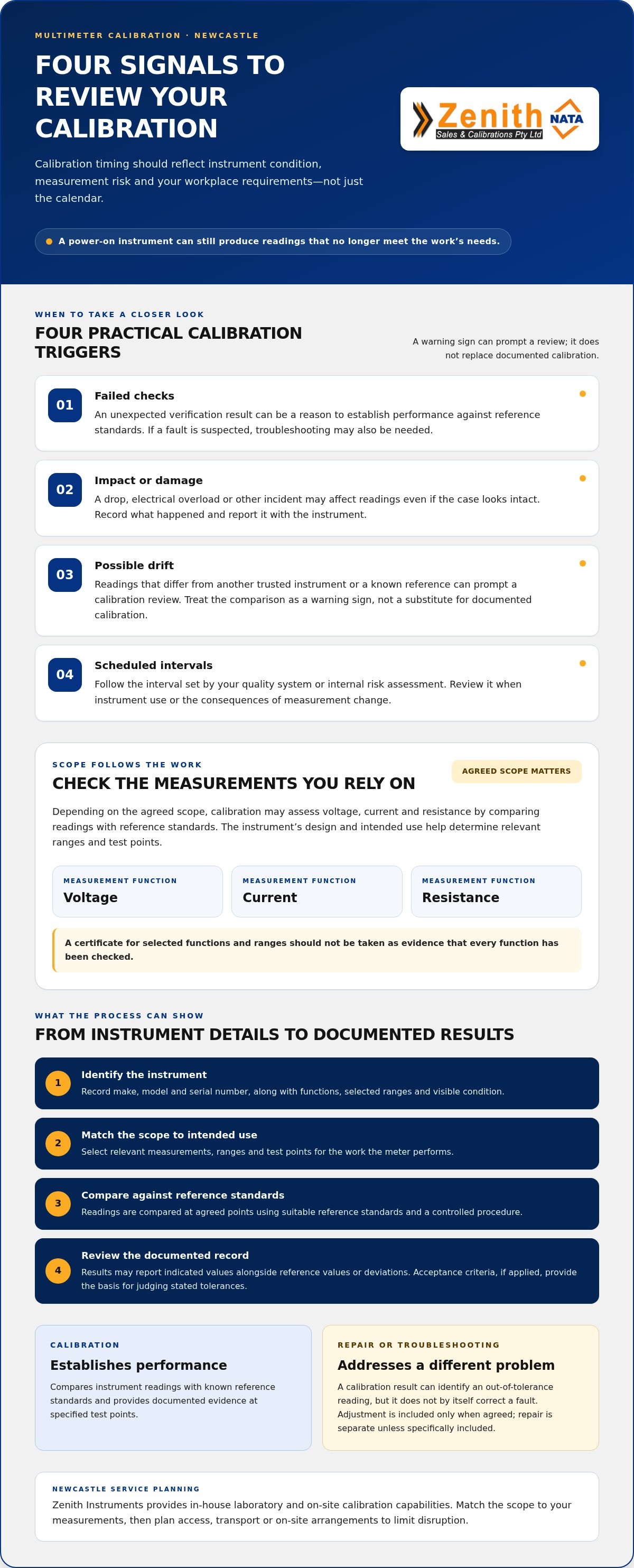
A multimeter can power on and still produce readings that no longer meet your work’s needs. Calibration helps establish how its measurements compare with known reference standards, giving you documented evidence of performance at specified test points. Multimeter calibration compares an instrument’s readings with known standards so users can assess whether it remains suitable for dependable measurements.
For a multimeter calibration service newcastle businesses can use, timing should reflect instrument condition, measurement risk and workplace quality-system requirements, not just the calendar. Calibration is not the same as repair: a result can identify an out-of-tolerance reading, but it doesn’t by itself correct a fault. Adjustment may form part of an agreed scope, while repair or troubleshooting addresses a different problem.
What multimeter calibration checks
Depending on the agreed scope, calibration may assess functions such as voltage, current and resistance by comparing readings with reference standards. The instrument’s design and intended use inform which ranges and test points are relevant. A certificate for selected functions and ranges should not be taken as evidence that every function has been checked. For general background on multimeter functions, see Multimeter calibration.
Why Newcastle workplaces plan calibration
In maintenance, production and electrical work, measurement results can inform decisions about equipment condition, fault diagnosis and process control. A documented calibration record can support internal quality records and provide a reference for reviewing instrument performance. Zenith Instruments’ calibration coverage includes Newcastle; its in-house laboratory and on-site capabilities support different service-planning needs without implying a laboratory is located in Newcastle.
Practical triggers for arranging calibration include:
- Failed checks: If a verification check gives an unexpected result, calibration can help establish instrument performance against reference standards. If a fault is suspected, troubleshooting may also be needed.
- Impact or damage: A drop, electrical overload or other incident may affect readings even when the case looks intact. Record the event and report it with the instrument.
- Possible drift: Readings that differ from another trusted instrument or a known reference can prompt a calibration review. A comparison is a warning sign, not a substitute for documented calibration.
- Scheduled intervals: Follow the interval set by your quality system or internal risk assessment, and review it when the instrument’s use or measurement consequences change.
Routine calibration and troubleshooting answer different questions. A scheduled calibration does not rule out an intermittent fault, and a repair does not automatically provide documented calibration results. For a broader measurement programme, a thermometer calibration service may also help keep temperature instruments’ records aligned with workplace needs. Set the multimeter scope around the measurements your team relies on, then plan access, transport or on-site arrangements to limit disruption.
What Happens During Multimeter Calibration and What Does the Certificate Show?
A documented calibration should make clear which instrument was assessed, what measurements were included and what results were recorded. For a multimeter calibration service newcastle businesses can arrange, that detail helps maintenance and quality teams judge whether the evidence matches the instrument’s role.
Calibration workflow and measurement scope
The process starts with identification. The instrument’s make, model and serial number are recorded, along with its functions, selected ranges and visible condition. Reporting an intermittent fault, damaged lead or unusual display behaviour at this stage helps distinguish a measurement comparison from fault investigation.
Next, the calibration scope is matched to the intended use. A meter used mainly for voltage checks may need different test points from one relied on for current or resistance measurements. The technician compares readings at agreed points against suitable reference standards, following a controlled procedure. Resources such as NIST calibration procedures illustrate how documented procedures support consistent measurement work, although the applicable procedure and scope depend on the service.
Results can show the instrument’s indicated value alongside the reference value or deviation, where reported. Acceptance criteria, if applied, provide the basis for judging whether results meet the stated tolerance. Adjustment is performed only when it forms part of the agreed scope; repair is a separate activity unless specifically included. If adjustment occurs, the record should make clear which results relate to the instrument before and after the work, where applicable.
How to review a multimeter calibration certificate
A certificate is useful when its details let you connect the results to the correct meter and assess their relevance. Review the record systematically rather than relying on a pass statement alone. Zenith’s broader electrical equipment calibration services provide context for calibration across related instrument types.
- Instrument identity: Match the make, model and serial number to the physical meter and your asset register.
- Calibration date and scope: Check the date and the functions, ranges or test points actually covered against your workplace requirements.
- Results and criteria: Review recorded readings or deviations and any stated acceptance limits. A result applies to the points assessed, not automatically to every setting.
- Traceability and endorsement: Read the certificate’s traceability statement and any endorsement carefully. NATA endorsement and accreditation scope must correspond to the service and measurements stated, not be assumed from a general claim.
A calibration certificate documents results for a defined scope; it isn’t a blanket guarantee that an instrument will remain accurate in every use or condition. Retain it with the instrument’s history and use it to support decisions about continued use, adjustment or further investigation. If you’re preparing records for your Newcastle operation, explore Zenith Instruments’ calibration services as part of planning the required scope and documentation.
How to Compare Multimeter Calibration Options for a Newcastle Business
The right arrangement depends on more than where the meter is tested. Compare the calibration scope, the evidence your quality system requires and the practical effect of removing equipment from service. For a multimeter calibration service newcastle operation teams can plan effectively, start by defining the measurements the instrument supports and how long the workplace can manage without it.
Compare service arrangements against operational needs
An in-house laboratory pathway involves sending the instrument to a calibration facility. This can suit planned work where the meter can be taken out of use and the required scope is completed in the laboratory. On-site calibration may help limit equipment removal where access or disruption is a concern, but suitability depends on the instrument’s scope and site conditions, including access to the equipment and a workable area for testing.
Zenith Instruments provides in-house laboratory and on-site calibration capabilities, with service coverage that includes Newcastle. This offers a choice of logistics without implying a laboratory is located in Newcastle. Consider the trade-offs in context:
| Factor | In-house laboratory | On-site calibration |
|---|---|---|
| Scope | Plan the functions, ranges and test points required for the meter’s use. | Confirm the planned scope fits the instrument and site setup. |
| Evidence | Specify the results and certificate details your records require. | Apply the same documentation requirements; location alone doesn’t define the evidence. |
| Logistics | Allow for packing, transport and time without the instrument. | Prepare access and a suitable work area, and coordinate around site operations. |
| Operational fit | Useful where the meter can be scheduled out of service. | May suit operations where removing equipment creates avoidable disruption. |
Match documentation to quality requirements
Before arranging calibration, check your organisation’s quality procedures and any applicable customer requirements. They may specify which measurements must be assessed, what results need recording and whether an endorsed certificate is required. Traceability and NATA endorsement are not interchangeable terms: traceability describes the measurement relationship to recognised standards, while endorsement relates to an accredited scope. The certificate wording and accreditation scope must match the service performed.
Build your comparison around the evidence you’ll actually use. A certificate that records the right functions and ranges is more relevant to your process than a general statement that a meter was calibrated. Zenith’s electrical equipment calibration services place multimeter work within a broader electrical calibration capability.
Finally, weigh downtime against logistics and documentation, not just convenience. A planned maintenance window may make laboratory handling straightforward; a site-based arrangement may better fit equipment that’s difficult to spare. Choose the route that supports the required scope, provides suitable records and fits the realities of your Newcastle operation.
Prepare Your Multimeter and Workplace for Calibration
A well-prepared enquiry helps define the calibration scope and plan the practical details before an instrument leaves service or a technician attends site. For a multimeter calibration service newcastle teams can arrange, provide accurate instrument information alongside the measurements and records your operation needs. This reduces avoidable follow-up and helps align the service plan with workplace requirements.
Information to provide with the instrument
Start with the identification details on the meter’s label and describe how your team uses it. Include accessories that form part of the measurement setup, such as leads or probes, and report any fault symptoms rather than attempting to diagnose them in advance. Clear information helps define relevant test points and avoids assumptions about functions or ranges.
- Instrument: Record make, model, serial number and asset ID, if used.
- Scope: List the functions and ranges relied on, such as voltage, current or resistance, and the specific measurement points your work requires.
- Condition: Note known faults, drift concerns, impact damage, unusual readings or missing accessories.
- Evidence: State the acceptance criteria and certificate requirements set by your quality procedures or customer requirements.
- Constraints: Identify critical equipment, preferred service windows or other operational limits before arranging the work.
Missing identifiers can make it harder to link results to the correct asset. Incomplete scope details can also lead to a mismatch between the measurements tested and those your team depends on. If you’re unsure which functions your meter supports, check its markings or manual; this overview of multimeter functions can help orient your review.
Plan calibration around Newcastle operations
Decide whether a laboratory pathway or on-site arrangement better fits the instrument and workplace. Sending meters to an in-house laboratory can suit planned work where equipment can be removed from use. On-site calibration may reduce equipment movement when the scope and site conditions suit that approach. Zenith Instruments provides both in-house laboratory and on-site capabilities, with service coverage that includes Newcastle.
Before choosing an arrangement, make a short logistics plan:
- Count the instruments and identify which are essential to current maintenance or production work.
- Check site access, any visitor or safety procedures, and whether a suitable work area is available for on-site activity.
- Map calibration against production schedules or maintenance windows, and note any dates when equipment is especially difficult to release.
- For laboratory handling, identify who will pack and dispatch each meter and how its asset details will travel with it.
Share these details together rather than treating calibration as a standalone instrument task. Zenith’s multimeter calibration service can be arranged around the defined scope and your Newcastle operation’s practical needs. Arrange multimeter calibration with Zenith Instruments.
Arrange Multimeter Calibration in Newcastle with Zenith Instruments
Arranging calibration is more straightforward when the instrument details, measurement scope and record requirements are clear from the outset. Zenith Instruments provides multimeter calibration within its wider electrical calibration services, with Australian coverage that includes Newcastle. In-house laboratory and on-site calibration capabilities give businesses different ways to plan the work, depending on operational needs, instrument scope and site conditions.
The service arrangement should suit the meter’s intended use and the evidence your organisation needs. Define whether voltage, current, resistance or other functions matter, and identify the ranges your team relies on. For a broader overview of multimeter functions, consult this multimeter guide. A laboratory pathway involves sending the instrument to a calibration facility; on-site calibration may reduce equipment movement when the scope and workplace conditions are suitable.
What to include in a calibration enquiry
Give us enough information to understand the instrument and its working role. Accurate identifiers help connect the calibration record to the right asset, while clear requirements help shape relevant test points, documentation and logistics. Include any customer or quality-system requirements that affect the certificate or acceptance criteria.
- Instrument details: Make, model, serial number and asset number, if applicable.
- Required scope: Functions and ranges used, plus measurement points important to the work.
- Condition: Known faults, suspected drift, damage or unusual readings.
- Operational needs: Quantity of meters, critical equipment, access considerations and scheduling constraints.
- Records: Certificate and traceability requirements, including any applicable customer specifications.
Incomplete or incorrect details can make scope definition less precise and complicate planning. For example, listing “voltage” alone may not identify which ranges your technicians use or which readings are important to the application. Providing the practical context helps us align the calibration work with your requirements.
Connect calibration with wider electrical equipment needs
Where a site manages several electrical instruments, consistent asset identification and recordkeeping can make calibration histories easier to review across a maintenance or quality programme. Zenith’s electrical equipment calibration services connect multimeter calibration with related electrical measurement needs. Certificate wording and endorsement depend on the applicable service scope, so define the evidence required by your procedures rather than assuming every instrument follows the same documentation route.
Newcastle businesses can plan around laboratory or on-site capabilities without assuming a local laboratory address or a fixed turnaround. Share instrument quantities, access details and the operational windows that matter, so the service plan can account for equipment movement or site coordination.
Ready to arrange multimeter calibration in Newcastle? Send Zenith Instruments the make, model, serial number, required functions and ranges, known faults, certificate requirements and any operational constraints. Provide your multimeter details and calibration requirements to begin planning the appropriate scope and service arrangement.
Put Your Calibration Plan Into Action
Use your next calibration cycle to make instrument records more useful, not simply to close a scheduled task. Decide which measurements are essential to your work, what evidence your quality process needs, and how you’ll use the results to manage the meter’s ongoing suitability. That gives your team a clear basis for planning future checks and responding to unexpected readings.
If you’re arranging a multimeter calibration service newcastle operation can rely on, prepare the instrument identifiers, required functions and ranges, any known issues, and your documentation requirements. These details help define a practical scope and service arrangement around how the meter is used.
Zenith Instruments is an Australian calibration provider founded in 2004, with service coverage that includes Newcastle and in-house laboratory and on-site capabilities. Take the next step by sharing your instrument and operational requirements with our team.
Arrange multimeter calibration with Zenith Instruments, and move forward with a clear, well-documented plan for your equipment.
Frequently Asked Questions
How often should a multimeter be calibrated?
Set the interval through your quality system or a documented risk assessment, rather than assuming one schedule suits every meter. A multimeter used daily for decisions affecting production may warrant a different review interval from a rarely used backup. Consider use frequency, measurement importance, past calibration results and any damage or unusual readings. Review the interval if the instrument’s role changes or repeated results indicate that the current schedule needs attention.
What does a multimeter calibration certificate show?
A certificate records the instrument and the results for the defined calibration scope. Use it to check that the asset identifier matches your records, then file it against the correct meter and update its calibration history. For example, if your asset register tracks separate workshop and field instruments, matching serial numbers prevents certificates being assigned to the wrong unit. Read any limitations alongside the results before using them to support decisions about the meter.
Is multimeter calibration available onsite in Newcastle?
Zenith Instruments provides on-site calibration capabilities and serves Newcastle. Whether a particular multimeter can be calibrated on-site depends on its measurement scope and site conditions. For example, access, a suitable work area and the planned test requirements may affect the arrangement. Share the instrument details and workplace constraints when planning a multimeter calibration service in Newcastle, so the service pathway can be considered against the equipment and operational setting.
Can a multimeter be adjusted during calibration?
Yes, adjustment can be included when it forms part of the agreed service scope and is appropriate for the instrument. Calibration results may identify a deviation, but adjustment is a separate action, not an automatic part of every comparison. If your procedure requires evidence of performance before and after adjustment, state that requirement in advance. A meter with physical damage or an intermittent fault may also need repair or diagnosis beyond calibration.
How long does multimeter calibration take?
There isn’t one fixed duration for every multimeter calibration. The scope, number of functions and ranges, instrument condition, and whether the work is arranged through a laboratory or on-site pathway can affect planning. If the meter supports critical work, identify a maintenance window or backup instrument before arranging service. Provide the instrument details and operational constraints early so the logistics can be planned around your site’s needs.
What should I provide when arranging multimeter calibration?
Provide the make, model, serial number, asset ID if used, functions and ranges required, and any known faults or recent damage. Include the number of instruments, their intended measurement use, certificate requirements and any acceptance criteria your quality procedures specify. For a group of meters, a simple register linking each serial number to its work area can help keep instruments and records correctly matched during service planning.
Does multimeter calibration need to be NATA-endorsed?
Not every application requires a NATA-endorsed certificate. The appropriate evidence depends on your quality procedures, customer requirements and the calibration scope. Traceability and NATA endorsement describe different aspects of calibration documentation, so don’t treat the terms as interchangeable. If endorsement is required, specify that before service and ensure the certificate’s stated scope corresponds to the measurements being calibrated. Your quality manager or customer specification can guide the evidence required for the task.