

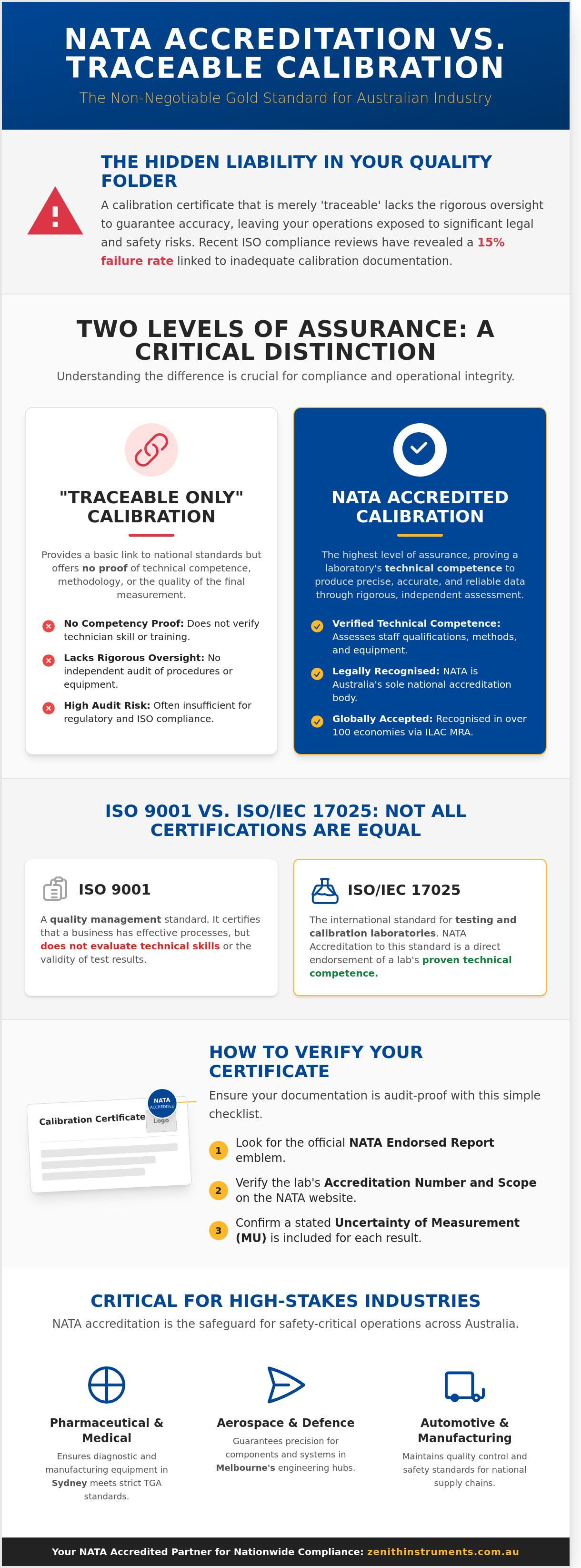
A calibration certificate that merely claims to be traceable is often the single biggest liability sitting in your quality folder. While it might look official, it lacks the rigorous oversight that keeps your operations within legal and safety bounds. We know that the distinction between being traceable and holding full nata accreditation is a common point of confusion for engineers in Sydney and Melbourne. You shouldn't have to guess whether your pressure gauges or thermal imaging tools will pass a 2026 regulatory audit.
We've developed this guide to explain why NATA accreditation remains the non-negotiable gold standard for precision and how it protects your business from the 15% failure rate seen in recent ISO compliance reviews. You'll discover how to eliminate equipment downtime through faster lab turnarounds and gain absolute confidence in your measurement accuracy. We'll outline the exact steps to ensure your documentation is audit-ready, providing a clear path to full regulatory compliance across all Australian industrial hubs.
Key Takeaways
- Understand the critical distinction between standard ISO 9001 certification and the technical rigor of ISO/IEC 17025 to ensure your instrumentation meets Australian regulatory standards.
- Learn how NATA-endorsed calibration safeguards safety-critical operations across Sydney’s pharmaceutical sectors and Melbourne’s aerospace and automotive engineering hubs.
- Discover the essential steps for verifying a calibration certificate, including how to identify the official emblem and validate the specific scope of accreditation for your equipment.
- Gain insights into why nata accreditation is the non-negotiable gold standard for technical competence, protecting your business from the legal and operational risks of measurement inaccuracy.
- Identify how a nationwide partner with strategic laboratory locations can streamline your compliance through comprehensive onsite services and industry-leading turnaround times.
What is NATA Accreditation? Understanding the Australian Standard
NATA (National Association of Testing Authorities) serves as the sole national body for laboratory accreditation in Australia. It functions as a critical pillar of the nation's "Standards and Conformance" infrastructure, operating alongside Standards Australia and the National Measurement Institute (NMI). While many professionals confuse it with general business certification, nata accreditation specifically confirms a facility's technical competence to produce accurate and reliable data. It's the difference between having a good management system and having the technical expertise to use a pressure gauge correctly. What is NATA Accreditation? It's the primary benchmark for laboratory performance across the country.
Understanding the gap between ISO 9001 and ISO/IEC 17025 is vital for compliance. ISO 9001 is a quality management system certification that applies to any business; it doesn't evaluate technical skills. Conversely, accreditation against ISO/IEC 17025 involves a rigorous peer review of staff qualifications, equipment maintenance, and testing methodologies. We see this distinction in high-stakes sectors like medical diagnostics or structural engineering where a simple certified system isn't enough to ensure safety. Only accreditation provides the technical assurance required for industrial precision.
The History and Authority of NATA in Australia
Established in 1947, NATA was the first comprehensive laboratory accreditation body in the world. It was created to drive industrial growth after World War II by ensuring local manufacturing met global standards. Today, it maintains a formal Memorandum of Understanding with the Australian Commonwealth Government. This agreement recognizes NATA as the sole authority for accrediting laboratories. Through the ILAC Mutual Recognition Arrangement, NATA-endorsed reports are recognized in over 100 economies globally, facilitating international trade for Australian exporters.
Accreditation vs. Traceable Calibration
Every measurement must be traceable to national standards maintained by the NMI. However, traceable calibration alone doesn't prove a technician is performing the test correctly. NATA endorsement adds a layer of legal and technical validity that standard calibration lacks. This oversight ensures that when we provide electrical equipment calibration, the results stand up to the strictest regulatory scrutiny. Obtaining nata accreditation means a facility has been audited by experts to prove its results are repeatable and scientifically sound.
NATA is the independent evaluator of a laboratory’s technical ability to perform specific tests.
The Technical Pillars of ISO/IEC 17025 and NATA Endorsement
ISO/IEC 17025:2017 serves as the definitive global benchmark for testing and calibration laboratories. It's not merely a set of guidelines; it's a rigorous framework that mandates 100% compliance with technical and management requirements. When NATA assessors visit a facility, they scrutinize the specific qualifications of personnel and the fitness of the equipment used. These assessments typically occur on an 18 to 24-month cycle to ensure that technical expertise doesn't stagnate. We understand that nata accreditation is a badge of technical excellence that proves a laboratory can produce consistently accurate data under strictly controlled conditions.
The concept of "Uncertainty of Measurement" (MU) remains a cornerstone of any accredited result. Without a calculated MU, a measurement lacks its necessary context. It provides a statistical range that quantifies the doubt inherent in any measurement process. Understanding Why NATA Matters for Industries involves recognizing that these precise calculations prevent costly errors in sectors like aerospace and medical manufacturing. To maintain this level of precision, labs must participate in regular Proficiency Testing (PT). These external blind tests compare a lab's results against other accredited facilities to identify any systemic biases or equipment drifts before they impact client operations.
Technical Competence and Equipment Standards
Precision starts with the validation of methods. Every calibration procedure we use undergoes a rigorous validation process to confirm it's fit for its intended purpose. We maintain our own reference standards with direct traceability to the International System of Units (SI). High-precision environments, such as those used for dimensional calibration, often require strict environmental controls. This includes maintaining temperatures at 20°C with a tolerance of only ±1°C to eliminate errors caused by thermal expansion. Equipment isn't just "checked"; it's managed through a disciplined maintenance schedule that prevents downtime and ensures reliability.
Document Control and Reporting
Standardised reporting is a non-negotiable aspect of compliance. A valid NATA-endorsed certificate must clearly display the NATA logo and the laboratory’s unique accreditation number. This visual marker tells auditors and regulators that the results are legally defensible. We maintain comprehensive record-keeping protocols that secure all raw data and calibration certificates for a minimum of 7 years. This ensures a complete audit trail, allowing us to reconstruct the exact conditions and equipment used for any specific job years after the fact. Our team provides NATA accredited calibration services in Sydney and across Australia to help your business satisfy these complex record-keeping mandates without the administrative burden.
Why NATA Matters for Industries in Sydney, Melbourne, and Brisbane
Industrial hubs across Sydney, Melbourne, and Brisbane operate under strict regulatory scrutiny that demands absolute measurement traceability. Maintaining standards set by the National Association of Testing Authorities, Australia (NATA) isn't just a recommendation; it's a prerequisite for market access and operational safety. In Brisbane and Newcastle, mining and heavy industry sectors rely on precise instrumentation to prevent catastrophic equipment failure. A single inaccurate reading in high-pressure environments can trigger an immediate site shutdown, costing operators upwards of A$180,000 per day in lost productivity. Our NATA-endorsed pressure gauge calibration services mitigate these risks by providing the technical certainty required for 2026 compliance audits.
Melbourne’s aerospace and automotive engineering hubs require similar levels of precision to maintain global supply chain certifications. In these safety-critical applications, nata accreditation provides the framework for verifying that every component meets rigorous design tolerances. We help firms navigate these requirements by delivering meticulous calibration data that stands up to the most demanding technical assessments.
Medical and Pharmaceutical Compliance
Sydney’s pharmaceutical manufacturing plants and Melbourne’s research laboratories must adhere to strict TGA and hospital audit protocols. We deliver specialized biomedical equipment calibration services for the NSW health sector to ensure diagnostic tools remain accurate and reliable. For Melbourne-based labs, we conduct critical temperature mapping for vaccine and drug storage. Even a 0.5°C deviation in a cold chain environment can compromise millions of dollars in pharmaceutical stock. Maintaining nata accreditation ensures these facilities remain compliant with ISO 17025 standards and local health regulations.
Infrastructure and Construction Safety
Tier 1 contractors on major civil projects in Sydney and Canberra now mandate NATA-endorsed reports for all site instrumentation. Ensuring structural integrity begins with the basics; we provide certified dumpy laser level calibration to prevent alignment errors that lead to expensive rework. Precision in torque and tension measurement is equally vital for steel assembly and bridge construction. By utilizing a NATA-accredited laboratory, engineering firms secure a defensive layer of documentation that proves their equipment was fit for purpose during every phase of the build.
Verification Guide: How to Read a NATA Calibration Certificate
Receiving a calibration report is only the first step in maintaining your compliance framework. We ensure our clients understand that a certificate’s validity hinges on specific technical markers required by nata accreditation standards. You must first locate the NATA emblem. This logo must be accompanied by a unique accreditation number, typically found directly beneath the symbol. Without this number, the document lacks the legal standing of a NATA-endorsed report and cannot be used for high-stakes regulatory audits in sectors like medical manufacturing or aviation.
Next, verify the Scope of Accreditation. We recommend cross-referencing the laboratory's number on the NATA website to confirm they're authorized for your specific measurement range and instrument type. Every valid certificate requires the signature of an Approved Signatory. This individual has been personally vetted by NATA for technical competence and assumes responsibility for the data's accuracy. Finally, analyze the Measurement Uncertainty values. If a pressure gauge shows an uncertainty of 0.2% but your internal process requires 0.1% accuracy, the instrument is technically unfit for your specific application regardless of its "pass" status. We provide detailed uncertainty data to ensure your tolerances are always met with 100% confidence.
Spotting Non-Compliant Documentation
Distinguishing between high-level quality management and technical competence is vital for site safety. A generic "ISO 9001 Certified" stamp indicates business processes are managed, but it doesn't prove measurement accuracy or traceability to national standards. Red flags include missing uncertainty intervals, hand-written corrections without initials, or certificates from labs with expired credentials. A NATA number must correspond to the specific service performed, not just the lab’s general status. If the documentation lacks a clear traceability statement to the SI units of measurement, it won't survive a rigorous 2026 industry audit.
Digital Transformation and AI in 2026
By 2026, the Australian calibration industry has transitioned toward fully digital, machine-readable certificates. We now utilize QR code verification on all equipment labels to provide instant, tamper-proof access to calibration history and PDF reports. AI-driven systems in modern Australian laboratories now flag data outliers with 99.9% precision, ensuring human fatigue doesn't compromise your results. These advancements align with the "Accreditation Matters 2026" standards update, which mandates stricter electronic record integrity and real-time data validation for all accredited facilities. Preparing for these changes now prevents costly downtime during your next accreditation cycle.
Zenith Instruments: Your NATA Accredited Partner for Nationwide Compliance
We provide the technical foundation for your regulatory success across the Australian industrial landscape. Our team delivers comprehensive NATA-certified standards across pressure, electrical, and temperature instrumentation to ensure your facility meets the highest benchmarks of precision. Securing nata accreditation for your equipment isn't just a box-ticking exercise; it's a critical safety and quality requirement for 2026 compliance. We maintain rigorous quality controls to ensure every measurement aligns with stringent ISO/IEC 17025 frameworks.
- Precision calibration for high-pressure systems and industrial vacuum gauges.
- NATA-traceable electrical testing for complex high-voltage environments.
- Temperature mapping and thermal imaging for medical, cold chain, and food storage.
- Expert technical support for complex instrumentation repairs and preventative maintenance.
Our engineers don't just verify numbers. We provide a proactive service model that identifies potential instrument drift before it leads to costly production failures. By integrating technical expertise with a commitment to international standards, we reassure our partners that their equipment remains in the hands of meticulous experts.
Sydney and Melbourne Laboratory Excellence
Our primary facilities in Chipping Norton (NSW) and Cheltenham (VIC) serve as the central hubs for our metropolitan operations. We offer specialized calibration services in Sydney that cater to the specific needs of the pharmaceutical, aerospace, and construction sectors. We understand that a 72-hour delay in calibration can stall an entire production line. That's why we prioritize fast turnaround times for critical Australian industries. Local contractors specifically rely on our electrical equipment calibration to meet AS/NZS 3000 standards without administrative delay.
National Coverage: Brisbane, Canberra, and Beyond
We bridge the gap between regional operations and metropolitan precision by mobilising expert technicians for on-site service calls across Australia. Whether you operate a mining site in regional Queensland or a manufacturing plant in Canberra, our mobile units bring the laboratory to you. This on-site approach reduces equipment downtime by 100% because your tools never leave the premises. We support the heavy mining and manufacturing sectors with NATA-endorsed standards, ensuring that even the most remote operations maintain global quality benchmarks. Our technicians provide a comprehensive audit of your instrumentation needs to ensure long-term reliability. Contact us today to secure your compliance audit and keep your operations running at peak performance.
Securing Your Operational Precision for 2026 and Beyond
Navigating the complexities of 2026 compliance requires more than just meeting basic requirements; it demands a commitment to technical excellence. We've established that nata accreditation isn't merely a badge but a rigorous validation of a laboratory’s competence under the ISO/IEC 17025 framework. Maintaining these standards ensures your pressure and thermal instrumentation deliver 100% accuracy, preventing costly downtime in Sydney and Melbourne’s competitive industrial sectors. Our team at Zenith Instruments operates as a NATA Accredited Facility, providing the specialized expertise needed to interpret complex calibration certificates and maintain regulatory alignment. We focus on rapid turnaround times to keep your operations moving without sacrificing the meticulous detail your equipment requires. By partnering with our expert technicians, you're securing a localized service that understands the exact logistical demands of Australian manufacturing and engineering. We've optimized our workflows to ensure every instrument meets the strict 2026 guidelines, giving you total confidence in your data. We're here to help you uphold the highest levels of safety and precision across every project. Let's ensure your facility remains a leader in industry standards.
Book Your NATA-Endorsed Calibration with Zenith Instruments Today
Frequently Asked Questions
What is the difference between NATA accreditation and ISO 9001 certification?
ISO 9001 is a generic quality management system that focuses on business processes, while NATA accreditation specifically assesses the technical competence of a laboratory. While ISO 9001 confirms a business follows its own documented procedures, NATA ensures the technical validity of measurement results through the ISO/IEC 17025 standard. In Australia, 100% of laboratories providing legally defensible data for critical infrastructure must hold NATA accreditation to prove their technical proficiency.
Is NATA accreditation mandatory for all Australian businesses?
NATA accreditation isn't mandatory for every business, but it's a legal requirement for those operating in regulated sectors like aviation, medical pathology, and government construction. Since its establishment in 1947, NATA has served as the sole national body for laboratory oversight. If your specific industry contract requires compliance with Australian Standards, such as AS/NZS 3760, you'll need NATA-endorsed reports to meet your 2026 compliance obligations and avoid insurance liabilities.
How can I check if a calibration laboratory is currently NATA accredited?
You can verify a laboratory's status by searching the "Find an Accredited Facility" directory on the official NATA website. Every certified facility is assigned a unique accreditation number, such as Accreditation No. 12345, which must appear on their documentation. We recommend reviewing the laboratory's "Scope of Accreditation" to ensure they're authorized for your specific instrument range. This directory is updated daily to reflect the current compliance status of facilities across Australia.
Can NATA calibration be performed on-site at my facility in Melbourne?
Yes, we perform NATA calibration on-site at Melbourne facilities to minimize equipment downtime and eliminate transit risks. Our mobile units service the Melbourne metropolitan area and regional Victoria, covering pressure, electrical, and thermal instrumentation. This on-site approach removes the typical 3 to 5 day delay associated with laboratory shipping. It ensures your operations remain productive while we maintain the high technical standards required for your 2026 regulatory audits.
Does a NATA calibration certificate expire?
A NATA calibration certificate doesn't have a fixed expiry date, but its validity depends on your industry's specific recalibration intervals. Most Australian manufacturing and engineering firms adopt a 12-month cycle as recommended by ISO 10012 protocols. If your equipment drifts beyond its specified tolerance before your next scheduled check, the certificate no longer guarantees accuracy. We provide automated tracking to ensure your instruments stay within their 365-day compliance window for maximum safety.
What happens if I use a non-NATA lab for my pressure gauge calibration?
Using a non-NATA lab for pressure gauge calibration puts your business at risk of legal non-compliance during a Work Health and Safety (WHS) audit. Without the NATA emblem, your reports lack the documented traceability to national standards required by Australian law. This can result in fines exceeding A$50,000 in the event of an industrial accident. You also lose the technical assurance that the technician followed the rigorous ISO/IEC 17025 methodology during the testing process.
How much more does a NATA-endorsed calibration cost compared to a standard check?
A NATA-endorsed calibration typically costs between A$45 and A$155 more than a standard non-accredited check, depending on the complexity of the instrument. This price reflects the cost of rigorous technical audits, specialized equipment maintenance, and the high-level expertise required to maintain accreditation. While the initial investment is higher, it prevents the significant financial losses associated with re-testing or legal penalties that arise from using unverified measurement data in your 2026 operations.
What is an "Approved Signatory" in the context of NATA?
An Approved Signatory is a technical expert whom NATA has formally evaluated and authorized to sign off on endorsed reports. This individual must demonstrate at least 5 years of relevant industry experience and a comprehensive understanding of measurement uncertainty. They take personal responsibility for the technical integrity of every calibration result. Their signature on your certificate confirms that the work performed meets the highest Australian benchmarks for precision and adherence to international standards.