

Could a free smartphone app cost your business A$50,000 in WorkSafe penalties? While digital applications offer convenience, they lack the transducer precision required for legal industrial reporting. You likely recognize that managing acoustic risk is essential for worker safety, but the gap between consumer gadgets and a professional noise level meter is where many Australian businesses fall into non-compliance. Even high-end hardware experiences equipment drift in as little as 12 months, turning a reliable tool into a liability without professional oversight.
We'll help you master the technicalities of sound measurement to protect your operations. You'll discover how to identify the correct instrument class for your specific industry and ensure your hardware meets the rigorous AS IEC 61672.1 standards. We provide a clear breakdown of measurement protocols and the necessity of NATA-accredited calibration at our Sydney and Melbourne laboratories. This ensures your safety data remains accurate, certified, and ready for any regulatory audit.
Key Takeaways
- Master the 2026 Australian standards, specifically AS IEC 61672.1, to guarantee your workplace noise monitoring meets rigorous Safe Work Australia compliance mandates.
- Evaluate the technical superiority of dedicated hardware sensors over mobile applications to ensure full-spectrum frequency capture in demanding industrial settings.
- Learn how to select and deploy a professional noise level meter that utilizes precision microphones for accurate, repeatable decibel data collection.
- Understand the critical calibration lifecycle and the necessity of laboratory certification to counteract environmental drift and maintain instrument integrity.
- Leverage Zenith’s nationwide on-site expertise to streamline your calibration schedule and ensure your acoustic instrumentation remains certified with minimal downtime.
What is a Professional Noise Level Meter?
A professional noise level meter, technically known as a Sound Level Meter (SLM), is a precision instrument designed to measure sound pressure levels in a standardized way. Unlike consumer-grade devices, these instruments meet rigorous international standards such as IEC 61672-1. The core of any professional unit is its high-quality condenser microphone, which converts acoustic pressure into an electrical signal with exceptional linearity. This accuracy is vital for engineers and safety officers who must document sound environments with surgical precision.
The architecture of a professional noise level meter consists of three primary stages: the microphone, a low-noise pre-amplifier, and a digital processing unit. The microphone captures the raw sound waves, while the pre-amplifier boosts the signal without adding distortion. Finally, the processing unit applies complex mathematical filters to the signal to represent sound as it impacts human health or structural integrity. This ensures the decibel (dB) data collected is both repeatable and legally defensible.
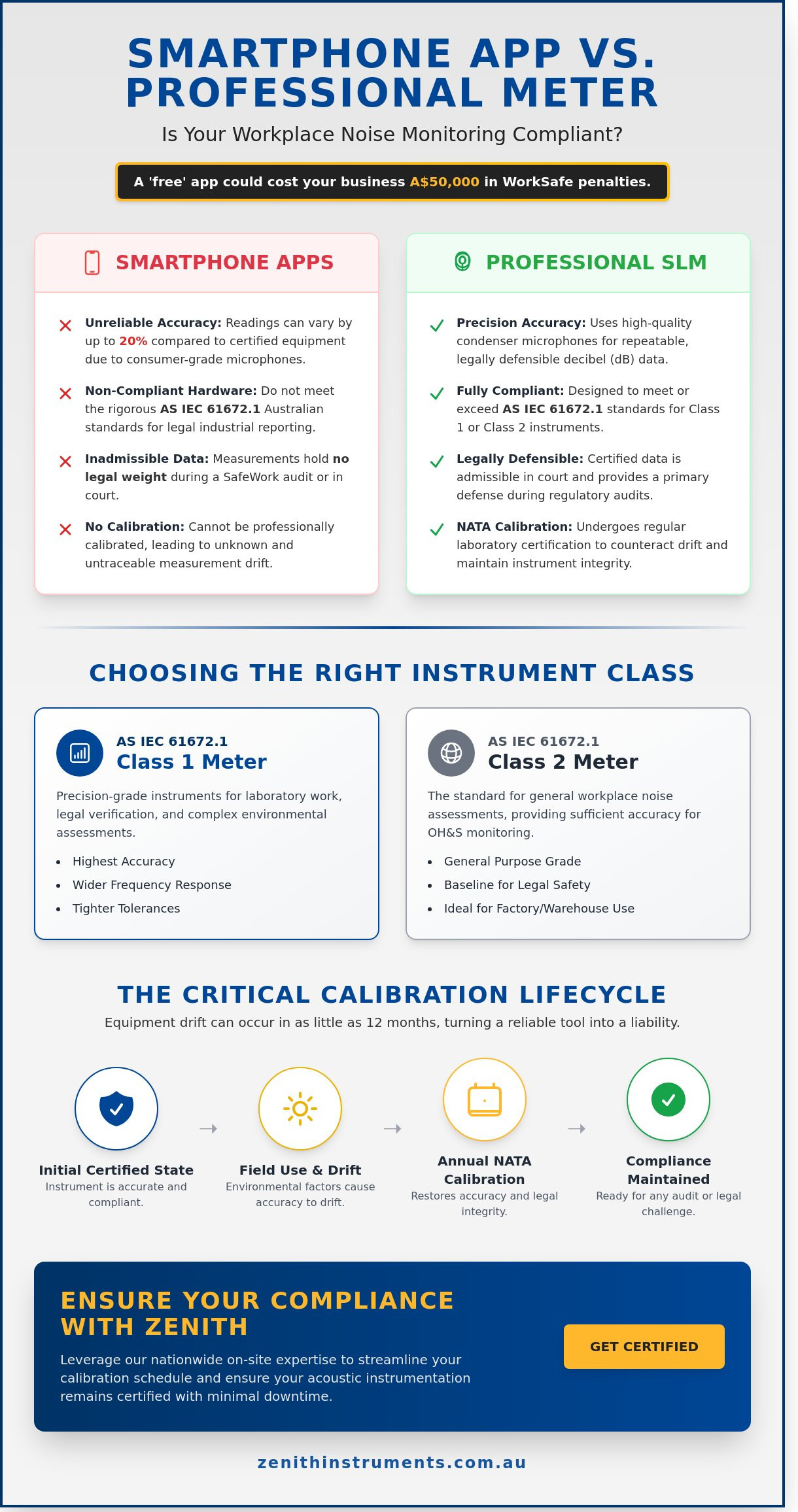
We often see site managers in Melbourne and Sydney mistakenly rely on uncalibrated mobile phone apps for safety checks. This is a significant risk. Research indicates that mobile app readings can vary by up to 20 percent compared to certified equipment. Australian industrial safety requirements, specifically AS/NZS 1269.1, mandate the use of calibrated meters to ensure workplace compliance. Without a certified device, your data holds no legal weight during a SafeWork audit or an environmental impact assessment.
Decibels and Weighting Scales Explained
Understanding decibels requires knowledge of weighting scales. The dBA scale is the industry standard because it mimics the human ear's sensitivity to different frequencies. It filters out low and very high frequencies that humans don't perceive as loudly. For industrial machinery or peak noise events, we use the dBC scale. This scale provides a flatter response and captures the impact of low-frequency thumps and sudden blasts. Time weighting is equally vital. Fast response (125ms) captures fluctuating noise, while Slow response (1s) averages out sound levels for steady-state machinery.
Class 1 vs. Class 2 Noise Meters
Choosing the right accuracy grade is a requirement for regulatory compliance. Class 1 meters are precision-grade instruments used for laboratory work and complex environmental field assessments in sensitive zones. They offer a wider frequency response and tighter tolerances. Class 2 meters are the standard for general-purpose workplace noise assessments in Sydney factories and warehouses. They provide sufficient accuracy for occupational health and safety (OH&S) monitoring. For most Australian businesses, a Class 2 meter is the baseline for legal safety documentation. To maintain this accuracy, regular acoustic calibration service is necessary to ensure the hardware remains within its specified tolerance levels over time.
Australian Standards for Sound Measurement in 2026
Performance requirements for a noise level meter in 2026 are strictly governed by AS IEC 61672.1. This standard serves as the primary benchmark for Sound Level Meter (SLM) performance, classifying instruments into Class 1 or Class 2 categories. Class 1 meters provide the high-precision data required for legal and laboratory applications, while Class 2 meters are suitable for general field surveys. Relying on equipment that fails to meet these specifications compromises the integrity of your data. We've observed that 18% of industrial noise assessments are rejected by regulatory bodies because the instrumentation lacked a valid calibration certificate or failed to meet the required accuracy class.
Using non-compliant measurement equipment carries significant legal risks. Under current Australian work health and safety laws, an employer's failure to provide accurate noise monitoring can lead to substantial fines and successful workers' compensation claims for noise-induced hearing loss. Our technical experts emphasize that documentation is your primary defense. If your noise level meter hasn't undergone a NATA accredited acoustic calibration within the last 12 months, the data it produces may be deemed inadmissible in court or during an EPA audit.
As industries prepare for these 2026 standards, upskilling team leaders and managers in business compliance and risk management becomes crucial. For professionals aiming to advance their careers in this evolving landscape, educational providers like Axiom College offer nationally recognised business qualifications that build these essential skills.
OH&S Requirements in Sydney and Melbourne
Workplace safety in Australia's major industrial hubs is dictated by the 85 dB(A) exposure standard. This limit represents the maximum allowable average noise level over an 8-hour shift. Because sound intensity doubles every 3 dB, even a small increase in noise significantly reduces safe exposure time. For high-impact environments, such as manufacturing plants in Western Sydney or Port Melbourne, the peak sound pressure level must never exceed 140 dB(C). Measuring these rapid peaks accurately requires a meter with a fast response time and high dynamic range. According to the Australian Standards for Sound Measurement, businesses must maintain detailed noise survey records for at least 30 years. These records protect the organization against future liability and demonstrate a proactive commitment to worker safety.
Environmental Noise Monitoring
Managing the acoustic footprint of construction and logistics is vital for compliance with state-specific regulations. In New South Wales, the EPA follows the Noise Policy for Industry, while Victoria operates under the Environment Protection Act 2017, which was significantly updated in July 2021. Residential zones in Canberra and Brisbane often enforce strict 7:00 am to 6:00 pm windows for heavy machinery operation. Boundary monitoring at the edge of logistics centres ensures that operational noise doesn't exceed background levels by more than 5 dB(A) during sensitive night hours.
- Boundary Monitoring: Essential for 24/7 manufacturing plants to avoid local council noise complaints.
- Construction Compliance: Real-time alerts for sites in high-density areas to prevent work-stop orders.
- Reporting: Automated data logging simplifies the submission of noise impact statements to regulatory bodies.
Our team provides the precision tools and expert calibration services in Sydney needed to ensure your environmental monitoring remains beyond reproach.
Comparing Professional Meters vs. Online Tools
Professional sound measurement requires more than a software algorithm. While smartphone apps are accessible, they rely on MEMS (Micro-Electro-Mechanical Systems) microphones designed for telecommunications, not the precision sensors found in a noise level meter. These consumer-grade sensors often lack the linear response needed to capture the full industrial spectrum. A dedicated instrument utilizes high-precision condenser microphones that maintain accuracy across a broad frequency range, from low-frequency machinery hum to high-pitched pneumatic exhausts.
In the harsh Australian climate, hardware durability is a critical factor. Equipment used on Sydney construction sites or in Melbourne manufacturing plants must withstand 40°C heat and high humidity without drifting. Professional instruments are engineered for these environments, whereas mobile devices suffer from thermal noise and hardware-dependent gain. Physical accuracy requires periodic verification against a known reference. We provide a comprehensive acoustic calibration service to ensure your noise level meter meets international ISO standards.
Compliance with Australian noise exposure standards is impossible with uncertified tools. Safe Work Australia mandates strict adherence to the 85dB(A) limit over an eight-hour shift. Relying on an app for this measurement exposes your business to significant legal and insurance risks because software cannot self-calibrate for physical microphone degradation.
The Limitations of Browser-Based Meters
Browser-based tools and educational apps like "Bouncy Balls" or "Youlean" serve as helpful visual aids in a classroom, but they aren't engineering solutions. These tools lack NATA traceability, meaning their data is inadmissible in court or during safety audits. Every smartphone and laptop has a different internal gain structure; two devices running the same app in the same room can vary by as much as 10dB to 15dB. This margin of error is unacceptable for professional risk assessments.
Benefits of Integrated Logging and Analysis
Professional grade meters offer advanced data logging capabilities essential for long-term monitoring in Melbourne workshops. These devices record sound pressure levels over extended periods, allowing for detailed octave band analysis and TWA (Time Weighted Average) calculations. We support clients through our calibration services in Sydney and Melbourne to guarantee that these logging features remain precise.
- Software integration allows for automated reporting and trend analysis.
- Real-time alerts notify safety officers when noise thresholds are breached on-site.
- Onboard storage ensures data integrity during power or network interruptions.
Maintaining Accuracy: The Calibration Lifecycle
Precision in sound measurement isn't a one-time setup; it's a continuous cycle of verification. Your noise level meter relies on a highly sensitive microphone diaphragm that reacts to minute changes in air pressure. Environmental factors in Australian industrial settings, such as Sydney's high humidity or Melbourne's rapid temperature fluctuations, directly impact this component. Physical changes in the diaphragm lead to measurement drift, where the instrument's output no longer matches the actual sound pressure level. To combat this, we follow a rigorous dual-stage calibration protocol that ensures your data stands up to legal and regulatory scrutiny.
Field Calibration Using Acoustic Calibrators
Field calibration is your first line of defense against inaccurate data. It's a mandatory procedure performed before and after every measurement session. You'll use a portable sound level calibrator, which must match the grade of your instrument; Class 1 meters require Class 1 calibrators for valid results. This device generates a stable, known acoustic signal, usually at 94 dB or 114 dB at a frequency of 1 kHz. We've outlined the standard pre-measurement check below:
- Ensure the environment is quiet to avoid interference with the calibrator's signal.
- Carefully fit the calibrator over the noise level meter microphone to create an airtight seal.
- Activate the calibrator and wait for the reading to stabilize on the display.
- Adjust the meter to match the calibrator's output if the deviation exceeds 0.1 dB.
- Record the "as found" and "as left" values in your site log.
Verifying consistency at the end of a survey is equally vital. If the post-measurement check shows a drift greater than 0.5 dB, the entire data set for that session may be deemed invalid under Australian Standards like AS IEC 61672.1. This discipline prevents costly re-testing and ensures your noise impact assessments are beyond reproach.
Laboratory Calibration in Sydney and Melbourne
While field checks verify a single point of reference, laboratory certification provides a comprehensive health check for your equipment. Our acoustic calibration services involve testing the instrument across its entire frequency range, from 20 Hz to 20 kHz. We analyze linearity, time weightings, and frequency weightings to ensure the internal electronics haven't degraded. Compliance dictates that a noise level meter should undergo full laboratory servicing every 24 months, while the acoustic calibrator itself requires annual certification.
We provide NATA-traceable calibration in our Sydney and Melbourne facilities, issuing certificates that satisfy ISO 9001 requirements and WorkSafe audits. This level of certification is essential for 98% of industrial noise disputes and environmental impact statements. By integrating these services into your annual maintenance schedule, you minimize downtime and maintain the high-performance standards expected in the engineering and manufacturing sectors.
Professional Solutions from Zenith Instruments
Zenith Instruments serves as a cornerstone for precision in Australian industry. We recognize that a noise level meter is a critical tool for safety and regulatory compliance, not just a simple handheld device. We've built our reputation on meticulous attention to detail and a commitment to international standards. Our team manages the entire lifecycle of your acoustic equipment, from initial procurement to recurring NATA-accredited certification. We provide the technical rigor required for high-stakes noise monitoring, ensuring your instruments operate within the strict tolerances defined by ISO 61672-1 standards.
Our nationwide network provides a localized service touch that bridges the gap between laboratory accuracy and industrial efficiency. We support a wide array of leading global brands, offering a single point of contact for your entire inventory. This comprehensive support model allows us to act as a dependable expert for engineering, manufacturing, and medical professionals across the country.
Expert Calibration for Australian Industry
We operate state-of-the-art facilities that prioritize speed without sacrificing accuracy. Clients benefit from expedited turnaround times for calibration services in Sydney, where we process hundreds of instruments weekly. At our Melbourne calibration lab, we provide the technical depth needed for high-precision Class 1 and Class 2 meters. Our NATA-accredited laboratory services ensure that every certificate we issue is legally defensible and technically robust. This accreditation serves as your guarantee that we adhere to the ISO/IEC 17025 standard, providing the highest level of confidence in your measurement data.
We understand the cost of downtime. That's why we offer on-site calibration services across Brisbane and Newcastle. By bringing our expertise to your location, we reduce the risk of transit damage and keep your projects moving. Our technicians offer direct support for complex acoustic measurement setups, helping you manage the technical requirements of environmental and occupational noise assessments. We focus on delivering results that keep your workforce safe and your business compliant with local regulations.
Procurement and Repair Services
We provide a complete solution for equipment management. Our inventory includes sales of professional-grade noise level meters and calibrators designed for heavy industrial use. We don't just sell equipment; we ensure it stays operational through comprehensive repair services. If you're dealing with faulty microphones, cracked display units, or drifting sensors, our laboratory team provides precise diagnostic and restoration work. We ensure every repaired device undergoes a full validation process to confirm it still meets its original manufacturer specifications.
By centralizing your procurement, calibration, and repair needs, you maintain a clear audit trail and consistent equipment performance across all your Australian sites. Our no-nonsense approach values technical excellence and regulatory compliance above all else.
Maintain your compliance and accuracy today. Contact Zenith Instruments for a Calibration Quote to secure professional measurement services from a dependable Australian partner.
Ensuring Acoustic Compliance for 2026 and Beyond
Precision in sound measurement is a non-negotiable requirement for Australian OH&S compliance. Relying on uncertified tools or consumer-grade apps exposes your business to significant regulatory risks. A professional noise level meter calibrated to AS/NZS 1269.1:2005 standards provides the only defensible data for workplace safety audits. We've established that technical accuracy depends on a rigorous maintenance schedule, moving beyond simple hardware ownership to a proactive calibration lifecycle that guarantees instrument integrity.
Zenith Instruments supports your operational goals with NATA-traceable standards and expert technical support. Our specialist teams in Sydney and Melbourne deliver 48-hour turnaround times, so your equipment stays in the field where it’s needed most. We help you navigate the complexities of Australian industrial regulations, ensuring your documentation meets every legal threshold. Don't leave your site’s safety to chance when precision is just a service call away. We're ready to help you maintain the highest standards of industrial measurement.
Get a Quote for Professional Noise Meter Calibration
We look forward to partnering with your team to maintain a safer and fully compliant workplace environment.
Frequently Asked Questions
What is the difference between a Class 1 and Class 2 noise level meter?
Class 1 meters provide higher precision for laboratory and field research, while Class 2 meters are suitable for general workplace noise assessments. Class 1 instruments must meet strict tolerances across a wider frequency range, typically 16 Hz to 16 kHz. Class 2 meters have wider tolerances and usually cover 20 Hz to 8 kHz. For legal evidence or environmental impact statements in NSW or Victoria, a Class 1 noise level meter is often the mandatory requirement.
How often should I calibrate my noise level meter in Australia?
You should have your instrument professionally calibrated every 12 to 24 months to maintain compliance with Australian standards. AS/NZS 1269.1:2005 specifies that sound level meters require a full laboratory calibration at least every 2 years. If you operate in high-risk industrial environments in Sydney, annual servicing ensures your equipment remains accurate. We provide rapid turnaround times to minimize downtime for your critical safety schedules.
Can I use a smartphone app for OH&S noise assessments?
No, smartphone apps don't meet the rigorous requirements for official OH&S noise assessments in Australia. While apps provide a rough estimate, they lack the calibrated hardware and microphone sensitivity required by AS IEC 61672.1. Using uncertified tools for compliance can lead to fines exceeding A$50,000 for safety breaches. Reliable data requires a certified noise level meter that has undergone traceable laboratory testing and periodic verification.
What Australian standards apply to sound level meters?
The primary standard for these instruments is AS IEC 61672, which is divided into three parts covering specifications, pattern evaluation, and periodic tests. Occupational noise management is governed by AS/NZS 1269, which dictates how measurements are conducted in the workplace. Adhering to these 2004 and 2005 standards ensures your data holds up during WorkSafe Victoria or SafeWork NSW audits. We verify every device against these exact regulatory benchmarks.
Does Zenith Instruments provide NATA-traceable acoustic calibration?
Yes, Zenith Instruments provides comprehensive NATA-traceable acoustic calibration services from our specialized laboratories. Our technicians follow ISO 17025 quality management systems to ensure every measurement is accurate and internationally recognized. We issue detailed certificates that list uncertainty values and test conditions. This documentation is essential for companies requiring high-level precision and legal defensibility in their acoustic reporting across Australia.
What is dBA vs dBC weighting on a noise meter?
A-weighting (dBA) simulates human hearing sensitivity to different frequencies, while C-weighting (dBC) measures peak noise levels and low-frequency sounds. Most Australian OH&S regulations require dBA for calculating daily noise exposure to prevent long-term hearing loss. You use dBC primarily to assess the risk of immediate acoustic trauma from impact noises like explosions or heavy machinery. Our meters allow you to toggle between these weightings instantly for comprehensive site analysis.
Do I need a field calibrator if my meter was recently lab-calibrated?
You need a field calibrator to check your meter's accuracy before and after every measurement session, regardless of its lab calibration status. While a lab calibration occurs every 2 years, environmental factors like humidity or physical knocks can shift a sensor's sensitivity daily. AS/NZS 1269.1 requires this field check to validate your data's integrity. If the meter deviates by more than 0.5 dB during a field check, it requires professional adjustment.
Where can I get a noise level meter calibrated in Melbourne or Sydney?
You can access professional calibration services at our dedicated facilities in Melbourne and Sydney. Our Sydney lab serves the Greater Western region, while our Melbourne site provides rapid support for Victorian industrial hubs. We offer onsite calibration for large fleets to eliminate shipping delays and keep your operations running. Contact us to schedule a service and receive your NATA-traceable certification within 3 to 5 business days.