

A single inaccurate reading on a high-pressure line can cost an Australian mining operation upwards of A$50,000 in unplanned downtime before the first shift even ends. You already know that in high-stakes environments, industrial pressure gauges are the critical first line of defense against catastrophic failure and regulatory non-compliance. Whether you're managing a medical facility in Sydney or a manufacturing plant in Brisbane, precision is non-negotiable. The margin for error is zero. We understand the frustration of dealing with equipment that fails to meet Australian Standard AS 1349-1986 or struggling to find instruments that survive the corrosive conditions of our local industries.
At Zenith Sales & Calibrations Pty Ltd, we've compiled this guide to ensure your operations remain both safe and efficient throughout 2026. You'll discover how to select the precise technology for your specific application, understand why NATA-certified accuracy is essential for legal compliance, and learn how to secure reliable calibration services. We'll examine the technical differences between digital and analog systems while providing a roadmap for maintaining peak performance across your entire Australian infrastructure.
Key Takeaways
- Identify the critical role of precision instrumentation in preventing catastrophic equipment failure across Australia's demanding mining and manufacturing sectors.
- Master the selection process for pressure gauges by evaluating mechanism types, such as Bourdon Tube and Diaphragm, against your specific application requirements.
- Determine the optimal materials needed to withstand extreme Australian environmental factors, from intense outback heat to corrosive coastal salt spray.
- Understand the technical necessity of NATA-certified calibration for maintaining regulatory compliance and ensuring adherence to international measurement standards.
- Learn how nationwide onsite calibration services can maximise operational efficiency and reduce turnaround times for facilities in major Australian industrial hubs.
What are Pressure Gauges and Why are They Critical for Australian Industry?
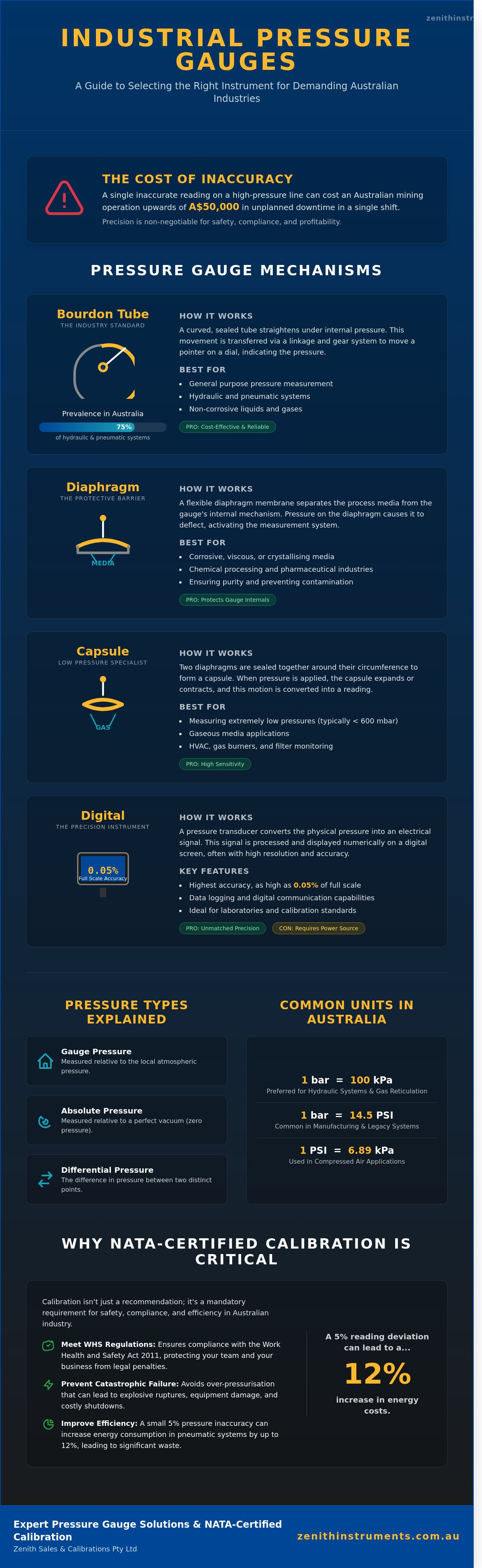
Pressure gauges are precision instruments designed to measure the intensity of a fluid or gas within a closed system. In the demanding environments of Australian mining and manufacturing, these tools act as the first line of defense against catastrophic equipment failure. We rely on these instruments to maintain operational equilibrium in high-stakes environments. Understanding various pressure measurement techniques is vital because different applications require specific reference points. Gauge pressure measures intensity relative to atmospheric pressure, while absolute pressure measures against a perfect vacuum. Differential pressure calculates the difference between two distinct points in a system, which is essential for monitoring filter health and flow rates.
Compliance isn't optional for local operators. Australian Work Health and Safety (WHS) regulations mandate the use of certified, calibrated equipment to ensure worker safety. Using uncertified pressure gauges risks more than just equipment damage; it jeopardizes the safety of every person on the job site. We ensure that our clients meet these rigorous standards through meticulous calibration and NATA accredited testing protocols.
The Consequences of Inaccurate Pressure Measurement
Inaccurate readings aren't just technical errors. They're financial and safety liabilities. Over-pressurisation in industrial boilers or high-pressure pipelines can lead to explosive ruptures and total site shutdowns. In 2023, industrial energy audits across Australian manufacturing sectors showed that even a 5% deviation in pressure accuracy can increase energy consumption by up to 12% in pneumatic systems. This leads to thousands of A$ in wasted operational costs every year. Beyond the balance sheet, failing to maintain calibrated instruments exposes Australian businesses to significant legal penalties under the Work Health and Safety Act 2011. It's a risk that no professional operation can afford to take.
Common Pressure Measurement Units in Australia
Australian industry utilizes a mix of metric and imperial units depending on the origin of the machinery and the specific sector. We see kilopascals (kPa) as the standard for civil engineering and gas reticulation, while bar is the preferred unit for hydraulic systems. PSI remains the staple for many legacy manufacturing plants and compressed air applications. Zenith Instruments supports multi-scale gauge requirements for diverse fleets across Sydney, Melbourne, and Perth. Use this quick reference for professional conversions:
- 1 bar = 100 kPa
- 1 PSI = 6.89 kPa
- 1 bar = 14.5 PSI
Our team ensures your instrumentation remains precise regardless of the unit of measure, providing the clarity needed for high-performance operations.
Understanding the Primary Types of Pressure Gauges and Their Mechanisms
The Bourdon tube remains the primary mechanical instrument across Australian industrial sites. It operates via a curved, elastic metal tube that straightens under internal pressure, moving a pointer through a geared movement. We see these installed in approximately 75% of hydraulic and pneumatic systems due to their cost-effectiveness and reliability. For more aggressive environments, diaphragm pressure gauges provide a critical barrier. They use a flexible membrane to isolate the internal mechanism from corrosive or viscous media; this is essential for chemical processing plants in Kwinana or Gladstone.
Capsule gauges fill a niche for gaseous media requiring measurement at extremely low pressures, often below 600 mbar. When precision is the priority, digital pressure gauges offer accuracies as high as 0.05% of full scale. These units facilitate seamless data logging in laboratory settings, though they require managed battery cycles in remote locations. Adhering to Australian calibration test methods ensures these diverse instruments maintain their integrity over time, following the strict guidelines of AS1349.
Mechanical vs. Digital: Which is Better for Your Facility?
Mechanical gauges excel in the harsh conditions of the Pilbara or the Goldfields. Their analog nature means they don't rely on external power, making them ideal for remote monitoring. Liquid-filled variants use glycerin or silicone to dampen vibrations, preventing pointer flutter in high-vibration mining machinery. Digital units provide superior readability and precision but require routine battery checks to prevent downtime at isolated Australian sites. Selecting between them depends on whether your priority is rugged autonomy or granular data accuracy.
Specialised Gauges for High-Stakes Sectors
Food and beverage facilities in Melbourne and Sydney require hygienic gauges with flush diaphragms to prevent bacterial growth. Similarly, medical gas systems in major hospitals must use oxygen-cleaned gauges to eliminate fire risks from hydrocarbon contamination. Zenith Instruments provides a comprehensive range of specialized instrumentation tailored to these strict regulatory frameworks. We ensure every unit meets the relevant Australian Standards for safety and performance, backed by our technical expertise in NATA-accredited environments.
Selection Criteria: Matching Gauges to Australian Industrial Environments
Selecting the right pressure gauges requires a deep understanding of the specific stressors found across Australian industrial sites. An instrument operating in a climate-controlled medical laboratory in Sydney faces vastly different challenges than one installed on a remote mining rig in the Pilbara, where ambient temperatures often exceed 45°C. For coastal installations or offshore platforms, we specify 316 stainless steel housings to resist salt-spray corrosion and chemical degradation. You must also ensure all connection threads, whether BSPP, NPT, or BSPT, align with existing Australian pipework standards to prevent high-pressure leaks and system downtime.
Accuracy and longevity depend heavily on the "middle third" rule. You should select a gauge where your normal operating pressure falls between 33% and 66% of the maximum scale. Operating at the extreme ends of the dial accelerates mechanical fatigue and risks permanent deformation of the Bourdon tube. If your process normally runs at 600 kPa, a gauge with a 0 to 1,000 kPa range is the technically superior choice for long-term reliability.
The Impact of Ambient Temperature and Vibration
Mechanical vibration from heavy machinery in Queensland's mining sector often causes pointer flutter, which makes accurate readings impossible and destroys internal gears. We solve this by using glycerine or silicone-filled gauges. These viscous fluids dampen internal movement and provide vital lubrication. It's also vital to account for thermal drift. Uncompensated gauges can drift by 0.4% for every 10°C shift in temperature. Use the following checklist when assessing your installation point:
- Identify if the gauge is mounted directly to vibrating equipment like pumps or compressors.
- Check if the ambient temperature exceeds the 60°C limit for standard dry gauges.
- Determine if the process media requires a diaphragm seal to prevent clogging or corrosion.
Accuracy Classes and Regulatory Compliance
Precision requirements vary significantly by sector. While a Class 1.0 gauge, offering 1% full-scale accuracy, suffices for general manufacturing, the aerospace and medical facilities in Melbourne often demand Class 0.25 or 0.5 instruments. These high-precision tools must maintain strict traceability to national standards for pressure. In the Australian regulatory environment, maintaining these accuracy classes is not optional for ISO-certified businesses. It requires a regular pressure gauge calibration service. Zenith Instruments provides NATA-accredited testing and onsite certification to ensure your hardware meets the exact safety and performance benchmarks required for your specific industry.
The Essential Role of NATA Calibration and Regular Maintenance
In the Australian industrial sector, accuracy isn't just a preference; it's a regulatory requirement. The National Association of Testing Authorities (NATA) serves as the gold standard for laboratory accreditation. While a standard factory calibration confirms a gauge functioned correctly at the point of manufacture, a NATA-certified calibration provides a legally defensible document traceable to national standards. This distinction is critical for businesses operating under strict safety protocols or ISO quality management systems where data integrity is paramount.
Why NATA Accreditation is Non-Negotiable
NATA certificates ensure your facility remains audit-ready and compliant with ISO/IEC 17025. This level of certification offers a layer of legal protection that standard manufacturer reports cannot match. Zenith Instruments operates NATA-certified laboratories across Sydney, Melbourne, Brisbane, and Perth to ensure your pressure gauges meet the highest precision benchmarks. Traceability to national standards is guaranteed, which eliminates the risk of measurement uncertainty during critical manufacturing or medical operations.
Calibration frequency depends on your specific application and the level of risk involved. Most industrial standards recommend a 12-month cycle to maintain system reliability. If your equipment operates in high-vibration environments or handles corrosive media, you should increase this frequency to every 6 months. Basic onsite maintenance can extend the life of your instrumentation by 25% if performed consistently.
- Inspect pressure ports weekly to clear debris or blockages.
- Check for leaking glycerin or silicone fill fluid, which indicates seal failure.
- Ensure the gauge is mounted vertically to prevent internal mechanism wear.
- Verify that the pointer rests at the zero pin when the system is depressurised.
Signs Your Pressure Gauge Requires Immediate Repair
You must act if you observe visual defects like cracked lenses or moisture buildup inside the dial. A pointer failing to return to zero is a definitive sign of internal fatigue or "drift," which manifests as increasingly inaccurate readings over time. If a gauge shows a drift of more than 1% of its full scale, it requires immediate recalibration or repair. We recommend a full replacement if repair costs exceed 50% of the price of a new unit. Internal components often wear at similar rates, making replacement more cost-effective for smaller pressure gauges used in high-cycle environments.
Ensure your facility remains compliant and safe by booking a NATA-certified calibration service with our expert technicians.
Zenith Instruments: Expert Pressure Gauge Solutions Across Sydney and Melbourne
Zenith Instruments operates two primary technical laboratories located in Chipping Norton, Sydney, and Cheltenham, Melbourne. These facilities provide the infrastructure required for the high-precision maintenance of industrial pressure gauges across the country. Our service model is built on three essential pillars: the sale of top-tier instrumentation, expert repair services, and NATA-certified calibration. We understand that equipment downtime costs Australian businesses thousands of dollars per hour; therefore, we've optimized our laboratory workflows to provide some of the fastest turnaround times in the industry, often completing standard calibrations within 24 to 48 hours.
- Full procurement support for leading global pressure brands and specialized components.
- NATA-accredited calibration ensuring international traceability and 100% regulatory compliance.
- Expert repair of damaged or drifted mechanical and digital units to extend equipment lifespan.
For large-scale industrial plants in Brisbane and Canberra, we offer comprehensive onsite calibration services. This mobile capability allows our technicians to verify your equipment in situ, which is essential for fixed installations and heavy machinery that cannot be easily transported. By bringing the laboratory to your site, we minimize the risks associated with instrument transit and ensure your operations remain online and safe.
Australia-Wide Coverage with a Local Touch
Our operational reach isn't limited to the major capitals. We service a diverse client base ranging from manufacturing hubs in Newcastle to the most remote mining sites in Western Australia. We don't just act as a third-party vendor; we function as a proactive extension of your maintenance team. We track your calibration cycles and alert you before certifications expire, ensuring you never fall out of compliance with Australian safety standards. If you need immediate assistance or a comprehensive site audit, request a quote or book a service through our online portal today.
The Zenith Advantage: Precision and Compliance
Compliance is a non-negotiable requirement in high-stakes engineering, manufacturing, and medical environments. Our commitment to ISO/IEC 17025 standards ensures that every measurement we take is backed by rigorous technical data and absolute accuracy. Zenith technicians possess the specialized expertise required to handle the complexities of both traditional mechanical pressure gauges and sophisticated electronic transmitters. We focus on the granular details that ensure your systems remain safe and efficient. Precision is our baseline. Reliability is our promise. Contact Zenith Instruments for NATA-certified pressure gauge services today.
Future-Proof Your Pressure Instrumentation Performance
Selecting the right hardware is only the first step in maintaining a safe, high-performance facility. For Australian engineers, the long-term reliability of pressure gauges depends on precise selection and a rigorous maintenance schedule. We've established that technical compliance isn't optional; it's the foundation of industrial safety and operational efficiency. Failure to calibrate regularly can lead to measurement drifts that compromise your entire production line.
At Zenith Instruments, we provide the technical expertise required to keep your systems running at peak capacity. Our NATA-accredited laboratories and ISO-compliant processes ensure every reading meets international standards. Whether you're operating in Sydney, Melbourne, or Brisbane, our mobile technicians deliver on-site services that eliminate logistical delays. We don't just test equipment; we partner with you to maintain a 100% compliant measurement environment. Don't leave your site's precision to chance when expert validation is a single step away.
Request a NATA-Certified Calibration Quote today to secure your equipment's accuracy. We're ready to help you achieve total measurement confidence across your entire fleet.
Frequently Asked Questions
How often should I have my industrial pressure gauges calibrated in Australia?
Most Australian industrial facilities require pressure gauge calibration every 12 months to maintain compliance with ISO 9001 standards. If your operations involve high-vibration environments or critical safety systems, we recommend a 6-month interval to prevent measurement drift. Regular scheduling ensures your equipment remains within its specified accuracy class, which typically ranges from 0.1% to 5% of the full scale.
What is the difference between NATA calibration and traceable calibration?
NATA calibration provides the highest level of technical assurance because it complies with ISO/IEC 17025 standards and is recognized by international bodies. Traceable calibration ensures the instrument is checked against a reference standard linked to national measurement institutes, but it doesn't carry the formal NATA endorsement logo. We provide both services across Australia to meet your specific regulatory or contractual obligations.
Can Zenith Instruments calibrate pressure gauges onsite at my facility?
We provide comprehensive onsite calibration services for pressure gauges across major Australian hubs including Sydney, Melbourne, Brisbane, and Perth. Our mobile technicians utilize portable reference standards to verify your instruments without removing them from the process line. This service reduces downtime by up to 80% compared to laboratory-based testing, ensuring your facility remains operational while maintaining strict compliance.
What are the most common causes of pressure gauge failure in industrial settings?
Mechanical vibration and pressure pulsations account for approximately 60% of gauge failures in Australian manufacturing plants. These forces cause internal wear on the movement and linkage, leading to inaccurate readings. Overpressure events, where the system exceeds the gauge's maximum scale by 10% or more, can also rupture the bourdon tube or permanently deform the sensing element.
Do you provide pressure gauge repair services for all major brands?
We repair and calibrate pressure gauges from all major global manufacturers including WIKA, Ashcroft, Marsh, and Budenberg. Our technicians evaluate components like the bourdon tube, pointer, and dial for signs of fatigue. If a gauge is beyond economical repair, we'll provide a detailed report and suggest a high-performance replacement that meets your specific technical requirements.
How do I choose between a liquid-filled and a dry pressure gauge?
Choose a liquid-filled gauge, typically containing glycerin or silicone oil, if your equipment generates constant vibration or rapid pressure spikes. The fluid dampens internal movement and lubricates the mechanism, extending the instrument's life by up to 3 times compared to dry versions. Dry gauges are suitable for stable environments where mechanical shock is minimal and the ambient temperature stays between -20°C and 60°C.
What documentation will I receive after my pressure gauge is calibrated by Zenith?
You'll receive a formal Calibration Certificate that includes the instrument's serial number, the reference standards used, and the specific test results. For NATA-accredited jobs, the document features the NATA endorsement logo, confirming the results meet ISO/IEC 17025 requirements. We also provide a calibration sticker for the gauge itself, clearly showing the date of service and the next scheduled due date.
Is NATA accreditation required for pressure gauges in the medical industry?
Yes, NATA accreditation is mandatory for many medical applications to ensure compliance with AS/NZS 3551 standards for medical equipment management. Facilities like hospitals and pathology labs require this high level of precision to guarantee patient safety and diagnostic accuracy. We help medical providers maintain these strict standards through rigorous testing protocols and detailed documentation that satisfies 100% of Australian regulatory audits.