

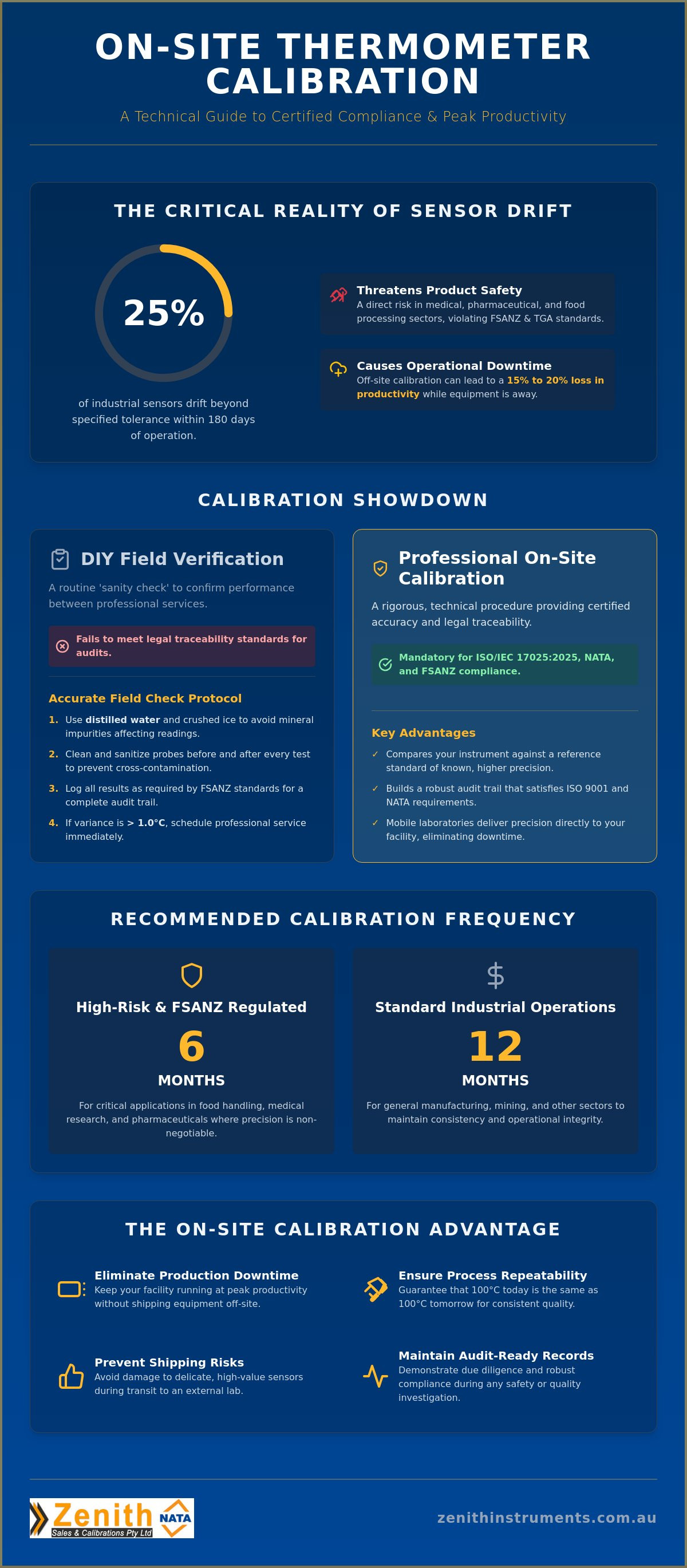
Recent industry audits reveal that nearly 25% of industrial temperature sensors drift beyond their specified tolerance within just 180 days of operation. For professionals in the medical, pharmaceutical, and food processing sectors, this drift isn't just a technical margin of error; it's a direct threat to product safety and regulatory standing. We understand the frustration of balancing rigorous FSANZ or TGA requirements with the need to keep your facility running at peak productivity. It's often difficult to justify the 15% to 20% loss in productivity that occurs when critical equipment is sent off-site for weeks at a time.
This 2026 guide provides a technical roadmap for achieving certified compliance through professional on-site thermometer calibration. You'll discover why simple DIY ice-point checks, while useful for daily verification, fail to meet the legal traceability standards required by the updated ISO/IEC 17025:2025 framework. We'll compare the rigorous assessment of NATA-accredited services against basic NATA-traceable checks; we also detail how mobile laboratories in major hubs like Sydney, Melbourne, and Brisbane deliver precision without halting your production line.
Key Takeaways
- Understand the critical technical distinction between routine DIY field verification and the professional calibration required for NATA-traceable audit compliance.
- Learn why the 2026 transition to ISO/IEC 17025:2025 standards makes formal certification a mandatory requirement for high-precision industrial and medical sectors.
- Identify the optimal calibration frequency for your operations, ranging from standard 12-month intervals to 6-month cycles for high-risk FSANZ-regulated food handling.
- Evaluate how on-site thermometer calibration eliminates logistical downtime and shipping risks by bringing NATA-standard mobile laboratories directly to your facility.
- Gain clarity on the specific protocols and distilled water requirements needed to perform accurate interim field checks between professional service visits.
What is Thermometer Calibration and Why is it Critical in Australia?
Scientific measurement relies on a foundation of verifiable accuracy. What is Calibration? It's the technical procedure of comparing a measurement instrument against a reference standard of known, higher precision to identify and document any deviations. In the Australian industrial landscape, this isn't just a best practice; it's a regulatory necessity. Food Standards Australia New Zealand (FSANZ) mandates precise temperature monitoring across the entire supply chain to prevent bacterial growth and ensure public safety. Without regular verification, a thermometer is merely a guessing tool that can lead to catastrophic financial and legal consequences.
Australian sectors such as manufacturing, medical research, and mining depend on exact thermal data to maintain operational integrity. In a medical laboratory, a two-degree variance in a vaccine fridge can render an A$ multi-million batch of medicine useless. Similarly, in mining, inaccurate readings on heavy machinery can lead to overheating and engine failure. To standardise these processes, the industry adheres to AS 2853, the Australian Standard for temperature measurement equipment. This framework ensures that temperature-controlled environments are measured with consistency and technical rigour. Implementing on-site thermometer calibration allows these facilities to maintain these standards without the logistical burden of shipping delicate equipment to a central lab.
The Technical Reality of Sensor Drift
Even the most sophisticated digital sensors aren't immune to the laws of physics. Drift is the gradual degradation of sensor accuracy caused by thermal cycling or mechanical shock. Research from July 2026 indicates that approximately 25% of industrial temperature sensors drift beyond their required tolerance within just 180 days of continuous use. When sensors drift, the risk of non-compliance skyrockets. This often leads to failed audits, heavy regulatory fines, and compromised safety protocols that can shut down a facility overnight. Regular on-site thermometer calibration serves as the primary defence against these invisible inaccuracies.
Core Benefits of Regular Calibration
The primary advantage of a structured calibration schedule is the assurance of process repeatability. Whether you're managing industrial ovens or complex cold chains, you need to know that 100°C today is the same as 100°C tomorrow. This consistency is vital for maintaining a robust audit trail that satisfies ISO 9001 and NATA requirements. By keeping detailed records of every adjustment, businesses can demonstrate due diligence during safety investigations. For more details on maintaining your equipment, see our thermometer calibration service page. We help you build a culture of precision that protects your assets and your reputation across the Australian market.
How to Calibrate a Thermometer: Standard DIY Verification Methods
Effective temperature management begins with a clear distinction between field verification and professional laboratory calibration. Field verification, often referred to as a "DIY check," is a routine procedure used to confirm that an instrument is still performing within an acceptable range between formal service intervals. However, these checks don't replace the requirement for a NATA-traceable on-site thermometer calibration. To perform an accurate field test, we recommend using only distilled water and crushed ice. Distilled water is essential because the minerals and impurities in standard Australian tap water can shift the freezing and boiling points, leading to false readings that compromise your data integrity.
Hygiene is equally critical in industrial and food service environments. We must clean and sanitise thermometer probes before and after every test to prevent cross-contamination. To maintain high standards of cleanliness, you can visit Serenity Chemicals Limited for specialized hygiene and cleaning solutions. For Australian food handling compliance, maintaining a meticulous calibration log is a mandatory requirement under FSANZ standards. This log serves as a legal record during health audits, documenting the date, the method used, the observed reading, and any corrective actions taken. If your internal checks reveal a variance greater than 1.0°C, it's time to schedule a professional thermometer calibration service to restore technical precision.
The Ice Point Method (0°C)
The ice point method is the most reliable field check for thermometers used in cold chain management. First, create a thick ice slurry by filling a container with crushed ice and adding just enough chilled distilled water to fill the gaps. Second, insert the probe into the centre of the slurry, ensuring it doesn't touch the bottom or sides of the container. Third, wait for the reading to stabilise, which typically takes 2 to 3 minutes. A correctly functioning probe should read exactly 0°C.
The Boiling Point Method (100°C)
This method verifies accuracy at the higher end of the thermal spectrum. Begin by bringing distilled water to a rolling boil in a deep, heat-resistant container. Immerse the probe at least 5cm into the water, taking care to avoid contact with the container walls, and wait for the display to stabilise. It's vital to adjust your expectations for altitude. In high-altitude Australian regions like the Blue Mountains or the Snowy Mountains, water boils at a slightly lower temperature than the sea-level standard of 100°C. You must account for this physical variance to avoid unnecessary equipment adjustments.
DIY Verification vs. Professional NATA-Traceable Calibration
While the ice point method described previously provides a basic sanity check, it doesn't constitute a formal calibration in a legal or technical sense. In the Australian regulatory environment, a 'check' only confirms that a device isn't wildly inaccurate; a 'calibration' establishes a documented link to national standards through a process known as traceability. This is where the National Association of Testing Authorities (NATA) plays a pivotal role. NATA is the peak body that accredits laboratories to the ISO/IEC 17025:2025 standard, ensuring that the technicians, equipment, and methodologies used meet the highest international benchmarks. Relying on an undocumented ice bath during a FSANZ or TGA audit can lead to immediate compliance failure.
A professional thermometer calibration service utilizes advanced metrology equipment that far exceeds the capabilities of a kitchen-grade ice slurry. We employ high-stability dry block calibrators for rapid, precise temperature control and stirred liquid baths for maximum thermal uniformity. For non-contact instruments, blackbody sources are utilized to simulate perfect thermal emitters, allowing for the accurate verification of infrared sensors. These specialized tools are integral to our on-site thermometer calibration workflow, providing the same level of precision found in a static laboratory while maintaining your operational flow.
When DIY Methods Are Insufficient
High-precision sectors such as medical refrigeration and vaccine storage require accuracy levels that DIY methods simply can't verify. For example, vaccines often have a narrow storage window between 2°C and 8°C; a 1°C error in a DIY check could result in the total loss of critical stock. Furthermore, it's physically impossible to use an ice bath for calibrating infrared (IR) or laser thermometers because the water's emissivity differs from the surfaces these tools are designed to measure. For a deeper look at these technical requirements, read our guide on Digital Thermometers: A Professional Guide for Australian Industry (2026).
Decoding Your Calibration Certificate
A professional calibration is only as good as the documentation that supports it. When reviewing your report, you must verify the instrument's serial number, the specific uncertainty measurements, and the traceability statement linking the results to national standards. There is a significant difference between a standard report and a NATA-endorsed certificate, which confirms the laboratory has undergone rigorous external auditing. A NATA-endorsed certificate is the 'gold standard' for Australian legal and regulatory compliance. This document provides the necessary evidence of due diligence required during Workplace Health and Safety (WHS) investigations or international quality audits.
Calibration Frequency and Industry Standards in Australia
Determining the correct interval for instrument verification is a balance between risk management and operational costs. While a general rule of annual professional calibration suffices for most industrial thermometers to maintain ISO 9001 compliance, high-risk sectors demand more frequent intervention. For instance, Food Standards Australia New Zealand (FSANZ) recommends 6-month intervals for thermometers used in high-risk food handling. This increased frequency mitigates the risk of bacterial growth caused by subtle sensor drift that occurs between annual checks. We help businesses establish these schedules to ensure they never fall out of compliance during a surprise audit.
In the medical and pharmaceutical sectors, Therapeutic Goods Administration (TGA) guidelines and ISO 13485 standards often dictate even stricter protocols. Critical equipment, such as those monitoring vaccine storage or blood banks, typically requires biannual certification to ensure patient safety and product efficacy. Beyond regulatory mandates, environmental factors play a significant role in determining your schedule. Heavy daily usage, accidental physical drops, or exposure to extreme temperatures can accelerate sensor degradation. If a device is subjected to mechanical shock, we recommend immediate on-site thermometer calibration to verify its continued accuracy before it's returned to service.
Sector-Specific Calibration Requirements
Mining and heavy industry sectors require a focus on durability and high-temperature accuracy. Instruments used in extreme Australian outback conditions must withstand vibration and dust while providing precise data to ensure worker safety and prevent machinery fires. Conversely, in HVAC and building management, precise thermal control is the primary driver for energy efficiency. Small inaccuracies in temperature sensors can lead to significant increases in power consumption and operational costs. For facilities managing specialized heat-treatment processes, regular industrial oven calibration ensures that thermal mapping remains consistent with AS 2853 requirements.
The Real Cost of Neglecting Calibration
Protect your facility from regulatory failures and operational downtime by booking your next on-site thermometer calibration through our specialized Sydney service team or our Melbourne experts today.
The Operational Advantages of On-Site Thermometer Calibration
The logistics of maintaining a large inventory of temperature-sensing equipment often present a significant hurdle for facility managers. Shipping critical instruments to a fixed laboratory involves complex packing requirements and a waiting period that can stall your operations. This gap in availability is the primary driver behind the productivity losses mentioned earlier in this guide. By opting for on-site thermometer calibration, we bring the laboratory directly to your facility, eliminating the risk of transit damage and ensuring your sensors are back in operation within hours rather than days.
Our mobile laboratory units are strategically deployed across Sydney, Melbourne, and Brisbane to provide national coverage with a localized touch. These units are equipped with high-precision dry blocks and reference thermometers that maintain NATA-traceable standards in the field. We possess the technical expertise to calibrate a broad spectrum of instruments, including digital handhelds, penetrating food probes, non-contact infrared sensors, and fixed industrial thermocouples. For larger facilities, this means we can service your entire inventory in a single visit, providing a level of efficiency that laboratory-bound competitors cannot match. We offer specialized calibration services in Sydney and Melbourne tailored to high-volume industrial needs.
Why Choose Zenith Sales & Calibrations Pty Ltd for Your On-Site Needs?
We prioritize technical excellence and regulatory transparency above all else. Our technicians provide NATA-certified standards and ISO-compliant documentation immediately upon completion of the service. This instantaneous reporting is essential for facilities facing imminent audits or those operating under strict TGA or FSANZ oversight. Our team understands the unique logistical challenges of Australian regional industries, from the dust-heavy environments of mining sites to the sterile requirements of pharmaceutical labs. We don't just check numbers; we ensure your equipment performs reliably under your specific operational conditions. This meticulous approach has made Zenith Sales & Calibrations Pty Ltd a trusted partner across the medical, mining, and manufacturing sectors.
Booking Your Professional Calibration
Scheduling a site visit is a streamlined process designed for industrial efficiency. We support a wide range of major brands, including Fluke and Major Tech, ensuring that your high-end assets are handled by meticulous experts. Whether you require a full facility sweep or a targeted visit for critical sensors, our team coordinates with your production schedule to minimize disruption. We provide clear, itemized quotes that reflect the technical scope of your requirements. Contact Zenith Sales & Calibrations Pty Ltd for an on-site calibration quote today to secure your facility's compliance and operational uptime.
Securing Technical Precision for Future Audit Success
Maintaining technical precision is no longer optional in Australia's increasingly regulated industrial landscape. While DIY checks serve as an important daily verification, only professional on-site thermometer calibration provides the NATA-traceable documentation required for FSANZ, TGA, and ISO audits. By transitioning to a mobile service model, your facility avoids the common 15% to 20% productivity loss caused by equipment downtime and shipping logistics.
Our expert technicians, based in Sydney and Melbourne, utilize specialized mobile laboratory equipment to deliver NATA-certified standards and ISO-compliant results directly to your door. This Australia-wide capability ensures that your sensors remain accurate under real-world operational conditions without halting your production line. We empower you to meet the rigorous demands of the medical, mining, and food sectors with absolute confidence in your data integrity.
Don't let sensor drift compromise your safety standards or audit success. Book Your NATA-Traceable Thermometer Calibration today and partner with a dependable expert dedicated to your operational excellence.
Frequently Asked Questions
How often should a digital thermometer be calibrated in Australia?
Digital thermometers should undergo professional calibration every 12 months to maintain ISO 9001 compliance. However, FSANZ recommends a 6-month interval for high-risk food processing sectors. This increased frequency accounts for the technical reality that many industrial sensors drift beyond their specified tolerance within half a year of continuous operation.
Is an ice bath calibration legally sufficient for a food safety audit?
An ice bath is considered a field verification rather than a legally sufficient calibration for formal audits. While it confirms daily consistency, auditors require NATA-traceable certification to prove measurement accuracy against national standards. Relying solely on DIY checks without scheduled professional intervention often leads to compliance failures during FSANZ or TGA inspections.
What is the difference between NATA calibration and traceable calibration?
NATA-accredited calibration is performed by a laboratory formally audited and approved to ISO/IEC 17025 standards. Traceable calibration indicates that the reference equipment used was calibrated by an accredited lab, but the facility itself hasn't undergone the same rigorous NATA assessment. For high-stakes industries like medical or mining, NATA-endorsed certificates provide the highest level of legal measurement assurance.
Can infrared thermometers be calibrated using the ice point method?
Infrared thermometers cannot be accurately calibrated using the ice point method. The emissivity of ice and water differs significantly from the industrial surfaces these devices are designed to measure, leading to false readings. Professional on-site thermometer calibration for IR tools requires specialized blackbody sources to simulate a perfect thermal emitter for precise verification.
What should I do if my thermometer fails a calibration check?
Immediately remove the instrument from service if it fails a routine verification check. You must investigate any products or processes measured by that device since its last successful check to identify safety risks or potential spoilage. Following this, schedule a professional service to adjust the sensor or determine if the unit requires total replacement due to permanent hardware degradation.
How much does professional thermometer calibration cost in Sydney or Melbourne?
The cost of professional thermometer calibration in Sydney or Melbourne varies based on the instrument type, the number of required calibration points, and the service location. Pricing is typically determined by whether you require a standard report or a NATA-endorsed certificate. We recommend requesting a direct quote to receive an accurate assessment tailored to your specific industrial inventory.
Do I need to calibrate a brand-new thermometer before its first use?
Most brand-new thermometers require initial calibration before being deployed in a regulated Australian environment. Factory certificates provided by manufacturers often lack the specific traceability or calculated uncertainty required for ISO compliance. Performing on-site thermometer calibration upon arrival establishes a baseline of accuracy and ensures the device wasn't compromised during shipping or storage.
What is the required accuracy for thermometers in the Australian food industry?
Thermometers used in the Australian food industry must maintain an accuracy of +/- 1.0°C or better according to FSANZ standards. This tolerance ensures that critical temperatures for storage and cooking are monitored effectively to prevent foodborne illnesses. If your internal verification reveals a variance approaching this limit, professional recalibration is necessary to restore the required technical safety margins.