

Could a calibration certificate look complete yet leave you unsure whether the instrument’s operating range was covered? The right questions to ask a calibration laboratory help you match its accredited scope and measurement capability to the risks your equipment supports.
Look beyond the certificate sticker. Find out whether accreditation applies to the instrument, range and method you need, what the results and measurement uncertainty mean, and how long the equipment may be out of service. For Australian businesses, clear documentation and a suitable service arrangement can also support operational and quality requirements.
This guide sets out practical questions for assessing technical capability, traceability, certificates and turnaround before you send instruments away. It also compares laboratory and on-site calibration against your production needs, with examples such as pressure gauges and other instruments. Use it to assess service fit and make an informed choice.
Key Takeaways
- Use the questions to ask a calibration laboratory to establish technical fit for your instrument and intended use, rather than relying on a general provider checklist.
- Distinguish documented traceability from accreditation, and consider whether measurement uncertainty suits your acceptance criteria.
- Compare laboratory and on-site calibration by weighing equipment access, removal constraints, downtime and site coordination.
- Plan the handover: define requirements, prepare instruments, agree on logistics and review the returned records.
- Zenith Sales & Calibrations Pty Ltd provides laboratory and on-site calibration, repair and service across Australia, with a NATA-accredited calibration service to ISO 17024 and an ISO 17025-compliant laboratory.
What should you ask a calibration laboratory before sending equipment?
A calibration result is useful when it gives you confidence in the measurement your process relies on. Your laboratory choice can affect measurement confidence, quality records and operational continuity, especially when an instrument is critical to production or routine checks. Use the questions to ask a calibration laboratory to establish technical fit for the task, not to create a generic vendor scorecard.
Start with the decision the measurement supports. A manufacturing team may need confidence in a pressure reading used to control a process. A mining operation may need to minimise disruption, while a medical, food or laboratory environment may have specific documentation and acceptance requirements. The instrument label alone does not show whether the proposed calibration covers the function and range you rely on. For a short primer on the purpose and terminology, see What is calibration?
Which instruments and measurements must the laboratory cover?
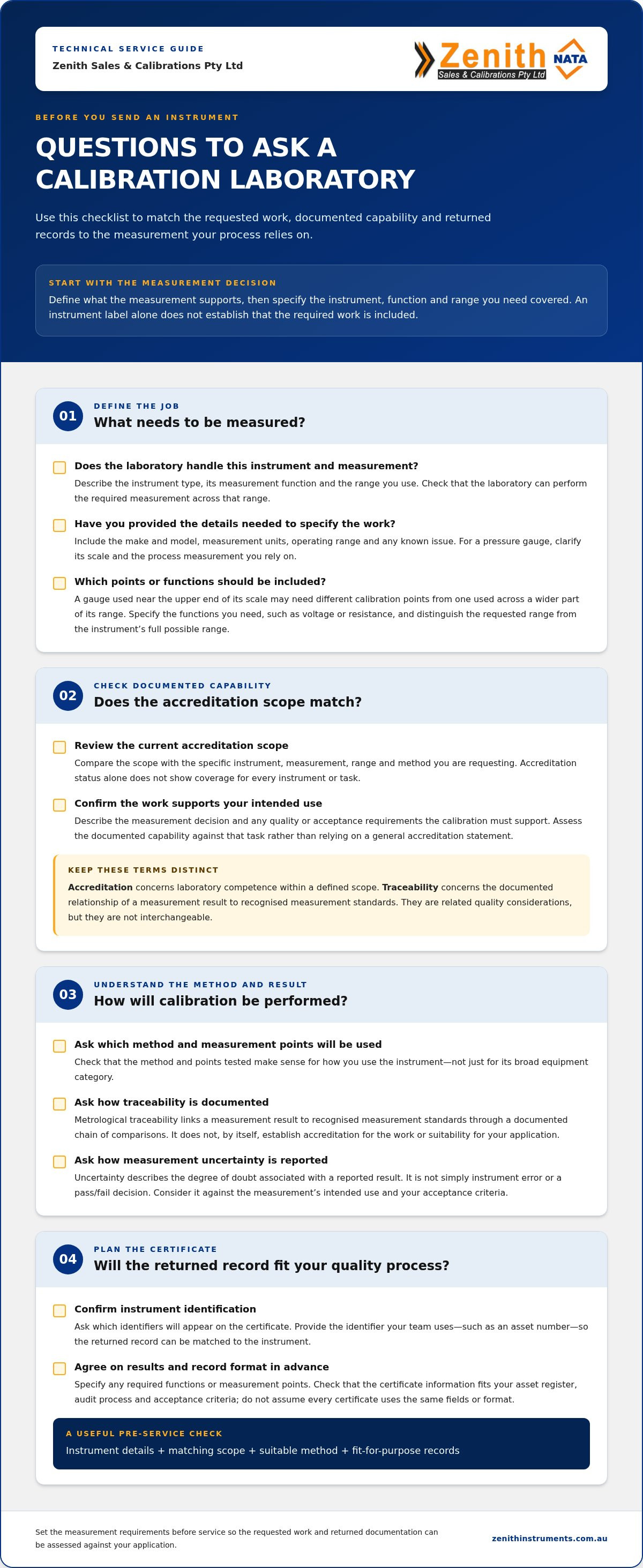
Describe the instrument, its measurement function and the range you use. Ask whether the laboratory handles that instrument type and can perform the required measurement across that range. A broad category such as “pressure gauge” may not explain the job: clarify the gauge’s scale and the process measurement you need to rely on.
When defining the work, include the instrument’s make and model, measurement units, operating range and any known issue. For example, a gauge used near the upper end of its scale may call for different calibration points from one used across a wider part of its range. These details help specify the work. Zenith provides pressure gauge calibration, alongside calibration for other instrument categories.
Does the laboratory’s accreditation scope match the work?
Ask to review the laboratory’s current accreditation scope and compare it with the instrument and requested measurement. Accreditation status alone does not establish coverage for every instrument, range or method. The scope shows which activities are accredited, so check that it includes the relevant measurement rather than relying on a general statement about accreditation.
Be specific about what the calibration needs to support. If an instrument measures several functions, such as voltage and resistance, clarify which functions are included in the work. Also distinguish the range you want calibrated from the instrument’s full possible range. This helps prevent a mismatch between the service requested and the evidence your quality process needs.
These checks apply whether you manage one instrument or a register across multiple sites. For Australian manufacturing, mining, medical, food and laboratory operations, define the measurement task first, then assess the laboratory’s documented capability against it. That is a more useful basis for evaluating instrument calibrations in Australia than treating a credential as blanket coverage.
How do you assess calibration method, traceability and the certificate?
Once the laboratory’s scope aligns with the work, find out how it will produce and document the result. Ask which calibration method will be used for your instrument and measurement, and how the results will be recorded. The method and points tested should make sense for how you use the instrument, not just its general equipment category.
Before service, explain what your quality process needs from the record. A maintenance register may need clear instrument identification and results, while an audit process may require evidence that the work meets defined acceptance criteria. Agree on the certificate information you need in advance. Requirements vary, so do not assume every certificate uses the same fields or format, or that a standard format will meet your organisation’s needs.
What does traceability tell you about a calibration result?
Metrological traceability is a documented relationship between a measurement result and recognised measurement standards, established through a chain of comparisons. That chain helps explain how a result relates to those standards. It does not, by itself, show that the laboratory is accredited for the work or that the calibration is suitable for your application.
Accreditation and traceability are related quality considerations, but they are not interchangeable. Accreditation concerns a laboratory’s competence within a defined scope; traceability concerns the documented relationship of a result to measurement standards. In Australia, NATA provides information about NATA accredited calibration laboratories in Australia. Assess the relevant scope and result documentation for the task you need done.
Which certificate details support your quality records?
Ask which instrument identifiers and measurement results the laboratory records, and whether the certificate format fits your asset register and audit process. Provide the identifier your team uses, such as an asset number, so the returned record can be matched to the instrument. If you need results for particular measurement points or functions, specify them before the work begins.
Measurement uncertainty describes the degree of doubt associated with a reported result. It is not simply an instrument’s error or a pass/fail decision. Consider it in relation to the measurement’s intended use and your acceptance criteria. A result may be documented but still not provide the confidence needed for a critical decision. Ask how uncertainty is reported for the relevant result and how your team should interpret it.
Use these questions to ask a calibration laboratory to agree on the method, records and acceptance basis before sending equipment. Zenith Instruments uses a computerised closed-loop software system for calibration. Its service is NATA-accredited to ISO 17024, and its laboratory is ISO 17025-compliant. These credentials do not replace checking the applicable scope for a specific measurement. For an overview of Zenith’s calibration services, consider how the documentation can support your quality process.
Should you choose laboratory or on-site calibration for your equipment?
The service setting affects how you access equipment, move it through calibration and coordinate the work. Laboratory calibration can suit instruments that can be safely removed. On-site work may be practical for fixed assets or equipment that is difficult to take out of operation. Neither setting is automatically more accurate. Suitability depends on the instrument, the required work and the laboratory’s capability.
Compare the practical constraints before choosing:
| Consideration | Laboratory calibration | On-site calibration |
|---|---|---|
| Equipment access | Equipment is sent or delivered to the laboratory. | Equipment is accessed at your workplace. |
| Removal constraints | Suitable when the instrument can be safely disconnected and transported. | May suit fixed or difficult-to-remove equipment. |
| Downtime | Plan for time away from the site, including transport and service. | Discuss how the work can fit around operations and equipment access. |
| Site coordination | Plan packing, dispatch, receipt and return-to-service checks. | Coordinate access, site requirements and a suitable work window. |
When might laboratory calibration suit the job?
Laboratory service can be practical when an instrument can be removed without disrupting essential operations or creating a safety issue. It gives your team a defined handover: identify the instrument, arrange dispatch, track its status and plan for its return. This can fit planned maintenance, particularly when your asset register and replacement equipment allow the instrument to be out of service during the work.
Before sending equipment, agree on the expected turnaround for that specific job and how you will receive updates if timing changes. Include transport and internal handling in your return-to-service plan.
When might on-site calibration reduce operational disruption?
On-site work may suit fixed, difficult-to-remove or operationally critical equipment. It avoids transporting the instrument, but still requires coordination. Agree on access arrangements, the work area, operating constraints and when the equipment can be made available. Establish how the visit will be scheduled and how the team will communicate progress or changes.
Zenith provides calibration services in Sydney. For sites in Sydney, as well as Melbourne, Newcastle, Canberra and Brisbane, consider equipment access and the practical requirements of the job when planning the service.
Zenith provides in-house, off-site and on-site calibration options, so you can consider the service arrangement alongside access and operating needs. As you use the questions to ask a calibration laboratory, clarify the expected timing for the job, how updates will be provided and what your team needs before returning the instrument to service. A plan for access, handover and records helps prevent calibration from becoming a simple dispatch task with no clear follow-through.
What practical questions help control turnaround and calibration handover?
Turnaround is easier to manage when the request, instrument and return-to-service plan are clear before work begins. A straightforward handover sequence helps prevent missing information, unclear timing expectations and avoidable logistics delays. Ask for the expected turnaround for the specific job, how progress updates will be provided, and who to contact if the schedule changes.
Use this sequence to prepare:
- Identify requirements. Record the instrument, measurement function, range and intended use. State any acceptance criteria and documentation your quality process needs.
- Prepare the instrument. Capture identifiers and condition notes, and include accessories only when they are needed for the requested work.
- Agree logistics. Confirm dispatch or site access arrangements, the expected service window and how timing changes will be communicated.
- Review returned records. Assign someone to check the results and records against the request before the instrument is released back into service.
What information should accompany an instrument?
Provide the instrument type, manufacturer, model, serial number and measurement range where available. Add your organisation’s asset number so the returned documentation can be matched to the correct equipment. Describe the instrument’s intended use and any known issue, such as an unstable reading or visible damage, that could affect the requested work.
Before arranging service, identify any certificate or internal record requirements. Clear information at intake helps align the requested work with the handover documentation.
How should you plan collection, site access and return to service?
For off-site work, agree how the instrument will be prepared, packed and delivered, and who will track its dispatch and return. For an on-site visit, identify access requirements, operating constraints and a suitable work window. Ask for a realistic timing estimate for the specific job instead of assuming a general turnaround applies to every instrument or service.
Zenith offers turnaround as fast as 24 hours, but this is not a guaranteed timeframe for every instrument or job. Confirm the expected timing for your request and how you will be updated if it changes. Before the equipment returns to use, designate someone to review the records, confirm the handover is complete and follow your organisation’s release process.
These practical questions to ask a calibration laboratory turn a service request into a coordinated workflow. For calibration, repair and service arrangements, arrange instrument calibration with Zenith.
How does Zenith support calibration requirements across Australia?
A useful service arrangement connects the instrument’s measurement requirements with the way your site operates. Zenith Instruments provides calibration, repair and service across Australia, with in-house, off-site and on-site options. Its facilities in Sydney and Melbourne support service delivery, and the appropriate arrangement depends on the instrument, the work required and practical factors such as access and operational constraints. Zenith serves businesses in Sydney, Melbourne, Newcastle, Canberra and Brisbane, as well as other locations across Australia.
As you apply the questions to ask a calibration laboratory, focus on evidence and fit. Zenith’s calibration service is NATA-accredited to ISO 17024, and its laboratory is ISO 17025-compliant. These credentials are useful context, but accreditation does not automatically demonstrate coverage for every instrument or measurement. Match the relevant scope to the work required and define the records your organisation needs.
What service capabilities can support different operating environments?
For instruments that can be removed from site, in-house or off-site calibration may fit a planned maintenance process. Where equipment is fixed, difficult to access or disruptive to remove, on-site calibration may be more practical. The choice should reflect the instrument and requested work, not an assumption that one setting is inherently more suitable.
Zenith uses a computerised closed-loop software system as part of its calibration process. This supports a documented process, but it is not a promise of zero error or a substitute for assessing the calibration result and its suitability for your intended use. Discuss the measurement requirement, the instrument’s access constraints and the documentation your records need.
Australian operations can involve different site and logistics requirements. Zenith’s Sydney and Melbourne facilities support service delivery across the country, including Sydney, Melbourne, Newcastle, Canberra and Brisbane. Whether your equipment is at a metropolitan facility or another Australian location, align the service plan with access, timing and return-to-service needs.
What is the next step when you have your question list?
Prepare a concise description of the work before arranging service. Include the instrument’s type and identifiers, the measurement function and range required, its intended use, any known condition issue and your documentation requirements. If the equipment must remain available for operations, note access or timing constraints so the service arrangement can account for them.
This information gives the service discussion a practical starting point. It helps distinguish what your team needs from the calibration result, method and handover. For example, a pressure gauge request should identify the measurement range and use case, while a thermometer request should specify the relevant measurement application. Clear requirements support a focused discussion because a broad instrument category alone does not define the full job.
Zenith’s turnaround can be as fast as 24 hours, depending on the service and job. This is not a universal guarantee. Include timing expectations in the discussion, along with your preferred service arrangement and records. To outline your instrument requirements and discuss calibration options, visit Zenith’s calibration services.
Turn your calibration questions into a clear service brief
Turn your requirements into a short brief your team can use consistently. Record which instruments need attention, which measurements matter to your process, what documentation supports your quality records and any access or timing constraints. This gives the service discussion a practical focus and helps your team assess whether the proposed work supports operational needs.
The questions to ask a calibration laboratory are most useful when they lead to clear decisions: what work is required, how the instrument will be handled and what your team needs to review before putting it back into use. Keep the brief with your asset records so future calibration planning starts from a reliable reference point.
Zenith Instruments provides calibration, repair and service for Australian businesses, with in-house, off-site and on-site arrangements. Discuss your instrument calibration requirements with Zenith and take the next step with a clear, practical plan.
Frequently Asked Questions
Is NATA accreditation enough to show that a calibration laboratory can calibrate my instrument?
No. NATA accreditation is relevant when the laboratory’s current scope covers the instrument, measurement and required range. Accreditation status alone does not establish capability for every task. Match the requested work to the scope, then record any application-specific requirements before service. These are among the key questions to ask a calibration laboratory, especially if your quality system requires evidence for a particular measurement or operating range.
What is the difference between a NATA-accredited calibration and a traceable calibration?
Accreditation concerns demonstrated competence for activities within a defined scope; traceability concerns the documented relationship between a result and recognised measurement standards. One term does not automatically establish the other. For example, a quality procedure may require a result traceable to standards, while a customer or application may also require accredited work. Identify what your process needs, then compare the laboratory’s scope and the certificate with that requirement.
Can a calibration laboratory calibrate equipment on-site?
Yes. Zenith provides on-site calibration alongside in-house and off-site options. The setting must suit the instrument and task. A fixed pressure sensor in a production line may be difficult to remove, while a portable meter may be straightforward to send away. Describe site access, operating conditions and any limits on taking equipment offline when arranging the work.
How long does calibration at a laboratory usually take?
There is no single timeframe for every job. Instrument type, requested measurements, workload and transport arrangements can all affect the schedule. Ask for an estimate tied to your specific instrument and confirm how you will be notified if timing changes. If a production or maintenance plan depends on the return date, include dispatch and internal review time, and identify any backup equipment before the instrument leaves your site.
What should a calibration certificate include?
A certificate should identify the instrument and document results relevant to the calibration performed, but its exact content and format can vary. Before service, decide how your team will file and use the record. On return, check that the instrument identity matches your asset record and that the documented work corresponds to the request. If anything appears inconsistent, hold the record for review rather than treating a label as a substitute for documentation.
How do I choose between laboratory and on-site calibration?
Choose the setting that fits the instrument, required method and operating conditions. Consider whether it can be disconnected and transported, whether site access is practical, and how long the equipment can be unavailable. A portable instrument used in routine checks may suit laboratory service; a fixed device tied to an active process may make on-site work worth considering. Neither option is automatically superior, so base the decision on technical and operational needs.