

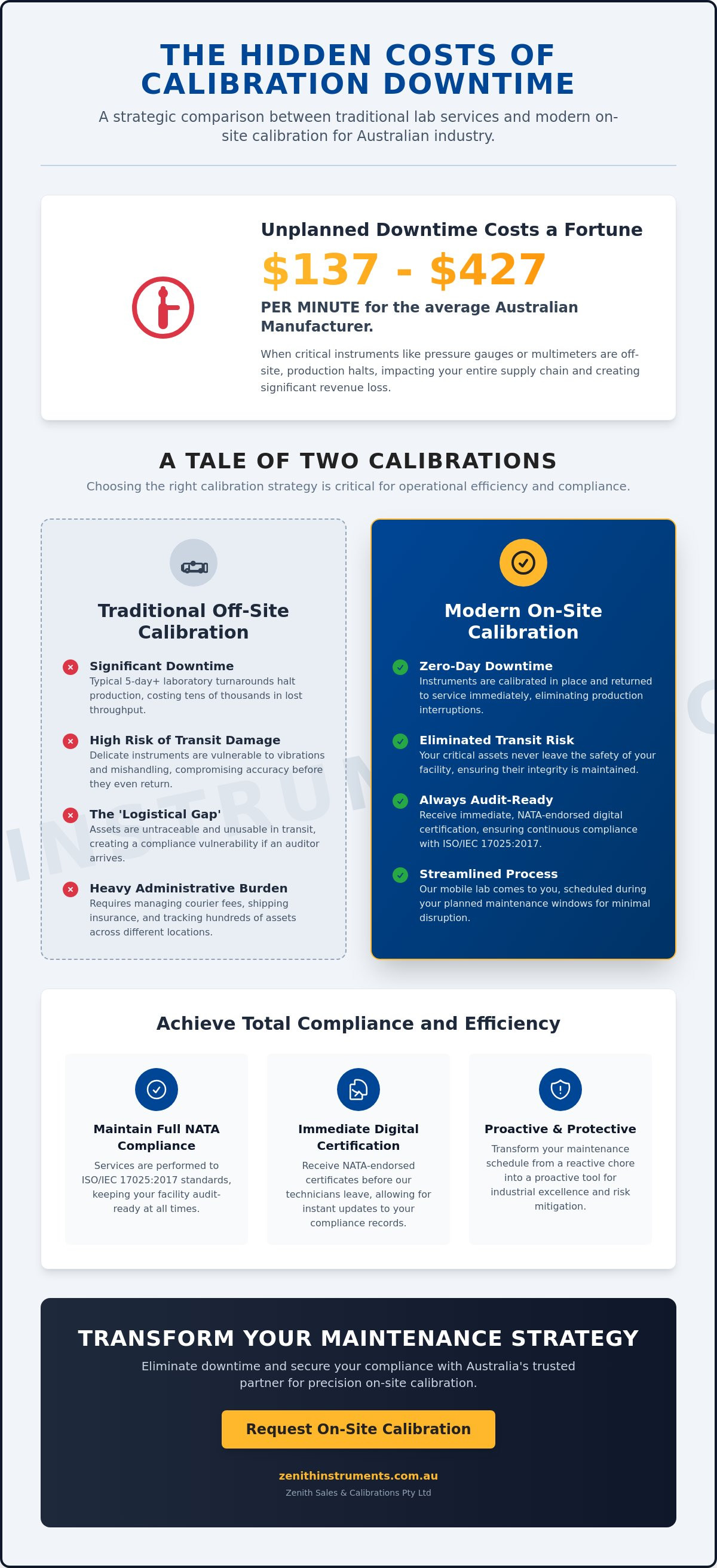
Did you know that unplanned equipment downtime costs the average Australian small-to-medium manufacturer between $137 and $427 every single minute? When a critical pressure gauge or multimeter fails, the financial impact ripples through your entire supply chain. We understand the frustration of halting production because a vital instrument is stuck in transit or sitting in a remote laboratory. You shouldn't have to choose between regulatory compliance and operational efficiency. That's why technical leaders now prioritize strategies to reduce equipment downtime with on-site calibration to keep their assets verified without the logistical lag.
In this guide, you'll discover how NATA-accredited technicians eliminate the risks of courier damage and the administrative burden of tracking hundreds of assets across Sydney and Melbourne. We'll show you how to achieve zero-day downtime while maintaining full compliance with ISO/IEC 17025:2017 standards. From oven calibration to gas monitor testing, we'll outline the precise steps to transform your maintenance schedule into a proactive tool for industrial excellence.
Key Takeaways
- Identify the hidden financial risks of traditional lab-based calibration, including the significant revenue loss caused by unplanned equipment interruptions and transit delays.
- See how you can reduce equipment downtime with on-site calibration by removing the logistical gap where most instrument damage and compliance failures occur.
- Compare the strategic benefits of on-site versus laboratory settings to ensure your critical gauges maintain full NATA compliance without leaving your production floor.
- Master the audit and access protocols required to streamline your next calibration event, ensuring technicians work efficiently across your Sydney or Melbourne facilities.
- Gain immediate access to digital certification and real-time data integrity, allowing your facility to remain audit-ready and compliant with ISO/IEC 17025:2017 standards.
The True Cost of Instrument Downtime for Australian Industry
Equipment downtime in the measurement sector isn't just a stalled assembly line; it's the total absence of the precision tools that ensure your facility operates safely and within legal tolerances. To understand what calibration means in a modern industrial setting, we must view it as a critical safeguard against measurement drift. When instruments leave your site for service, the visible costs like courier fees and shipping insurance are only a fraction of the total expense. The true burden lies in the operational disruption caused by missing assets.
Delicate instruments such as pressure gauges and thermometers are particularly vulnerable to transit damage. High-frequency vibrations in a delivery vehicle can shift sensitive internal components, potentially compromising the accuracy of the device before it even returns to your floor. For an electrical maintenance team in Sydney, a missing multimeter or insulation tester doesn't just represent a logistical hurdle. It restricts the entire crew from performing certified work, leading to immediate productivity drops and scheduling bottlenecks.
Calculating the Hourly Impact on Your Production Line
Recent industry data indicates that unplanned downtime for Australian small to medium-sized manufacturers costs between $137 and $427 per minute. When a Melbourne facility waits for a typical 5-day laboratory turnaround, the lost throughput often reaches tens of thousands of dollars. We find that many businesses attempt to mitigate this by maintaining expensive 'buffer stock' or redundant tools. This ties up capital in idle inventory and increases the administrative burden on maintenance teams. You can effectively reduce equipment downtime with on-site calibration by ensuring your technicians have the tools they need exactly when they need them.
Compliance Risks and the 'Logistical Gap'
Maintaining continuous compliance with ISO/IEC 17025:2017 is difficult when your primary instruments are sitting in a lab queue or a courier's warehouse. If an auditor arrives while your critical gas monitors or appliance testers are off-site, proving your facility's safety status becomes a complex challenge. Our on-site service model eliminates these vulnerabilities by providing immediate, NATA-endorsed certification. The 'Logistical Gap' is the period between tool removal and return where production risk is highest. By closing this gap, you ensure your facility remains audit-ready every hour of the working day. Transitioning to a proactive, on-site model allows your team to focus on technical excellence rather than tracking shipments.
How On-Site Calibration Eliminates Logistical Bottlenecks
Traditional laboratory calibration often creates a logistical choke point that slows down industrial operations. Our mobile laboratory concept solves this by bringing NATA-certified standards directly to your facility. This bypasses the need for complex shipping schedules and the inherent risks of transporting sensitive instrumentation. By performing the work at your location, we eliminate the transit time that often stretches into weeks. Unplanned downtime is a significant financial burden; research from Industry Australia suggests it can cost a company as much as $260,000 an hour in high-output sectors. Transitioning to a local, on-site model is the most effective way to protect your revenue stream.
One of the primary advantages of our service is real-time certification. Our technicians generate NATA-endorsed documentation before they leave your site, allowing your quality managers to update compliance records immediately. If an instrument shows minor inaccuracies, our experts perform immediate adjustments on the spot. This eliminates the "repair and return" cycle where tools are sent back to a workshop for simple tweaks. We schedule these visits during your planned maintenance windows or off-peak shifts to ensure minimal disruption to your core activities. This strategic approach allows you to reduce equipment downtime with on-site calibration while maintaining peak measurement accuracy.
The Zenith On-Site Workflow in Sydney and Melbourne
Our process begins with meticulous pre-visit coordination to identify every critical asset requiring attention. We establish a controlled testing environment within your facility, ensuring that environmental factors like temperature and humidity meet the strict requirements for technical precision. For businesses operating in New South Wales, our calibration services Sydney team provides rapid response times and localized expertise. We arrive fully equipped with reference standards that are traceable to national benchmarks, ensuring your site remains a center of technical excellence.
Reducing Asset Management Complexity
Managing hundreds of instruments across multiple sites is an administrative challenge that often leads to compliance gaps. Our on-site visits allow for a 100% asset audit in a single day, ensuring no thermometer or electrical tester is overlooked. This systematic approach eliminates the "lost in the mail" syndrome that frequently occurs with small, portable devices. We integrate the resulting data directly into your facility's maintenance software, creating a digital paper trail that simplifies future audits. If your facility operates in Victoria, our calibration service melbourne provides the same high-performance, on-site response to keep your production lines moving without logistical delays.
NATA-Accredited On-Site vs. Lab Calibration: Making the Strategic Choice
Deciding between sending instruments to a laboratory or requesting a mobile technician involves balancing precision requirements with operational urgency. While laboratory environments offer the ultimate control for primary reference standards, modern mobile laboratories now achieve comparable accuracy for the vast majority of industrial tools. The most striking difference is the timeline. A standard off-site service often takes 7 to 10 business days including transit; conversely, an on-site technician completes the same task in approximately 2 hours. This speed allows you to reduce equipment downtime with on-site calibration without sacrificing the technical integrity of your measurements.
The "NATA shield" represents a commitment to quality that is particularly difficult to maintain in a mobile setting. To achieve NATA accreditation for on-site services, we must demonstrate that our field reference standards remain stable and that we can effectively control environmental variables at your facility. This accreditation is more valuable for you because it proves that the precision you receive on your factory floor matches the rigorous standards of a stationary lab. NATA-accredited on-site calibration provides the same regulatory confidence as lab-based service.
Instrument Suitability for On-Site Service
Certain asset classes are better suited for field service due to their volume or physical nature. We categorize these based on their operational impact and sensitivity to transport.
- High-volume assets: Managing pressure gauge calibration on-site is highly efficient for facilities with dozens of gauges, as it removes the need to tag, pack, and track each unit individually.
- Delicate electronics: We prioritize on-site electrical equipment calibration for sensitive multimeters and testers to prevent internal component shifts caused by courier transit vibrations.
- Fixed plant: Many instruments, such as gas detectors and industrial thermometers, are integrated into permanent machinery and cannot be removed without significant mechanical labor.
The Decision Matrix: When to Book the Mobile Lab
Efficiency is a key driver for technical managers. We generally find that an on-site visit becomes cost-effective once a facility reaches a threshold of 10 to 15 instruments requiring service simultaneously. However, the criticality factor often overrides volume. If a specific gauge is the single point of failure for a production line, the "On-Site Mandatory" rule applies. In these cases, the ability to reduce equipment downtime with on-site calibration justifies the service regardless of total instrument count. We help you evaluate your inventory to determine which assets require the controlled environment of our permanent lab and which can be serviced immediately at your location.
Planning Your On-Site Calibration: A Guide for Facility Managers in Brisbane & Canberra
Planning a successful calibration event in Brisbane or Canberra requires technical foresight to ensure maximum efficiency. We recommend a four-step preparation phase to streamline the workflow. By following a rigorous preparation checklist, you can further reduce equipment downtime with on-site calibration and ensure the technician's time is spent on precision work rather than logistics. Effective coordination ensures that your facility remains compliant without unnecessary interruptions to your production schedule.
- Step 1: Inventory Audit. Group your pressure gauges, thermometers, and multimeters by their physical location within the plant. This allows our technicians to move systematically through your facility, preventing wasted time backtracking between production lines.
- Step 2: Access & Safety. Ensure our technicians have completed necessary site inductions. Communicate any specific PPE mandates, such as high-visibility gear or safety boots, at least 48 hours prior to the visit.
- Step 3: Power & Environment. Designate a stable workspace with access to 240V power. Our reference standards require a vibration-free environment to maintain their NATA-certified accuracy during the testing process.
- Step 4: Documentation. Have previous calibration certificates and clear asset IDs ready for verification. This speeds up the data entry process and ensures 100% asset traceability.
Logistical Considerations for Large Industrial Sites
For large industrial sites in Brisbane or Newcastle, coordinating a multi-day visit is often the most efficient way to handle high asset volumes. This is particularly true for mining operations where instruments are spread across vast distances. If you operate in the healthcare sector, refer to our specialized guide on biomedical equipment calibration to understand the unique compliance requirements for medical environments. Managing site-specific safety protocols in hazardous areas is a priority; we ensure our team is fully briefed on your internal safety standards before arrival.
Maximising Value During the Technician's Visit
Use the technician's presence as a training opportunity for your maintenance staff. We encourage teams to ask technical questions about instrument care and measurement drift. Identifying "trouble" instruments ahead of time also allows for immediate on-site repair during the visit. This proactive strategy ensures that your entire toolkit returns to service at peak performance. To schedule your 2026 site audit and reduce equipment downtime with on-site calibration, speak with our technical team today to secure your preferred dates.
Zenith Instruments: Australia’s Partner for Precision On-Site Calibration
Zenith Sales & Calibrations Pty Ltd serves as a cornerstone of technical reliability for the Australian industrial sector. We maintain a robust national footprint, delivering consistent, NATA-accredited standards to facilities in Sydney, Melbourne, Brisbane, and Perth. Our service model is designed to reduce equipment downtime with on-site calibration by deploying expert technicians directly to your production floor. This eliminates the need for premium-priced express lab services, as our standard turnaround occurs in real-time at your location. We provide a single point of contact for diverse instrumentation needs, ranging from specialized torque wrench calibration to the retail supply of high-quality pressure gauges.
Why We Are the Dependable Expert for AU Industry
Our reputation is built upon a strict adherence to rigorous internal audits and international benchmarks. We conduct regular field assessments to ensure our mobile reference standards remain as precise as those in our stationary laboratories. This commitment allows Zenith Sales & Calibrations Pty Ltd to act as a comprehensive partner for all your measurement requirements, including electrical, pressure, temperature, and gas detection systems. For businesses in Sydney and Melbourne, our local presence means we can provide rapid-response call-outs for critical instrument failures. You don't have to manage multiple vendors when a single, NATA-certified partner can oversee your entire asset register.
Secure Your Calibration Schedule for 2026
Forward planning is essential for maintaining operational continuity during major maintenance shutdowns in 2026. We recommend booking your on-site visits at least six weeks in advance to ensure availability during peak periods. Many of our long-term partners utilize customized service contracts for quarterly or bi-annual visits. These agreements automate the compliance process and ensure no instrument falls out of its certified cycle. This predictable maintenance rhythm allows your team to focus on core production targets rather than administrative tracking. It's the most reliable way to maintain safety and accuracy across your entire facility. Contact Zenith Sales & Calibrations Pty Ltd today to book your on-site calibration and eliminate downtime.
Optimise Your Facility’s Performance with Strategic Precision
Transitioning to a mobile service model is a strategic decision that protects your bottom line. We've explored how the logistical gap between tool removal and return creates unnecessary risk for Australian manufacturers. By choosing to reduce equipment downtime with on-site calibration, you ensure your production lines in Sydney, Melbourne, or Brisbane never stop for a routine compliance check. Our NATA-accredited technicians bring laboratory standards directly to your floor, providing the accuracy your industry demands without the 10-day wait associated with traditional lab queues.
With over 20 years of technical expertise, we understand the meticulous nature of managing high-volume assets across Australia. From Newcastle to Canberra, our national team provides the authoritative oversight needed for full ISO/IEC 17025 compliance. It's time to replace logistical delays with real-time precision and certified results that keep your facility audit-ready at all times. Request an On-Site Calibration Quote for Your Facility today to secure your 2026 maintenance schedule and maintain peak operational efficiency.
Frequently Asked Questions
Is on-site calibration as accurate as laboratory calibration?
Yes, on-site calibration provides the same level of accuracy for most industrial instruments when performed by NATA-accredited technicians. We use portable reference standards that are regularly verified against national primary standards to maintain technical integrity. This approach allows you to reduce equipment downtime with on-site calibration without compromising on the precision required for ISO compliance.
Which Australian cities does Zenith offer on-site calibration services in?
We provide nationwide coverage across all major Australian industrial hubs. Our technicians regularly service facilities in Sydney, Melbourne, Brisbane, Canberra, Newcastle, and Perth. This localized presence ensures rapid response times and a deep understanding of the specific logistical needs of regional and metropolitan Australian sectors.
Can NATA-endorsed certificates be issued for on-site calibrations?
Yes, we issue NATA-endorsed certificates for all on-site work that falls within our accredited scope. These digital certificates are generated in real-time, ensuring your quality management system is updated before our technician leaves your facility. This bypasses the administrative delays common with laboratory-based reporting.
What types of equipment can be calibrated on-site at my facility?
Most common industrial measurement tools are suitable for on-site service. This includes pressure gauges, thermometers, multimeters, insulation testers, and gas monitors. We also specialize in fixed-plant equipment like ovens and environmental chambers that are physically impossible or prohibitively expensive to transport to a lab.
How much does an on-site service call-out cost compared to lab service?
Pricing is provided on a per-quote basis to reflect your specific asset volume and location. While a call-out fee applies, the total cost is often lower than lab service when you account for the elimination of courier fees, shipping insurance, and the $137 to $427 per minute cost of unplanned downtime for Australian SMBs.
How long does a typical on-site calibration visit take?
A standard on-site visit for a batch of 10 to 15 instruments typically takes about 2 hours to complete. For larger manufacturing plants or mining sites with hundreds of assets, we coordinate multi-day visits to ensure every device is verified systematically without disrupting your core production schedule.
What happens if an instrument fails calibration while the technician is on-site?
Our technicians perform immediate on-site adjustments if an instrument is found to be outside of its tolerance range. This proactive approach allows the tool to return to service immediately. If a major mechanical failure is detected, we tag the unit as "out of service" to prevent compliance breaches and provide a repair or replacement quote.
Do I need to provide any equipment or power for the Zenith technician?
You only need to provide a stable, vibration-free work area and access to a standard 240V power outlet. Our team arrives with all necessary NATA-certified reference standards and testing equipment. Providing these basic requirements helps us reduce equipment downtime with on-site calibration by allowing our team to begin work immediately upon arrival.