

What if the best calibration plan is the one that keeps the right equipment available for classes, rather than sending every tool away at once? Choosing TAFE workshop tool calibration brisbane starts with a clear inventory: identify the measuring instruments in use, what they measure and what records each one needs. It’s understandable to be concerned about accuracy, documentation and disruption to practical training.
This guide explains how to scope a mixed workshop inventory, compare onsite and offsite calibration, and plan equipment availability around service needs. You’ll also learn what to look for in calibration records, traceability and accreditation, including why NATA accreditation applies only within a laboratory’s accredited scope. Zenith Sales & Calibrations Pty Ltd provides calibration and onsite, in-house and offsite service options. Calibration uses a computerised closed-loop software system designed to reduce human error. With Australia-wide service, including Sydney, Melbourne, Newcastle, Canberra and Brisbane, Zenith Sales & Calibrations Pty Ltd can help you build a practical plan around your workshop’s instruments and logistics.
Key Takeaways
- Build an instrument register with identifiers, measurement ranges, locations, use frequency and calibration history to define the scope.
- Match onsite or offsite calibration to instrument requirements, batch size, access and the impact of equipment being unavailable.
- For TAFE workshop tool calibration brisbane, distinguish traceability from NATA accreditation and align the evidence required with each instrument’s use.
- Compare calibration scope, certificate details and service logistics to create a plan that supports reliable records and workshop continuity.
- Zenith Instruments uses computerised closed-loop software designed to reduce human error and provides onsite, in-house and offsite calibration options.
TAFE workshop tool calibration in Brisbane: what needs to be planned?
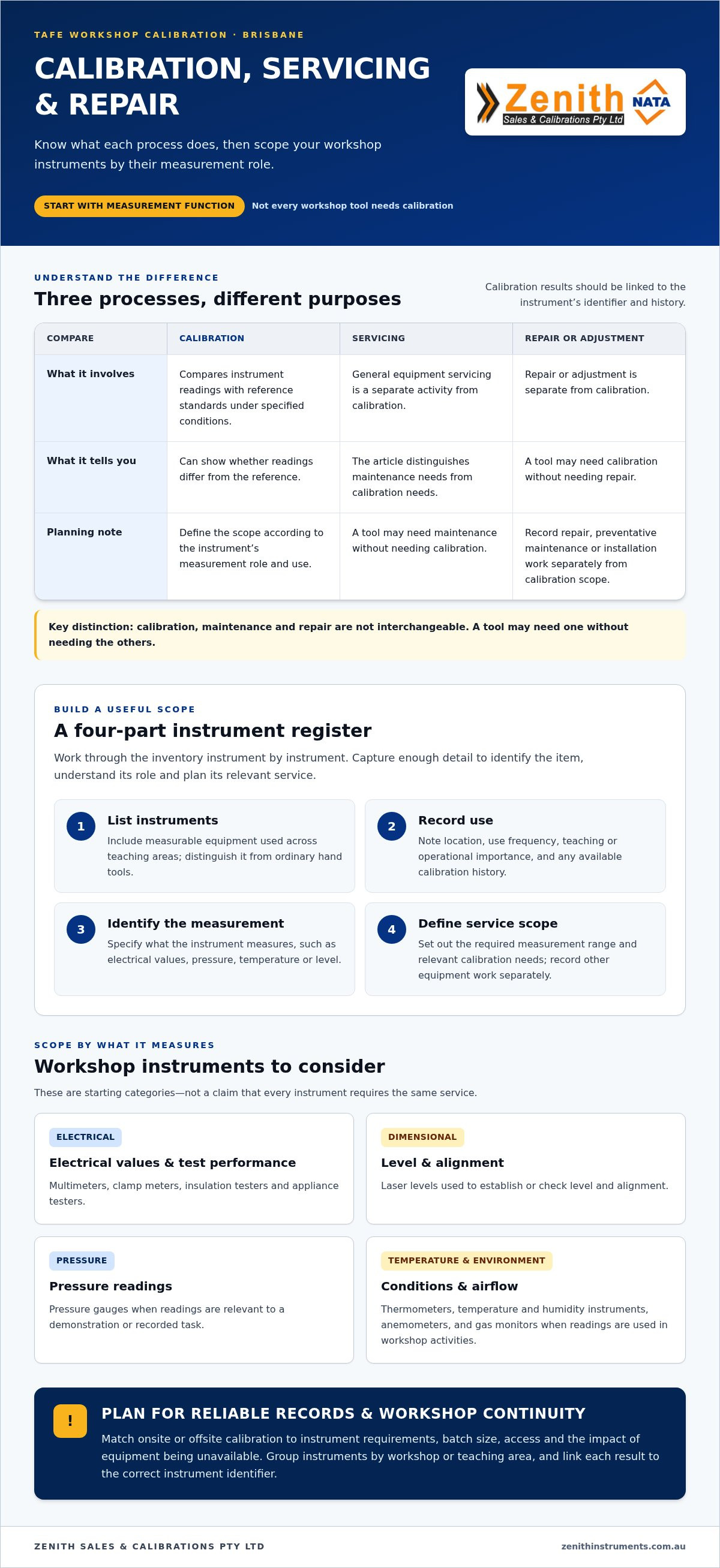
A TAFE workshop calibration program is a documented process for identifying instruments that affect measurement, defining the required calibration scope and linking results to each instrument. Calibration compares an instrument’s readings with reference standards under specified conditions. It can show whether readings differ from the reference, but it isn’t the same as general servicing, repair or adjustment. A tool may need maintenance without needing calibration, or calibration without repair.
For teaching, dependable readings help instructors demonstrate techniques consistently, support fair practical assessments and maintain useful equipment records. An unexpected result can confuse a learner or affect an assessment. A planned approach helps staff understand which instruments are in scope, what each one is used for and how to manage availability.
Which workshop equipment may need calibration?
Start with measurement function, not the broad label “workshop tool”. Ordinary hand tools such as hammers and spanners don’t automatically need calibration. An item is a candidate when its measurement is used for instruction, assessment, process decisions or records. The required scope depends on that role and the workplace’s requirements.
- Electrical: multimeters, clamp meters, insulation testers and appliance testers measure electrical values or test performance.
- Dimensional: laser levels are used to establish or check level and alignment. Zenith provides dimensional calibration services.
- Pressure: pressure gauges provide readings that may be relevant to a demonstration or recorded task.
- Temperature and environmental conditions: thermometers, temperature and humidity instruments, and anemometers measure temperature, humidity or airflow. Gas monitors are another category to include when their readings are used in workshop activities.
This is a practical starting point, not a claim that every instrument in every category requires the same service. For background on general principles, see What is Calibration?
Why Brisbane TAFE workshops need a planned approach
Shared equipment can pass between classes, instructors and work areas, while use varies with teaching schedules. A register helps prevent a measuring instrument from being overlooked because it’s stored elsewhere or used only for a particular module. Record what it measures, where it is kept and how its readings are used before setting its calibration scope.
For TAFE workshop tool calibration brisbane, planning also means considering access and availability. Grouping instruments by workshop or teaching area can help staff coordinate calibration with class timetables and avoid removing all similar equipment at once. Keep calibration results linked to the instrument’s identifier so staff can match each result to the correct item and use its history when reviewing the plan.
A clear inventory turns calibration from a broad “test every tool” exercise into a focused process based on measurement purpose. It gives workshop staff a practical basis for prioritising instruments, arranging service and maintaining consistent demonstrations and assessment records.
How to scope calibration for a mixed TAFE workshop inventory
Build the calibration scope instrument by instrument, rather than assuming that every item in a workshop needs the same treatment. Measurement function, range, teaching use, operating conditions and available history all affect what service is relevant. For TAFE workshop tool calibration brisbane, a structured register turns a mixed inventory into a clear schedule and helps distinguish calibration from other equipment work.
Build an instrument register before requesting calibration
Record enough detail to identify each instrument and understand its role. Include its model, serial number, measurement range, accessories, location and current status where available. Note how often it’s used, which teaching activities rely on it and whether its readings matter to an assessment or equipment record. This information helps prioritise scheduling and match the instrument to a suitable scope.
Work through the inventory in sequence:
- List instruments. Include measurable equipment used across teaching areas, and distinguish it from ordinary hand tools.
- Record use. Note location, use frequency, teaching or operational importance, and any available calibration history.
- Identify measurement function. Specify what the instrument measures, such as electrical values, pressure, temperature or level.
- Define service scope. Set out the required measurement range and relevant calibration needs, recording repair, preventative maintenance or installation work separately.
This detail prevents a broad request from obscuring differences between instruments. For example, a multimeter used for practical electrical testing and a thermometer used in a teaching process have different measurement functions, even if both are stored in the same workshop. Relevant electrical testers can be scoped alongside electrical equipment calibration services.
Match instrument categories to relevant service scope
Scope should follow each instrument’s measurement function, range, use and workplace requirements. Those factors determine what result is meaningful and what documentation supports its intended use. Keep the register specific rather than grouping equipment solely by department or storage location.
- Electrical instruments: identify multimeters, clamp meters, insulation testers and appliance testers by function and range.
- Pressure and temperature: list pressure gauges and thermometers separately, noting the values they’re used to measure.
- Dimensional and level measurement: record dimensional instruments and laser levels by their role in demonstrations or practical work.
- Torque tools: record these separately from general hand tools. Zenith provides authorised repair, calibration and preventative maintenance for Wera Torque Tools. Relevant work can be scoped through torque wrench calibration services.
Calibration addresses measurement performance; it doesn’t automatically resolve damage, wear or installation needs. Flag those separately so they aren’t mistaken for calibration requirements. Zenith’s instrument calibration services include onsite, in-house and offsite options, supporting a scope shaped around the instruments and their use.
Onsite or offsite calibration in Brisbane: which suits your workshop?
The right service arrangement depends on more than how many instruments are due. Consider the instrument type and scope, access to the equipment, batch size and the effect of temporary removal on teaching. For TAFE workshop tool calibration brisbane, the goal is to choose a practical method that supports the required calibration while helping staff manage equipment availability. Neither onsite nor offsite service is universally faster, less expensive or more accurate.
When onsite calibration may support workshop continuity
Onsite calibration can reduce transport and the time instruments spend away from their usual location. That can be useful when equipment is shared across classes or removing it would affect scheduled demonstrations and practical work. Zenith provides onsite calibration across Australia, including Brisbane. The appropriate arrangement depends on the instrument, access and required service scope.
Before scheduling onsite work, identify where instruments are stored or used and whether the calibration activity can be carried out in an accessible area. A grouped visit may be convenient for a batch of suitable instruments, but the number of items alone doesn’t determine whether onsite service is appropriate. The required work must suit the onsite method.
When offsite or laboratory calibration may be appropriate
Offsite calibration can suit instruments whose required scope calls for laboratory handling, or when a planned batch can be prepared and transported together. The trade-off is temporary unavailability: staff need to account for packing, transport and the period instruments are away from the workshop. Grouping equipment can make logistics easier to coordinate, but teaching activities that depend on those items still need to be planned.
Zenith offers offsite and in-house calibration options, and its laboratory is ISO 17025-compliant. This describes laboratory compliance; it doesn’t mean every instrument or calibration scope is NATA-accredited. The appropriate method depends on the instrument and service scope.
- Consider onsite service when keeping suitable instruments at their normal location is a priority and the required work can be performed onsite.
- Consider offsite service when laboratory handling suits the scope or when a batch can be transported and managed together.
- Plan around access and classes by identifying equipment locations, teaching periods and any instruments that can’t all be unavailable at once.
- Decide instrument by instrument rather than assigning one method to every item in a mixed workshop inventory.
A staged plan may combine both methods: keep suitable, frequently used instruments onsite where practical, and schedule other items for offsite service in manageable groups. Record which equipment will be unavailable and arrange teaching activities accordingly. This gives workshop staff a clearer view of the logistics before calibration begins, while keeping the method aligned with each instrument’s requirements.
How to compare Brisbane calibration services for TAFE tools
Compare calibration services against the needs in your instrument register, not just a headline description. For TAFE workshop tool calibration brisbane, assess the measurement scope, evidence supplied, accreditation status and practical arrangements for equipment access. The service should match the instrument’s purpose and the records your workshop needs to maintain.
What to look for in calibration records
Calibration records should identify the instrument and explain the work performed. Review each certificate for the instrument’s identifier, calibration date, reported results and information about the references used. Check that the scope relates to the instrument’s measurement function and range. Keep the record linked to the instrument’s register entry so staff can track its status and history.
A clear record helps workshop coordinators see which items have been calibrated and plan future work without relying on memory or labels alone. Keep the service date and any relevant interval decision alongside the certificate. When establishing documentation practices, consider the instrument’s use and workplace requirements, and record enough detail to support a later review.
How to evaluate accreditation and traceability claims
Traceable calibration means measurement results are connected through a documented chain to a national measurement standard. NATA accreditation is different: it recognises a laboratory’s technical competence against ISO/IEC 17025 requirements and applies only to activities listed within its accredited scope. Traceability alone does not mean a calibration was performed under NATA accreditation.
Check that any accreditation claim covers the specific instrument type and calibration activity relevant to your requirement. Don’t assume every certificate from an accredited laboratory is NATA-endorsed, or that a laboratory’s accreditation covers every service it performs. ISO 17025 compliance and NATA accreditation are also not interchangeable: compliance describes a laboratory’s alignment with the standard, while accreditation is formal recognition for a defined scope.
- Scope: Does the proposed calibration cover the instrument’s function and required range?
- Traceability: Do records identify the measurement references and traceability information?
- Accreditation: If required, does the NATA-accredited scope apply to this instrument and activity?
- Certificate details: Can staff match the result to the instrument and understand what was measured?
- Service logistics: Are onsite or offsite arrangements compatible with workshop access and equipment availability?
Calibration intervals aren’t universal. Set review timing with regard to the instrument’s use, manufacturer recommendations and applicable workplace requirements, then use its history to inform future planning. Avoid treating a common interval as a rule for every instrument.
Zenith Instruments provides calibration services for workshop instruments, with onsite, in-house and offsite arrangements. Review calibration options for your workshop instruments as you turn the checklist into a Brisbane service plan.
Plan TAFE workshop calibration with Zenith in Brisbane
A workable calibration plan connects each instrument’s measurement role with the required service scope, where the work will take place and how equipment availability will be managed. Zenith Instruments supports Brisbane customers with instrument-specific calibration and onsite, in-house or offsite service options. This lets workshop coordinators plan around the instruments in their inventory rather than treating every item as the same job.
Calibration uses a computerised closed-loop software system designed to reduce human error. The fastest calibration service can be as fast as 24 hours, but turnaround depends on the instrument and job, so this isn’t a standard or guaranteed timeframe. Planning ahead helps teams coordinate service with teaching schedules and decide how to manage equipment while it’s being calibrated.
What Zenith’s calibration approach brings to workshop planning
For a mixed teaching workshop, instrument scope, service location and scheduling need to be considered together. Electrical testers, pressure gauges, thermometers and laser levels have different measurement functions, so the required calibration work is specific to each instrument. Onsite service may help reduce equipment removal where suitable; offsite or in-house options provide alternatives when the scope and logistics call for them.
Zenith’s calibration services include NATA-accredited capabilities within the relevant accredited scope, and its laboratory is ISO 17025-compliant. These terms describe different things: NATA accreditation applies to defined activities, while ISO 17025 compliance describes the laboratory’s alignment with the standard. Neither statement means every instrument or calibration activity is covered by an accredited scope. For torque tools, Zenith also provides authorised repair, calibration and preventative maintenance for Wera Torque Tools.
Prepare a clear service request
A concise equipment list makes it easier to plan a scoped request. Include the instrument type, identifier, measurement range, location and preferred service arrangement, along with current calibration records where available. Note which instruments are used regularly for teaching or assessment, and any periods when they’re especially difficult to take out of service. This preparation helps make the service plan specific to your workshop.
With that information, planning can focus on the actual inventory: which instruments need calibration, what scope is relevant, and whether onsite or offsite service best fits the workshop’s schedule. Keep repair or maintenance needs distinct from calibration so each can be considered appropriately. Clear scoping also helps align documentation and service logistics with how equipment is used.
For TAFE workshop tool calibration brisbane, start with the instruments and their use, then build a plan around scope, records and availability. Discuss your workshop calibration requirements with Zenith to plan the next steps for your inventory.
Make calibration part of workshop planning
Once the inventory is scoped, make calibration part of how the workshop manages equipment, rather than a task that resurfaces only when a certificate is requested. Assign responsibility for keeping records matched to instruments, noting changes in use and reviewing the schedule when equipment is added, moved, repaired or used more intensively. This gives staff a clear basis for planning future work and reduces the chance of calibration becoming a last-minute interruption to teaching.
For TAFE workshop tool calibration brisbane, begin the next planning cycle by identifying priority instruments and recording the service requirements attached to each. A consistent review process helps workshop teams keep the plan relevant as equipment and teaching needs change. It also gives coordinators a practical starting point for aligning calibration arrangements with equipment availability.
Turn your inventory into a workable service plan with Zenith. Plan your workshop calibration with Zenith and move forward with a clear, manageable approach.
Frequently Asked Questions
Does every tool in a TAFE workshop need calibration?
No. Calibration is relevant to instruments that provide measurements used for teaching, assessment or operational decisions, not automatically to every workshop item. A hand tool such as a hammer generally has no measurement function to calibrate, while an electrical tester or pressure gauge does. For TAFE workshop tool calibration brisbane, use the instrument’s purpose and the consequences of an unreliable reading to determine whether it belongs in the calibration plan.
How often should a TAFE workshop’s measuring instruments be calibrated?
There’s no single interval that suits every instrument. A 12-month cycle is a common starting point, not a universal rule. Consider the manufacturer’s recommendations, frequency and conditions of use, the instrument’s history and how critical its readings are. For example, an instrument used frequently in demanding workshop conditions may warrant a different review interval from one used occasionally. Record the reasoning so the schedule can be reviewed as use changes.
Can workshop equipment be calibrated onsite in Brisbane?
Yes. Zenith provides onsite calibration in Brisbane for instruments and scopes suited to onsite work. This can be useful when equipment is installed, shared between teaching spaces or difficult to transport. Workshop staff can help make the visit productive by grouping relevant instruments, identifying their locations and planning access around classes. The service method should match the instrument and required scope.
What should a calibration certificate include for workshop equipment?
A useful certificate should identify the instrument clearly and state the calibration date, results and relevant reference traceability. Depending on the service and instrument, it may also report measurement conditions, uncertainty, or results before and after adjustment. Check that the document corresponds to the correct serial number and measurement range. Keep it linked to the equipment record so staff can retrieve the result when reviewing status or planning future calibration.
What happens if an instrument is found outside its specified tolerance?
If a result is outside the instrument’s specified tolerance, treat it as a reason to assess the instrument’s suitability for use. Identify and control the instrument so it isn’t relied on without review, then consider whether earlier measurements or records could be affected. The next action may involve adjustment, repair or replacement, followed by calibration as appropriate. Document the decision and outcome in the equipment history to support a traceable review.
How long can calibration take for TAFE workshop equipment?
Timing depends on the instrument, required scope, service arrangement and the number of items being handled. Zenith’s fastest calibration service can be as fast as 24 hours, but that isn’t a guaranteed turnaround for every instrument or job. For planning, identify equipment needed for upcoming classes and discuss how the batch will be managed. This helps coordinators account for transport or temporary unavailability without assuming a fixed duration.
Can torque tools be calibrated as part of a workshop equipment program?
Yes. Torque tools can be included as a distinct category in a wider workshop equipment plan, with their service needs recorded separately from general hand tools. Zenith provides authorised repair, calibration and preventative maintenance for Wera Torque Tools in Australia and New Zealand. Keep each tool’s identifier and available service history with the workshop records, and plan its availability around teaching activities that rely on controlled torque application.