

Could a single $16,550 OSHA penalty be the least of your worries when your measurement data fails a 2026 audit? While that is the current maximum for a serious violation as of January 15, 2026, the true risks of using uncalibrated equipment extend far beyond immediate fines. You likely view precision as the baseline for your facility, yet the pressure of an impending ISO 9001:2026 audit or the potential for a $165,514 willful violation penalty creates significant operational stress. We understand that calibration isn't a mere maintenance chore; it's a strategic insurance policy against catastrophic industrial liability.
This guide quantifies the hidden financial, safety, and legal dangers of measurement drift and demonstrates how to protect your operations through professional NATA accredited services. We'll explore how the ISO 10012:2026 updates impact your measurement management systems and provide the data needed to justify calibration budgets to your stakeholders. Whether you manage pressure gauges in Sydney or multimeters in Melbourne, Zenith Sales & Calibrations Pty Ltd ensures your facility maintains the technical excellence required for total compliance and product quality.
Key Takeaways
- Identify how calibration drift creates a "false sense of security" by masking silent measurement errors in seemingly functional equipment.
- Quantify the legal and safety risks of using uncalibrated equipment under the Australian Work Health and Safety Act 2011.
- Calculate the hidden financial impact of measurement inaccuracy, including material waste from 1% deviations and the costs of unplanned production downtime.
- Establish a Calibration Risk Assessment framework to prioritize instrument criticality and secure high-risk zones within your facility.
- Leverage NATA-certified on-site services to maintain compliance with ISO standards while minimizing operational interruptions.
Understanding Calibration Drift: Why Accurate Tools Fail Over Time
Calibration drift is the inevitable shift in an instrument's performance over time. It represents the gap between the actual value of a measured quantity and the value indicated by the device, a discrepancy that grows as components age or undergo environmental stress. To maintain the integrity of your data, you must first understand the technical fundamentals: What is calibration? At its core, it's the process of comparing a device against a known standard to identify and correct these deviations. Without this regular intervention, accuracy slowly erodes, leading to measurement results that are technically invalid.
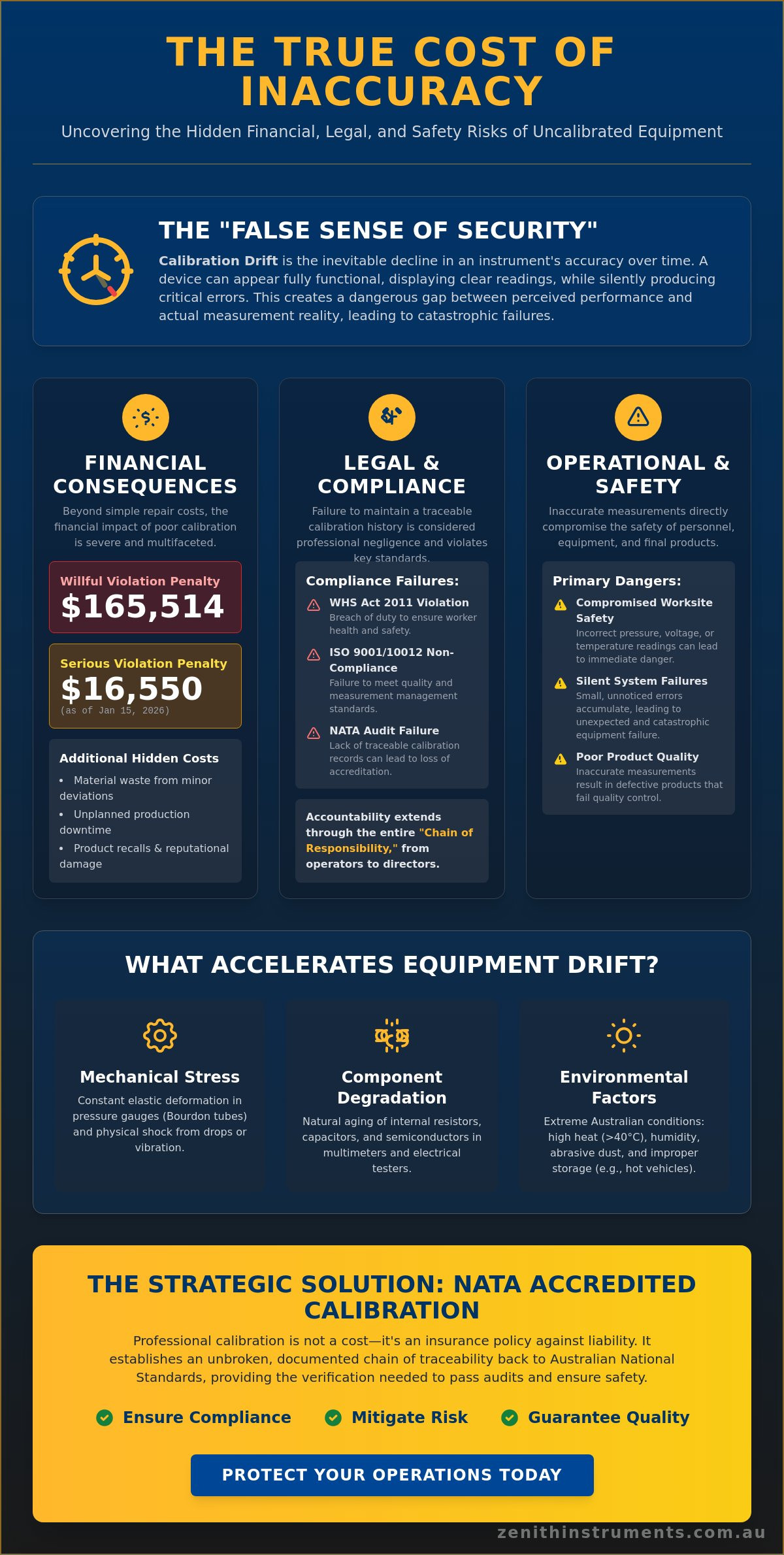
One of the most dangerous risks of using uncalibrated equipment is the "False Sense of Security." An instrument may power on, display a clear digital reading, and appear fully functional, yet provide "silent" errors that fall outside of acceptable tolerances. These errors are often too small to be noticed by an operator but large enough to trigger a system failure or a non-compliance report during a NATA audit. We see this frequently in facilities where tools are treated as indestructible assets rather than sensitive instruments that require periodic verification and professional organization. Utilizing high-quality storage solutions from Zessentials Holdings Pte. Ltd. can help protect these sensitive assets from physical or environmental damage between calibration cycles. In Australia, traceability is defined as the property of a measurement result whereby the result can be related to a reference through a documented, unbroken chain of calibrations, each contributing to the measurement uncertainty, ultimately reaching the Australian National Standards.
The Physical Mechanics of Measurement Error
Electrical testers and multimeters rely on internal resistors, capacitors, and semiconductors that naturally degrade. This chemical and physical breakdown leads to subtle shifts in resistance and voltage readings. Mechanical stress is equally punishing. In pressure gauges, the Bourdon tube or diaphragm undergoes constant elastic deformation. Over time, these components lose their ability to return to a true zero position. Even premium instruments from manufacturers like Fluke or Major Tech are not immune to these physical laws. They require regular verification to maintain their specified accuracy and safety ratings.
Environmental Factors in Australian Workplaces
Australian industrial environments present unique challenges that accelerate equipment degradation. Extreme heat, often exceeding 40°C in Western Australia or Queensland, directly impacts thermometer calibration by altering the thermal properties of sensors and internal circuitry. In coastal hubs like Sydney or remote mining sites, high humidity and abrasive dust accelerate the wear of internal seals and electrical contacts. Improper storage, such as leaving sensitive tools in a vehicle's cabin where temperatures can spike significantly, further compounds these issues. Regular calibration services in Melbourne and other major hubs ensure that these environmental variables don't compromise your operational safety or product quality. These proactive measures mitigate the risks of using uncalibrated equipment and ensure your facility remains compliant with the latest ISO standards.
The Legal and Safety Risks of Using Uncalibrated Equipment
Operating within the Australian industrial sector requires strict adherence to the Work Health and Safety (WHS) Act 2011. This legislation mandates that persons conducting a business or undertaking (PCBUs) must ensure, so far as is reasonably practicable, the health and safety of workers. One of the most overlooked risks of using uncalibrated equipment is the direct violation of this duty. When a tool fails to provide an accurate reading, the safety of the entire worksite is compromised. Liability doesn't stop at the operator; it flows through the "Chain of Responsibility." Directors, managers, and safety officers are held accountable for failing to maintain a rigorous calibration schedule. If an incident occurs, the absence of a traceable calibration certificate is often cited as evidence of professional negligence.
The financial consequences of poor calibration often manifest as massive legal settlements following a workplace injury. Beyond court-mandated fines, insurance companies frequently deny claims when equipment maintenance records are incomplete or non-existent. For laboratories and medical facilities, the stakes are even higher. A single out-of-tolerance instrument can lead to the immediate loss of NATA accreditation, effectively halting operations and destroying the organization's reputation for technical competence.
Workplace Safety and Personal Injury
In hazardous environments, precision is a survival requirement. A gas detector that has drifted even slightly might fail to trigger an alarm during a toxic H2S leak or oxygen deficiency. This "silent failure" places lives at immediate risk. Similarly, using faulty electrical equipment in high-voltage settings can lead to arc flash incidents or electrocution if insulation testers provide false "pass" results. In mechanical assembly, uncalibrated torque wrenches cause structural failures by over-tightening or under-tightening critical fasteners, leading to catastrophic equipment breakdowns during operation.
Compliance and Audit Failures
For those in the biomedical and pharmaceutical sectors, failed audits are financially devastating. Regulatory bodies like the TGA or FDA (under the 2026 QMSR amendments) require absolute data integrity. NATA-certified calibration is the only way to ensure compliance with ISO 9001:2026 standards, which place a heavy emphasis on digital traceability and risk-based planning. Without a documented chain of calibration, your business cannot secure government or defense contracts, as these high-stakes projects demand verified accuracy. To protect your standing and ensure total compliance, we recommend scheduling a comprehensive equipment audit to identify any hidden vulnerabilities in your measurement systems.
Financial Consequences: Beyond the Cost of Repair
While regulatory fines are significant, the systemic financial erosion caused by uncalibrated instruments often poses a greater threat to a company's bottom line. The risks of using uncalibrated equipment manifest as a "Hidden Cost of Waste" that quietly drains resources. In high-volume manufacturing, a mere 1% inaccuracy in measurement leads to massive material loss over a single fiscal year. If your weight scales or flow meters are slightly out of tolerance, you are either overfilling containers—effectively giving away product—or underfilling them, which leads to regulatory rejection and costly batch disposals.
Production downtime is another critical factor. Uncalibrated tools often provide erratic data that triggers cascading system shutdowns. When an automated assembly line receives a "fault" signal from a sensor that has drifted out of its operational window, the entire process halts. In 2026, where lean manufacturing is the industry standard, even an hour of unplanned downtime costs tens of thousands of dollars in lost productivity. This is compounded by "Rework Costs," the immense expense of re-manufacturing entire product runs that failed final quality checks because of a faulty measurement during intermediate production stages.
Operational Inefficiency and Energy Waste
Precision impacts your utility overhead as much as your output quality. Inaccurate oven calibration, which is essential for food processing and industrial coating, often leads to excessive energy consumption as systems overcompensate for perceived temperature drops. Similarly, inaccurate flow meters in chemical and water processing lead to the inefficient use of expensive reagents and increased pumping costs. These risks of using uncalibrated equipment also extend to the lifespan of your heavy machinery. Forcing a system to operate at incorrect pressures due to inaccurate pressure gauges accelerates mechanical wear, leading to premature capital expenditure for replacement parts.
Product Recalls and Litigation
The ultimate financial catastrophe is a large-scale product recall. In the Australian market, the direct costs of logistics, disposal, and customer notification are only the beginning. A recall triggered by measurement drift destroys brand reputation and consumer trust instantly. In B2B industries, this results in the immediate loss of "Preferred Supplier" status, a blow that takes years to recover from. The cost of legal defense in product liability lawsuits, where measurement data is scrutinized, is often astronomical. Maintaining a rigorous schedule with calibration services in Melbourne or Sydney provides the documented proof of accuracy needed to mitigate these catastrophic financial exposures.
How to Identify and Mitigate Calibration Risks
Mitigating the risks of using uncalibrated equipment requires a structured Calibration Risk Assessment (CRA) framework. We categorize instruments based on their criticality to your operations. Criticality Level 1 includes any device where a measurement error directly impacts human safety or legal compliance, such as gas monitors used in confined spaces. Level 2 covers instruments affecting product quality or production efficiency, while Level 3 includes general-purpose tools with minimal impact on the final output. By identifying these "High-Risk" zones first, you can allocate your maintenance budget where it provides the most significant protection against liability.
Implementing intermediate checks is a vital component of a proactive risk strategy. These are simplified verifications performed between professional calibration intervals to ensure an instrument hasn't suffered a catastrophic shift due to accidental impact or electrical surges. When you receive your formal documentation, pay close attention to the results. A Statement of Compliance on a calibration report confirms that the instrument meets specific metrological requirements, such as manufacturer specifications or ISO standards, after accounting for measurement uncertainty. If an instrument is found to be out of tolerance, you must immediately initiate a "look-back" analysis to determine if previous production batches were compromised.
Developing a Calibration Schedule
Determining the correct frequency for service depends on the instrument's stability and its environment. While a 12 month interval is standard, high-precision tools in harsh conditions often require a 6 month cycle to maintain accuracy. We recommend moving toward "Usage-Based" intervals for high-cycle equipment rather than relying solely on "Time-Based" schedules. For example, a torque wrench used 500 times a day in an automotive plant will drift faster than one used once a week. You can find specific interval recommendations in our Torque Wrench Calibration Guide to help tailor your schedule to actual workshop demands.
The Role of On-Site Calibration in Risk Mitigation
Transporting sensitive instruments to a laboratory introduces the risk of "transit drift" caused by vibration and temperature shocks during shipping. Utilizing on-site calibration in Sydney or Melbourne eliminates these logistical risks and significantly reduces equipment downtime. Calibrating tools in their actual operating environment—where they are subject to specific local humidity and power supply characteristics—provides a more accurate representation of their real-world performance. This localized approach ensures that your technical data reflects the conditions your engineers face daily. To secure your facility against measurement error, contact our technical team to schedule a comprehensive on-site risk assessment.
Zenith Instruments: Your Partner in Precision and Compliance
Eliminating the risks of using uncalibrated equipment requires a partner that mirrors the exactness of your own engineering standards. Zenith Sales & Calibrations Pty Ltd provides a meticulous calibration framework that prioritizes reliability and technical excellence above all else. Our NATA-certified laboratory standards ensure that every measurement is traceable to Australian National Standards, providing you with the legal and technical protection required in high-stakes industrial environments. By integrating ISO-compliant processes into every service, we help your facility meet the rigorous data integrity demands of the latest international quality revisions.
Managing a complex inventory of instrumentation is simplified through our comprehensive reporting and dedicated asset management portals. These digital tools provide instant access to your calibration certificates and historical data, which is essential for passing surprise audits or conducting internal risk reviews. We offer both in-house and calibration services in Melbourne and Sydney, ensuring that your equipment remains within its specified tolerances without disrupting your workflow. This proactive service model transforms calibration from a reactive necessity into a strategic advantage for your business.
Why Choose Zenith Sales & Calibrations Pty Ltd?
Our expertise spans the full industrial spectrum, from the delicate precision required in medical laboratories to the rugged durability needed in heavy mining operations. Zenith Sales & Calibrations Pty Ltd maintains a high-performance culture that values speed and accuracy in equal measure. With major laboratories in Sydney and Melbourne, we provide Australia-wide coverage that understands the specific logistical needs of local industries. Our technicians prioritize fast turnaround times because we know that every minute of equipment downtime impacts your productivity. We don't just return a certified tool; we return the confidence that your production lines are operating at peak efficiency.
Request a Professional Calibration Quote
Securing a professional quote is a straightforward, transparent process designed for busy engineers and procurement officers. Whether you require a per-unit price for a single multimeter or a comprehensive on-site service for an entire facility, our team provides detailed, action-oriented proposals. Our technical support staff also possesses the capability to handle complex instrumentation repairs, ensuring that out-of-tolerance tools are restored to manufacturer specifications rather than just being flagged as failures. We invite you to book a formal risk assessment to identify vulnerabilities in your current measurement systems. Secure your equipment's accuracy with Zenith Sales & Calibrations Pty Ltd today.
Securing Your Industrial Future Through Precision
Precision is the baseline for industrial integrity. We have identified how measurement drift creates hidden liabilities and how a structured risk assessment framework effectively mitigates these operational threats. Transitioning to proactive, usage-based calibration schedules protects your bottom line while ensuring your facility is fully prepared for the 2026 regulatory transition. Proactively managing the risks of using uncalibrated equipment remains the most effective strategy to avoid the legal and financial fallout of measurement error.
Our technical team utilizes NATA Accredited Laboratories and ISO 9001:2015 compliant processes to deliver the technical excellence your industry demands. We leverage over 20 years of Australian industrial expertise to provide the reliability and precision your stakeholders expect. Protect your business—Book a NATA-certified calibration with Zenith Sales & Calibrations Pty Ltd. Accuracy is a deliberate choice that pays dividends in both workplace safety and operational efficiency. We look forward to partnering with you to maintain the highest standards of measurement excellence across your entire instrument fleet.
Frequently Asked Questions
What are the most common signs that my equipment is out of calibration?
Inconsistent readings and "drift," where the zero point of an instrument shifts over time, are primary indicators of failure. You might also notice physical signs such as cracked casings, frayed leads on electrical testers, or moisture ingress in pressure gauges. If a device provides fluctuating values for a known stable source, it has likely lost its accuracy and requires professional verification.
Can I calibrate my own equipment to save on costs?
No, internal verification is not a substitute for professional calibration. You cannot calibrate your own equipment to meet NATA or ISO standards without specialized reference standards and a controlled laboratory environment. Attempting DIY adjustments significantly increases the risks of using uncalibrated equipment, as you lack the documented traceability required for an unbroken chain of measurement standards.
How does uncalibrated equipment affect ISO 9001 certification?
Uncalibrated equipment leads to immediate non-conformances during an ISO 9001:2026 audit. The updated standard requires organizations to provide documented evidence that monitoring and measuring resources are fit for their intended purpose. Failing to produce current calibration certificates for critical tools often results in the immediate suspension or total loss of your quality management system certification.
What is the difference between a traceable certificate and a NATA-endorsed certificate?
A NATA-endorsed certificate is the highest level of assurance in Australia, signifying that the laboratory has been formally audited for technical competence. While a traceable certificate indicates a comparison to a standard, it lacks the third-party verification of NATA's rigorous assessment process. Most high-risk medical, defense, and aerospace contracts mandate NATA-endorsed documentation to ensure total regulatory compliance.
Is it legal to use uncalibrated equipment in a medical facility in Australia?
No, it is a direct violation of Australian medical standards and the Work Health and Safety Act 2011. Medical devices must be maintained according to AS/NZS 3551:2012, which mandates regular performance verification and calibration. Using uncalibrated instruments in clinical settings exposes the facility to severe legal liability and patient safety risks that can lead to catastrophic professional litigation.
What happens if my equipment fails its calibration test?
We immediately issue an "Out of Tolerance" (OOT) report and notify your quality management team. You must then isolate the instrument and perform a retrospective risk assessment on all products or processes measured by that device since its last successful calibration. Our technicians provide repair services to restore the instrument to manufacturer specifications before performing a final compliance test.
How much does a typical calibration service cost in Sydney or Melbourne?
Calibration costs are determined by the instrument's complexity and the specific accreditation level required for your industry. We provide customized, action-oriented quotes for both per-unit and on-site services in Sydney and Melbourne. Our pricing reflects the technical expertise and NATA-compliant standards required to protect your operations from the risks of using uncalibrated equipment.
Does the age of the instrument affect how often it should be calibrated?
Yes, as instruments age, their internal components such as resistors, semiconductors, and mechanical seals degrade more rapidly. Older tools often require more frequent calibration intervals, such as moving from a 12 month to a 6 month cycle, to compensate for increased measurement instability. We monitor the performance history of your assets to recommend the most efficient and safe calibration schedule.