

What if a thermometer still powers on but its readings can’t be trusted? For Melbourne businesses, an undetected fault can undermine quality checks and operating decisions. Thermometer repair melbourne is about more than getting an instrument working again: repair addresses function, while calibration assesses whether readings are accurate.
It can be difficult to tell whether a thermometer needs repair, calibration or replacement, especially when delays affect day-to-day operations. This guide explains common signs of a fault, how repair differs from calibration, and what information to prepare for an assessment. You’ll also learn what to expect when arranging service and how verification can help you understand an instrument’s performance after repair.
Zenith Sales & Calibrations Pty Ltd provides thermometer repair and calibration from its Melbourne facility, with in-house laboratory and on-site calibration capabilities. These services address different needs, though they can be considered together. The guidance below explains how the process works and how calibration can help you assess a thermometer’s measurement performance.
Key Takeaways
- Thermometer repair melbourne can address faults that affect an instrument’s function, while calibration assesses how its readings compare with standards.
- A thermometer that switches on may still need its measurement performance assessed. Consider the instrument’s role and the risk of relying on its readings.
- Weigh fault severity, measurement requirements and service history when deciding whether repair is a practical option.
- Clear fault notes and instrument details help technicians assess the issue and plan the next steps.
- Understand what work is completed and whether verification is needed before returning the thermometer to use.
Thermometer Repair in Melbourne: What the Service Can Resolve
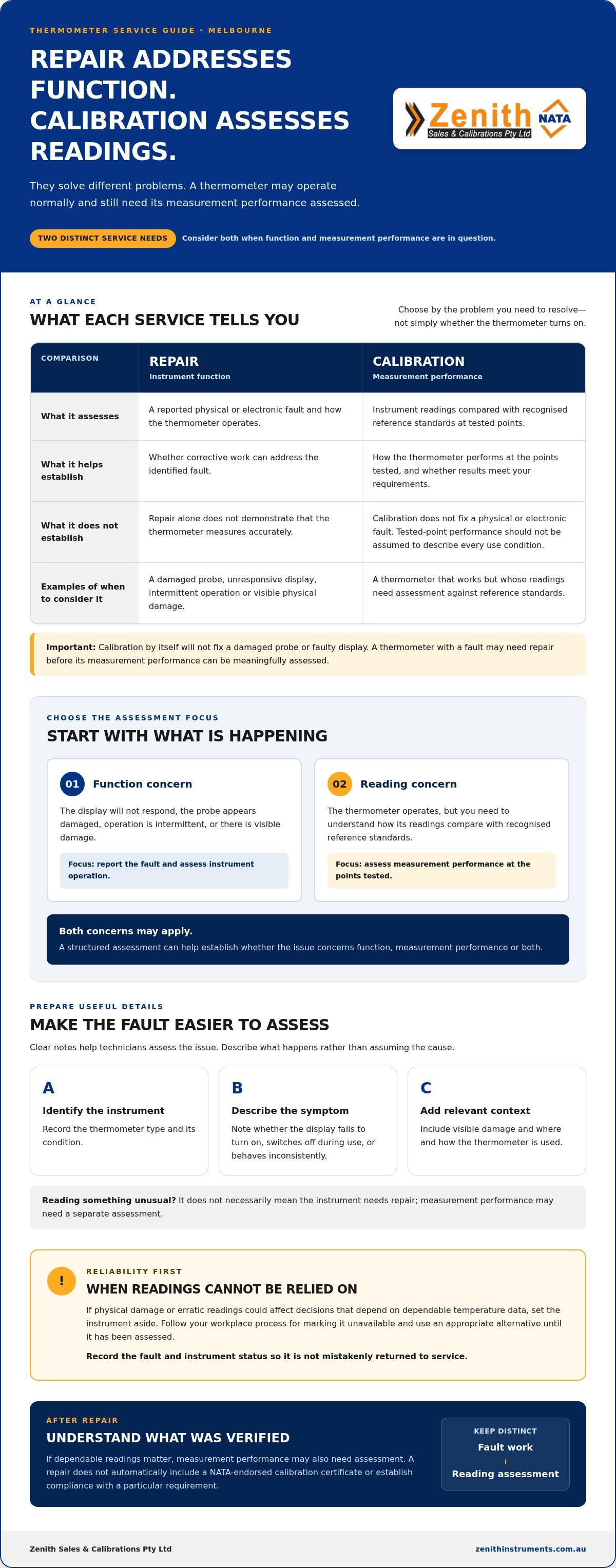
Thermometer repair diagnoses and addresses faults that interfere with an instrument’s operation. Calibration is different: it evaluates measurement performance against reference standards. A thermometer may operate normally yet still need its readings assessed. Calibration, by itself, won’t fix a damaged probe or faulty display.
This distinction matters wherever temperature informs a process. In Melbourne manufacturing, food and medical workflows, staff may use readings to guide production checks, storage decisions or equipment monitoring. An unreliable result can undermine those decisions. Thermometers use different measurement principles and come in various forms; an overview of types of thermometers can help identify the instrument you’re working with. Zenith Instruments provides local thermometer repair and calibration from its Melbourne facility. Learn more about our Melbourne calibration service.
Which thermometer problems may need repair?
Arrange an assessment if the display won’t respond, the probe appears damaged, operation is intermittent or the instrument has visible physical damage. These signs point to a possible fault, but they don’t establish its cause or whether the thermometer remains suitable for its application. Record the thermometer type, what happens during use and the conditions in which the issue occurs. This information helps technicians assess the fault.
Be specific in your notes. For example, say whether the display fails to turn on, switches off during use or behaves inconsistently. Include visible damage and relevant operating conditions, such as where and how the thermometer is used. An unusual reading doesn’t necessarily mean the instrument needs repair; it may need a separate assessment of measurement performance.
When should a thermometer be taken out of service?
Set aside an instrument with physical damage or erratic readings if decisions depend on dependable temperature data. Continuing to use suspect measurements can lead staff to make process or quality decisions based on information they can’t trust. Follow your workplace process for marking the instrument as unavailable, and use an appropriate alternative until it has been assessed.
Record the fault and the instrument’s status so it isn’t mistakenly returned to service. If you use digital instruments, the digital thermometer industry guide offers further context on their role in Australian industry. A structured assessment can help establish whether the issue concerns instrument function, measurement performance or both.
Thermometer Repair or Calibration: Which Does Your Melbourne Instrument Need?
Choose the service according to the problem you need to resolve. Repair addresses faults that affect an instrument’s operation; calibration evaluates how its readings compare with reference standards. You can consider both services together, but neither replaces the other.
| Service | What it assesses | What it helps establish |
|---|---|---|
| Repair | A reported physical or electronic fault and the thermometer’s operation. | Whether corrective work can address the identified fault. |
| Calibration | Instrument readings compared with recognised reference standards at tested points. | How the thermometer performs at those points and whether results meet your requirements. |
A thermometer can switch on and display a reading yet still need calibration assessment. Conversely, a thermometer with a damaged probe or intermittent display may need repair before its measurement performance can be meaningfully assessed. For businesses considering thermometer repair in Melbourne, identifying whether the issue is functional, measurement-related or both helps clarify the next step.
What does thermometer repair assess?
Repair starts with the reported fault and an assessment of the instrument’s operation. The technician considers the thermometer type, symptoms and condition to determine appropriate corrective work. The work depends on the instrument and the fault, so a symptom alone doesn’t establish the repair method or outcome.
Repair addresses function; it doesn’t automatically demonstrate that a thermometer measures accurately. If dependable readings are important after repair, its measurement performance may also need to be assessed.
What does thermometer calibration establish?
Calibration compares an instrument’s indications with readings from recognised reference standards. The results show how the thermometer performs at the points tested. They don’t correct a physical or electronic fault, and performance at tested points shouldn’t be assumed to describe every possible use condition.
For Australian measurement context, the National Measurement Institute’s temperature and humidity measurement information is a useful reference. Certificate type and accreditation depend on the applicable service scope. A repair doesn’t automatically include a NATA-endorsed calibration certificate or establish compliance with a particular requirement.
Zenith Instruments provides both thermometer repair and calibration, treating fault assessment and measurement verification as distinct steps. Explore our thermometer calibration service for measurement assessment, or visit Zenith Instruments to learn about our temperature instrument services.
How to Decide Whether Thermometer Repair Is Worthwhile
A sound repair decision considers more than whether the thermometer can be made to work. Separate repairability from suitability: an instrument may be repairable yet still fail to meet the accuracy, operating range or reliability your application requires. When assessing thermometer repair in Melbourne, weigh the fault against the instrument’s role and the consequences of relying on its measurements.
- Fault severity: Is the issue occasional or persistent? Is there visible damage, or does the instrument stop operating?
- Instrument role: Does it support a routine check, or a process where readings directly inform important quality or operating decisions?
- Measurement risk: What could happen if a reading is wrong or unavailable? Consider the process and your organisation’s quality procedures.
- Service history: Has the same fault returned? Review previous repairs, calibration records and recurring observations.
Whether to repair or replace depends on the assessment, the instrument’s application and your business requirements. A technician’s findings can clarify the thermometer’s condition; your team can then decide whether it remains fit for its intended use. A working display alone doesn’t prove that the instrument meets your measurement needs.
Repair alone does not prove measurement accuracy. Correcting an operational fault and assessing readings are separate tasks, so consider each in your decision.
What information helps assess a faulty thermometer?
Provide the make and model, thermometer type, symptoms and when the issue first appeared. Note the relevant temperature range and use environment, along with any recent handling, impact or visible damage. Previous calibration records and observations of recurring faults add useful context. Clear details help technicians understand how the instrument behaves in its application and assess the reported problem.
When should repair be followed by calibration?
Consider calibration after repair when measurement confidence matters to the instrument’s intended application or your quality procedures. This is particularly relevant if the work could affect measurement performance or you need evidence of how readings compare with reference standards. The appropriate verification depends on your requirements and the service scope. Repair doesn’t confirm accuracy or establish a universal calibration interval.
Use the assessment to decide whether the thermometer is operational, suitable for its role and supported by the measurement verification your process requires. These questions are related, but each needs its own answer.
What to Expect from a Melbourne Thermometer Repair Service
A clear service process helps your team understand what happens to an instrument and what information is needed. For thermometer repair in Melbourne, the steps are straightforward: describe the fault, arrange an assessment, review the findings, agree on appropriate work, then consider whether separate measurement verification is needed before returning the instrument to use.
- Describe the fault. Explain what the thermometer does, when the issue occurs and how it affects use.
- Arrange an assessment. Provide the instrument and relevant details so technicians can examine the reported problem.
- Review the findings. Understand what the assessment indicates about the fault and the instrument’s operation.
- Agree on the next step. Decide how to proceed with suitable corrective work based on the findings.
- Verify as needed. If confidence in readings is important, consider calibration separately from repair.
Zenith Instruments provides temperature-instrument service and repair from its Melbourne facility, alongside in-house laboratory and on-site calibration capabilities. For local service information, see our calibration services in Melbourne.
How to prepare a thermometer for assessment
Record the make, model and thermometer type, then describe the fault in practical terms. Include when it began, how often it occurs and the conditions in which it appears. Note the operating environment and any handling or damage. Include previous service or calibration documentation if available. These details help technicians assess the issue in context.
Pack the instrument to protect vulnerable components during transport. Prevent the display, probe and connectors from being knocked or bent, and include any accessories needed to assess the reported fault. Clear identification and careful packaging help avoid unnecessary handling issues.
How results support a return-to-service decision
Assessment findings help determine the next step: corrective work, further evaluation or a review of whether the thermometer remains suitable for its intended use. Completing a repair addresses the identified fault, but it is distinct from a calibration result. A calibration certificate relates to the measurement assessment performed and its applicable scope, not automatically to the repair.
Keep service and calibration records with your instrument history. They help your team track recurring faults, plan maintenance and follow internal quality processes. Before returning a thermometer to a task that depends on reliable readings, consider whether its condition and any required measurement verification meet the task’s needs.
To discuss a thermometer fault and arrange an assessment, contact Zenith Instruments about thermometer repair.
Arrange Thermometer Repair in Melbourne with Zenith Instruments
Zenith Instruments provides thermometer service and repair from its Melbourne facility, supporting businesses that rely on temperature instruments in manufacturing, medical and other temperature-sensitive work. Our technicians assess reported faults and clarify the appropriate next step. Repair addresses instrument function; it doesn’t, by itself, verify measurement performance.
For thermometer repair in Melbourne, keeping this distinction clear supports a considered service decision. If readings also need assessment, Zenith’s in-house laboratory and on-site capabilities support calibration, which evaluates measurement performance against reference standards. Calibration processes use NATA-certified standards and are ISO-compliant within the applicable service scope. Any accreditation or documentation applies only where relevant to that scope.
Why Melbourne businesses use a local technical service partner
A local facility gives Melbourne organisations a nearby technical point of coordination for instruments used in production, medical settings and other temperature-dependent workflows. A structured assessment connects the reported fault with the instrument’s use, while clear records support maintenance planning and internal quality processes. This gives your team better information to consider before returning an instrument to a task that relies on trustworthy temperature data.
Zenith combines temperature-instrument service and repair with separate calibration capability. A fault can therefore be assessed without assuming calibration will fix it, and measurement verification can be considered when evidence of accuracy matters to the application.
Prepare the details for your service enquiry
Gather a few practical details before arranging an assessment. Clear information helps technicians understand the issue and its operational context:
- Instrument identification: thermometer type, make and model.
- Fault symptoms: what happens, when it occurs and whether it is intermittent or persistent.
- Intended application: how the thermometer is used and what decisions rely on its readings.
- Relevant records: previous service history or calibration documentation, if available.
These details help establish what needs assessment. The findings inform the next step, including agreed corrective work and whether separate calibration is appropriate. Clarify the scope of work and any verification before returning the instrument to use.
Discuss thermometer repair with Zenith Instruments and share the instrument details and fault symptoms to begin.
Restore Instrument Function and Confidence in Your Readings
Reliable thermometer decisions start by separating an instrument fault from a measurement concern. Repair addresses problems that affect function; calibration assesses readings against reference standards. A thermometer that works after repair may still need separate verification before returning to a task where dependable measurements matter.
Zenith Instruments provides temperature instrument service and repair from its Melbourne facility. For calibration needs, in-house laboratory and on-site capabilities support assessment of measurement performance. NATA-certified standards and ISO-compliant processes apply within the relevant service scope. Repair alone is not proof of accuracy or a calibration certificate.
If you’re considering thermometer repair melbourne, note the instrument type, fault symptoms, intended use and any relevant service history. These details help establish a clear path from assessment to agreed next steps, without assuming every instrument requires the same work.
Discuss thermometer repair with Zenith Instruments and take the next step towards returning a suitable, appropriately assessed instrument to use.
Frequently Asked Questions
Can a thermometer be repaired in Melbourne?
Yes. Zenith Instruments provides thermometer repair and temperature-instrument service from its Melbourne facility. We assess reported faults to determine the appropriate next step for the instrument and its application. Zenith also has a Sydney facility, with service coverage that includes Newcastle, Canberra and Brisbane. Share the thermometer type, model and symptoms so the assessment can take account of how the instrument is used.
What is the difference between thermometer repair and calibration?
Repair addresses faults affecting the thermometer’s function, while calibration evaluates its readings against reference standards. For example, a damaged probe or unresponsive display may need repair; an instrument that operates but gives uncertain readings may need calibration assessment. The services can be considered together, but calibration doesn’t fix physical damage, and repair alone doesn’t demonstrate measurement accuracy.
Should a thermometer be calibrated after repair?
Calibration after repair may be appropriate if dependable measurement performance matters to the instrument’s intended use or your quality procedures. This is especially worth considering if the fault or corrective work could affect readings. Calibration assesses performance at the points tested against reference standards. It isn’t automatically required after every repair, so base the decision on the assessment findings and your operational requirements.
What information should I provide when arranging thermometer repair?
Provide the thermometer’s type, make and model, along with a clear description of the fault and when it occurs. Note its intended application, relevant operating conditions, temperature range and any recent damage or handling. Previous service history, calibration records and recurring fault observations can also help technicians assess the issue in context. Clear information supports an organised assessment and discussion of next steps.
Can an infrared thermometer be repaired?
An infrared thermometer can be assessed for repair, but the appropriate work depends on the instrument and the fault identified. Describe symptoms such as an unresponsive display, inconsistent operation or visible damage, and include the model and intended use. An assessment helps establish the next step. If the instrument operates but readings are uncertain, measurement performance may also need separate calibration assessment.
How do I know whether to repair or replace a thermometer?
Consider the fault’s severity, the thermometer’s role, the risk of relying on its readings and its service history. Assessment findings can help determine whether corrective work is practical, while your application determines whether the instrument will remain suitable. A thermometer that can be repaired may still not meet your measurement needs. Compare its assessed condition with the performance your process requires before deciding.
Does thermometer repair include a calibration certificate?
Not automatically. Repair addresses an instrument fault, while a calibration certificate relates to a separate assessment of measurement performance, where performed. Certificate type and any accreditation claim depend on the applicable service scope. Zenith uses NATA-certified standards and ISO-compliant processes within relevant scopes, but this doesn’t mean every repair includes a NATA-endorsed certificate. The documentation relates to the agreed work and its scope.