

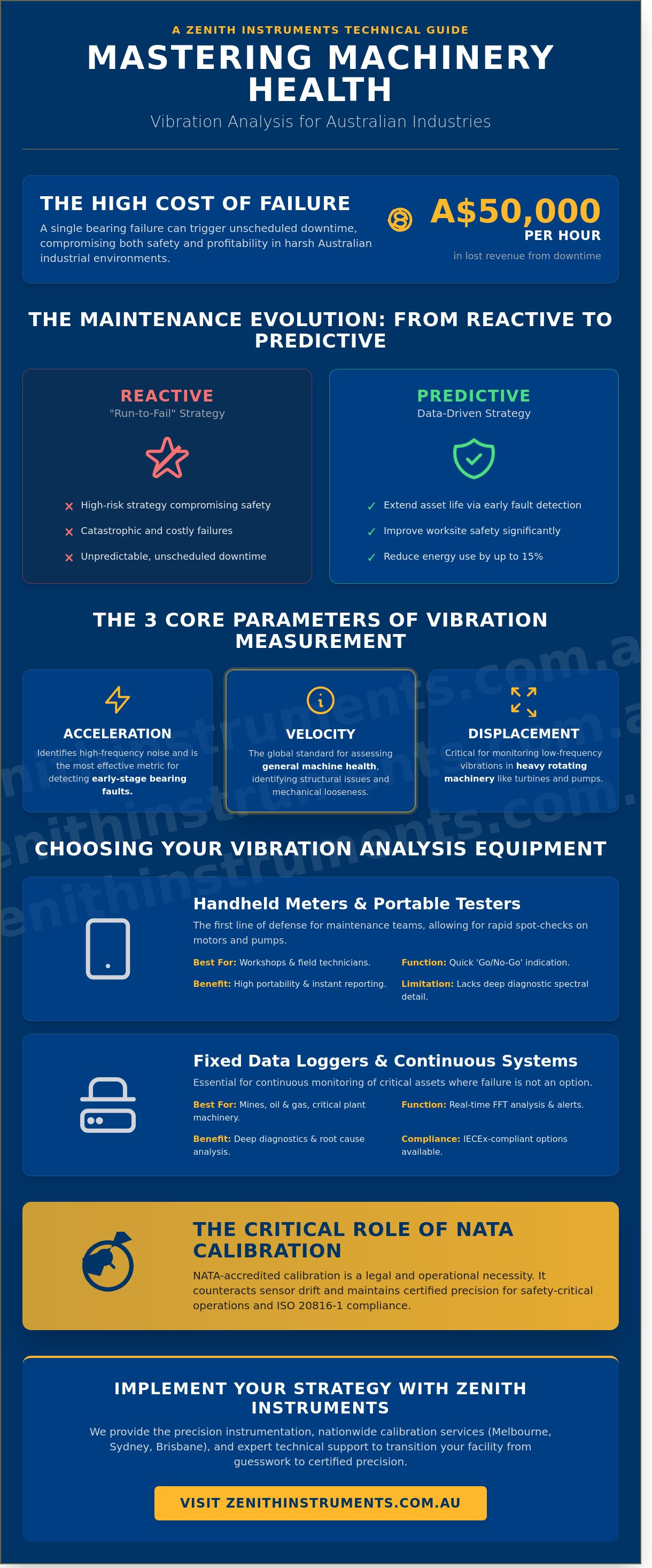
In the Australian industrial sector, a single bearing failure can trigger unscheduled downtime costing an average of A$50,000 per hour in lost revenue. You already know that relying on reactive maintenance in harsh environments, from the Pilbara to Western Sydney, is a high-risk strategy that compromises both safety and profitability. We recognize the difficulty of interpreting complex FFT data and the constant pressure to keep your assets within strict ISO 20816-1 tolerances. Selecting the right vibration analysis equipment is a critical technical decision that dictates the reliability of your entire facility.
Zenith Sales & Calibrations Pty Ltd has developed this professional guide to help you master these technical complexities and ensure your machinery remains NATA-compliant through 2026. You'll learn how to leverage precision instrumentation to reduce breakdowns and secure reliable data for long-term asset management. We'll examine the specific hardware requirements for Australian conditions, the path to achieving ISO compliance, and how Zenith Sales & Calibrations Pty Ltd's nationwide calibration services in Melbourne, Sydney, and Brisbane support your operational goals. This technical overview provides the roadmap for transitioning from guesswork to certified precision.
Key Takeaways
- Transition from reactive repairs to predictive maintenance strategies to maximize machinery uptime across Sydney and Melbourne industrial sectors.
- Learn how to select the most suitable vibration analysis equipment, ranging from handheld meters for Newcastle workshops to fixed data loggers for continuous monitoring.
- Identify critical hardware specifications for harsh Australian environments, including moisture resistance for Queensland mines and IECEx compliance for the oil and gas sector.
- Understand the legal and operational necessity of NATA-accredited calibration to counteract sensor drift and maintain certified precision in safety-critical operations.
- Discover how Zenith Instruments’ technical support ensures rapid turnaround times and comprehensive compliance for leading brands like Fluke and Major Tech.
Understanding Vibration Analysis Equipment: The Foundation of Predictive Maintenance
Vibration analysis equipment encompasses the specialized instrumentation required to detect, measure, and evaluate mechanical oscillations within industrial machinery. By capturing these signals, engineers identify underlying faults before they result in catastrophic failure. The fundamental principles of vibration analysis rely on converting mechanical motion into electrical signals through sensors like accelerometers. In Australia's major industrial hubs, particularly Sydney and Melbourne, there is a clear transition toward predictive maintenance. Facilities that once relied on reactive "run-to-fail" models now utilize sophisticated vibration analysis equipment to prevent unplanned downtime, which can cost Australian manufacturers upwards of A$50,000 per hour in lost productivity. Implementing these tools offers three primary advantages. First, it extends asset life by detecting early-stage bearing wear or misalignment. Second, it improves worksite safety by preventing high-speed component disintegration. Third, it reduces energy consumption, as unbalanced machines often draw 10% to 15% more power to maintain operational speeds. As we approach 2026, the industry is moving toward wireless sensor integration and real-time FFT (Fast Fourier Transform) analysis. This allows technicians to process complex frequency data instantly on-site rather than waiting for laboratory post-processing.The Core Parameters: Acceleration, Velocity, and Displacement
Precision measurement requires selecting the correct parameter based on the machine's rotational speed.- Acceleration: This is the most effective metric for identifying high-frequency noise and early-stage bearing faults, typically measured in Gs.
- Velocity: Recognized as the global standard for assessing general machine health, velocity helps identify structural issues and common mechanical looseness.
- Displacement: This parameter is critical for monitoring low-frequency vibrations in heavy rotating machinery, such as large-scale turbines or sleeve-bearing pumps.
Vibration Monitoring vs. Vibration Analysis
It's helpful to view vibration monitoring as a "check engine light" for your plant. It provides basic threshold alerts when vibration levels exceed ISO 10816 standards. In contrast, vibration analysis serves as a deep diagnostic tool to pinpoint the root cause, whether it's unbalance, misalignment, or gear mesh issues. Zenith Sales & Calibrations Pty Ltd supports Australian industries by providing the precision instrumentation and calibration services necessary for both basic monitoring and complex diagnostic analysis. Our technical experts ensure your vibration analysis equipment is accurately calibrated, expertly installed, and consistently performs to deliver reliable data for your critical assets.Types of Vibration Measurement Tools: From Handheld to Fixed Systems
Selecting the right vibration analysis equipment depends on the criticality of your machinery and the required depth of data. For many Newcastle workshops, handheld vibration meters serve as the first line of defense. These devices allow maintenance teams to conduct rapid spot-checks on motors and pumps, identifying baseline deviations before they escalate into costly failures. We've seen that consistent monitoring can reduce unexpected downtime by up to 30% in heavy industrial environments.
Handheld Meters and Portable Testers
Maintenance technicians across Brisbane and Canberra often choose between entry-level pen-style testers and full-function handheld analysers. Pen-style units provide a quick "go/no-go" indication of overall vibration levels, but they lack the diagnostic depth of full-function analysers. While the smaller units are convenient for a tool belt, they don't offer the spectral detail needed to pinpoint specific bearing faults or resonance issues. Modern portable systems now integrate directly with mobile apps, allowing for instant reporting and data synchronization with cloud-based maintenance management systems. This connectivity ensures that field data is immediately available for engineering review without the need for manual data entry.
Advanced Sensors and Data Acquisition
Piezoelectric accelerometers remain the industry workhorse due to their rugged construction and ability to operate across wide frequency ranges. For complex plant layouts where cabling costs are prohibitive, wireless sensors offer a scalable alternative, providing continuous data without the infrastructure overhead. FFT analysis is the process of converting time-domain signals into frequency-domain data. To maintain the accuracy of these readings, adherence to Australian vibration calibration standards is mandatory. Regular calibration ensures that sensors remain compliant with NATA requirements, providing the precision necessary for high-stakes decision making.
For critical assets where failure is not an option, fixed online systems provide 24/7 monitoring. These systems catch transient faults that periodic manual checks might miss. When these tools identify an issue, laser alignment tools are frequently used to correct the underlying mechanical misalignment identified during the analysis. If your facility requires precise instrument verification, our acoustic calibration service ensures your monitoring hardware performs to international standards.
Vibration data loggers bridge the gap between handheld checks and permanent installations. They allow for long-term trend analysis without requiring constant manual supervision, making them ideal for monitoring machines with intermittent duty cycles. This structured approach to vibration analysis equipment selection ensures that every asset receives the appropriate level of scrutiny based on its operational importance. By utilizing a mix of these tools, Australian manufacturers can maintain a robust predictive maintenance program that safeguards their production targets.
Selecting the Right Equipment for Australian Industrial Environments
Selecting the right vibration analysis equipment requires a deep understanding of the operational environment. In Queensland mining sites, temperatures frequently peak above 42°C, and fine dust particles can penetrate standard housings. We recommend hardware with an IP67 rating or higher to ensure long-term reliability in these conditions. For teams in the oil and gas sector, equipment must meet IECEx or ATEX standards to operate safely in explosive atmospheres. We don't compromise on these safety protocols; they're essential for protecting both personnel and assets.
Frequency range is another critical technical factor. A sensor must match the machine's rotational speed to capture relevant data. For a standard 1,440 RPM motor, a sensor with a 10 kHz range usually suffices, but high-speed turbines require specialized high-frequency accelerometers. For those seeking a deeper technical background, this comprehensive guide to vibration analysis explains the fundamental physics behind these measurements. Our team focuses on vibration analysis equipment that integrates seamlessly with existing Australian ERP systems like SAP or Oracle, which are used by over 80% of the nation's top-tier industrial firms to manage work orders and maintenance schedules.
Mining and Heavy Industry (Newcastle & Brisbane)
In the industrial hubs of Newcastle and Brisbane, we deploy vibration monitoring for high-torque assets like conveyors, crushers, and large-scale pumps. These machines operate under extreme loads where even minor misalignments lead to catastrophic failure. We ensure all diagnostic tools meet National Measurement Institute (NMI) standards for accuracy. Integrating these sensors with pressure gauge calibration for hydraulic systems provides a dual-layered approach to asset health. This strategy identifies both mechanical and fluid power issues before they cause unplanned downtime.
Manufacturing and Medical (Sydney & Melbourne)
Facilities in Sydney and Melbourne demand extreme precision for CNC machines and high-speed production lines. Vibration control is vital in sensitive medical environments and laboratories where micro-oscillations can ruin experiments or compromise imaging results. Our holistic maintenance model pairs vibration monitoring with biomedical equipment calibration to protect patient safety and ensure regulatory compliance. We help labs maintain the exactness required for ISO certification through meticulous onsite testing. It's about ensuring every instrument performs to its certified specification every day.
The Critical Role of Calibration and NATA Standards in Australia
Vibration analysis equipment operates in demanding industrial environments where exposure to extreme temperatures and physical shock is common. Over time, these conditions lead to sensor drift, where the internal piezoelectric components or MEMS sensors lose their original factory alignment. In Australia, maintaining the precision of these instruments isn't just a best practice; it's a requirement for operational safety. The National Association of Testing Authorities (NATA) provides the framework that gives calibration certificates legal weight. When a technician presents data during a safety audit, a NATA-accredited report serves as definitive proof that the measurements are accurate and defensible under Australian law.
Regular calibration establishes traceability to international measurement standards. This ensures that a reading taken in a Perth mining facility is identical in value to one taken in a Brisbane manufacturing plant. While "traceable" calibration confirms an instrument was checked against a master device, "NATA-certified" calibration involves a more rigorous audit of the laboratory's entire quality system. We prioritize NATA standards to ensure our clients meet the highest level of technical competence required by high-risk industries. This process ensures that every vibration analysis equipment unit we service provides results that are both repeatable and reliable.
On-Site vs. Laboratory Calibration Services
For many facilities, equipment downtime is the primary barrier to regular maintenance. Our on-site services in Sydney and Melbourne eliminate transit risks and ensure zero equipment transit time. This allows your team to continue monitoring critical assets without interruption. While on-site work is efficient, laboratory-based calibration remains necessary for high-precision reference standards that require a controlled, vibration-free environment. You can access our calibration services in Sydney for local workshop support tailored to your specific schedule.
Compliance with ISO 10816 and Australian Standards
Australian industries rely on ISO 10816 vibration severity charts to determine if machinery is operating within safe limits. These charts categorize machines based on size and mounting, providing specific thresholds for "good," "satisfactory," "unsatisfactory," and "unacceptable" vibrations. A valid calibration certificate is the only way to prove your vibration analysis equipment is measuring these levels correctly during a compliance audit. For a deeper look at the regulatory landscape, see our guide on Vibration Monitoring in Australia. Ensuring your sensors are calibrated according to these standards prevents catastrophic failure and protects your personnel.
Ensure your machinery stays within safe operating limits by booking a professional service. Schedule your NATA-accredited calibration with Zenith Instruments today.
Implementing Your Strategy with Zenith Instruments
Reliable maintenance programs depend entirely on the accuracy of your measurements. At Zenith Instruments, we operate as your dependable expert in the Australian industrial landscape. We provide more than just hardware; we deliver technical assurance through a proactive service model. Our team supports leading global brands like Fluke and Major Tech, ensuring your diagnostic tools meet rigorous international standards. With physical facilities in Sydney (Chipping Norton) and Melbourne (Cheltenham), we also extend our expert on-site calibration and technical support to major industrial hubs such as Brisbane, Newcastle, and Canberra, providing the localized assistance crucial for high-stakes engineering environments.
We understand that precision requires consistency. To support this, we provide customized service contracts that cover annual calibration and preventative maintenance. These agreements are designed to align with your specific operational cycles, ensuring that your vibration analysis equipment remains compliant with ISO standards without interrupting your production schedule. Our technicians bring a meticulous, disciplined approach to every instrument, mirroring the exactness required by the medical and manufacturing sectors we serve.
Sales and Technical Support
Selecting the right vibration analysis equipment involves more than comparing spec sheets. Our experts provide technical guidance to help you choose tools that match your specific application, whether you're monitoring high-speed turbines or heavy-duty conveyor systems. Beyond vibration tools, we maintain a comprehensive inventory of electrical test equipment to support your entire maintenance department. If your hardware becomes faulty or shows signs of wear, our technical repair services restore your instrumentation to its original performance specifications, preventing the cost of premature replacement.
The Zenith Advantage: Fast Turnaround and Reliability
Downtime is a significant cost factor in Australian industry. We minimize this impact through efficient in-house and on-site calibration workflows that prioritize speed without compromising on NATA accreditation standards. Our mobile calibration labs bring our expertise directly to your facility, which is a major advantage for businesses with large inventories of fixed assets. We focus on building long-term partnerships through the following service pillars:
- Meticulous Record-Keeping: We maintain detailed histories of every instrument we service.
- Automated Reminders: You'll receive re-calibration notifications well in advance of expiry dates.
- Compliance Assurance: Every service is backed by certification that meets Australian regulatory frameworks.
- National Reach: Consistent service quality across all major Australian industrial hubs.
We're committed to the technical excellence and regulatory compliance your business requires to operate safely. Contact Zenith Instruments today for a technical consultation or a quote on your next calibration cycle.
Securing Industrial Precision through Rigorous Calibration
Australian industries in 2026 face increasing pressure to maintain 100% uptime while adhering to strict safety standards. Successful predictive maintenance relies on the accuracy of your vibration analysis equipment to detect early-stage bearing wear or structural imbalances before they lead to catastrophic failure. We've highlighted that hardware selection is only the first step; the real value lies in maintaining that equipment through NATA accredited calibration that guarantees measurement traceability. Zenith Instruments provides the technical foundation for this reliability with over 20 years of technical expertise in the Australian market. Our team delivers expert on-site calibration across Australia to keep your operations running without interruption. We leverage our NATA Accredited Laboratory Services to ensure every reading meets international ISO requirements. It's time to eliminate the guesswork from your maintenance schedule. Request a Quote for Vibration Equipment Calibration and partner with a team that understands the demands of local manufacturing and mining. We look forward to supporting your site's technical excellence and operational safety.
Frequently Asked Questions
How often should vibration analysis equipment be calibrated in Australia?
You should calibrate your vibration analysis equipment every 12 months to remain compliant with Australian industrial standards and ISO 9001 quality management systems. Regular annual intervals ensure that sensor sensitivity hasn't drifted due to mechanical shock or environmental exposure. We recommend this cycle to maintain the high level of precision required for critical machinery health monitoring across Australian mining and manufacturing sites.
What is the difference between a vibration meter and a vibration analyser?
A vibration meter provides a single, overall value representing the total vibration level, while a vibration analyser breaks that signal down into individual frequencies using Fast Fourier Transform (FFT) processing. Meters are ideal for quick "go or no-go" checks by maintenance staff. In contrast, advanced vibration analysis equipment allows engineers to pinpoint specific faults like gear teeth wear or electrical motor defects by examining the specific frequency peaks.
Is NATA accreditation mandatory for all vibration measurement tools?
NATA accreditation isn't legally mandatory for every industrial application, but it's often a contractual requirement in high-stakes sectors like defence, aviation, and power generation. Choosing a NATA-accredited laboratory ensures your equipment meets the ISO/IEC 17025 standard for testing and calibration. We provide these certified services to give you a traceable audit trail, which is vital for risk management and insurance compliance within Australia.
Can vibration analysis equipment detect bearing failure before it happens?
Yes, precision vibration analysis equipment detects internal bearing flaws up to 9 months before a functional failure occurs. By monitoring high-frequency energy in the 5 kHz to 40 kHz range, technicians identify the earliest stages of metal-to-metal contact and subsurface fatigue. This early warning system allows your team to order parts and schedule repairs during planned shutdowns, avoiding the emergency costs of a catastrophic breakdown.
What are the common causes of inaccurate vibration readings in industrial settings?
Improper sensor mounting and poor surface preparation cause approximately 60% of all measurement errors in the field. If a sensor isn't rigidly attached to a flat, clean metal surface, the high-frequency data becomes muffled and unreliable. Other factors include cable strain, electromagnetic interference from nearby 415V motors, and "thermal shock" caused by moving a cold instrument into a hot engine room without allowing it to stabilise.
Does Zenith Instruments provide on-site calibration for vibration sensors in Brisbane?
We provide full on-site calibration services for vibration sensors and handheld analysers throughout Brisbane and the surrounding South East Queensland region. Our mobile technicians bring the laboratory to your facility, which eliminates the risk of transit damage and reduces your equipment downtime to just a few hours. We focus on providing a fast turnaround so your predictive maintenance program continues without interruption.
What is an accelerometer and why is it used in vibration analysis?
An accelerometer is a specialized transducer that converts mechanical motion into a proportional electrical signal. It's the industry standard for vibration analysis because it's rugged, compact, and capable of measuring a massive frequency range from 1 Hz up to 15,000 Hz. Most modern systems use piezoelectric accelerometers because they don't have moving parts, making them durable enough for the harsh conditions found in Australian processing plants.
How does temperature affect the accuracy of my vibration analysis equipment?
Extreme temperatures cause the internal piezoelectric crystals in a sensor to expand or contract, which can result in a sensitivity shift of 5% or more. If you're measuring a pump housing that exceeds 100°C, you must use a sensor rated for high-temperature environments or a thermal isolator. We've seen many cases where "thermal transients" create false alarms in a vibration program, so it's critical to use calibrated equipment that's compensated for your specific operating climate.