

What if the calibration plan that looks simplest on paper creates the most disruption on site? For water and wastewater operations, choosing a provider for water authority instrument calibration Newcastle teams can rely on starts with matching the calibration scope to the instruments in use, then fitting the work around plant access and operational constraints.
It’s reasonable to want confidence that critical measurements are supported by clear evidence without creating avoidable downtime. Calibration requirements vary across pressure, temperature and electrical instruments, so look beyond a broad service description and assess whether the scope and documentation meet your needs.
This guide explains how to assess instrument coverage, calibration records and traceability, and how to compare on-site and laboratory arrangements against operational priorities. It also covers what to look for in calibration processes and accreditation information, including why the exact scope matters. We’ll start with instruments and measurement requirements, then consider documentation, logistics and provider fit, so you can make a more informed decision for your Newcastle operation.
Key Takeaways
- Start water authority instrument calibration Newcastle planning by mapping instruments to their operational measurement roles and required calibration scope.
- Compare pressure, temperature and electrical instrument needs to identify where calibration evidence supports monitoring and maintenance decisions.
- Assess calibration records, traceability and accreditation scope against your organisation’s quality and maintenance requirements.
- Weigh on-site and laboratory arrangements against instrument handling, plant access and scheduling constraints.
- Prepare instrument details and an access plan to support a clear service arrangement. Zenith uses computerised closed-loop software in its calibration process.
Water Authority Instrument Calibration in Newcastle: Start With Operational Requirements
Dependable measurements support decisions throughout water and wastewater treatment, from checking process conditions to planning maintenance and documenting operational performance. If an instrument drifts or gives an inconsistent reading, staff may respond to a condition that isn’t present, overlook a developing issue or record data that doesn’t accurately reflect the measurement. Calibration assesses measurement performance against a reference. It doesn’t replace sound operating procedures or instrument maintenance.
For Newcastle and the wider Hunter region, define requirements around the work each instrument performs rather than treating every device as interchangeable. Plant instrumentation, such as pressure gauges, thermometers and electrical instruments, supports monitoring and control within operational processes. Portable water-quality meters and probes are another group, typically used for field sampling or checks. The parameters and procedures depend on the equipment and your organisation’s requirements. A general overview of water quality helps explain why reliable measurement matters, but it doesn’t set a plant’s calibration schedule.
Which operational decisions depend on reliable instrument readings?
Readings inform routine process checks, maintenance investigations and records used to understand operating conditions over time. For example, a pressure reading may help a technician assess equipment performance, while a temperature measurement may form part of a process check. Electrical test instruments can support inspection and maintenance tasks. These examples are illustrative: the instrument’s function, measurement range and site procedures determine the relevant calibration need. A pressure gauge used for a critical process may warrant a different control approach from a portable instrument used for intermittent checks. See the related pressure gauge calibration service information.
How should a water authority define its calibration scope?
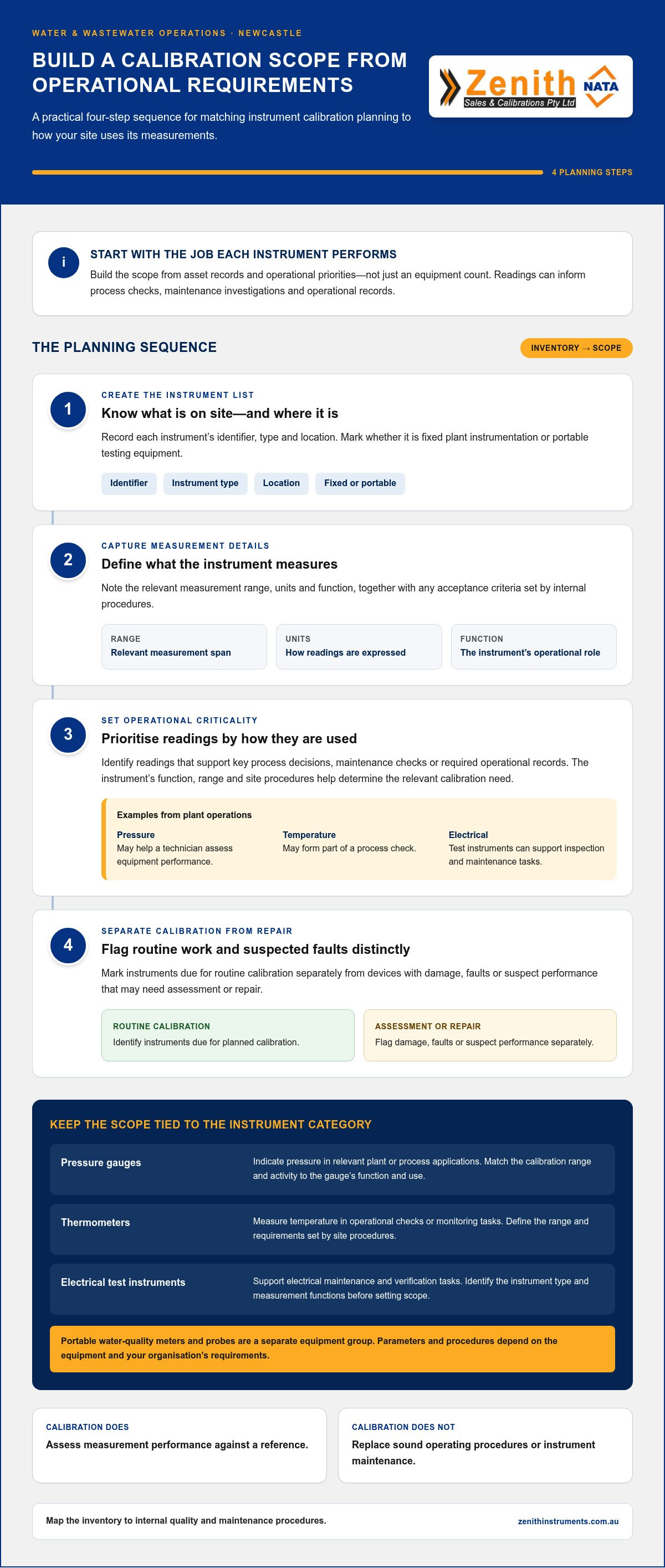
Build the scope from asset records and operational priorities, not just an equipment count. A structured inventory gives maintenance and quality teams a shared view of what needs attention and why.
- List the instruments. Record identifiers, instrument types, locations and whether each device is fixed plant instrumentation or portable testing equipment.
- Capture measurement details. Note the relevant range, units, function and any acceptance criteria defined by internal procedures.
- Set criticality. Identify which readings support key process decisions, maintenance checks or required operational records, then prioritise planning accordingly.
- Separate calibration from repair. Mark instruments due for routine calibration separately from devices with damage, faults or suspect performance that may need assessment or repair.
Map the inventory to internal quality and maintenance procedures, including how results are recorded and how out-of-tolerance findings are handled. This makes water authority instrument calibration Newcastle planning more precise: the scope reflects actual operational functions, while the following sections address instrument categories and service arrangements in more detail.
Which Water and Wastewater Instruments Need Calibration Support?
Calibration planning should reflect the range of measurement tasks across a facility, not just portable water-quality testing. Plant instruments and electrical test equipment support different operating and maintenance activities, while portable meters used to assess water-quality parameters are a separate category. The table focuses on pressure, temperature and electrical instrument categories covered by Zenith’s calibration services. Define the specific instrument and activity when setting the scope for each job.
| Instrument category | Typical measurement role | Service consideration |
|---|---|---|
| Pressure gauges | Indicate pressure in relevant plant or process applications. | Match the calibration range and activity to the gauge’s function and use. |
| Thermometers | Measure temperature in operational checks or monitoring tasks. | Define the measurement range and requirements set by site procedures. |
| Electrical test instruments | Support electrical maintenance and verification tasks. | Identify the instrument type and its measurement functions before setting the calibration scope. |
Pressure and temperature instruments in treatment operations
A pressure gauge indicates pressure at its measurement point. Calibration requirements depend on how the reading is used, the instrument’s range and the organisation’s procedures. Zenith provides pressure gauge calibration for this instrument category.
Thermometers measure temperature, but their required calibration points and acceptance criteria depend on their role and the process in which they’re used. Identify the relevant range and any tolerances required by internal procedures when developing a calibration plan. Zenith provides thermometer calibration for this measurement category.
Electrical instruments and other plant equipment
Electrical test instruments can be used during inspection, maintenance and verification work. The equipment register should distinguish each instrument type and its measurement functions, rather than grouping everything under “electrical”. This makes it easier to define a suitable calibration scope and organise records for the people who rely on the results. Zenith provides electrical instrument calibration, with the specific instrument and activity defining the scope.
Calibration, repair and installation are separate activities. Calibration evaluates measurement performance against a reference. Repair addresses a fault or damage, while installation concerns fitting or setting up equipment. A device may need assessment or repair before calibration can provide useful evidence, so record its condition and service history alongside its calibration status.
For water authority instrument calibration Newcastle planning, connect each instrument to its operating role and required measurement evidence. Portable pH or conductivity meters, for example, have distinct measurement functions, so include their exact type and intended calibration activity in the scope. Zenith uses computerised closed-loop software to eliminate human error in calibration. For a broader view of its calibration services, visit Zenith’s calibration service information.
Calibration Certificates, Accreditation and Traceability: What to Evaluate
A calibration record is useful when it helps an asset team understand what was assessed, what the results mean for the instrument’s use and how the evidence fits its quality and maintenance system. The required level of detail depends on the organisation’s documented procedures, operational risk and audit needs. Treat a certificate as one part of the evidence: interpret it alongside the instrument’s identity, intended function and acceptance criteria.
What should a calibration record help the asset team establish?
Review records for the information needed to connect a calibration result to the right instrument and maintenance decision. Certificate formats can vary, so focus on whether the evidence answers practical questions rather than expecting a particular layout or set of fields.
- Instrument identity: Can the record be matched to the asset register, including the instrument’s identifier and type?
- Calibration result: Does the evidence make clear what was assessed and how the result relates to the organisation’s acceptance criteria?
- Traceability: Is relevant information provided to support confidence in the measurement reference and its relationship to recognised standards?
- Follow-up: Can the asset team use the result to inform the next maintenance action, such as retaining the instrument in service, arranging assessment or updating its calibration status?
Consistent records help teams compare results over time, identify instruments needing attention and prepare evidence for internal reviews or audits. Establish a common filing and asset-register process so a record can be retrieved by instrument identifier, location or service date. This also reduces ambiguity when staff change or maintenance work is handed between teams.
How should buyers interpret accreditation claims?
NATA accreditation and laboratory compliance are distinct. Accreditation applies to a defined scope of activities and technical capabilities, so match the scope to the instrument and calibration activity rather than assuming it covers every service an organisation performs. Compare the relevant evidence with your documented quality and maintenance requirements.
Zenith provides an ISO 17024 NATA-accredited calibration service and operates an ISO 17025-compliant laboratory. These are separate descriptions. ISO/IEC 17025:2017 is the international standard for the competence of testing and calibration laboratories; compliance with the standard is not the same as NATA accreditation. When an accredited result is required, match the instrument and calibration activity to the applicable NATA scope.
For water authority instrument calibration Newcastle, identify evidence requirements before scheduling work. Set out any certificate or traceability criteria in your internal procedures, determine how out-of-tolerance results are handled, and retain records with the corresponding asset history. A professional guide to instrument calibrations in Australia can provide broader context, while your organisation’s own requirements should guide acceptance of calibration evidence.
On-Site or Laboratory Calibration in Newcastle: Compare the Service Fit
The right service arrangement depends on more than location. Instrument suitability, access to the equipment, process constraints and calibration scope all affect whether work is better completed on site or through a laboratory workflow. For Newcastle and Hunter region operations, planning these factors together helps coordinate calibration with maintenance windows and minimise unnecessary handling or disruption.
Zenith provides on-site calibration by trained engineers across Australia. This can support operations where taking an instrument out of service or transporting it presents a practical challenge. The instrument, required calibration activity and site conditions should guide the arrangement.
When can on-site calibration better suit plant operations?
On-site work may be practical for equipment that is difficult to remove, transport or replace temporarily. Calibrating at the installation location can reduce handling and help the team coordinate work with site operations. It may also suit situations where equipment access or the process schedule makes off-site work harder to organise.
Planning still matters. Site access, safe work procedures, instrument condition and the calibration method can all affect suitability. Identify access restrictions, operational contacts and any isolation or work-window requirements in advance. On-site service isn’t automatically the best option for every device, so compare the instrument’s needs with the site’s operating constraints.
When can laboratory calibration be the practical option?
An instrument that can be removed and transported may suit a laboratory workflow, particularly when the required calibration scope or equipment handling makes off-site processing more appropriate. Account for removal, transport, processing and return when setting maintenance windows, and plan how the asset will be managed while it’s unavailable.
Compare the approaches against your priorities. On-site work may reduce transport and removal demands; laboratory work may suit instruments that can be safely taken out of service and processed away from the plant. Neither option should be selected on convenience alone. The required measurement range, calibration activity and evidence requirements remain central to the decision.
- Consider on-site calibration when access and instrument suitability support work at the installation location, and reducing removal or transport is operationally valuable.
- Consider a laboratory workflow when the instrument can be removed and the maintenance plan can accommodate transport and time away from the plant.
Zenith’s fastest calibration turnaround can be as fast as 24 hours. Timing depends on the work and service arrangement, so factor it into planning rather than assuming it applies to every job. For water authority instrument calibration Newcastle planning, align the chosen approach with your maintenance schedule, safe work procedures and required calibration scope.
Review Zenith’s calibration service options to compare arrangements against your instruments and operational requirements.
Arrange Water Authority Instrument Calibration in Newcastle With Zenith
A well-prepared calibration request makes it easier to align instrument requirements, evidence and service logistics before work is scheduled. For water and wastewater operations in Newcastle, start with the equipment and required calibration activity, then plan how instruments can be accessed or transported with minimal disruption to site routines.
What information helps plan a calibration request?
Gather the details that define the work and the conditions around it. A clear request helps establish a practical service plan around the equipment and operational requirements.
- Define the scope. Identify the instrument category, what it measures and the calibration activity or evidence required by your organisation’s procedures.
- Prepare instrument details. Provide the asset identifier, instrument type and measurement range. Include relevant records or known performance concerns where available.
- Set timing priorities. Note the preferred maintenance window and any operational dates that affect when an instrument can be made available.
- Plan access and logistics. Explain whether the instrument is installed or portable, relevant site access arrangements, safe work requirements and any process constraints affecting removal or on-site work.
These details help distinguish routine calibration from a request that also involves a fault or other service need. They also provide a basis for choosing whether on-site work or a laboratory arrangement better fits the equipment and plant schedule.
How Zenith supports calibration and related instrument needs
Zenith Sales & Calibrations Pty Ltd provides instrument calibration across Australia, including on-site calibration by trained engineers. Relevant categories for water and wastewater operations include pressure gauge, thermometer and electrical instrument calibration. Zenith’s computerised closed-loop software eliminates human error in calibration.
Zenith provides an ISO 17024 NATA-accredited calibration service and operates an ISO 17025-compliant laboratory. Accreditation applies to a defined scope, so match the instrument type and calibration activity to your organisation’s evidence requirements. Laboratory compliance and NATA accreditation are distinct.
Zenith also provides repair, service and installation of instruments. These activities are distinct from calibration, so include the equipment and the issue in your request when the work involves more than checking measurement performance.
For water authority instrument calibration Newcastle, bring instrument details, evidence requirements and site constraints together before arranging the work. Discuss your calibration requirements with Zenith to plan a service arrangement around your equipment and operational needs.
Turn Calibration Planning Into a Stronger Asset Routine
Use the calibration plan as a working part of asset management, not just a task to complete when instruments fall due. Assign responsibility for reviewing results, updating asset records and deciding what action follows if an instrument’s performance falls outside your organisation’s criteria. This creates a clearer link between measurement evidence and future maintenance planning.
For water authority instrument calibration Newcastle, bring instrument priorities and operational requirements into one practical service discussion. A well-defined request gives the team a sound basis for planning work around its equipment and site needs.
For water and wastewater teams in Newcastle, Sydney, Melbourne, Canberra and Brisbane, discuss your instrument calibration requirements with Zenith to plan a service arrangement around your equipment and operational needs.
Frequently Asked Questions
How often should water authority instruments be calibrated?
There’s no universal interval for every instrument. Set calibration intervals using the manufacturer’s guidance, your documented quality system, operating conditions, historical performance and applicable requirements. For example, an asset team may review a device’s history and criticality when setting its schedule. Document the rationale, then revisit intervals if readings drift, operating conditions change or maintenance findings raise concerns. This supports a consistent approach to water authority instrument calibration Newcastle operations can apply.
Is NATA-accredited calibration required for every instrument used by a water authority?
No, there isn’t a universal NATA-accreditation requirement for every instrument. Requirements depend on an instrument’s purpose, organisational procedures, contract conditions and applicable regulatory obligations. Check the documents governing the specific measurement task to establish what calibration evidence is required. If accreditation is specified, match the service’s NATA scope to both the instrument and calibration activity. Don’t assume an organisation’s general accreditation claim covers every service it performs.
What happens when an instrument is found outside its acceptable tolerance?
An out-of-tolerance result should be assessed against the instrument’s intended use and your organisation’s acceptance criteria. The asset owner may need to decide whether adjustment or repair is appropriate, and whether earlier readings could have affected operational decisions. Consider whether related process records require review. Calibration identifies and documents measurement performance; it doesn’t decide the operational response or guarantee a corrected result. Record the assessment and actions under your established procedures.
Can a calibration certificate prove an instrument is suitable for every water treatment application?
No. A calibration certificate records information about a defined instrument and calibration scope, but it doesn’t establish suitability for every application. Suitability also depends on factors such as measurement range, required accuracy, installation conditions and the acceptance criteria for the task. For example, evidence for one range may not address a different operating range. Interpret the certificate alongside the instrument specifications and your organisation’s quality procedures before relying on it for a particular use.
What is the difference between calibration and instrument repair?
Calibration compares an instrument’s indication with known measurement standards and documents the findings. Repair addresses a fault or condition affecting operation. They’re different activities: a calibration result may identify a performance issue, but calibration alone doesn’t repair a defective instrument. Depending on the findings, the asset owner may arrange repair and then determine whether further calibration is needed. Keep each activity and its records distinct so maintenance history clearly shows what was assessed and what action followed.
Why does instrument identification matter when arranging calibration?
Clear identification helps link an instrument to its measurement range, service history, asset records and intended calibration scope. A serial number or internal asset number can help distinguish similar devices across a plant inventory, reducing the chance of mixing up records or scheduling the wrong equipment. Before arranging work, gather the identifiers available and match them to your asset register. Consistent naming also makes it easier for teams to locate past results and track future maintenance.
Does a faster calibration turnaround always make a service the best choice?
No. Speed matters if an instrument’s absence affects operations, but it’s only one part of the decision. Consider whether the service meets the required scope, provides suitable evidence, fits the instrument’s handling needs and aligns with the maintenance window. A fastest-case turnaround shouldn’t be treated as a standard commitment. Compare the planned service timing with the operational impact of removing or temporarily taking the instrument out of use, then prioritise the arrangement that fits.