

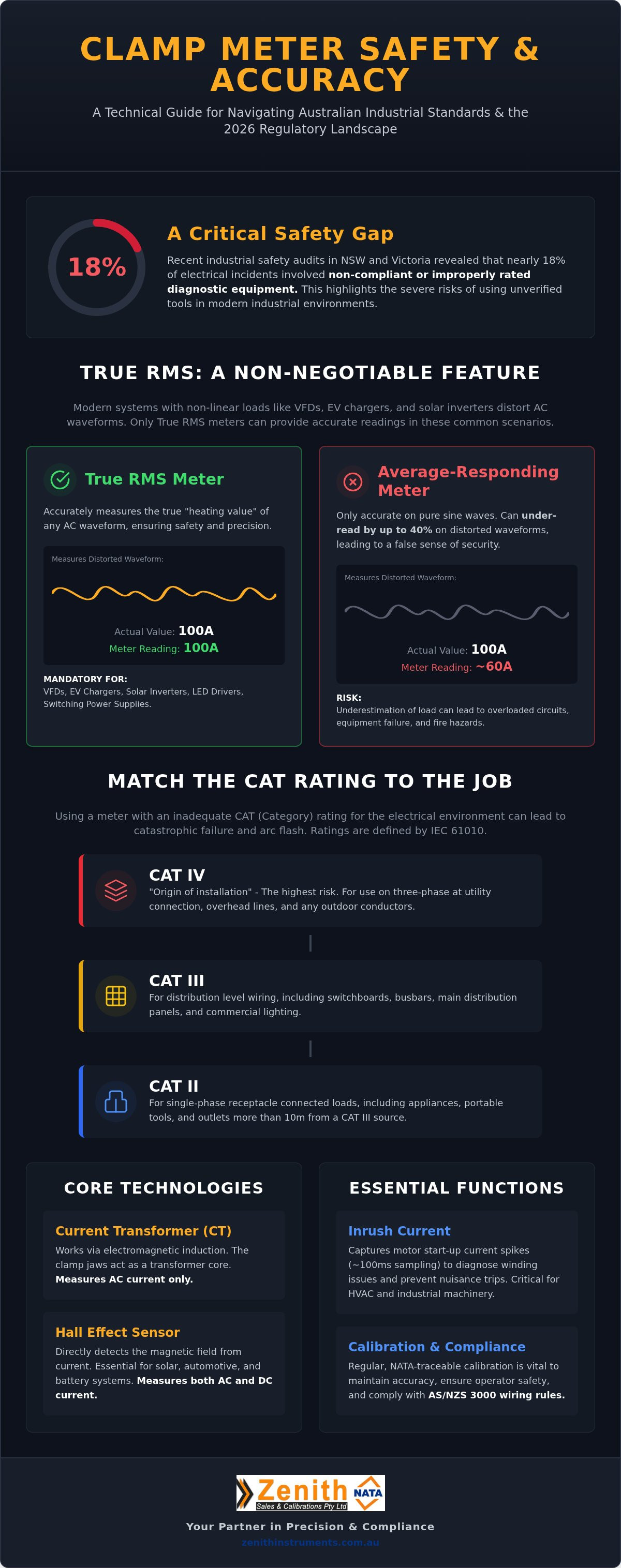
Recent industrial safety audits across New South Wales and Victoria revealed that nearly 18% of electrical incidents involved the use of non-compliant or improperly rated diagnostic equipment. It's a sobering figure that underscores the risks of using a tool that hasn't been verified for the specific demands of a modern industrial environment. We know that managing a fleet of test equipment while keeping up with shifting Australian standards is a complex task, especially when you're trying to balance operational safety with the annual clamp meter calibration cost.
This guide provides the technical clarity you need to navigate the 2026 regulatory landscape, from selecting the correct CAT IV meter for mains work to understanding the factors that influence NATA-traceable compliance. We'll examine the critical shift toward True RMS technology necessitated by modern non-linear loads and explain how the Electrical Safety Regulation 2026 impacts your operational requirements. By the end of this article, you'll have a clear framework for maintaining equipment accuracy and ensuring your team remains protected under the latest AS/NZS 3000 wiring rules.
Key Takeaways
- Identify why True RMS technology is mandatory for accurate readings on distorted waveforms common in modern EV chargers, VFDs, and solar inverters.
- Understand how to match your tool's CAT rating to the specific installation category as defined by IEC 61010 to prevent catastrophic equipment failure.
- Learn how factors like multi-function capabilities and NATA-traceable certification impact the total clamp meter calibration cost for your business.
- Discover how mobile calibration laboratories in major Australian hubs can reduce logistical delays and keep your operations compliant with AS/NZS 3000 wiring rules.
What is a Clamp Meter and How Does it Work?
A clamp meter is an essential diagnostic tool for Australian electricians and industrial technicians. Unlike a standard multimeter, it allows for the measurement of current without the need to disconnect wires or interrupt circuit operation. This non-invasive approach is vital for maintaining uptime in critical environments. For those curious about the underlying mechanics, What is a Clamp Meter? provides a foundational look at how these devices leverage electromagnetic principles to provide safe, accurate data.
The device works by detecting the magnetic field generated by current flowing through a conductor. In industrial troubleshooting and HVAC maintenance, this capability is indispensable. Commercial electrical audits also rely heavily on these tools to verify load balancing and identify circuit overloads. While multimeters remain useful for low-voltage electronics, clamp meters have largely replaced them in high-current applications. They eliminate the safety risks and logistical hurdles of breaking a live circuit. We recognize that maintaining the precision of these instruments is paramount. Inaccurate readings can lead to catastrophic failure or regulatory non-compliance, which is why understanding the factors behind clamp meter calibration cost is a priority for maintenance managers.
Current Transformer (CT) Technology for AC
CT technology relies on the principle of electromagnetic induction. The clamp's jaws act as a transformer core, and the conductor being measured serves as the primary winding. As alternating current flows through the wire, it induces a proportional current in the meter's secondary winding. Because induction requires a changing magnetic field, CT-based meters are strictly limited to AC measurements. Current Transformer technology serves as the technical foundation for all AC-only clamp measurement instruments.
Hall Effect Sensors for AC and DC Measurements
Measuring direct current (DC) requires a different approach since DC produces a static magnetic field that doesn't induce current in a traditional transformer. Hall Effect sensors solve this by detecting the magnetic flux directly. This technology is highly versatile, making these meters essential for solar installations, automotive diagnostics, and battery storage sectors. You can typically identify a Hall Effect meter by the presence of a Zero button, which cancels out the Earth's magnetic field or other interference before taking a DC reading. Maintenance managers must account for clamp meter calibration cost when planning their annual service cycles to ensure these complex sensors remain within tolerance. Our electrical calibration services ensure that both CT and Hall Effect instruments meet the rigorous standards required for industrial compliance.
Key Technical Features: True RMS vs. Average Responding
Measurement accuracy in modern electrical systems depends on how an instrument interprets complex waveforms. Many industrial environments now feature non-linear loads, such as Variable Frequency Drives (VFDs), LED drivers, and switching power supplies. These devices distort the traditional sine wave, creating "noisy" signals that basic meters struggle to process. Understanding this technical distinction is vital when evaluating your equipment and planning for your annual clamp meter calibration cost.
Average responding meters are designed for pure sinusoidal waves. When they encounter distorted signals from a VFD, they can under-read the actual current by as much as 40%. In contrast, a True RMS (Root Mean Square) meter uses complex mathematical formulas to calculate the equivalent heating value of the current, regardless of the waveform shape. If your facility utilizes modern automation or high-efficiency lighting, True RMS isn't a luxury; it's a safety and compliance requirement under Australian Safety Standards. You can usually identify these instruments by the "True RMS" label clearly marked on the front of the meter body.
Inrush Current and Peak Hold Functions
Capturing the surge current when a motor or compressor starts is critical for preventing nuisance breaker trips and diagnosing winding issues. Standard measurement modes are too slow to catch these spikes. You need an instrument with an inrush function that utilizes a sampling rate of approximately 100ms to capture the peak current accurately. This feature is a staple in HVAC diagnostics and industrial machinery maintenance, allowing technicians to see the maximum load during the first few cycles of equipment activation.
Leakage Current Measurement
Specialized leakage clamp meters are designed to measure minute currents in the milliamp range. These tools allow you to detect insulation breakdown or circuit faults without disconnecting equipment, which is a significant advantage for maintaining operational uptime. Because these sensors are highly sensitive, they require regular verification to ensure their high-resolution readings remain within tolerance. We recommend utilizing professional electrical equipment calibration services to maintain the integrity of your leakage detection program. If you're unsure if your current fleet meets these technical requirements, our team at Zenith Instruments can provide expert guidance on equipment selection and maintenance cycles.
Safety Standards and CAT Ratings in Australia
Electrical safety in Australia is governed by strict frameworks, notably AS/NZS 3000, known as the Wiring Rules. The Electrical Safety Regulation 2026, which commenced on 1 September 2026, reinforces the necessity for rigorous equipment standards across all industrial sectors. For technicians, compliance isn't just about the installation; it's about the tools used to verify it. The IEC/EN 61010 standard dictates the safety requirements for handheld testers, ensuring they can withstand transient overvoltages. Failure to use a correctly rated meter can result in arc flash incidents, where a short circuit releases a massive amount of energy. High-quality meters incorporate high-energy fuses designed to interrupt a circuit before catastrophic failure occurs. Maintaining these safety features is a core component of your clamp meter calibration cost, as a professional service verifies that internal protection remains functional.
Traceability is essential for meeting international quality benchmarks. While Australian standards are the priority, global Calibration Requirements highlight the necessity of documenting every verification step. This disciplined approach ensures that your safety ratings aren't just numbers on a spec sheet but verified performance metrics. We prioritize these standards to ensure your fleet remains compliant with modern WHS regulations.
Choosing the Right CAT Rating for Your Work
Selecting an instrument requires matching its overvoltage category to the specific environment. CAT II is designed for single-phase receptacle-connected loads, such as residential appliances and office equipment. CAT III covers three-phase distribution systems, including commercial lighting, feeders, and heavy-duty motors. CAT IV provides the highest level of protection, required for utility connections, electricity meters, and any outdoor conductors where lightning strikes or high-energy transients are most likely. When maintaining medium-voltage infrastructure from manufacturers like Africa Switchgear & Transformers, matching the tool to the supply source is a non-negotiable safety step.
Before every measurement, a thorough visual inspection is mandatory. Technicians must check for finger guards and insulation integrity to prevent accidental contact with live conductors. It's a common mistake to use third-party or generic leads that don't match the meter's rating. A meter is only as safe as its lowest-rated component. If you use CAT II leads on a CAT IV meter, the entire system is downgraded to CAT II. Regular checks through our electrical equipment calibration services help identify these vulnerabilities before they lead to injury.
Understanding Clamp Meter Calibration Requirements and Cost Factors
Even the most advanced digital instruments aren't immune to the physical realities of component aging and environmental stress. Over time, internal reference voltages and resistor networks drift. This leads to measurement errors that might go unnoticed without formal verification. Identifying these inaccuracies early is essential for maintaining site safety and operational efficiency. When you're budgeting for annual maintenance cycles, the clamp meter calibration cost is influenced by several technical variables, including the meter's complexity and the required level of certification. Multi-function instruments that measure current, voltage, resistance, and capacitance require more extensive testing protocols than single-function tools. Each additional parameter adds specific test points to the procedure, which naturally increases the time required for a meticulous verification.
A comprehensive calibration certificate acts as a formal chain of custody for your equipment. It documents that your instrument has been verified against known standards by technical experts. This documentation is your primary defense during safety audits or insurance investigations. For organizations managing large inventories across Victoria, our Melbourne calibration services provide a structured approach to fleet management, ensuring every tool in your kit is accurate and audit-ready. Book your next service through our electrical calibration services portal to ensure your equipment remains within precise tolerances.
NATA vs. Traceable Calibration
NATA (National Association of Testing Authorities) accreditation represents the highest tier of technical competence in the Australian measurement industry. While a traceable calibration ensures that an instrument is checked against a national standard, NATA-certified calibration provides a higher level of confidence for legal and regulatory purposes. We recommend reviewing Instrument Calibrations in Australia: The 2026 Professional Guide to determine which standard applies to your specific industry requirements. For many high-risk industrial sites and government contracts, NATA-certified results are a mandatory requirement for WHS compliance.
Recommended Calibration Intervals
A 12-month calibration cycle is the industry standard for most electrical test equipment to ensure ongoing accuracy. However, certain factors necessitate more frequent checks. Equipment used in harsh environments, such as remote mining sites or high-temperature manufacturing plants, is prone to faster degradation. Heavy daily use also increases the risk of mechanical wear on the clamp jaws, which can affect magnetic circuit integrity. We help you manage these critical timelines through our automated reminder system, ensuring your fleet never falls out of compliance. This proactive service model minimizes the risk of using inaccurate tools and helps you plan your maintenance budget effectively.
Professional Calibration Solutions at Zenith Instruments
Precision measurement is the foundation of industrial safety and operational efficiency. At Zenith Sales & Calibrations Pty Ltd, we operate state-of-the-art laboratories in Sydney and Melbourne, providing a dual-facility approach that ensures rapid turnaround times for businesses across the country. Our technical expertise goes beyond basic verification; we offer comprehensive repair services to provide full technical restoration for instruments that have drifted out of tolerance. For local support and specialized advice, our Sydney calibration services hub serves as a primary resource for New South Wales technicians and safety managers.
Large-scale operations in the mining and manufacturing sectors often can't afford the downtime associated with shipping equipment off-site. Zenith Sales & Calibrations Pty Ltd addresses this through our mobile on-site calibration labs. These units bring our meticulous standards directly to your facility, allowing for the immediate verification of your entire fleet. This proactive service model reduces logistical complexity and helps manage the total clamp meter calibration cost by minimizing production interruptions. Whether you're operating a processing plant or a remote mine site, our mobile teams ensure your diagnostic tools remain accurate without leaving your premises.
Australia-Wide Coverage and Technical Support
The Zenith Sales & Calibrations Pty Ltd service network extends well beyond our physical laboratory locations. We serve regional hubs including Newcastle, Canberra, and Brisbane through a secure courier-based service designed to protect sensitive instrumentation during transit. This national reach ensures that specialized technical support is accessible to every Australian industry. We maintain a strong partnership with global leaders like Major Tech, allowing us to provide expert sales advice and technical troubleshooting for complex measurement issues. If your team is experiencing significant drift or intermittent faults, our technicians possess the industry-specific knowledge to identify the root cause and restore equipment performance.
Stay Compliant with Zenith Sales & Calibrations Pty Ltd Certification
Maintaining audit readiness is a critical requirement for modern industrial sites. Every service Zenith Sales & Calibrations Pty Ltd performs concludes with the issuance of detailed digital and hard-copy certificates. These documents provide the formal evidence required to meet ISO 9001 and NATA-traceable standards, ensuring you're always prepared for regulatory inspections. Our certification processes are highly organized and mirror the exactness of the technical services we provide. We help you stay ahead of compliance cycles and manage your clamp meter calibration cost through transparent reporting and automated scheduling. When you're ready to verify your equipment's precision, you can Request a Quote for Clamp Meter Calibration through our specialized service portal.
Maintaining Technical Excellence in Your Electrical Fleet
Precision in electrical measurement isn't a static achievement; it's a continuous commitment to safety and regulatory compliance. We've examined how selecting the correct CAT rating and utilizing True RMS technology are fundamental steps in protecting your personnel and your assets. However, even the highest-quality hardware cannot guarantee accuracy if it's not supported by a rigorous verification schedule. Effectively managing your annual clamp meter calibration cost requires a partner who understands the nuances of Australian industrial standards and the specific demands of high-stakes environments.
We provide a comprehensive service model that includes NATA-certified laboratory standards and ISO-compliant technical reporting to keep your operations audit-ready. Our on-site mobile calibration in Sydney and Melbourne minimizes downtime by bringing expert technicians directly to your facility. Don't leave your site's safety to chance or unverified equipment. Book Your Clamp Meter Calibration with Zenith Instruments Today to ensure your fleet remains accurate and fully compliant with the latest 2026 regulations. We're ready to support your technical maintenance goals with precision and reliability.
Frequently Asked Questions
What is the difference between a clamp meter and a multimeter?
A clamp meter measures current non-invasively by clamping around a conductor, while a multimeter requires breaking the circuit to measure current in series. While both tools often share features like voltage and resistance measurement, the clamp meter is specifically engineered for high-current applications where interrupting the power supply isn't feasible. Technicians in Sydney and Melbourne rely on these instruments for rapid industrial troubleshooting and load balancing in commercial distribution boards.
Can a clamp meter measure DC current?
A clamp meter can measure DC current provided it utilizes Hall Effect sensors instead of standard Current Transformer technology. Hall Effect sensors detect the static magnetic flux produced by direct current, making these meters essential for solar installations, battery storage systems, and automotive diagnostics. You'll generally find a Zero button on these models to calibrate the sensor against the Earth's magnetic field before taking a reading to ensure maximum precision.
How often should I calibrate my clamp meter in Australia?
We recommend a standard 12-month calibration interval for all electrical test equipment used in professional Australian environments. This cycle ensures your fleet remains compliant with AS/NZS 3000 and helps you manage the long-term clamp meter calibration cost by preventing equipment failure. If your tools are used in high-intensity industrial sectors or harsh regional environments like mining sites, more frequent intervals might be necessary to maintain audit readiness and operational safety.
Is True RMS necessary for residential electrical work?
True RMS is highly recommended for modern residential work because standard average-responding meters often fail to accurately measure non-linear loads. Most Australian homes now feature LED drivers, switching power supplies, and solar inverters that produce distorted waveforms. Using a True RMS meter prevents under-reading the actual current, which is vital for verifying circuit loads and ensuring that safety switches operate within their specified technical parameters under the latest wiring rules.
What does a CAT IV 600V rating actually mean for my safety?
A CAT IV 600V rating indicates the instrument is designed to withstand high-energy transients at the source of the low-voltage installation. This includes electricity meters, primary overcurrent protection devices, and utility connections. In the context of Australian safety regulations, using a CAT IV rated tool is mandatory for any work performed at the utility entry point, as it provides the highest level of protection against arc flash incidents caused by lightning or switching surges.
Can I measure current on a multi-core cable with a clamp meter?
You cannot measure current by clamping onto a multi-core cable because the magnetic fields from the active and neutral wires cancel each other out. To obtain a reading, you must isolate a single conductor and place it within the center of the clamp jaws. If you need to measure a multi-core lead, use a specialized line splitter that separates the conductors temporarily, allowing the meter to detect the magnetic field of just one wire.
Why are my clamp meter readings inconsistent?
Inconsistent readings are usually caused by dirt or oxidation on the jaw mating surfaces, which prevents a complete magnetic circuit. If the jaws aren't properly closed or if there's significant component drift due to aging, the accuracy of the instrument will suffer. Factoring professional verification into your annual clamp meter calibration cost helps identify these mechanical and electronic issues early, ensuring your measurements remain reliable and traceable to national standards for compliance purposes.
Does Zenith Instruments offer on-site calibration in Sydney?
We provide mobile on-site calibration services across Sydney and Melbourne to reduce operational downtime for our clients. Our fully equipped mobile laboratories bring NATA-traceable standards directly to your facility, allowing for the immediate verification of your electrical test equipment. This service is particularly beneficial for large industrial sites and manufacturing plants in Newcastle, Canberra, and Brisbane that require high-volume testing without the logistical delays of shipping equipment to a laboratory.