

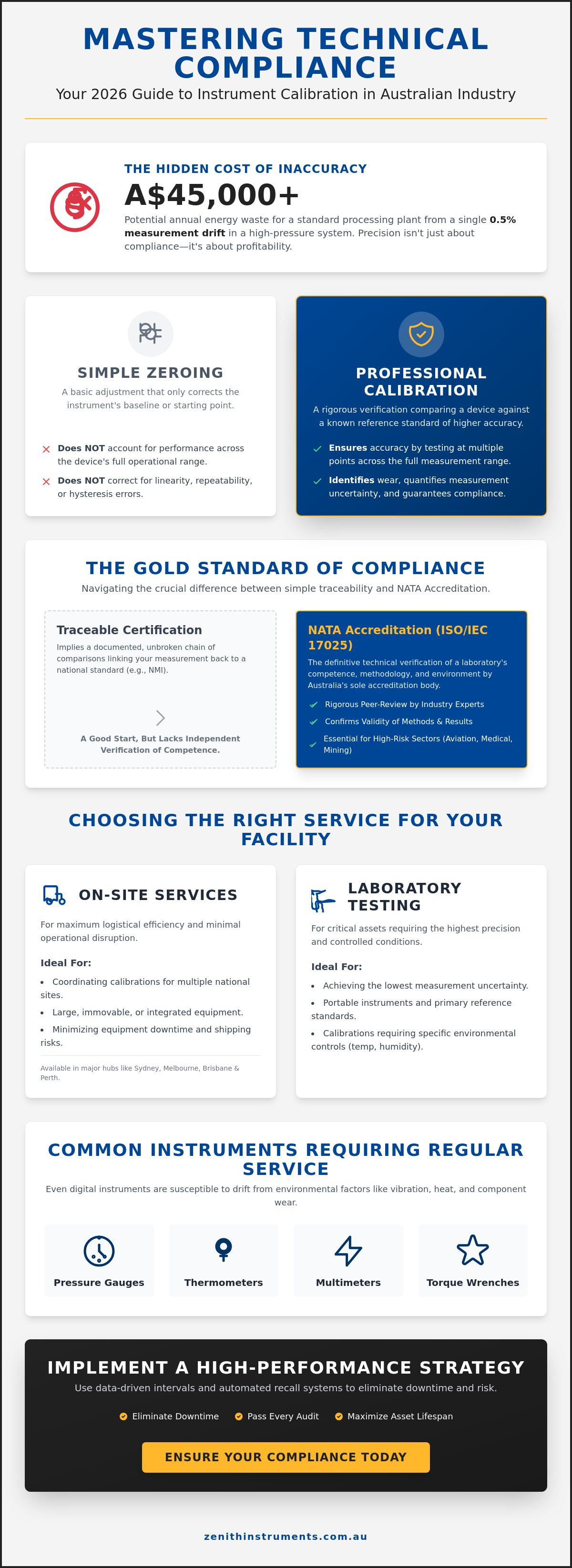
A single measurement drift of just 0.5% in a high-pressure industrial system can lead to over A$45,000 in annual energy waste for a standard Australian processing plant. You likely recognize that maintaining precise calibrations across multiple national sites is a logistical bottleneck that often causes unnecessary equipment downtime. It's a frustrating reality when rigorous regulatory requirements clash with your need for continuous production and high output.
We've designed this 2026 guide to help you master your technical compliance and maximize the operational lifespan of your critical assets. You'll gain a clear understanding of the mandatory distinctions between NATA accredited and traceable certifications to ensure your facility passes every audit without fail. We also provide a strategic framework for coordinating on-site services in major hubs like Sydney, Melbourne, Brisbane, and Perth. This structured approach minimizes operational disruptions while guaranteeing that your instrumentation meets the highest international standards for accuracy and safety. By the end of this article, you'll have a proactive plan to eliminate scheduling conflicts and maintain a seamless calibration cycle.
Key Takeaways
- Distinguish between simple tool zeroing and professional calibrations to ensure your instrumentation meets the rigorous precision standards required by Australian industry.
- Navigate the complexities of NATA accreditation and traceability to ensure your facility remains compliant with National Measurement Institute (NMI) frameworks.
- Determine the optimal balance between the logistical efficiency of on-site services and the superior environmental controls of laboratory-based testing for your critical assets.
- Align your equipment maintenance with industry-specific requirements tailored for major hubs, including Sydney's medical networks and Melbourne’s heavy manufacturing sectors.
- Establish a high-performance calibration management strategy using data-driven intervals and automated recall systems to eliminate downtime and risk.
Understanding Instrument Calibrations and Their Role in Australian Industry
In the Australian industrial landscape, precision is the difference between a high-performing facility and a costly shutdown. Understanding Instrument Calibrations starts with the fundamental process of comparing a device under test against a known reference standard of higher accuracy. This process isn't merely a check; it's a technical verification that ensures your equipment operates within its specified tolerances and meets rigorous performance criteria.
Many operators mistake 'zeroing' a tool for a complete service. While zeroing adjusts the instrument’s baseline, it doesn't account for linearity, repeatability, or hysteresis across the device’s full range. Professional calibrations involve rigorous testing at multiple points to identify these discrepancies. Without this depth, Australian businesses face significant legal liabilities and safety risks. A single measurement error in a high-pressure system can lead to catastrophic incidents, making precision a non-negotiable priority for compliance with national safety standards.
We also focus on measurement uncertainty as a critical metric for industrial reliability. This value quantifies the doubt inherent in any measurement, accounting for factors like ambient temperature and the resolution of the standard used. It allows engineers to make informed decisions based on the actual performance of their tools rather than theoretical perfection.
The Core Objectives of Regular Calibration
Maintaining accuracy is vital for ensuring product quality and operational safety across all sectors. Regular checks prevent minor deviations from escalating into systemic failures, which helps in extending the functional lifespan of expensive instrumentation by identifying wear before it causes a total breakdown. Traceability is the unbroken chain of documented comparisons that links your local measurements back to national standards through a series of certified laboratory benchmarks.
Common Measurement Instruments Requiring Service
Most industrial environments rely on a core set of tools, including pressure gauges, thermometers, multimeters, and torque wrenches. Even digital instruments aren't immune to accuracy loss; they drift over time due to mechanical wear and environmental factors like vibration or extreme heat in Australian workshops. We recommend regular pressure gauge calibration for any equipment used in high-cycle environments where component fatigue is a constant factor, ensuring your calibrations remain current and your site remains safe.
The NATA Accreditation Standard: Ensuring Traceability and Accuracy
The National Association of Testing Authorities (NATA) serves as the sole body responsible for the accreditation of laboratories across Australia. In 2026, the relevance of calibrations performed under this framework is higher than ever, as global supply chains demand stricter adherence to the ISO/IEC 17025:2017 standard. This international benchmark isn't just a certificate on the wall; it's a technical verification of a laboratory's ability to produce precise and accurate data. Without this oversight, there's no independent guarantee that the equipment used to test your instruments is itself accurate.
It's vital to distinguish between NATA-accredited services and those merely claiming to be "traceable to NIST or NMI." While traceability implies a documented path back to national standards, NATA Accreditation confirms the competence of the personnel, the suitability of the environment, and the validity of the methodology used. For high-risk sectors like aviation, mining, and medical technology, NATA-endorsed certificates aren't optional. These industries operate under strict regulatory frameworks where a single measurement error can lead to catastrophic mechanical failure or compromised patient safety.
Why NATA Accreditation is the Gold Standard
Laboratories seeking this status must undergo a rigorous peer-review process. Technical experts from the industry evaluate every procedure, ensuring that the lab's uncertainty calculations and equipment maintenance schedules meet global requirements. This level of scrutiny provides essential "legal metrology" protection. If your business faces a safety audit or a legal dispute regarding equipment performance, a NATA-endorsed report serves as a robust defense in court. It proves that you've exercised due diligence by using a technically competent facility. For a comprehensive look at these regulatory requirements, you can read our detailed post on NATA Accreditation in Australia: The 2026 Guide for Industry Compliance.
Traceability and the National Measurement Institute (NMI)
Measurement science relies on an unbroken chain of comparisons. This chain connects your local workshop tools to the International System of Units (SI) through the National Measurement Institute (NMI). Every link in this chain must have a known uncertainty. If one link is missing or unverified, the entire measurement process becomes scientifically invalid. Zenith Instruments maintains these rigorous standards for local clients, ensuring that every reading is defensible and accurate. We provide specialised calibration services in Sydney and other major Australian hubs to keep your operations compliant with the latest 2026 standards. This localized expertise ensures that your equipment stays within tolerance while minimizing downtime for your critical assets.
Laboratory vs. On-Site Calibrations: Choosing the Right Service for Your Facility
Selecting the appropriate environment for your instrument calibrations involves balancing technical precision with logistical efficiency. We understand that every facility has unique requirements, ranging from fixed industrial assets to portable precision instruments. Our service model is designed to accommodate these variables through either our NATA accredited laboratories or our mobile on-site units. Deciding between these two pathways is a strategic choice that impacts both your operational uptime and the long-term reliability of your measurements.
When to Choose On-Site Services
On-site service is the logical choice for heavy, fixed, or high-volume equipment. We bring our mobile laboratories directly to your facility, which is particularly beneficial for workshops in Sydney and Melbourne managing hundreds of torque wrenches or electrical testers. This model eliminates the logistical headache of packing and shipping sensitive gear. It also removes the risk of equipment being damaged during transit. By performing calibration services in Sydney or Melbourne at your location, we help you avoid the typical 3 to 5 day turnaround time required for lab-based shipping.
Our technicians serve Newcastle and Brisbane with fully equipped mobile units, allowing for immediate certification of production line tools. This immediate feedback loop is essential for maintaining safety standards in fast-paced industrial environments. While mobilisation fees apply for site visits, it's often more cost-effective than losing production time. We focus on maintaining your operational rhythm. By integrating with your maintenance schedule, we ensure that your calibrations are completed with minimal disruption to your daily workflow.
The Advantages of Laboratory Calibration
For instruments requiring the absolute highest level of precision, our controlled laboratory environments are superior. Our lab equipment calibration services take place in rooms where temperature and humidity are monitored constantly. These factors are critical when dealing with biomedical tools and high-end master standards. Even a minor shift in room temperature can affect the accuracy of a measurement by several microns.
In our labs, we utilize specialized technicians and high-end standards that are too delicate for mobile transport. This ensures that your most sensitive devices are tested against the most accurate references available in Australia. We recommend laboratory service for smaller batches of portable tools where shipping costs are lower than a technician's mobilisation fee. Our facilities in major Australian cities are NATA accredited, providing you with a gold-standard certificate that is recognized globally. We prioritize the integrity of your data by ensuring every instrument is handled in an environment designed specifically for measurement excellence. Whether you're in Perth or Brisbane, our lab network provides a dependable anchor for your compliance needs.
Industry-Specific Calibration Requirements Across Sydney, Melbourne, and Brisbane
Australia’s industrial landscape demands a localized approach to instrument maintenance. In Newcastle’s heavy manufacturing hubs and Melbourne’s production lines, pressure and torque calibrations are non-negotiable for operational safety. A 2024 industry report indicates that 15% of mechanical failures in heavy plant equipment stem from improperly torqued fasteners or inaccurate pressure readings. We provide onsite verification to ensure these high-risk assets remain within OEM specifications, minimizing downtime in Victoria's manufacturing corridor. In Canberra, the expansion of infrastructure projects like the Light Rail Stage 2 has increased the demand for precision laser level and dimensional accuracy checks to prevent costly rework on site.
The resource sector in Brisbane and regional Queensland faces unique environmental challenges that affect instrument drift. High humidity and dust levels in mining environments necessitate more frequent service intervals for gas detectors and insulation testers. Maintaining a rigorous schedule ensures that safety systems respond correctly in volatile atmospheres, protecting both personnel and capital infrastructure.
Medical and Biomedical Precision
Sydney’s extensive hospital networks, including facilities within the South Eastern Sydney Local Health District, operate under strict AS/NZS 3551:2012 standards. Precise thermal management in pathology labs and accurate blood pressure monitoring are critical for patient safety. Annual verification creates a robust clinical audit trail, reducing liability and ensuring diagnostic reliability across the network. You can access specialized biomedical equipment calibration services to maintain these high standards and ensure your facility remains compliant with national health regulations.
Electrical Safety and Compliance
For the Brisbane resource sector and local electrical contractors, compliance with AS/NZS 3760 is a legal mandate. Portable appliance testing (PAT) ensures that onsite tools don't pose a risk of electrocution or fire. Multimeters, clamp meters, and insulation testers require annual verification to ensure "sparkies" receive accurate readings when diagnosing live circuits. We offer comprehensive electrical equipment calibration services that include NATA traceable certification for all handheld testing units. This proactive service model helps contractors avoid the heavy fines associated with non-compliant equipment during site audits.
Ensure your fleet meets the highest safety standards with our NATA accredited solutions. Book your onsite calibration today to maintain total compliance.
Implementing a Calibration Management Strategy with Zenith Instruments
Establishing a robust strategy for your facility ensures regulatory compliance and operational safety. We work with Australian businesses to move beyond reactive maintenance toward a proactive, data-driven approach. This strategy begins with identifying every critical measurement point and ends with a verifiable audit trail that meets international standards.
Determining Your Calibration Intervals
Many facilities default to a standard 12 month interval without considering the specific demands placed on their equipment. This approach often ignores the balance between cost and risk. A high-use pressure gauge in a 24/7 manufacturing plant requires more frequent attention than a multimeter used weekly in a climate-controlled lab. We help you evaluate manufacturer recommendations alongside your specific usage frequency to set intervals that protect your data integrity.
You should monitor your tools for signs of drift between scheduled services. These signs include inconsistent zero-points, readings that fail to stabilize, or physical damage to the housing. Excessive thermal cycling and high humidity levels in Australian industrial environments can degrade internal components, leading to accelerated measurement drift. By identifying these issues early, you prevent the costly rework associated with out-of-tolerance results.
- Automated Recall Systems: We utilize advanced tracking to notify you well before a certificate expires.
- Detailed Record-Keeping: Every service is backed by comprehensive documentation that simplifies the audit process.
- Risk Mitigation: Regular calibrations reduce the likelihood of catastrophic equipment failure or safety breaches.
Why Partner with Zenith Australia?
We bring over 20 years of technical expertise to every project, providing a level of precision that generalist providers cannot match. Our NATA-certified standards provide the highest level of traceability for your calibrations, ensuring your results are recognized both locally and internationally. We understand that downtime is expensive, so we've optimized our logistics to offer the fastest turnaround times in the industry.
Our network serves major industrial hubs including Sydney, Melbourne, Newcastle, Canberra, and Brisbane. This geographic footprint allows us to offer rapid onsite services, bringing our mobile laboratories directly to your facility to minimize operational disruptions. You can learn more about our commitment to technical excellence in our detailed post on Zenith Australia: The Premier Choice for Industrial Calibration & Instrumentation in 2026.
We don't just provide a certificate; we provide a partnership built on technical authority and reliability. Our technicians are meticulously trained to handle complex instrumentation across the medical, engineering, and manufacturing sectors. Whether you require a single tool check or a full-scale plant management plan, we deliver the exactness your industry demands.
Secure your facility's accuracy today. Contact our team to get a professional quote for your facility's instrumentation needs and experience the Zenith advantage.
Future-Proof Your Compliance and Measurement Accuracy
Maintaining rigorous standards for your calibrations isn't just about technical precision; it's a fundamental requirement for operational safety and regulatory standing in 2026. We've established that NATA accreditation remains the gold standard for traceability in Australia, providing the necessary framework to meet ISO requirements. Whether you're managing complex medical facilities in Melbourne or heavy manufacturing plants in Perth, your choice between laboratory and on-site services will directly impact your bottom line. We understand that equipment downtime is a significant cost factor for Australian enterprises. That's why we've optimized our NATA Accredited Laboratory workflows to deliver fast turnaround times without compromising on technical detail. Our team provides comprehensive Australia-wide service coverage, ensuring that expert technicians are available in Sydney, Brisbane, and beyond. By implementing a proactive management strategy, you'll protect your assets and maintain seamless compliance throughout the year. We're ready to support your facility with the meticulous care your high-precision instruments deserve.
Book Your NATA-Certified Calibration Service with Zenith Instruments Today
We look forward to helping you achieve total measurement confidence across your entire instrument fleet.
Frequently Asked Questions
How often should my instruments undergo calibrations?
Most industrial instruments require professional calibrations every 12 months to maintain regulatory compliance and operational safety. This interval aligns with ISO 9001 standards and manufacturer recommendations. We suggest shorter cycles of 3 or 6 months for equipment used in high-stress environments or critical medical applications where drift exceeds 0.5% of the full scale. Regular scheduling prevents measurement errors that lead to costly production downtime in 2026.
What is the difference between NATA and traceable calibration?
NATA accreditation signifies that a laboratory meets the rigorous ISO/IEC 17025 international standards for technical competence. While traceable calibration links your measurements to national standards held by the National Measurement Institute (NMI), it doesn't provide the same level of third-party verification. We provide NATA-certified reports for high-risk industries like aerospace and medicine where legal defensibility is mandatory for audit success and risk mitigation.
Can calibrations be performed on-site at my facility in Sydney?
We perform onsite calibrations at facilities across Sydney and greater New South Wales to minimize your equipment downtime. Our mobile technicians arrive with portable reference standards to verify pressure, electrical, and thermal instruments directly on your production line. This service eliminates the 3 to 5 day transit window typically required for laboratory shipping. It's a proactive solution for large-scale manufacturing plants with fixed machinery that can't be moved.
What happens if my instrument fails calibration?
If your device fails, we issue an Out of Tolerance (OOT) report detailing the specific measurement deviations recorded during testing. Our technicians then evaluate the instrument for potential repair or adjustment to bring it back within the manufacturer's specified tolerances. We provide a full "As Found" and "As Left" data set so your quality manager can assess the impact on products manufactured since the last successful check.
How do I read a calibration certificate to ensure compliance?
You must verify the NATA endorsement logo, the unique certificate number, and the stated measurement uncertainty. Ensure the "As Found" results fall within the permissible limits defined by your industry standards. We include a clear pass or fail statement on every document to simplify your audit trail. Check that the calibration date matches your internal 2026 compliance schedule to avoid gaps in your quality management system or regulatory filings.
Is calibration required for brand-new equipment?
New equipment requires calibration before its first use to establish a performance baseline and verify that transit didn't affect its accuracy. Factory certificates often lack the specific data points required for ISO compliance in the Australian market. We recommend a full initial check to ensure the device meets its 99% accuracy rating from day one. This practice protects your investment and ensures your initial data sets are reliable for future comparisons.
How long does a typical calibration service take at Zenith?
Our standard laboratory turnaround time is 3 to 5 business days from the moment we receive your equipment. We also offer an expedited 24-hour service for urgent requirements to keep your operations running smoothly. For clients with high-volume needs, our onsite service teams complete most batches within a single shift. We prioritize efficiency to ensure your critical tools return to service without unnecessary delays or extended periods of inactivity.
What are the risks of using uncalibrated electrical tools?
Using uncalibrated electrical tools creates significant safety risks, including potential fire hazards or electrocution if insulation testers or multimeters provide false readings. Inaccurate measurements can lead to non-compliance with AS/NZS 3000 wiring rules, resulting in fines or voided insurance claims. We've seen measurement errors as small as 2% cause catastrophic component failure in sensitive power grids. Regular testing ensures your team remains safe and your legal liability is strictly managed.