

A single incorrect reading from a wind sensor can lead to catastrophic structural failure or compromised ventilation in a deep-shaft mine. Reliable anemometer calibration is the only way to mitigate these risks and ensure your site remains operational. We know the pressure you're under to maintain compliance with ISO/IEC 17025 (2017) standards while keeping your project on schedule. It's frustrating when you're caught between the necessity for precision and the reality of equipment downtime. You shouldn't have to choose between technical accuracy and operational efficiency.
In this 2026 guide, we'll demonstrate how professional laboratory calibration ensures your wind measurement instruments meet Australian safety and compliance standards. We'll clarify the differences between NATA-traceable and standard certifications, provide a roadmap for current regulatory requirements, and explain how our Sydney and Melbourne facilities help you maintain peak performance. From vane to hotwire sensors, we'll show you how to secure reliable airflow data for any industrial environment with minimal disruption to your workflow.
Key Takeaways
- Understand why precise airflow data is a safety mandate for crane operations and HVAC balancing in Australian industrial sites.
- Learn the specific maintenance requirements for different sensors and why vane or hot-wire units require professional anemometer calibration to maintain accuracy.
- Navigate the complexities of ISO/IEC 17025 standards to distinguish between NATA-traceable and NATA-endorsed certification for your audit requirements.
- Discover why "brute force" field tests fail and how controlled wind tunnel testing ensures laminar flow for precise instrument verification.
- Identify how to minimize equipment downtime through specialized lab facilities in Sydney and Melbourne or proactive on-site service options.
What is Anemometer Calibration and Why is it Critical?
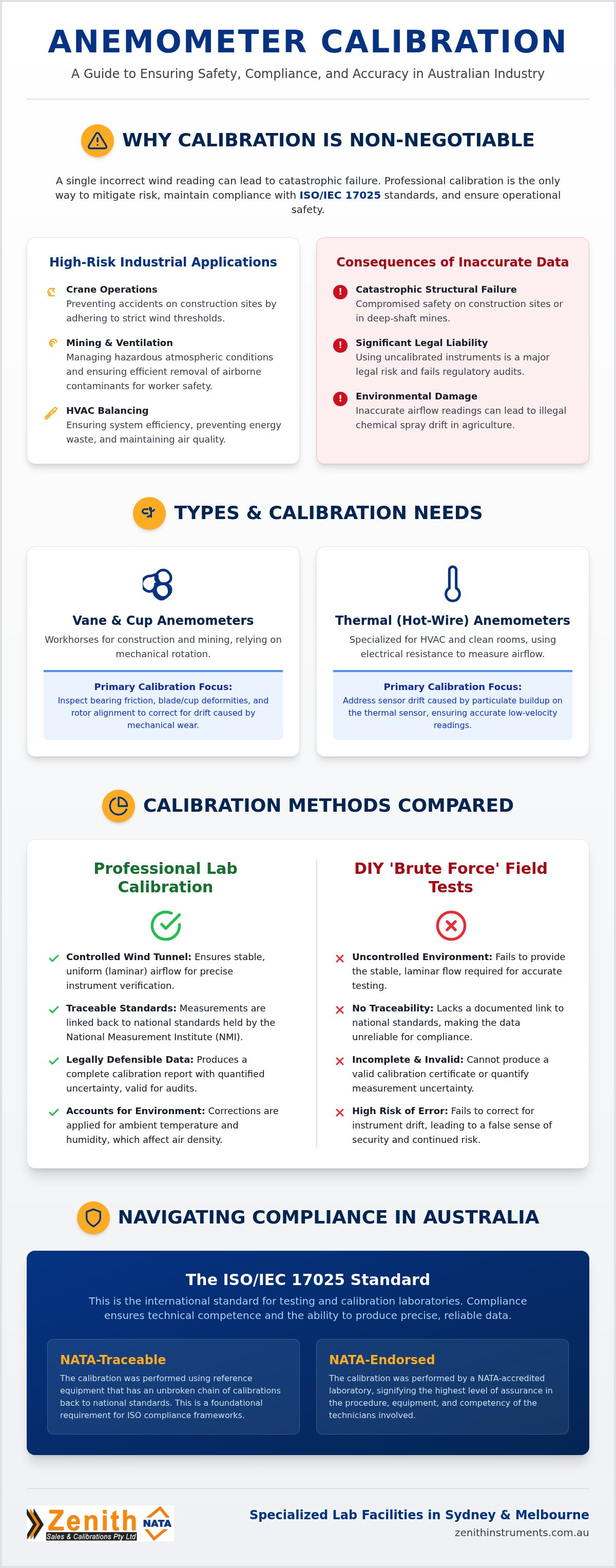
Anemometer calibration is the rigorous technical process of comparing an instrument's readings against a traceable reference standard within a controlled environment, such as a wind tunnel. To understand the device itself, one might ask, What is an Anemometer? It's a specialized tool designed to measure wind speed and pressure, and its accuracy is fundamental to industrial safety. Precision isn't optional. Inaccurate readings can lead to HVAC system imbalances that waste energy or, more critically, crane accidents on construction sites where wind thresholds are strictly governed. Accuracy naturally degrades over time due to "drift," caused by bearing friction in vane models or particulate buildup on thermal sensors. Professional anemometer calibration corrects these deviations and ensures your data remains legally defensible.
We ensure all measurements are linked back to national standards maintained by the National Measurement Institute (NMI). This chain of traceability is a foundational requirement for any business operating under ISO compliance frameworks. Without a documented link to national standards, your measurement data lacks the authority required for regulatory audits or safety certifications.
The Role of Accuracy in Australian Workplace Safety
High-risk sectors like mining rely on precise wind data to manage hazardous atmospheric conditions and ensure worker safety. Using uncalibrated instruments in these environments isn't just a technical oversight; it's a significant legal liability. In agricultural sectors, inaccurate airflow readings compromise Delta-T assessments, which can lead to illegal chemical spray drift and subsequent environmental damage. Industrial ventilation systems also depend on exact velocity data to ensure the efficient removal of airborne contaminants. We provide specialized calibration services in Sydney and Melbourne to address these specific safety mandates across the country.
Key Measurement Parameters in Wind Calibration
Technicians must navigate various units of measure, including meters per second (m/s), knots, and kilometres per hour (km/h). While m/s is the standard for most scientific and industrial applications, knots remain the benchmark in marine and aviation sectors. During the calibration process, we apply corrections for ambient temperature and humidity, as these factors significantly influence air density and sensor response. Calibration uncertainty is the quantified doubt in a measurement result. Without this value, a calibration report is incomplete, as it fails to provide the necessary context regarding the reliability of the instrument's performance under specific conditions.
Types of Anemometers and Their Specific Calibration Needs
Industrial applications across Australia require diverse instrument designs, each presenting unique challenges for anemometer calibration. Vane and cup models rely on physical rotation, while thermal anemometers utilize electrical resistance, and ultrasonic versions use sound waves. Ensuring these diverse technologies align with Australia's national measurement standards requires specialized laboratory equipment capable of simulating precise environmental conditions. We categorize these instruments based on their physical sensors to determine the specific testing protocols required for certification.
Vane and Cup Anemometers: Mechanical Precision
Vane and cup anemometers are the primary workhorses for the Australian construction and mining sectors. Their reliability depends entirely on the integrity of their mechanical components. During anemometer calibration, we meticulously inspect the bearings for resistance and the blades or cups for physical deformities. Even microscopic chips or slight misalignments in the rotor assembly can cause significant measurement errors at high wind speeds. We often utilize our Dimensional Calibration Service to verify that physical tolerances haven't been compromised by harsh site conditions or mechanical wear. Regular verification ensures these units provide the accurate data needed for crane safety and site atmospheric monitoring.
Thermal Anemometers: HVAC and Clean Room Specialisation
Thermal or hot-wire anemometers operate on a different physical principle. They measure the cooling effect of moving air on a heated filament to determine mass flow. This makes them exceptionally sensitive and ideal for low-velocity measurements in HVAC balancing and clean room environments. Because the sensor is so delicate, calibration must occur in a clean-air environment to prevent filament contamination. For Alnor or TSI velometers used in sensitive medical settings, precision is a safety requirement. We integrate these checks with our Biomedical Equipment Calibration Services to provide a comprehensive compliance solution for hospital and laboratory facilities.
Ultrasonic anemometers represent the high-end of meteorological measurement. With no moving parts, they are less prone to mechanical wear but require sophisticated electronic verification to ensure the transducers are firing and receiving signals correctly. Similarly, Pitot-tube anemometers, often used in high-speed ductwork, require precise pressure differential testing to maintain accuracy. Regardless of your instrument type, our technicians provide the expertise needed to keep your fleet compliant. If you're managing a diverse range of sensors, we recommend scheduling a calibration service in Sydney or Melbourne to ensure every device meets national standards.
Professional Lab Calibration vs. DIY 'Brute Force' Methods
Attempting to verify wind speed accuracy without a controlled environment is a dangerous shortcut. A common "brute force" method often cited in online forums involves holding an instrument out of a moving vehicle window and comparing it to GPS speed. This approach is fundamentally flawed for industrial certification. It fails to account for vehicle-induced turbulence, external wind gusts, and the inherent latency of consumer-grade GPS. For a valid anemometer calibration, the variables of the external environment must be eliminated, not embraced.
Why Wind Tunnels are Non-Negotiable
Professional laboratories utilize specialized wind tunnels to create a steady-state testing environment. Laminar flow is the smooth, uninterrupted path of air required for true calibration. Unlike the chaotic air found outdoors, this controlled stream allows technicians to isolate the instrument's performance. We employ high-precision reference anemometers that possess a much higher degree of accuracy than the unit under test. These standard units are themselves traceable to national benchmarks, providing a reliable baseline for comparison.
Environmental control is equally critical during the testing phase. Air density changes based on temperature and barometric pressure, which directly affects how a sensor responds. We stabilize these parameters within the lab to ensure that the results are repeatable and accurate. A comprehensive anemometer calibration report will always include both 'As-Found' and 'As-Left' data. The 'As-Found' data documents the instrument's performance upon arrival, which is vital for historical trend analysis and determining if previous safety data was compromised. The 'As-Left' data confirms the device’s accuracy after necessary adjustments or repairs.
The Risks of DIY Calibration
Relying on DIY methods or uncertified "offset" math in a custom script introduces significant liability. If an anemometer is used to clear a crane for operation or to balance a medical ventilation system, the data must be legally defensible. DIY tests cannot account for mechanical issues like bearing drag or the specific efficiency of the cup assembly. Professional adjustment is a meticulous process that aligns the instrument's internal firmware or mechanical response with the reference standard. We provide these technical services at our Sydney and Melbourne labs to ensure your equipment meets the rigorous demands of Australian industrial standards.
Standards, Compliance, and Calibration Frequency in Australia
Adhering to international standards is the only way to ensure technical competence in a laboratory environment. Precision isn't optional. For Australian industries, ISO/IEC 17025 (2017) serves as the definitive benchmark for anemometer calibration. While ISO 9001 focuses on general management systems, ISO 17025 specifically validates the technical proficiency of the lab and its technicians. We maintain these rigorous standards to provide our clients with legally defensible data that stands up to scrutiny. This technical solution ensures that every instrument we certify adheres to the formal requirements of your specific industrial framework.
Understanding the distinction between NATA-traceable and NATA-endorsed certification is essential for compliance managers. A NATA-endorsed certificate carries the NATA logo and confirms the laboratory is accredited for that specific measurement range. NATA-traceable certificates verify that the reference equipment used is linked to national standards but may be issued by a facility that lacks specific accreditation for that scope. Regulatory bodies like SafeWork Australia and various environmental protection agencies prioritize NATA-endorsed records during safety audits and incident investigations.
How Often Should You Calibrate?
Factors like harsh mining environments, high-salt coastal areas, or daily heavy use significantly shorten the calibration cycle. If your equipment is exposed to corrosive dust or high-velocity saline air, a six-month interval is often safer than the standard annual check. You should also monitor internal stability logs to see if your instrument is drifting faster than expected. For a deeper look at industry-wide requirements, consult our Instrument Calibrations in Australia: The 2026 Professional Guide.
Reading Your Calibration Certificate
A professional report isn't just a receipt; it's a technical document. It must identify the reference standards used and their own chain of traceability. You'll find 'Pass/Fail' criteria based on the manufacturer's original specifications. For audit trails, the 'Date of Calibration' and 'Next Due Date' are the most critical fields. If you need to ensure your fleet is compliant before your next audit, schedule your anemometer calibration with our expert team today.
Professional Anemometer Services at Zenith Instruments
We provide comprehensive support for leading instrumentation brands, including Kestrel, TSI, Alnor, and Dwyer. Our technical team understands that anemometer calibration is a critical component of your safety infrastructure. We operate dedicated laboratory facilities in Sydney and Melbourne, serving the mining, medical, and manufacturing sectors with Australia-wide coverage. By partnering with us, you ensure your equipment is handled by meticulous experts who prioritize reliability and precision above all else.
Laboratory and On-Site Solutions
Choosing between laboratory and on-site service often depends on your specific precision requirements and logistical constraints. Our in-house labs offer the highest level of environmental control for sensitive thermal and ultrasonic units. However, for large-scale facilities where removing gear from the line is impossible, our on-site mobilisations eliminate transit time and operational downtime. We frequently deploy technicians to regional hubs like Brisbane, Canberra, and Newcastle to ensure rapid turnaround times for critical equipment. This dual-model approach allows us to maintain lab-grade precision while providing the localized service touch that regional industries require. It's a proactive service model designed to keep your operations running without interruption.
Our capabilities extend beyond wind measurement. Many modern weather stations and environmental monitors are multi-parameter devices. We can calibrate temperature, humidity, and pressure sensors in a single visit, providing a streamlined compliance solution. This integrated approach reduces administrative overhead and ensures all your data points are synchronized to the same rigorous standards. We deliver technical solutions backed by formal certification, moving efficiently from identifying your needs to providing a fully calibrated fleet.
Book Your Anemometer Calibration Today
The process begins with a straightforward quote request, followed by the meticulous testing of your instrument against our NATA-traceable standards. If a device fails initial testing, we don't just issue a fail report. Our technicians possess the technical repair capabilities to address mechanical or electronic faults, often returning the instrument to service without the need for a costly replacement. This meticulous attention to detail mirrors the exactness of the technical services we provide. For those managing integrated systems, we also offer electrical equipment calibration services to ensure every component of your monitoring network is fully certified.
Don't wait for a safety audit to reveal inaccuracies in your wind data. We've been a dependable expert in the field since 2004, and our ISO-compliant processes are designed to protect your personnel and your reputation. We invite you to contact our team today to secure your next anemometer calibration and experience the Zenith advantage. We remain a no-nonsense, high-performance service provider that values technical excellence and regulatory compliance as our primary mission.
Securing Your Operational Safety for 2026 and Beyond
Precision wind measurement is a foundational pillar of industrial safety and regulatory compliance. We've established that laboratory-controlled environments and steady-state laminar flow are non-negotiable for achieving reliable airflow data. Accuracy isn't optional. Whether you're managing complex HVAC systems or high-risk mining operations, maintaining regular anemometer calibration is the only way to meet Australian safety mandates and protect your personnel from the risks of inaccurate readings. It's about more than just numbers; it's about defensible data.
At Zenith Instruments, we combine over 20 years of technical expertise with a commitment to NATA-traceable standards. Our dual-lab presence in Sydney and Melbourne ensures that businesses across Australia have access to meticulous expert service with minimal downtime. We prioritize your equipment's accuracy to keep your projects moving forward with absolute confidence. Don't leave your site safety to chance or uncertified measurement methods. We're ready to partner with you to maintain your compliance and operational excellence throughout the coming year.
Request a Quote for Professional Anemometer Calibration
Frequently Asked Questions
What is the difference between NATA-accredited and NATA-traceable calibration?
NATA-accredited calibration is performed by a laboratory audited by the National Association of Testing Authorities for a specific scope of work, resulting in an endorsed certificate. NATA-traceable calibration confirms that the reference standards used are linked to national benchmarks, though the facility itself may lack specific accreditation for that individual test. We provide both options to ensure your anemometer calibration meets the precise audit requirements of your industry, whether you operate in medical, mining, or manufacturing sectors.
How long does a professional anemometer calibration take?
Laboratory turnaround times typically range from three to five business days, excluding transit. We prioritize efficiency to minimize your equipment downtime. For facilities in Sydney, Melbourne, or Brisbane that cannot afford to have critical instruments off-site, we offer on-site calibration services. This proactive model eliminates shipping delays entirely. Our technicians move efficiently from receipt to certification, ensuring your operations remain compliant without the burden of extended logistical gaps or project delays.
Can I calibrate my own anemometer using a car and GPS?
No, attempting to verify wind speed accuracy using a vehicle and GPS is fundamentally flawed and legally indefensible. This method cannot account for vehicle-induced turbulence, external wind gusts, or GPS latency. Professional anemometer calibration requires a controlled wind tunnel to establish laminar flow and stabilize environmental variables like barometric pressure. Without these laboratory conditions, your measurement data lacks the authority required for Australian safety standards, particularly in high-risk sectors like construction or mining.
Which industries in Australia require certified anemometer calibration?
Any sector where wind speed impacts personnel safety or process efficiency requires certified calibration. This includes the mining industry for ventilation monitoring, the construction sector for crane operation safety, and the medical field for clean room airflow management. Agricultural businesses also rely on precise data for chemical spray drift assessments. We support these diverse industries across Newcastle, Canberra, and beyond, providing the technical documentation necessary to satisfy SafeWork Australia audits and international ISO frameworks.
What happens if my anemometer fails the calibration test?
If an instrument fails its initial verification, we don't simply issue a failure report. Our qualified technicians possess the expertise to perform mechanical and electronic repairs. We diagnose issues such as bearing resistance in vane models or filament degradation in thermal sensors. Once the hardware is restored to manufacturer specifications, we repeat the calibration process. This integrated service model ensures your equipment returns to the field in peak condition, avoiding the high cost of replacement.
How much does anemometer calibration cost in Sydney or Melbourne?
Calibration costs vary based on the instrument type, the number of measurement points required, and whether you choose laboratory or on-site service. We provide tailored quotes for businesses in Sydney, Melbourne, and across regional Australia to ensure you receive the most cost-effective compliance solution. While specific fees depend on the complexity of the sensor technology, our pricing reflects a commitment to technical excellence and NATA-traceable standards. Contact our team for a detailed assessment of your fleet.
Do you calibrate handheld weather meters like Kestrel?
Yes, we provide comprehensive calibration support for handheld weather meters from leading global brands, including Kestrel, TSI, Alnor, and Dwyer. These portable units are frequently used in agricultural spraying, HVAC balancing, and environmental monitoring. Our technicians verify the accuracy of these devices against traceable reference standards in our specialized labs. We ensure that even small, portable sensors provide the high-precision data required for industrial compliance and site safety throughout Sydney, Melbourne, and Brisbane.
Is on-site anemometer calibration available for remote mining sites?
We offer on-site mobilisations for large-scale facilities and remote mining sites across Australia. This service allows us to deploy technicians and reference equipment directly to your location, ensuring zero transit time for your critical gear. Our mobile capabilities are a specific competitive advantage for regional industries that require rapid response times and meticulous technical support. We function as a wide-reaching partner, understanding the logistical challenges of maintaining high-performance measurement equipment in remote or specialized environments.