

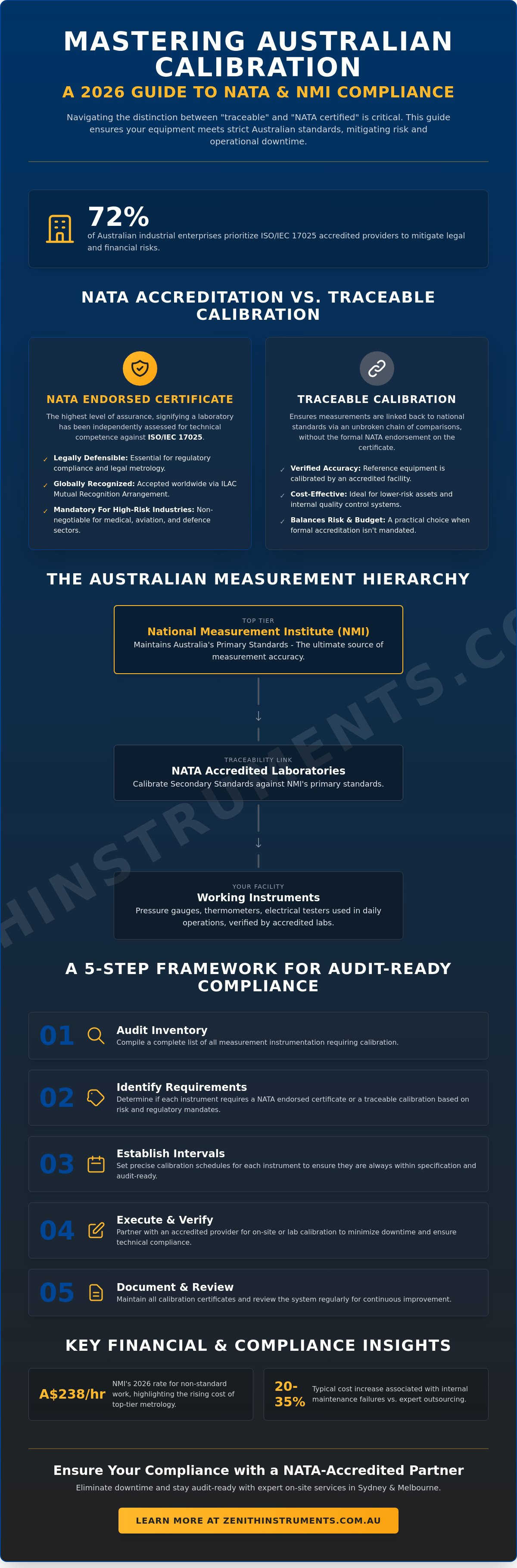
Over 72% of Australian industrial enterprises now prioritize calibration providers accredited to ISO/IEC 17025 to mitigate the legal and financial risks of measurement error. You're likely aware that navigating the distinction between "traceable" and "NATA certified" is often the difference between passing a regulatory audit and facing a total operational shutdown. We understand the pressure of maintaining compliance while managing technical costs, such as the A$238.00 per hour rate for non-standard NMI work.
This 2026 guide provides a definitive roadmap to master Calibration Requirements for Australian Standards, ensuring your pressure gauges, thermometers, and electrical testers meet strict NATA and NMI traceability requirements. We'll clarify the latest NATA fee models and the specific benchmarks of AS ISO/IEC 17025:2018. We'll also provide a clear schedule for equipment verification to keep your facility audit-ready. You'll learn how to leverage onsite services in Sydney or Melbourne to eliminate equipment downtime and maintain your competitive edge through technical excellence and precision.
Key Takeaways
- Understand how the National Measurement Act and NMI traceability form the foundation of legal metrology for all Australian industrial equipment.
- Learn to distinguish between NATA-endorsed certificates and basic traceable services to meet specific calibration requirements for australian standards.
- Identify industry-specific mandates, including TGA requirements for medical devices and ruggedized protocols for the mining and manufacturing sectors.
- Implement a structured 5-step framework to audit your instrumentation inventory and establish precise calibration intervals that satisfy regulatory audits.
- Discover how local on-site calibration services in Sydney and Melbourne can significantly reduce industrial downtime while maintaining technical compliance.
Understanding Australian Calibration Standards & NMI Traceability
The National Measurement Act 1960 establishes the legal foundation for all measurement activities across the country. It ensures that every unit of measurement used in commercial trade, healthcare, and industrial safety is uniform and accurate. At the heart of this framework sits the National Measurement Institute (NMI). They are the peak body responsible for maintaining Australia's primary standards. Compliance with calibration requirements for australian standards begins with ensuring your instrumentation is traceable to these national benchmarks. If your equipment lacks this link, your measurements hold no legal standing in a court of law or a regulatory audit.
The Hierarchy of Measurement in Australia
Precision is maintained through a rigorous hierarchy. The NMI holds the primary standards, which are the most accurate references in the country. Secondary standards are then calibrated against these primary units by accredited laboratories. We utilize these secondary standards at our Sydney and Melbourne sites to verify your working instruments. This unbroken chain of traceability is what guarantees accuracy on your factory floor. As of January 1, 2026, the NMI has implemented a new fee schedule for its services, with non-standard work now billed at A$238.00 per hour. This change highlights the rising costs of maintaining the highest levels of metrological integrity, making it more efficient for businesses to partner with established local laboratories.
Key Governing Bodies: NMI, NATA, and Standards Australia
It's vital to distinguish between the organizations that shape the industry. Standards Australia writes the rules, such as AS ISO/IEC 17025:2018, which is the current benchmark for laboratory competence. However, they don't perform inspections. That role falls to NATA. They assess laboratories to ensure they possess the technical expertise and equipment to perform specific calibrations. While many providers claim to be "traceable," only NATA-accredited facilities offer the rigorous oversight required for high-risk sectors. We focus on these standards because they provide a clear roadmap for calibration requirements for australian standards. By following these AS codes, you ensure your equipment meets the mandatory intervals required for safety and trade, protecting your business from the 20-35% cost increases often associated with internal maintenance failures.
NATA Accreditation vs. Traceable Calibration: Which Do You Need?
Deciding between a NATA-endorsed certificate and a traceable calibration is a critical business decision for any operation. NATA accreditation signifies that a laboratory has been independently assessed for technical competence and adherence to ISO/IEC 17025. These certificates carry the NATA emblem, which is recognized globally through the ILAC Mutual Recognition Arrangement. This means a report issued in Sydney or Melbourne is accepted by regulatory bodies worldwide, ensuring your products can enter international markets without re-testing. However, not every piece of equipment requires this level of formal endorsement to satisfy calibration requirements for australian standards.
Traceable calibration refers to an unbroken chain of comparisons back to primary standards held by Australia's National Measurement Institute. While the provider may not have NATA accreditation for that specific measurement scope, their reference equipment must be calibrated by a NATA-accredited facility. This ensures accuracy without the administrative overhead of a full endorsement. For many businesses, choosing the right level of service is about balancing risk against the 20-35% savings typically seen when outsourcing maintenance to a high-performance third-party provider. Understanding the calibration requirements for australian standards allows you to allocate your budget where it matters most, focusing NATA resources on critical assets while maintaining traceability for others.
When NATA Endorsement is Non-Negotiable
High-risk industries leave no room for ambiguity. If you operate in medical, aviation, or legal metrology, NATA-endorsed certificates are mandatory. In these sectors, a measurement error isn't just a technical glitch; it's a legal liability. A NATA certificate serves as a robust legal defense in the event of a safety incident, proving that your equipment met the highest possible standards of verification. For instance, our biomedical equipment calibration services strictly adhere to these frameworks to protect patient safety and ensure facility compliance during regulatory audits.
Traceable Calibration for General Industry
For internal quality control or non-critical monitoring, traceable calibration is often the pragmatic choice. It's suitable for equipment where a slight deviation won't compromise safety or product integrity. Don't confuse this with "factory" calibrations. Many manufacturers provide a simple "statement of conformity" that lacks the specific drift data and measurement uncertainty found in a true calibration report. Without this data, you can't predict when an instrument might fail its next check or cause a production error. Always verify that your provider's master equipment is NATA-certified. If you're unsure which path fits your facility, our technical team in Sydney can perform a risk assessment to determine the most cost-effective compliance strategy for your fleet.
Industry-Specific Calibration Requirements in Australia
Every industry faces a unique set of regulatory hurdles that dictate how and when instrumentation must be verified. While the ISO 17025 framework provides a general baseline, specific sectors like medical, food safety, and mining demand tighter tolerances and more frequent intervals. Understanding the calibration requirements for australian standards within your specific field is essential to avoid the high cost of downtime or the risk of a failed audit. For instance, the Australia New Zealand Food Standards Code requires temperature devices to be accurate to ±1°C for hazardous food. In the dairy industry, this requirement is even stricter, with the ANZDAC manual specifying a 0.5°C accuracy threshold for heat treatment equipment.
Medical and pharmaceutical facilities must navigate the complexities of TGA and ISO 13485 requirements. Here, measurement precision directly impacts patient safety and product efficacy. These high-stakes environments often rely on the National Measurement Institute (NMI) calibration services to maintain the highest level of traceability for their primary reference standards. By aligning your facility's internal protocols with these national benchmarks, we help you ensure that every reading on the production line is defensible under professional scrutiny.
Pressure and Flow Standards in Industrial Sydney
Industrial operations across Sydney often involve high-risk plant equipment where pressure management is a critical safety pillar. Compliance with the AS 1349 standard for industrial gauges is mandatory to prevent catastrophic failure in boilers and pressure vessels. We provide specialized pressure gauge calibration to ensure your assets operate within safe limits. In harsh mining environments, where vibration and dust accelerate instrument drift, we recommend more frequent verification cycles to maintain operational integrity and meet WHS obligations.
Electrical and Telecommunications Compliance
Electrical contractors must adhere to AS/NZS 3000, commonly known as the Wiring Rules, which necessitates accurate test and tag equipment. This includes regular verification of multimeters, insulation testers, and clamp meters to ensure they provide reliable safety data. For Melbourne's growing network of data centers, we offer comprehensive electrical equipment calibration services. On-site service is particularly valuable for these facilities. It eliminates the 15-25% productivity loss often associated with sending critical diagnostic tools away to a laboratory, allowing your technicians to remain productive while we handle the technical compliance work on your floor.
- Medical: TGA and ISO 13485 compliance for thermometers and pressure sensors.
- Food Safety: ±1°C accuracy for FSANZ and 0.5°C for dairy processing.
- Electrical: AS/NZS 3000 compliance for insulation and appliance testers.
- Surveying: NSW surveyors must verify EDM equipment annually against a standard of length.
How to Meet Compliance: A 5-Step Calibration Framework
Achieving full adherence to calibration requirements for australian standards requires a structured, five-step framework that integrates into your facility's quality management system. We recommend beginning with a comprehensive inventory audit to identify every instrument that impacts your quality control or site safety. Once logged, you must define your intervals by synthesizing manufacturer data with specific AS codes. This prevents over-calibrating low-risk tools while ensuring critical assets never fall out of tolerance. The third step involves verifying that your chosen provider's NATA scope matches your specific instrumentation; a generic accreditation is insufficient for specialized tools.
The fourth stage focuses on record management. You must store all certificates in a centralized, easily accessible repository to ensure instant retrieval during a surprise inspection. Finally, you should review and adjust your strategy based on historical performance. By performing drift analysis on past reports, you can optimize your maintenance spend and potentially reduce the 20-35% cost burden associated with inefficient calibration cycles. If your facility requires a professional assessment of its current fleet, you can book a comprehensive site audit with our technical team.
Determining Your Calibration Frequency
While a 12-month cycle is a common baseline, it isn't a universal rule. Equipment used in high-stress Australian environments, such as remote mining sites or high-volume production lines, often requires more frequent verification. If a tool fails an intermediate "bump test" or shows signs of physical wear, it must be pulled from service immediately for professional recalibration. For a deeper dive into specific asset classes, read our guide on How Often Should You Calibrate Pressure Gauges in AU?
Preparing for a Quality Audit
An ISO auditor looks for a clear, unbroken chain of evidence. They'll scrutinize your reports for valid NATA logos, technician signatures, and clear "as found" and "as left" data points. Common pitfalls include out-of-date labels on equipment or missing traceability chains for master standards. Zenith Sales & Calibrations Pty Ltd simplifies this process through our digital certificate management system. It provides a centralized repository that ensures your facility is always audit-ready, preventing the high cost of downtime that follows a failed compliance check. Precision isn't just about the measurement; it's about the documentation that proves it. Consult with Zenith Sales & Calibrations Pty Ltd to establish your 2026 audit preparation plan.
Choosing a NATA-Accredited Partner for National Compliance
Selecting the right technical partner is the final, most critical step in satisfying calibration requirements for australian standards. While basic verification is common, a NATA-accredited partner provides the technical certainty required for high-stakes industrial environments. Zenith Sales & Calibrations Pty Ltd operates specialized laboratories in Sydney and Melbourne, ensuring fast turnaround times that laboratory-bound competitors cannot match. This local presence isn't just about logistics; it's about having experts who understand the specific regulatory pressures facing Australian manufacturing, medical, and engineering sectors.
Since 2004, Zenith Sales & Calibrations Pty Ltd has maintained a commitment to meticulous accuracy and NATA-certified excellence. We provide comprehensive support across multiple disciplines, including pressure, electrical, thermal, and dimensional metrology. This single-source approach allows your business to consolidate its maintenance schedule, reducing the administrative burden of managing multiple vendors. By outsourcing to a dedicated expert, you can reduce internal maintenance costs by 20-35% while ensuring that every instrument in your fleet remains compliant with the latest 2026 standards.
Why On-Site Calibration is the Modern Standard
Sending delicate instrumentation through the mail introduces unnecessary risks, including transit damage and environmental shocks that can cause immediate drift. Zenith Sales & Calibrations Pty Ltd offers on-site services to eliminate these variables. We perform calibrations within your actual operating environment, ensuring that readings account for local conditions. This proactive service model improves equipment uptime by 15-25%, as your technicians don't have to wait days for tools to return from a lab. You can request a quote for national coverage to ensure your sites in Brisbane, Perth, or Adelaide receive the same high-performance service as your primary hubs.
The Zenith Sales & Calibrations Pty Ltd Difference: Technical Expertise and Reliability
Precision requires more than just checking boxes; it requires deep technical knowledge. Our team provides direct access to qualified technicians who can handle complex troubleshooting for major industrial brands. We support high-precision equipment from manufacturers like Fluke, Druck, and Emerson. Whether you need electrical equipment calibration services or specialized pressure gauge calibration, we deliver results backed by rigorous certification. Ensure your equipment meets Australian Standards with Zenith Sales & Calibrations Pty Ltd today.
Securing Your Operational Precision for 2026 and Beyond
Compliance is no longer just a checkbox; it's the backbone of industrial reliability. By mastering the calibration requirements for australian standards, your facility transitions from reacting to audits to leading with technical integrity. We've defined the hierarchy of measurement and the critical role of NATA endorsement in protecting your legal and commercial interests. This technical foundation ensures that every measurement on your floor is defensible, accurate, and aligned with the National Measurement Act. For enterprises navigating these complex regulatory environments, JZ Law provides specialized legal counsel to ensure corporate compliance and mitigate legal risks.
Zenith Sales & Calibrations Pty Ltd stands as your national partner for metrological excellence. With our NATA Accredited Laboratories and ISO 9001:2015 certified processes, we provide the rigorous oversight your instrumentation demands. Our Australia-wide on-site service ensures that whether you're operating in a Sydney medical lab or a Perth mining site, your equipment remains a precision asset. Book Your NATA-Accredited Calibration Service with Zenith Sales & Calibrations Pty Ltd to solidify your compliance strategy and ensure your measurements are defensible under any level of scrutiny. We're ready to help you maintain the highest standards of accuracy in the Australian market.
Frequently Asked Questions
What is the difference between NATA and NMI in Australia?
The National Measurement Institute (NMI) is Australia's peak measurement body responsible for maintaining the national standards of measurement. In contrast, the National Association of Testing Authorities (NATA) is the accreditation body that assesses laboratories to ensure they possess the technical competence to perform specific tests. While NMI provides the ultimate primary reference, NATA ensures the commercial laboratories you use are capable of providing traceable and accurate results.
Is it a legal requirement to have my equipment calibrated?
Calibration is a legal requirement for any measurement used in trade or where safety regulations apply under the National Measurement Act 1960. For example, NSW surveyors must verify EDM equipment annually, and businesses handling hazardous food must ensure thermometer accuracy to ±1°C. Failing to meet these calibration requirements for australian standards can result in legal liability and the rejection of your measurement data during a regulatory audit.
How do I know if a laboratory is actually NATA accredited?
You can verify a laboratory's status by searching the NATA website directory for their unique accreditation number. It's essential to check their specific "Scope of Accreditation," as a lab might be accredited for pressure gauges but not for electrical multimeters. Every valid NATA-endorsed certificate must also feature the NATA emblem and the laboratory's specific accreditation number to be considered legitimate and technically valid.
Does Australian law require a specific calibration interval?
Australian law does not mandate a single universal interval; instead, frequency is dictated by specific industry standards and manufacturer recommendations. For instance, AS ISO/IEC 17025:2018 requires laboratories to establish intervals based on the risk of drift and equipment usage. Most industrial standards, such as those for pressure vessels or medical devices, typically suggest a 12-month cycle, though harsh environments often necessitate more frequent quarterly checks.
Can I calibrate my own equipment to meet Australian Standards?
You can perform internal "check-outs" or "bump tests," but these do not satisfy calibration requirements for australian standards for high-risk or regulated industries. Without NATA accreditation, your internal processes lack independent verification of technical competence. Most quality auditors and regulatory bodies, such as the TGA or FSANZ, require third-party certification to prove that your internal standards are themselves traceable to national benchmarks held by the NMI.
What should I do if my instrument fails calibration?
If an instrument fails, you must immediately remove it from service and perform a "reverse traceability" impact assessment. This involves reviewing all measurements taken with that device since its last successful calibration to determine if product quality or safety was compromised. The instrument should then be repaired, adjusted, or replaced by a qualified technician before being re-certified for use in your facility to maintain compliance.
How long does a typical NATA calibration take in Sydney or Melbourne?
Typical in-laboratory turnaround times in Sydney and Melbourne range from 3 to 5 business days, depending on the complexity of the instrumentation. However, we offer on-site calibration services that can be completed in a single shift. This on-site approach is a significant driver for the 15-25% improvement in equipment uptime seen in industrial facilities, as it eliminates the logistical delays and risks of shipping delicate tools.
Are international calibration certificates (like NIST) valid in Australia?
International certificates from bodies like NIST in the United States are generally valid in Australia through the ILAC Mutual Recognition Arrangement. NATA is a signatory to this agreement, which ensures that technical reports from equivalent overseas accreditation bodies are recognized as equivalent. However, for local legal metrology or specific Australian trade requirements, authorities often insist on certificates that demonstrate direct traceability to the NMI's primary standards.