

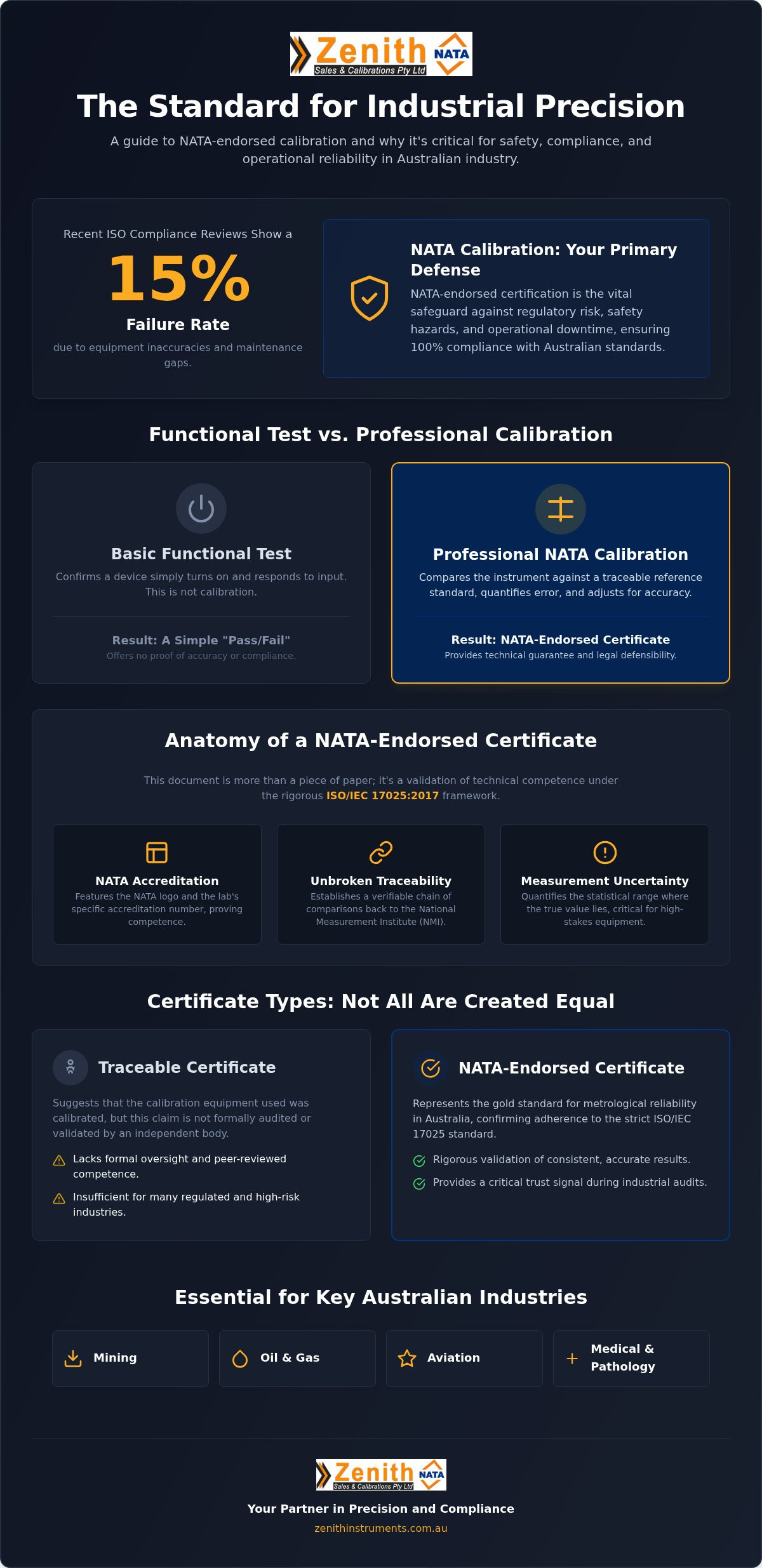
A 15% failure rate in recent ISO compliance reviews highlights a critical gap between basic equipment maintenance and true industrial precision. We understand that for your Australian operation, securing a NATA calibration certificate is more than a box-ticking exercise; it's a vital safeguard for your safety protocols and production schedules. You shouldn't have to worry about whether your gas monitors or pressure gauges are drifting into dangerous territory while you're focused on meeting output targets.
This guide demonstrates how NATA-endorsed certification serves as your primary defense against regulatory risk and operational downtime. We'll examine the technical framework of ISO/IEC 17025:2017 and explain why the competence of your calibration technician is just as vital as the documentation they provide. By prioritizing these rigorous standards, we help you achieve 100% compliance with Australian regulations while ensuring your equipment remains reliable in the field. You'll gain a clear understanding of how expert maintenance protects your bottom line and keeps your facility running without the fear of unexpected safety hazards or measurement inaccuracies.
Key Takeaways
- Understand why a professional calibration technician is essential for maintaining safety standards and equipment longevity through expert repair and maintenance.
- Learn how a NATA calibration certificate ensures 100% compliance with ISO/IEC 17025:2017 standards, protecting your business from audit failure.
- Compare the benefits of on-site service call-outs against laboratory calibration to minimize downtime in high-pressure industrial environments.
- Discover the specific metrological requirements for regulated sectors like mining, oil and gas, and the medical industry.
- Identify how localized mobile laboratory services in Sydney, Melbourne, and Brisbane provide technical excellence without logistical delays.
Who Are Calibration Technicians and Why Are They Essential?
A calibration technician is a specialist in metrology, the science of measurement. They don't just check equipment. They ensure every reading on a pressure gauge or multimeter aligns with established physical constants. Their role is essential because measurement drift is an inevitable physical reality. Over time, mechanical wear, electrical stress, and environmental exposure cause instruments to lose accuracy. Without the intervention of a skilled technician, this drift leads to compromised product quality, safety hazards, and regulatory non-compliance.
These experts establish a chain of traceability to national and international standards. In Australia, the National Association of Testing Authorities (NATA) serves as the authority that accredits laboratories to perform these critical tasks. When a technician operates within a NATA-accredited framework, they provide more than just a service. They issue a NATA calibration certificate that acts as a technical guarantee of measurement integrity and legal defensibility.
The Difference Between Testing and Professional Calibration
It's a common mistake to assume a functional test is the same as calibration. Testing simply confirms that a device turns on and responds to inputs. Professional calibration involves comparing the device against a known reference standard with a higher degree of accuracy. This process quantifies the error and adjusts the instrument to bring it back within specification. For broader context on local requirements, see our guide on Instrument Calibrations in Australia. Reference standards are the backbone of this workflow. They ensure every measurement is anchored to a verifiable source.
Key Traits of a High-Performance Calibration Specialist
Meticulous attention to detail is the hallmark of a high-performance specialist. Diagnosing subtle instrumentation errors requires a disciplined approach to the scientific method. Technicians must account for environmental variables such as temperature and humidity. These factors can significantly alter measurement results in sensitive electrical or thermal categories. A technician's value also lies in their knowledge of evolving Australian regulatory frameworks. They manage risk. By staying updated on ISO/IEC 17025:2017 requirements, they ensure your business remains audit-ready and operationally safe.
Understanding the NATA Calibration Certificate and ISO 17025
A NATA calibration certificate represents the gold standard for metrological reliability in Australia. It confirms that a laboratory operates under the ISO/IEC 17025:2017 framework, which was reaffirmed in 2023 to prioritize risk-based thinking and technical competence. This accreditation is not merely a badge. It is a rigorous validation of a laboratory's ability to produce consistent, accurate results. The presence of the NATA logo on your documentation serves as a critical trust signal during industrial audits, providing immediate proof that your facility adheres to strict NATA accreditation requirements.
Technicians don't simply provide a pass or fail result. They calculate the uncertainty of measurement for every instrument. This statistical value defines the range within which the true value lies, accounting for variables such as equipment resolution, technician technique, and environmental conditions. Understanding this uncertainty is vital for businesses managing high-stakes equipment where even a minor deviation can lead to safety hazards or production failure.
Documentation and the Traceability Chain
A valid certificate must include the laboratory's accreditation number, the date of service, and detailed as-found and as-left data. This documentation establishes the traceability chain. Traceability is the unbroken path of comparisons to a primary standard held by the National Measurement Institute (NMI). When we calibrate your equipment, we ensure this link remains intact. Without a verifiable chain back to the NMI, your measurements lack the legal and technical standing required for Australian regulatory compliance.
NATA-Endorsed vs. Traceable Certificates
There is a significant difference between a NATA-endorsed certificate and a standard traceable certificate. While traceable calibration suggests the use of calibrated equipment, it lacks the formal oversight and peer-reviewed competence of a NATA-accredited process. For regulated industries such as aviation, medical pathology, or government construction, a full NATA calibration certificate is often a legal necessity rather than an optional extra. The rigour involved in NATA-endorsed servicing provides a higher level of assurance and is more widely accepted in international trade and complex legal disputes. Our electrical equipment calibration services provide the necessary certification levels to ensure your business remains 100% compliant with Australian standards.
Laboratory vs. On-Site Calibration: Choosing the Right Service Model
Choosing the right service model is a strategic decision that impacts both your compliance status and your bottom line. We provide two primary pathways: laboratory-based precision and on-site technical flexibility. Both methods are designed to produce a NATA calibration certificate, ensuring your business meets the rigorous ISO/IEC 17025:2017 standards. While the laboratory offers the ultimate controlled environment, mobile laboratories bring master standards directly to your facility, solving the logistical challenge of removing critical equipment from active production lines.
The National Association of Testing Authorities (NATA) oversees the accreditation of these facilities, ensuring that whether you choose on-site or lab-based service, the technical competence of the provider is verified. We help you navigate this choice by assessing the accuracy requirements of your specific tools against the logistical constraints of your site. Ultimately, the goal is 100% compliance with Australian standards without sacrificing operational efficiency.
The Advantages of On-Site Technical Services
On-site technical services focus on maximizing uptime. By deploying technicians to your location, we eliminate the risk of transit damage and the significant downtime associated with shipping sensitive gear. We provide these services across major hubs, including Sydney and Melbourne, as well as Newcastle, Canberra, and Brisbane. For regional or remote industrial sites, we utilize a mobilization fee model to ensure expert support is accessible. This proactive approach allows for immediate repair and maintenance alongside testing, keeping your operations running smoothly.
When to Opt for In-House Laboratory Calibration
Laboratory calibration is non-negotiable for high-accuracy instruments that demand extreme environmental stability. In our facilities, we control temperature and humidity to a degree that is impossible to replicate in a field environment. This stability is crucial for reducing the uncertainty of measurement to the lowest possible levels. Certain primary reference standards are immobile or highly sensitive to vibration, requiring the instrument to come to the lab. For these specialized requirements, our lab equipment calibration services offer the necessary metrological rigour. We ensure that even the most sensitive instruments receive a NATA calibration certificate that stands up to the most demanding industrial audits.
Key Industries Relying on Professional Calibration Expertise
Patient safety is the absolute priority in the medical and biomedical sectors. Australian clinics and hospitals must adhere to strict legal requirements for equipment maintenance to avoid audit failures and malpractice risks. Our biomedical equipment calibration services provide the technical precision required for digital thermometers, blood pressure monitors, and infusion pumps. Meticulous calibration ensures that diagnostic data remains reliable, allowing healthcare professionals to make informed decisions without doubting their tools. We understand that in a clinical environment, a single inaccurate reading can compromise patient outcomes.
Mining and Heavy Industrial Applications
The mining and oil and gas sectors operate in some of Australia's most hazardous environments. Technicians play a vital role here by maintaining gas detectors that prevent underground explosions or toxic exposure. These devices must be calibrated to detect hazardous gases at precise thresholds to ensure worker safety. Additionally, heavy machinery maintenance relies on exact torque application to prevent structural failures. You can review current workshop standards in our Torque Wrench Calibration Guide. Our mobile laboratories frequently deploy to sites near Newcastle and Brisbane to provide these services on-site, minimizing the downtime of multi-million dollar equipment.
Precision is equally vital in food manufacturing and cold chain logistics, where temperature drift can ruin entire product batches. We ensure your sensors are accurate to within fractions of a degree, maintaining the integrity of the supply chain. Additionally, pressure gauge calibration is a fundamental safety requirement in any industrial plant using steam, hydraulic, or pneumatic systems. An inaccurate gauge is a silent hazard. By securing a NATA calibration certificate for your pressure systems, you protect your staff and your facility from high-pressure ruptures. If your operation requires the highest level of measurement reliability, book a NATA-certified calibration service with our specialist team today.
Why Zenith’s Calibration Technicians are the Standard for Australian Industry
We position ourselves as the definitive partner for Australian industry by prioritizing reliability and technical exactness above all else. Every Zenith technician embodies the Dependable Expert personality, combining meticulous discipline with deep metrological knowledge. Our unwavering commitment to ISO/IEC 17025:2017 ensures that every NATA calibration certificate we issue serves as a primary trust signal for your business. We don't just provide a document; we provide the absolute certainty that your equipment operates at peak precision within the required regulatory framework.
Our expertise spans critical categories including electrical, pressure, and thermal instrumentation. With dedicated, high-performance facilities in Sydney and Melbourne, we provide comprehensive national coverage backed by localized technical support. This infrastructure allows us to maintain the highest standards of metrological rigour, ensuring your business avoids the 15% failure rate often seen in modern compliance reviews.
A Proactive Approach to Equipment Maintenance
Zenith Sales & Calibrations Pty Ltd technicians adopt a proactive service model, emphasizing comprehensive on-site capabilities. We go beyond simple testing to offer comprehensive diagnosis and repair. If an instrument fails to meet its specifications, we don't just record the error; we identify the cause and provide a solution. We utilize high-quality components and support from global leaders like PT Global and Major Tech to ensure your equipment remains durable and accurate. Our rapid response times are specifically tailored to meet the high-pressure needs of specialized industrial and scientific sectors where every hour of downtime is a significant cost.
National Reach with a Localized Service Touch
While our primary laboratories are situated in major hubs, our reach extends deeply into Newcastle, Canberra, and Brisbane. This geographic signature reinforces our identity as a leading national player that understands the specific logistical needs of regional industries. Managing multiple vendors for different instrument types is inefficient and increases regulatory risk. We offer a single-partner solution for all your instrumentation needs, from pressure gauges to complex electrical testers. By consolidating your servicing with us, you ensure a consistent standard of excellence and a unified traceability chain. We invite you to contact our team today for a technical consultation or to schedule an on-site visit to secure your next NATA calibration certificate.
Securing Your Industrial Compliance for 2026
Precision measurement is the backbone of industrial safety and regulatory adherence. By choosing a partner that prioritizes the ISO/IEC 17025:2017 framework, you eliminate the risks of measurement drift and audit failure. We provide the technical expertise required to maintain your complex instrumentation while ensuring every NATA calibration certificate we issue meets the highest Australian standards. Whether you require the extreme control of our laboratory or the convenience of our mobile service units, our focus remains on minimizing your downtime.
As a NATA Accredited Laboratory that is also ISO 9001:2015 Certified, we offer the meticulous oversight your operation demands. We understand the logistical pressures of the modern industrial landscape. Our Mobile Calibration Services are available to ensure your equipment stays in the field where it's needed most. Don't leave your compliance to chance or unverified providers. It's time to anchor your operations in accuracy and technical excellence.
Contact our expert calibration technicians today for a quote or on-site service. We look forward to protecting your facility's reliability and safety through our professional partnership.
Frequently Asked Questions
What qualifications do calibration technicians need in Australia?
Technicians typically require a combination of formal technical education, such as a Diploma in Laboratory Technology or Instrumentation, and specialized metrology training. Experience working within an ISO/IEC 17025 accredited environment is essential for understanding NATA requirements. They must demonstrate competence in specific measurement categories and undergo regular proficiency testing. This ensures they can manage complex instrumentation while maintaining the technical standing required by Australian regulatory bodies and industrial safety standards.
How often should a business hire a calibration technician for their equipment?
Most industrial equipment requires annual calibration, but the interval depends on your specific usage, manufacturer recommendations, and regulatory risk. High-stakes environments like medical pathology or underground mining often demand more frequent checks, such as every six months. We recommend a risk-based approach where you monitor for measurement drift and adjust your schedule based on the historical stability of each instrument. This strategy helps maintain 100% compliance with Australian standards and minimizes downtime.
What is the difference between a NATA-endorsed and a traceable certificate?
A NATA calibration certificate is issued by a laboratory that has been formally peer-reviewed for technical competence under the ISO/IEC 17025 standard. Traceable certificates only indicate that the reference tools used were calibrated; they don't guarantee the laboratory's overall procedural rigour. For regulated Australian industries, NATA endorsement is often a mandatory requirement. It ensures the highest level of measurement reliability and audit acceptance, providing a legally defensible record of your equipment's accuracy.
Can calibration technicians repair my equipment if it fails testing?
Yes, our technicians are experts who handle both repair and maintenance in addition to standard testing. If an instrument fails to meet the required accuracy thresholds, we diagnose the fault and perform necessary adjustments or component replacements. This proactive model ensures that your equipment is returned in full working order, accompanied by valid certification. It eliminates the need for a separate repair vendor, significantly reducing your logistical burden and total equipment downtime.
Is on-site calibration as accurate as laboratory-based calibration?
On-site calibration is highly accurate for most industrial tools, provided the environment is stable enough to meet the technician's reference standards. While our mobile laboratories bring master standards to your facility, certain high-precision instruments require the extreme temperature and humidity controls only found in a fixed lab. We assess your equipment's sensitivity to determine if on-site service or laboratory-based precision is the most appropriate model. This ensures your certification remains technically valid and compliant.
What industries require the most frequent calibration services?
Industries such as aviation, medical pathology, and government construction require the most frequent services due to strict legal mandates. Mining and oil and gas sectors also demand regular calibration for safety-critical devices like gas monitors and pressure gauges. These sectors face high operational risks, so maintaining a rigorous schedule ensures 100% compliance with Australian standards. It protects workers from hazards caused by inaccurate readings and helps businesses avoid the 15% failure rate seen in compliance reviews.
What should I look for when choosing a calibration provider in Sydney or Melbourne?
You should prioritize providers with formal NATA accreditation and a proven track record in your specific industry sector. Look for a partner that offers both laboratory and mobile service capabilities across major hubs like Sydney, Melbourne, and Brisbane. A dependable expert will provide comprehensive documentation, including calculated uncertainty of measurement. They should also offer repair services to minimize your logistical burden, ensuring your business stays audit-ready with a valid NATA calibration certificate at all times.
How long does a typical calibration service take?
A typical service for a single instrument usually takes between one and three hours, depending on the complexity of the device and the number of test points required. On-site call-outs allow for multiple instruments to be serviced in a single day, significantly reducing operational downtime. Laboratory-based services may require a few business days for transit and stabilized testing. This ensures the highest level of precision for sensitive instrumentation while maintaining a steady and reassuring workflow for your team.