

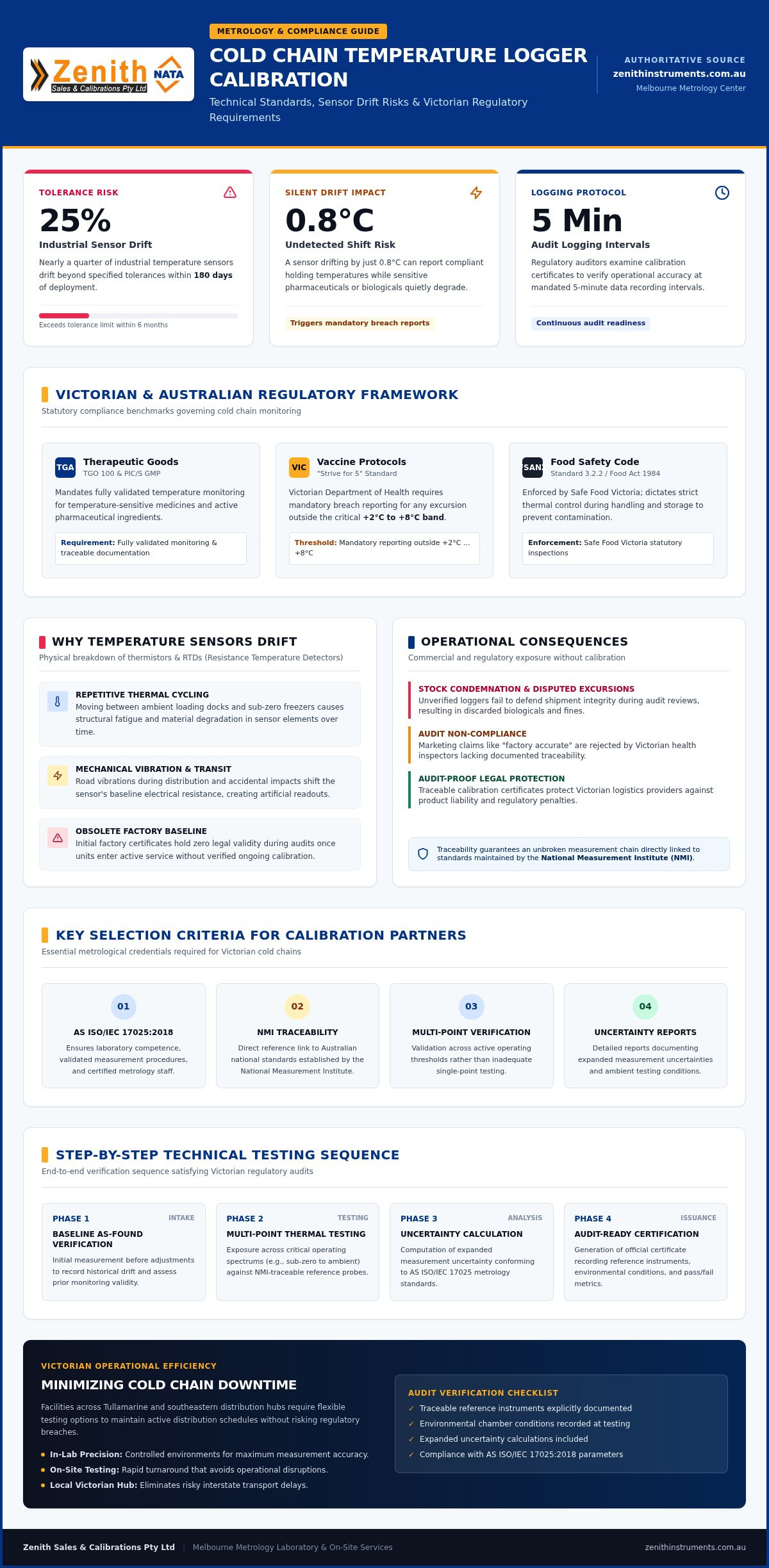
Nearly 25% of industrial temperature sensors drift beyond their specified tolerances within 180 days of deployment. In tightly regulated supply chains, an undetected shift of a single degree can compromise critical pharmaceutical stock, trigger mandatory breach reports to the Victorian Department of Health, or cause audit failures under TGA and FSANZ standards. Securing dependable cold chain temperature logger calibration melbourne services is essential to verify that your environmental monitoring instruments perform to exact operational specifications.
We understand that extended instrument downtime disrupts active distribution schedules, while vague certification leaves you vulnerable during rigorous compliance reviews. You shouldn't have to balance operational efficiency against technical precision. This 2026 guide shows you how to select compliant, NATA-traceable calibration services across Melbourne logistics and healthcare, ensuring audit-proof records across critical storage thresholds with minimal turnaround time. We examine essential accreditation criteria, multi-point validation requirements, and the technical documentation needed to satisfy Victorian regulatory authorities.
Key Takeaways
- Understand the critical role of multi-point verification across active cold storage thresholds to prevent sensor drift and audit non-compliance.
- Discover the key criteria for selecting ISO/IEC 17025-aligned providers for cold chain temperature logger calibration melbourne operations.
- Evaluate the practical differences between in-lab precision and on-site testing to minimize operational downtime across Victorian distribution networks.
- Review the complete testing sequence, from baseline as-found verification to detailed uncertainty reports required by Victorian regulators.
- Learn how partnering with established local technical facilities secures traceable compliance records while eliminating interstate transport delays.
Why Cold Chain Temperature Logger Calibration Matters in Victoria
Maintaining temperature integrity across Victoria requires rigorous equipment validation. In technical terms, cold chain calibration verifies that a sensor's readings match traceable reference standards within documented tolerances. Without verified measurement traceability, an unbroken chain of comparisons linked directly to national standards maintained by the National Measurement Institute, data records lack legal and technical validity. Facilities operating across Tullamarine and southeastern distribution hubs process critical biologicals and food inventory within a complex cold chain network where factory baseline certificates quickly become obsolete.
Relying on initial factory calibrations exposes facilities to compliance failures during state audits. Engaging a dedicated calibration service melbourne laboratory ensures your data loggers satisfy strict Victorian regulatory thresholds rather than unverified manufacturing assumptions.
Regulatory Compliance Under TGA and FSANZ Standards
Therapeutic Goods Administration rules, specifically Therapeutic Goods Order 100 and PIC/S Good Manufacturing Practice guides, require fully validated temperature monitoring for temperature-sensitive medicines. Simultaneously, Standard 3.2.2 of the Food Standards Code mandates strict thermal control during handling and storage, supported locally by the Food Act 1984 and the consolidated enforcement of Safe Food Victoria.
- Vaccine compliance: Victorian Department of Health protocols mandate reporting any storage breach outside the +2°C to +8°C band under the National Vaccine Storage Guidelines "Strive for 5".
- Audit readiness: Inspectors review instrument calibration certificates to verify operational accuracy at required 5-minute data logging intervals.
- Financial protection: Traceable certification safeguards logistics facilities against disputed excursions, stock condemnations, and operational fines.
The Mechanics and Hidden Risks of Sensor Drift
Electronic loggers rely on internal thermistors or resistance temperature detectors (RTDs). These internal components undergo structural wear. Repetitive thermal cycling between ambient loading docks and sub-zero freezers degrades sensor materials over time. In addition, mechanical vibration from road transit or accidental impacts shifts the sensor's baseline electrical resistance.
A sensor drifting by just 0.8°C might report compliant holding temperatures while sensitive stock degrades. Routine cold chain temperature logger calibration melbourne routines detect these invisible measurement offsets, preventing false compliance records before audits or product recalls occur.
Key Selection Criteria: Choosing a Melbourne Calibration Provider
Selecting the right technical partner requires evaluating laboratory competence against rigorous international benchmarks. A credible provider must operate testing processes compliant with AS ISO/IEC 17025:2018. This technical standard proves that the facility maintains documented quality management, validated measurement procedures, and competent metrology staff. When vetting partners for cold chain temperature logger calibration melbourne facilities, demand clear evidence that reference standards trace directly to the National Measurement Institute.
Traceability and Standards Compliance
Marketing terms like "factory calibrated" or "certified accurate" hold little weight during a formal quality audit. Legal and regulatory compliance depends on unbroken traceability to Australian national standards. For deep technical requirements, consult our professional instrument calibration guide. Audit-ready certificates must explicitly state the reference instruments used, the specific environmental conditions during testing, and the expanded measurement uncertainty calculations.
Multi-Point Calibration Across Critical Operating Ranges
Single-point testing cannot establish sensor linearity across varied operational cycles. In practice, a logger verified only at ambient temperatures might exhibit substantial non-linear deviations at critical thresholds:
- Refrigerated logistics: Verification must target the mandatory +2°C to +8°C band, aligned with the National Vaccine Storage Guidelines.
- Frozen distribution: Commercial frozen foods and standard biological inventories require calibration down to -18°C or -20°C.
- Ultra-low applications: Specialized pharmaceutical and clinical assets demand deep-freeze verification chambers testing between -70°C and -80°C.
Turnaround Times and Operational Downtime Management
Operational velocity matters as much as technical precision. Freight delays to interstate laboratories remove crucial monitoring devices from active distribution fleets, forcing companies to carry costly excess buffer inventory. Working with a local Victorian laboratory reduces transit intervals and eliminates freight-induced mechanical stress on delicate sensors. When you need dependable compliance with minimal turnaround, partner with Zenith Instruments to access dedicated testing capabilities and structured recalibration schedules.
On-Site vs. In-Lab Calibration for Melbourne Logistics Facilities
Operations managers face an ongoing trade-off between absolute metrological precision and facility operational continuity. When coordinating cold chain temperature logger calibration melbourne operations, selecting between field testing and permanent laboratory testing depends heavily on equipment mobility, required measurement uncertainty, and workflow demands. Both pathways deliver compliant verification, yet their technical implementations serve different operational profiles across Victoria's freight corridors.
In-Lab Testing: Ultimate Precision and Environmental Control
Controlled testing environments provide the highest level of measurement confidence. Dedicated laboratories utilize high-stability liquid baths and precision environmental chambers that eliminate ambient thermal fluctuations. These systems achieve lower expanded measurement uncertainty values, which is vital when verifying primary reference loggers or validating temperature sensors for strict clinical trials. Highly sensitive equipment, including reference digital thermometers and master audit loggers, requires these tight laboratory tolerances to establish baseline compliance.
On-Site Field Testing: Minimizing Logistics and Supply Friction
Logistics distribution hubs in Truganina, Dandenong South, and Altona often manage thousands of active monitoring devices. Dispatching these units off-site creates significant operational friction and leaves active shipments unmonitored. Mobile technicians eliminate this bottleneck by bringing portable dry-block calibrators and thermal references directly to your loading facility.
- Zero transit disruption: Loggers remain on-site, returning to cold store monitoring duty immediately after verification.
- Integrated system checks: Technicians inspect sensors alongside their integrated control panels, alarm relays, and local display hardware.
- Regulatory compliance: Testing validates equipment against official Victorian cold chain requirements without interrupting ongoing stock handling.
For operations balancing mixed instrumentation, a hybrid model works best. Stationary warehouse probes and routine freight loggers undergo swift on-site validation, while primary master units head to a dedicated local facility for comprehensive multi-point laboratory calibration. Beyond monitoring equipment, ensuring proper facility heating and cooling performance is just as crucial for overall thermal control, where commercial HVAC contractors such as Zee Jay Mechanical help maintain stable building environments.
Step-by-Step Calibration and Verification Process Explained
Precision calibration follows a structured, repeatable sequence to ensure measurement defensibility. When submitting instruments for cold chain temperature logger calibration melbourne facilities, each stage of testing must capture observable data under strictly controlled thermal conditions. Knowing what occurs inside the testing facility allows quality managers to audit their suppliers effectively and verify that testing procedures follow proper metrological standards.
Inspection, Stabilization, and Multi-Point Testing
Every evaluation begins with physical intake diagnostics. Technicians inspect the housing seal, verify battery voltage levels, check memory buffers, and examine external probe cabling for micro-fractures that compromise electrical resistance. Once cleared, the logging unit enters comparative calibration chambers alongside reference probes traceable to the National Measurement Institute.
- As-Found recording: Testing captures baseline sensor deviation immediately upon arrival, proving whether past historical monitoring fell within compliant limits.
- Thermal equilibrium: Loggers soak inside fluid baths or dry blocks until internal temperature stabilizes, eliminating gradient errors across the casing.
- Multi-point testing: Technicians record readings across distinct setpoints, capturing exact deviations across both low-temperature and ambient ranges.
- As-Left verification: After required electronic offsets or adjustments are completed, a final test cycle confirms accurate performance across all thresholds.
Understanding the Calibration Certificate and Uncertainty Data
A compliant calibration report delivers complete transparency regarding measurement tolerances. Quality managers must evaluate expanded measurement uncertainty to confirm the instrument's tolerance budget meets their internal operational guidelines. If your testing reveals that uncertainty exceeds acceptable margins, the instrument cannot guarantee regulatory compliance, even if the nominal readout appears stable.
Every certificate documents specific serial numbers, environmental ambient values, reference master details, and paired as-found and as-left tables. These paired figures demonstrate your quality control continuity during regulatory inspections. For broader facility coverage including handheld probes, reference probes, and loggers, book our thermometer calibration service to secure comprehensive documentation that stands up to Victorian regulatory scrutiny.
Partnering with Zenith Instruments for Melbourne Cold Chain Compliance
Established as an Australian instrumentation leader in 2004, Zenith Sales & Calibrations Pty Ltd delivers specialized calibration engineering designed around strict regulatory requirements. Meeting state-mandated traceability requires more than simple pass-or-fail testing; it requires deep metrological expertise backed by traceable reference standards. Operating dedicated calibration facilities in Melbourne and Sydney, we eliminate the operational risks and delays associated with sending delicate monitoring instruments to interstate or offshore laboratories.
Our localized Victorian infrastructure ensures your operational fleet remains fully compliant without disrupting active delivery schedules. By maintaining testing processes compliant with AS ISO/IEC 17025:2018, we deliver calibration certificates that provide full legal and technical defensibility during audits conducted by the TGA, Safe Food Victoria, or international quality registrars.
Comprehensive Temperature and Lab Instrumentation Support
Cold chain integrity extends beyond the freight vehicle. Distribution centers, pharmaceutical packaging hubs, and cold storage warehouses depend on an interconnected network of monitoring hardware. Our technicians provide end-to-end testing across data loggers, platinum resistance thermometers, and specialized environmental recording systems. For complete medical and testing environments, our specialized lab equipment calibration services ensure that incubators, autoclaves, and stability chambers maintain equal measurement confidence across your entire cold chain workflow.
Access Local Expertise in Greater Melbourne
Location directly impacts operational efficiency. Transporting sensitive electronic logging equipment across interstate freight networks introduces transit vibration, risk of physical loss, and days of unnecessary downtime. Working with our Melbourne technical team delivers key operational advantages:
- Minimal turnaround intervals: Direct access to local technicians keeps your monitoring hardware in service and reduces the need for expensive backup units.
- Victorian regulatory insight: Our team understands local audit challenges under Victorian Department of Health guidelines and Safe Food Victoria frameworks.
- Multi-instrument servicing: Combine data logger testing with thermometer, pressure gauge, and electrical test equipment verifications in a single streamlined program.
Securing audit-proof compliance for your temperature monitoring assets starts with reliable local support. Connect with our technical team through our dedicated calibration service melbourne division to schedule in-lab multi-point testing or coordinate on-site technician visits for your logistics facilities.
Secure Audit-Ready Temperature Integrity for Your Supply Chain
Accurate thermal verification across actual operational thresholds is the only way to safeguard biologicals, pharmaceuticals, and perishable stock against costly compliance breaches. Paired as-found and as-left documentation, supported by verifiable measurement uncertainty data, eliminates regulatory exposure under strict Victorian health and food safety standards. Choosing a dependable local partner ensures your monitoring hardware stays accurate without disrupting active distribution schedules.
Operating continuously since 2004, Zenith Instruments delivers the metrological precision required for rigorous cold chain temperature logger calibration melbourne operations. Our dedicated Melbourne facility utilizes NATA-certified reference standards and ISO-compliant calibration processes to deliver complete traceability while minimizing instrument turnaround times. You don't need to risk interstate freight delays or unverified sensor drift when proven metrological expertise is available locally.
Book your temperature logger calibration with Zenith Instruments Melbourne today to safeguard your critical cargo and maintain complete compliance across every distribution route.
Frequently Asked Questions
How often should cold chain temperature loggers be calibrated in Melbourne?
Most cold chain operations require calibration every 12 months, though high-risk pharmaceutical and biological sectors often mandate 6-month cycles. National Vaccine Storage Guidelines "Strive for 5" and FSANZ standards recommend regular annual verification. If a logger experiences severe physical impact, rapid thermal shock, or a suspected excursion breach, immediate recalibration is necessary to confirm accuracy before returning it to active service.
Is NATA traceable calibration mandatory for TGA cold chain audits?
Yes, TGA auditors require measurement traceability directly linked to Australian national standards or equivalent international baselines. While testing laboratories operate under ISO/IEC 17025 quality frameworks, the reference equipment used during cold chain temperature logger calibration melbourne procedures must have unbroken traceability to the National Measurement Institute. Certificates lacking documented reference standards or expanded uncertainty figures face immediate rejection during formal audits.
What is the standard turnaround time for data logger calibration in Melbourne?
Routine in-lab calibration typically takes between three to five business days at a dedicated local facility. Choosing a local laboratory avoids interstate transit delays that can stretch turnaround times into weeks. Local servicing keeps replacement buffer stock minimal. Facilities with urgent dispatch schedules can also arrange expedited processing or scheduled routine servicing to ensure active cold chain fleets remain compliant.
Can temperature loggers be calibrated on-site at our cold storage warehouse?
Yes, field technicians can calibrate fixed sensors and mobile loggers directly at your warehouse using portable dry-block calibrators. On-site service eliminates shipping risks and keeps monitoring devices within your active operational facility. Technicians verify sensors in their operating environment while inspecting alarms and display interfaces. However, high-precision primary reference instruments requiring ultra-low uncertainty figures may still need testing within a controlled fluid bath laboratory environment.
What temperature points are tested during cold chain logger calibration?
Testing points correspond directly to your active cold chain operating range. For standard pharmaceutical logistics, multi-point verification tests across +2°C, +5°C, and +8°C. Frozen storage profiles require setpoints at -18°C or -20°C, while ambient distribution loggers undergo verification between +15°C and +25°C. Selecting points that match your specific handling thresholds ensures the calibration curve reflects genuine operating conditions rather than arbitrary factory baselines.
What happens if a temperature logger fails its calibration tolerance test?
If an instrument drifts outside acceptable operational tolerance limits, the technician records the deviation in the "as-found" data table before attempting adjustment. When internal adjustment is supported, the unit is corrected and retested to establish compliant "as-left" readings. If the sensor has degraded permanently or suffered mechanical damage, the unit fails verification, prompting quarantine and replacement to prevent invalid data recording in active freight runs.
How does ambient temperature in Victoria affect data logger measurement accuracy?
Victoria's sharp seasonal temperature swings and rapid weather changes create steep thermal gradients across logger casings during loading dock transfers. Moving instruments between high summer ambient heat and chilled transport vehicles causes thermal shock and internal condensation. Over time, this stress accelerates electronic resistance drift. Regular cold chain temperature logger calibration melbourne routines verify that sensor accuracy remains stable despite the volatile ambient conditions encountered across Victorian supply routes.