

What if the digital display on your industrial oven is the only thing currently meeting your safety standards? For many operators, the assumption that a set point equals actual internal temperature is a risk that leads directly to inconsistent product quality or, worse, a failed health audit. We understand the pressure of maintaining rigorous thermal uniformity while navigating the Australia New Zealand Food Standards Code and the National Measurement Guidelines 2016. It's a complex landscape where even a minor deviation can compromise an entire production batch.
Securing professional commercial oven temperature validation Newcastle ensures your facility eliminates dangerous "cold spots" that foster foodborne illness and mechanical inefficiency. This 2026 compliance guide provides the technical roadmap you need to align your operations with AS 2853 and ISO/IEC 17025 benchmarks. We'll detail the essential verification protocols that protect your business from liability, reduce waste, and provide the documented precision required by modern regulatory frameworks. From understanding the critical 5°C to 60°C danger zone to implementing rigorous testing, you'll learn how to maintain a high-performance kitchen or industrial facility that stands up to any inspection.
Key Takeaways
- Distinguish between a standard thermostat reading and a full thermal validation to ensure complete heat uniformity throughout your equipment.
- Learn why multi-point temperature mapping with NATA-traceable equipment is the only reliable method for detecting internal thermal variances.
- Align your facility with HACCP and NSW Food Authority requirements by scheduling a professional commercial oven temperature validation Newcastle.
- Identify operational red flags, such as uneven curing or frequent display alarms, that signal the need for immediate technical verification.
- Discover how mobile laboratory services minimize downtime by delivering precision validation and certification directly to your Newcastle site.
Understanding Commercial Oven Temperature Validation in Newcastle
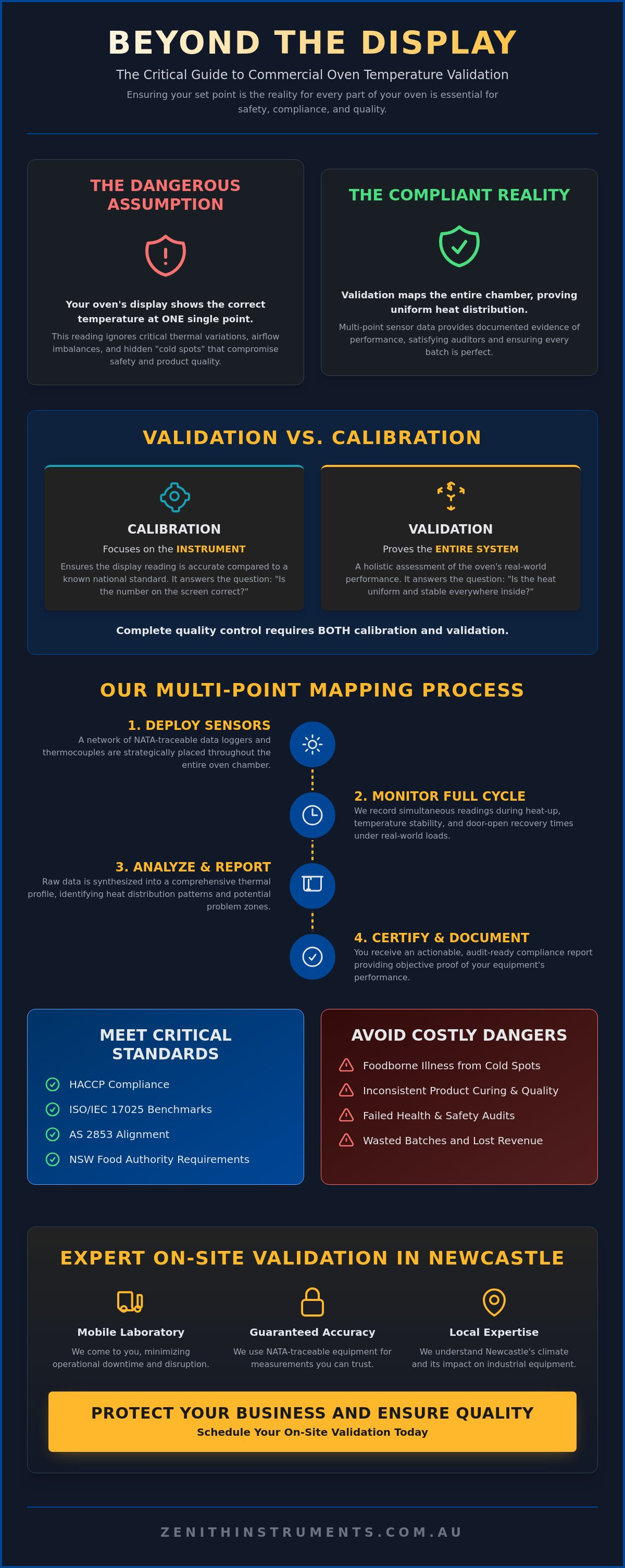
Temperature validation is the formal process of verifying that an oven maintains uniform heat across all internal zones. It's a rigorous scientific procedure, not a simple maintenance task. Many operators in the Hunter region mistake a basic thermostat check for a complete performance verification. While a thermostat measures temperature at a single fixed point, it fails to account for thermal stratification or airflow imbalances. Professional commercial oven temperature validation Newcastle identifies these discrepancies by mapping the entire internal chamber. We use multi-point sensors to ensure every cubic centimeter of the cooking or curing space meets your specific requirements.
For Newcastle's hospitality and industrial sectors, documented evidence of thermal performance is a non-negotiable requirement. Businesses must prove their equipment can consistently reach and hold specific temperatures to meet HACCP Compliance Standards. Precision instrumentation is the only way to reveal 'cold spots' that internal sensors miss. These hidden zones of low temperature are often the primary cause of bacterial growth in food or structural weaknesses in manufactured components. We provide the technical data necessary to eliminate these risks and satisfy regulatory auditors during safety inspections.
Validation vs. Calibration: Which Do You Need?
Understanding the distinction between these two services is vital for equipment reliability. Calibration focuses on the accuracy of the instrument's display or controller, ensuring the number on the screen matches a known standard. Validation, however, proves the entire system performs as intended under a specific load. It's a holistic assessment of the oven's capability. We offer both a thermometer calibration service and comprehensive validation to ensure your hardware and your process are both functioning at peak efficiency. Relying on one without the other leaves a significant gap in your quality control protocol.
The Impact of Newcastle's Climate on Industrial Equipment
Newcastle's coastal environment presents unique challenges for high-precision thermal equipment. High ambient humidity and significant seasonal temperature fluctuations can alter how industrial ovens maintain internal pressure and heat distribution. In the Hunter region, manufacturing processes often require tighter tolerances that are easily disrupted by these external environmental factors. We've observed local cases where coastal moisture led to sensor drift and uneven heating, resulting in significant batch loss. Proactive validation helps you adjust for these regional variables and maintain consistent quality year-round, regardless of the weather conditions outside your facility.
The Technical Process: Multi-Point Temperature Mapping
Relying on a single internal sensor is a common operational oversight that compromises both safety and product consistency. Our methodology for commercial oven temperature validation Newcastle utilizes multi-point mapping to provide a comprehensive thermal profile of your equipment. We deploy a network of NATA-traceable data loggers and thermocouples throughout the oven chamber to record simultaneous readings. This rigorous approach follows the technical requirements established by the National Measurement Institute, ensuring that every measurement is linked to a recognized national standard of accuracy.
We monitor the entire operational lifecycle of the unit rather than just a snapshot in time. Our technicians track heat-up times to reach the designated set point, recovery times after the door is opened, and the stability of cool-down cycles. If an oven takes too long to recover its temperature during high-volume periods, it risks falling into the bacterial danger zone. We synthesize these raw temperature readings into an actionable compliance report. This document identifies exactly how your equipment behaves under real-world loads, providing the objective proof required for safety audits.
Equipment Used in Professional Validation
Precision requires specialized industrial hardware. We utilize high-accuracy thermocouples designed to withstand the extreme temperatures found in industrial curing or high-volume commercial baking. Wireless data logging systems are essential as they allow us to capture internal data without compromising the oven's door seals, which would otherwise skew the results. A NATA-certified standard for thermal measurement ensures that the instrumentation used has been verified against rigorous international benchmarks for accuracy and reliability.
Identifying Thermal Non-Uniformity
We focus our mapping efforts on "worst-case" zones where heat loss is most likely to occur. These typically include the corners of the chamber, areas immediately adjacent to door seals, and the geometric center of the load. Airflow patterns and the specific placement of racks significantly influence heat distribution within the unit. If we identify significant variances, we recommend specific corrective actions to restore performance. These may include:
- Adjusting internal circulation fans to improve heat transfer.
- Replacing worn or brittle door seals that allow heat to escape.
- Recalibrating heating elements to ensure they engage at the correct intervals.
If you suspect your equipment is underperforming or producing inconsistent results, our expert thermometer calibration service and thermal mapping can identify the root cause. We prioritize technical precision to help you maintain a reliable and compliant operation at zenithinstruments.com.au.
Compliance Standards: HACCP, ISO, and Australian Regulations
Regulatory adherence is the foundation of operational safety for any facility in the Hunter region. For local businesses, meeting the requirements of the NSW Food Authority is not just a matter of best practice; it's a legal obligation under the Australia New Zealand Food Standards Code. Specifically, Standards 3.2.2 and 3.2.2A mandate that potentially hazardous food must be kept outside the 5°C to 60°C danger zone. Professional commercial oven temperature validation newcastle provides the verifiable data needed to prove your equipment consistently exceeds these safety thresholds during every heating cycle.
Within a Hazard Analysis and Critical Control Points (HACCP) framework, oven temperature is frequently designated as a Critical Control Point (CCP). If your oven fails to maintain uniform heat, the entire safety plan collapses. We align our testing protocols with ISO 17025, the international benchmark for testing and calibration laboratories, to ensure your documentation stands up to the highest level of scrutiny. This certification proves that the measurement equipment used is accurate, traceable, and maintained to global quality management standards like ISO 9001:2015.
Food Safety and the Hunter Health Audit
Local health inspectors in Newcastle increasingly demand more than just a handwritten log of internal thermometer readings. They look for formal validation reports that confirm the thermal performance of convection and combi ovens. Because these units rely on complex airflow to distribute heat, they are prone to developing "cold spots" that basic sensors cannot detect. Certified validation logs protect your business from legal liability by providing objective proof that your "hot hold" and reheating processes are effective. This is especially critical given the 2026 emphasis on food safety culture as a management responsibility across the hospitality sector.
Industrial and Laboratory Compliance
The requirements for pharmaceutical and medical laboratories in the Newcastle region are even more stringent. Laboratory ovens used for sterilization or sample incubation must adhere to specific Australian Standards, such as AS 2853, which governs temperature-controlled enclosures. We provide the technical verification needed for these high-stakes environments, ensuring that every batch meets the precision required for medical safety. For manufacturers in the Hunter region, having traceable certification is often a prerequisite for international export. Our lab equipment calibration services ensure your facility remains compliant with both national and global quality benchmarks.
Signs Your Newcastle Facility Needs Immediate Validation
Equipment performance degrades over time due to thermal stress and mechanical wear. Maintaining a rigorous schedule for commercial oven temperature validation Newcastle prevents small technical drifts from becoming expensive compliance failures. The most obvious sign of a problem is visible inconsistency in your output. If batches of baked goods show uneven coloration or industrial coatings fail to cure uniformly across a single rack, your oven's thermal mapping is likely compromised. These variations indicate that heat is no longer distributing evenly, creating pockets of under-processed material that pose a significant safety risk.
Your oven’s internal control system often provides the first warning. Frequent "out of tolerance" alarms or fluctuating temperature readings on the digital display suggest that the internal sensors or heating elements are struggling to maintain stability. Physical inspections are equally vital. Brittle or cracked door seals allow heat to escape, which forces the unit to overwork and creates permanent cold spots near the entrance. If you've recently replaced a heating element, controller, or sensor, you must re-validate immediately. Technical interventions change the thermal characteristics of the machine, making previous certification data obsolete.
Operational Red Flags
Subtle shifts in operational efficiency often precede a total equipment failure. An inexplicable increase in energy consumption for the same thermal output usually indicates that the system is compensating for heat loss or inefficient airflow. We also recommend monitoring recovery times. If your oven takes longer than the manufacturer's original specifications to return to the set point after a door opening, the unit is no longer performing as intended. A critical red flag occurs when your internal display disagrees with a handheld probe. This discrepancy proves that either your controller requires a thermometer calibration service or the internal sensor is positioned in a non-representative zone.
When to Schedule Your Next Visit
Determining validation frequency depends on your specific industry and equipment usage. While annual testing is the standard for many commercial kitchens, high-volume industrial facilities or medical laboratories often require bi-annual validation to maintain their quality benchmarks. For a deeper understanding of how these requirements fit into broader national standards, consult our guide on Instrument Calibrations in Australia. Regardless of your schedule, post-maintenance validation is a mandatory requirement to ensure the unit remains compliant after any repair. We provide rapid, on-site testing to minimize your operational downtime. You can secure your next compliance check by contacting our team for a professional oven calibration service today.
Zenith Instruments: Expert On-Site Validation in Newcastle
Zenith Instruments provides a proactive service model through our advanced mobile laboratory capabilities. We bring precision instrumentation directly to your facility, which eliminates the logistical burden and risk associated with transporting heavy industrial equipment. This on-site approach is essential for accurate commercial oven temperature validation newcastle because it allows our technicians to test your equipment within its actual operating environment. We verify thermal performance under your specific site conditions, accounting for the ambient environmental factors that influence heat distribution and sensor accuracy.
Minimizing operational downtime is a core priority of our service delivery. We utilize efficient testing procedures designed to integrate seamlessly with busy commercial environments, from industrial manufacturing plants to high-volume kitchens. By deploying high-speed data loggers and multi-point thermocouples, we capture comprehensive thermal data without requiring extended equipment shutdowns. Our technicians possess the expertise to validate all major makes and models, ensuring that your specific hardware is tested against its original manufacturer specifications and relevant Australian Standards.
The final output of our validation process is a set of NATA-traceable reports that serve as a definitive trust signal for your facility. These documents provide the rigorous technical evidence required by health inspectors, safety auditors, and quality insurance providers. We don't simply provide a pass or fail certificate; we deliver a granular analysis of your oven’s thermal mapping. This data helps identify potential areas for mechanical improvement or energy optimization, ensuring your equipment operates at peak efficiency long after the validation is complete.
Why Choose a Local Newcastle Specialist?
Being a localized partner allows us to offer rapid response times that laboratory-bound competitors cannot match. Whether you require an emergency validation after a major repair or a scheduled compliance check to meet upcoming 2026 regulations, our presence in the Hunter region ensures we understand the specific logistical needs of local industries. We provide the localized touch of a regional provider backed by the technical authority of a national leader in measurement science. You can learn more about our regional reach through Zenith's Newcastle Calibration Services, where we detail our commitment to the Hunter Valley industrial and hospitality sectors.
Requesting a Validation Quote
To provide an accurate technical proposal, our team requires specific details regarding your equipment. Please have your oven type, its standard operational temperature range, and the total number of units ready for our specialists. The Zenith difference lies in technical support that extends well beyond the delivery of a certificate. We partner with you to maintain long-term equipment reliability and regulatory compliance. You can Contact Zenith Instruments for Commercial Oven Validation in Newcastle to schedule your site assessment and secure your 2026 compliance status today.
Secure Your Operational Precision for 2026
Maintaining thermal uniformity is the only way to safeguard your facility against health audits and mechanical inefficiency. We've established that multi-point mapping reveals the hidden cold spots that internal sensors often miss. By integrating NATA-traceable standards and ISO-compliant reporting into your maintenance schedule, you ensure every batch meets the rigorous safety requirements of the Newcastle and Hunter Valley regions. Our mobile laboratory brings this level of technical expertise directly to your site, allowing you to prioritize compliance without sacrificing productivity.
Reliability in commercial oven temperature validation newcastle is about more than just checking a box; it's about cementing a foundation of quality that supports your business's long-term growth. Don't leave your compliance to chance when precision is within reach. Book Your Newcastle On-Site Oven Validation Today and partner with a dependable expert committed to your success. We look forward to helping you achieve total equipment reliability and precision in every cycle.
Frequently Asked Questions
What is the difference between oven calibration and temperature validation?
Calibration focuses on verifying the accuracy of the oven’s temperature controller or thermometer against a known reference standard. Validation is a more comprehensive process that proves the entire system maintains thermal uniformity across all internal zones under load. We perform both to ensure your hardware is accurate and your entire process remains consistent and safe.
How often should a commercial oven be validated in Newcastle?
Most commercial kitchens and industrial facilities in Newcastle should schedule validation annually to maintain compliance with Australian safety standards. High-volume operations or those in the medical and pharmaceutical sectors often require bi-annual testing to mitigate the risk of sensor drift. It's also mandatory to re-validate after any major mechanical repair or heating element replacement.
Does Zenith Instruments provide on-site validation for Newcastle businesses?
We provide full on-site mobile service for commercial oven temperature validation newcastle businesses across the Hunter Valley and surrounding regions. Our technicians bring NATA-traceable equipment directly to your facility to minimize operational downtime. This eliminates the need to transport heavy equipment and allows for testing under your site's specific environmental and ambient conditions.
Is temperature validation required by law for Newcastle restaurants?
Yes, the Australia New Zealand Food Standards Code requires businesses to prove they are keeping hazardous food outside the bacterial danger zone. While the code doesn't always specify the validation method, professional testing provides the objective, documented proof that health inspectors require during an audit. It's the most reliable way to demonstrate a proactive and compliant food safety culture.
How long does a professional oven temperature mapping session take?
A standard multi-point mapping session typically takes between two to four hours per unit, depending on the oven's size and technical complexity. This timeframe includes the setup of high-accuracy thermocouples, the stabilization period at various set points, and the monitoring of heat recovery cycles. We work efficiently to ensure your production schedule experiences minimal disruption during the process.
Will I receive a certificate after my oven validation is complete?
You'll receive a comprehensive, NATA-traceable validation report upon the successful completion of our testing procedures. This document includes detailed thermal maps, data logs, and a formal certificate of compliance that meets ISO 9001 and ISO 17025 standards. These reports are essential for satisfying regulatory auditors and maintaining your facility's quality and safety certifications.
Can Zenith validate industrial curing ovens as well as commercial kitchen ovens?
We possess the technical expertise to validate both high-volume commercial kitchen ovens and specialized industrial curing or laboratory ovens. Our equipment is designed to handle the extreme temperatures required for industrial heat treatment while maintaining the precision needed for scientific applications. We tailor our mapping protocols to suit the specific regulatory requirements of your particular industry.
What happens if my oven fails the temperature validation test?
If your equipment fails to meet the required thermal uniformity, we provide a detailed technical analysis of the failure points. Our technicians identify the root cause, such as faulty door seals, airflow imbalances, or drifting controllers, and recommend specific corrective actions. Once repairs are completed, we perform a follow-up commercial oven temperature validation newcastle to certify the unit's return to compliance.