

The cheapest quote for your equipment might actually be the most expensive decision your facility makes this year. You've likely encountered opaque pricing and hidden mobilization fees that make budgeting for precision nearly impossible. We understand that for engineers and facility managers, the cost of instrument calibration sydney isn't just about the invoice; it's about the risk of industrial downtime and regulatory failure.
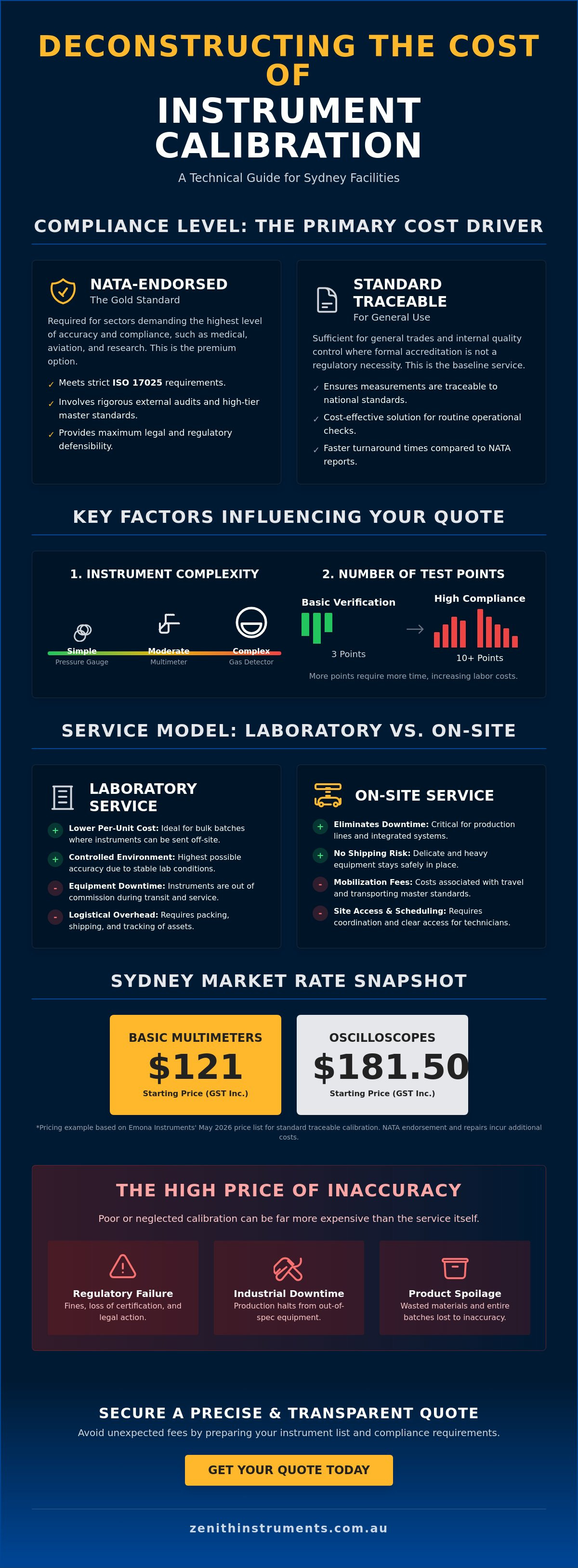
This guide provides a technical breakdown of current market rates, such as Emona Instruments’ May 2026 starting price of $121 for basic multimeters and $181.50 for oscilloscopes. We'll help you navigate the variables of NATA traceability and on-site service models so you can justify every dollar of your maintenance spend to management. You'll gain a clear framework to secure compliant, efficient calibration that keeps your operations running at peak accuracy while adhering to the strictest ISO 17025 standards.
Key Takeaways
- Differentiate between NATA-endorsed and traceable calibration to ensure your facility maintains ISO 17025 compliance while optimizing your service budget.
- Identify how measurement complexity and extreme ranges influence the cost of instrument calibration sydney to provide precise data for management approval.
- Compare the logistical efficiency of on-site services against laboratory turnaround times to eliminate hidden downtime costs across Sydney industrial zones.
- Calculate the financial impact of non-compliance and batch spoilage to shift your calibration strategy from a reactive expense to a proactive risk-mitigation tool.
- Streamline the quoting process by preparing critical instrument specifications and site-access requirements to avoid unexpected mobilization or administrative fees.
Understanding Instrument Calibration Pricing Models in Sydney
The standard pricing model for professional measurement services relies on a per-unit fee structure. We verify each individual instrument against a known master standard to ensure its output matches the expected value. To understand the foundational process, one might ask, What is instrument calibration? It's essentially the comparison between a device under test and a reference standard of higher accuracy. In the Sydney market, basic electrical testers often start at $121 including GST, according to May 2026 price lists from providers like Emona Instruments. However, this base rate often covers only standard traceable reporting. If your device fails its initial verification, we apply technical repair rates, typically billed as hourly labor, to restore the instrument to its required tolerances. This two-tier approach ensures you only pay for the precision you need, but it's a clear indicator of why budgeting for potential repairs is critical for older or heavily used inventory.
Bulk discounting serves as a strategic lever for Sydney firms operating large fleets of instrumentation. By coordinating the calibration of pressure gauges, multimeters, and gas monitors into a single batch, we reduce the logistical overhead per device. This efficiency is passed on to the client through reduced per-unit rates. Conversely, technical repair rates are an essential consideration for equipment that has drifted outside of its manufacturer-specified range. When an instrument fails its "as-found" test, our technicians must perform adjustments or component replacements. These services are typically billed at an hourly rate plus parts, ensuring that the final certificate reflects a unit that is fully compliant and safe for industrial use.
NATA Accredited vs. Traceable Calibration Costs
Choosing between a standard traceable certificate and a NATA-endorsed report is a primary driver of the cost of instrument calibration sydney. NATA accreditation is the gold standard for Australian laboratory competence. While standard traceable certificates suffice for general trades, sectors like medical manufacturing or aviation require NATA-endorsed reports to meet ISO 17025 requirements. This endorsement carries a premium because it necessitates rigorous external audits and the maintenance of high-tier master standards directly traceable to national benchmarks.
The "Per-Unit" vs. "Service Contract" Approach
Small workshops typically utilize one-off, per-unit pricing for immediate needs. We don't recommend this for larger facilities where structured calibration services Sydney under a service contract are more effective. These agreements provide price stability and automated compliance reminders. Sydney businesses can also reduce costs through bulk discounting by bundling multiple instruments into a single service window, which lowers the administrative burden and the average cost per unit compared to ad-hoc requests.
Key Factors Influencing Your Instrument Calibration Quote
Quotations for calibration services aren't arbitrary; they reflect the technical resources and time required to meet specific accuracy thresholds. A simple mechanical pressure gauge requires a different set of master standards and labor hours compared to a multi-channel gas detector or a high-precision biomedical device. The National Measurement Institute (NMI) maintains the primary standards that underpin all Australian measurements, and our adherence to these benchmarks requires significant investment in high-tier laboratory equipment. This rigorous chain of traceability is a foundational driver of the cost of instrument calibration sydney, particularly for sectors where a 0.1% margin of error is unacceptable.
Complexity often manifests in the number of test points required. While a basic verification might check three points across a range, a high-compliance audit might demand ten. Each additional point requires stabilization time and meticulous data recording. High-accuracy "Master" gauges themselves require more frequent internal verification to maintain their status as reference standards, which adds to the overall overhead of the service provider. If you're managing a diverse inventory, our team can help you identify professional calibration solutions that balance technical depth with budget constraints.
Logistics also impact the final quote. Delicate laboratory equipment cannot be treated like standard freight. Secure, vibration-dampened transport is often necessary to prevent the instrument from losing its newly calibrated state during transit. We prioritize secure handling to ensure that the precision achieved in our lab remains intact until the device reaches your facility. Shipping costs for heavy or oversized items, such as large torque wrenches or industrial ovens, also factor into the total investment.
Complexity and Precision Requirements
The time required for pressure gauge calibration is significantly lower than the hours needed for complex biomedical tools or multi-sensor environmental monitors. Every additional test point increases the labor time, as sensors must reach thermal or pneumatic equilibrium before a reading is recorded. High-accuracy master gauges also carry higher internal maintenance costs, which are reflected in the pricing for high-precision verification.
Urgency and Turnaround Times in Sydney
Standard turnaround times in the Sydney market typically range from 3 to 5 business days. If your facility faces a production stoppage, we offer express or same-day services for a premium fee. This cost-benefit analysis is simple: the price of priority service is often a fraction of the lost revenue caused by an idle production line. We focus on minimizing downtime through a disciplined laboratory workflow that prioritizes speed without sacrificing accuracy.
Cost Comparison: Laboratory vs. On-Site Services in Sydney
Deciding between laboratory and on-site service is a critical factor in managing the cost of instrument calibration sydney. While on-site service eliminates the logistical headache of shipping, it introduces mobilization fees that vary based on your facility's location. For industrial hubs stretching from Campbelltown to Botany, these call-out charges cover the travel time and specialized transport of master standards to your site. We typically find that on-site service requires a minimum quantity of instruments to be economically viable. If you only have two or three items, the mobilization fee will significantly inflate the per-unit price, making a laboratory drop-off a more cost-effective choice.
Downtime remains the most significant hidden cost in any calibration cycle. Sending critical equipment away for three business days can stall production lines or delay project milestones. We mitigate this by offering structured on-site windows where our technicians integrate into your facility's workflow. This proactive model ensures your gear never leaves the premises, providing immediate "as-found" and "as-left" data. However, precision has physical limits; certain high-specification calibrations require the vibration-isolated, climate-controlled environment of a dedicated facility to achieve the necessary measurement uncertainty.
When On-Site Calibration Saves You Money
On-site service is the most efficient choice for fixed plant equipment such as industrial ovens or large-scale weighing systems that cannot be moved without significant labor. We also recommend this for sensitive electrical equipment to reduce the risk of mechanical shock during transit. In a recent audit for a Sydney-based manufacturing plant, the facility achieved a 15% reduction in total annual spend by bundling 40 different instruments into a single two-day on-site visit. This approach consolidated mobilization fees and eliminated the administrative burden of managing multiple shipping manifests.
Laboratory Services: The Cost of Precision
Certain procedures, particularly high-accuracy thermometer calibration, must occur in a laboratory where ambient temperature and humidity are strictly regulated. Maintaining NATA Accreditation for Calibration in a lab setting ensures that every measurement is performed under optimal conditions, which is often impossible in a dusty or fluctuating factory environment. Laboratory services typically offer lower per-unit costs for individual items because our master standards are permanently staged and ready for use. To minimize shipping overheads, Sydney businesses can utilize local courier networks or scheduled drop-off points to ensure their precision instruments are handled with the care they require.
The Hidden Costs of Poor Calibration and How to Avoid Them
The actual cost of instrument calibration sydney extends far beyond the service fee; it encompasses the total financial risk of operational failure. In New South Wales, failing an ISO 9001 or ISO 17025 audit due to uncalibrated equipment results in significant administrative penalties and the potential suspension of certified processes. If an auditor rejects a non-accredited certificate, your facility faces the "double cost" of paying for a second, compliant calibration while halting production to rectify the non-conformance. This administrative friction often costs ten times more than the initial professional service fee.
Product spoilage represents another severe financial drain for Sydney manufacturers. Inaccurate temperature or pressure readings in industrial environments lead to wasted batches that can't be sold or reworked. For instance, a drift of just 2 degrees in an industrial oven can compromise the structural integrity of specialized components, leading to thousands of dollars in scrapped materials. Similarly, the legal and insurance implications of a safety incident involving uncalibrated gas detectors are immense. If a device fails to alert workers to hazardous atmospheric conditions, the resulting WorkCover investigation and potential litigation can threaten the existence of a business. Regular calibration also extends asset lifespan by identifying sensor degradation before it leads to a catastrophic instrument failure.
Regulatory Compliance and Audit Readiness
Maintaining audit readiness requires more than just a sticker on a meter. We recommend consulting our Instrument Calibrations in Australia: The 2026 Professional Guide to understand the full scope of national requirements. A critical part of this process is maintaining a digital asset register. This tool prevents missed calibration intervals, ensuring every device in your fleet is verified before its expiration date. Relying on an unaccredited provider might save money upfront, but the cost of re-doing the work when that certificate is rejected by a primary auditor is a risk no professional facility should take.
Operational Efficiency and Risk Mitigation
A $200 calibration can prevent a $20,000 production failure by identifying measurement drift before it impacts your output. Precision also plays a vital role in energy efficiency, particularly for Sydney HVAC and industrial systems where accurate pressure and temperature control reduce power consumption. Avoid the "cheap sticker" trap; the lowest quote often lacks the technical depth and NATA traceability required to truly mitigate risk. For reliable protection against operational errors, we invite you to book a professional calibration audit with our expert team today.
Securing a Precise Quote for Your Sydney Facility
To obtain a firm, no-hidden-fee quote, we require specific technical details that go beyond a simple equipment count. Vague requests often lead to administrative delays and back-and-forth emails that stall your compliance schedule. We prioritize efficiency by requesting the brand, model, measurement range, and required accuracy or certification level for every device in your inventory. Providing this data upfront allows our technical team to calculate the exact labor hours and master standards required, ensuring the cost of instrument calibration sydney remains transparent and predictable for your budget cycle.
Logistics are equally critical for accurate quoting, especially for on-site services. We need to understand your facility's site access protocols, including safety induction durations, parking for service vehicles, and available power access in the testing area. These factors influence the mobilization fee and the total time our technicians spend on your premises. Furthermore, planning your calibration frequency on a 6 or 12-month interval allows for long-term budgeting. This structured approach prevents the financial shock of bulk expirations and ensures your facility remains in a constant state of audit readiness without unexpected spikes in maintenance spend.
Preparing Your Equipment List
An accurate inventory is the foundation of a professional service agreement. We recommend grouping your instruments by type, such as separating torque wrenches from electrical multimeters, to help us optimize our laboratory workflow or on-site scheduling. This organization often reveals opportunities for better rates through batch processing. It's also vital to identify "Critical" versus "Non-Critical" assets. By prioritizing spend on high-impact instruments that directly affect product quality or safety, you can allocate your resources more effectively while maintaining essential compliance standards.
The Zenith Instruments Commitment
We provide a proactive service model backed by NATA-certified standards and ISO-compliant processes. Our local presence in Sydney ensures we understand the specific logistical needs of local industries, offering fast turnaround times that keep your equipment in the field rather than on a courier truck. We don't just provide a sticker; we deliver a partnership based on technical excellence and regulatory discipline. Our meticulous approach mirrors the exactness of the instruments we calibrate, giving you total confidence in your measurement data. Request a comprehensive calibration quote for your Sydney business today to secure your facility's precision and compliance.
Optimising Your Technical Compliance and Maintenance Budget
Effective management of your facility's precision assets requires a disciplined approach to both laboratory and on-site logistics. We've established that the cost of instrument calibration sydney is a strategic investment in risk mitigation; the price of a NATA-endorsed certificate is significantly lower than the financial impact of a failed ISO audit or a compromised production batch. Since 2004, we've helped Sydney industries maintain operational continuity through meticulous adherence to ISO 17025 compliant processes and national measurement standards.
We invite you to leverage our technical expertise to streamline your next calibration cycle. By preparing a detailed inventory and choosing the right service model, you'll eliminate hidden downtime and secure the accuracy your engineering or medical team demands. Our team stands ready to provide the precision and reliability your equipment requires to perform at its peak. Get a Professional Calibration Quote for Your Sydney Site and ensure your facility remains a benchmark for industrial safety and accuracy.
Frequently Asked Questions
How much does basic multimeter calibration cost in Sydney?
Basic multimeter calibration in Sydney starts at approximately $121 including GST, according to May 2026 industry benchmarks from providers such as Emona Instruments. This base rate typically covers standard traceable verification for a single unit. More complex digital multimeters or those requiring NATA-endorsed reporting will attract higher fees due to the extended testing points and administrative overhead required for ISO 17025 compliance.
Is on-site calibration more expensive than laboratory service?
On-site calibration includes mobilization fees that often make it more expensive for small batches, but it's more cost-effective for large inventories. You avoid the three to five-day downtime associated with shipping equipment to a lab. For facilities with more than 15 instruments, the reduction in operational disruption usually offsets the call-out charge, making the total cost of instrument calibration sydney lower overall.
What is the price difference between NATA and traceable calibration?
NATA-endorsed certificates carry a premium because they require rigorous adherence to international standards and regular external audits by the National Association of Testing Authorities. A standard traceable certificate verifies the instrument against a master standard but lacks the specific accreditation badge required for high-risk sectors. In regulated industries like aviation or medical manufacturing, you must budget for this premium to ensure audit acceptance.
Are there additional fees for instrument adjustments or repairs?
Technical repairs and adjustments are billed as additional hourly labor if an instrument fails its initial "as-found" verification. We don't include these in the base calibration fee because not every unit requires restoration. If a device has drifted beyond its manufacturer-specified tolerances, our technicians must perform precise adjustments to return it to a compliant "as-left" state for safe operation.
Do I have to pay for a new certificate if I lose mine?
Digital certificate management is a standard part of our service, allowing you to access records through our secure portal without additional fees. Some providers may charge administrative costs for manual re-issues of physical paper records. We maintain a meticulous digital archive of your NATA and traceable reports to ensure you're always audit-ready without incurring extra overhead or administrative delays.
How often should I budget for calibration to remain compliant in Australia?
Most Australian industrial standards require calibration every 6 to 12 months to maintain valid traceability. High-use or high-precision equipment in the medical and engineering sectors often necessitates a six-month cycle to mitigate the risk of measurement drift. Regular budgeting for these intervals prevents the $20,000 production failures that can occur when measurement accuracy is neglected over long periods.
Does Zenith offer discounts for large volumes of instruments?
We offer structured volume discounts for Sydney businesses that bundle multiple service categories, such as electrical and pressure instrumentation, into a single visit. Consolidating your cost of instrument calibration sydney through a bulk agreement reduces our logistical overhead. This efficiency allows us to provide more competitive per-unit rates for large-scale facility audits and long-term service contracts.
What are the typical mobilisation fees for on-site service in Western Sydney?
Mobilisation fees for Western Sydney industrial zones cover the secure transport of master standards and technician travel time. These fees vary based on the specific distance from our laboratory hub to your site in areas like Parramatta or Penrith. These charges ensure your equipment is verified on-site using reference standards that are themselves strictly maintained and calibrated to national benchmarks.