

Tool calibration isn't merely a routine workshop checklist; it's your primary legal liability shield against failed safety audits and costly site shutdowns. Securing dependable electrical contractor tool calibration in Newcastle guarantees that your multimeters, insulation testers, and clamp meters deliver verifiable measurement precision across demanding industrial and commercial projects.
We know how disruptive it is to send critical testing instruments away to distant metro facilities, stranding field technicians and triggering expensive operational delays. With mandatory digital eCert lodgements now active in New South Wales and heightened scrutiny on workplace electrical safety, relying on unverified equipment is a risk no trade business can afford. You can easily master testing accuracy, maintain strict AS/NZS 3000 compliance, and leverage local calibration logistics to protect your Newcastle electrical business from audit vulnerabilities.
Below, we examine mandatory instrument testing intervals, resolve the confusion between factory certificates and traceable calibration, and show you how to maintain unquestioned legal proof of measurement accuracy across every project.
Key Takeaways
- Understand how traceable calibration links your field measurements directly to National Measurement Institute standards to safeguard switchboard sign-offs.
- Identify how rough transit, humidity, and coastal environments degrade sensitive internal reference components across clamp meters, multimeters, and insulation testers.
- Distinguish between standard traceable calibration and NATA-endorsed certificates to avoid overpaying for unnecessary endorsements or failing critical site audits.
- Establish optimal testing intervals based on operational frequency and environmental risk rather than relying solely on default 12-month manufacturer baselines.
- Streamline electrical contractor tool calibration in Newcastle using localized logistics that eliminate trade downtime and keep your technicians active on-site.
Why Electrical Contractor Tool Calibration Is Vital in Newcastle
Many regional trade directories mistakenly conflate electrical trades with laboratory metrology services. However, licensed contractors know that workshop installation tasks differ fundamentally from precision metrology checks. Technical calibration compares your field devices against primary reference hardware directly traceable to the National Measurement Institute (NMI). When an uncalibrated meter drifts, it produces inaccurate safety sign-offs across switchboards, directly threatening lives and electrical assets. Sourcing dependable electrical contractor tool calibration newcastle ensures that every reading taken across the Hunter region remains legally and technically defensible.
Heavy industrial sites across Kooragang Island, the Port of Newcastle, and the Tomago industrial precinct enforce strict quality management systems. Site safety officers routinely inspect contractor tool registers before approving gate access. If your multimeters, installation testers, or specialized equipment such as a calibrated gas detector lack current certification, you risk immediate exclusion from the project. Investing in routine electrical contractor tool calibration newcastle guarantees uninterrupted access to these tier-one commercial and industrial sites.
Regulatory Mandates Under AS/NZS 3000 and SafeWork NSW
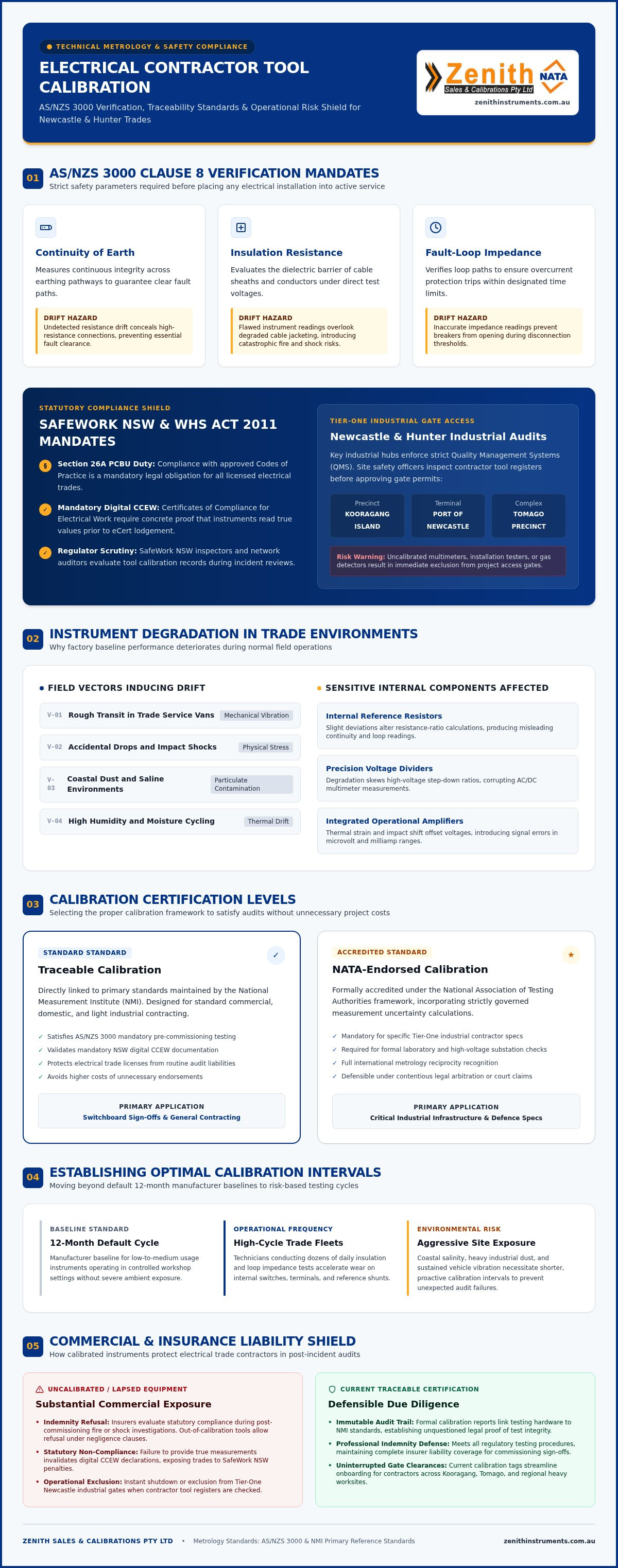
Clause 8 of AS/NZS 3000 (the Australian/New Zealand Wiring Rules) mandates strict verification and testing protocols before placing any electrical installation into service. Licensed trades must prove that test hardware accurately measures mandatory safety parameters:
- Continuity of the earthing system: Undetected resistance drift can conceal high-resistance connections that prevent fault clearance.
- Insulation resistance: Flawed readings may overlook degraded cable jacketing, introducing dangerous fire and shock risks.
- Earth fault-loop impedance: Inaccurate impedance measurements prevent overcurrent protection devices from operating within required disconnection times.
Under Section 26A of the Work Health and Safety Act 2011 (NSW), compliance with approved Codes of Practice is a mandatory legal duty for PCBUs. SafeWork NSW inspectors and network auditors require concrete evidence that your instruments read true values when signing off mandatory digital Certificates of Compliance for Electrical Work (CCEW).
Mitigating Commercial and Legal Liabilities for Electrical Trades
Unverified test instruments leave your business exposed to catastrophic liability claims if a post-commissioning fire or shock event occurs. Professional indemnity and public liability insurers actively evaluate whether safety sign-offs complied with statutory testing procedures. If an investigation reveals that your business relied on out-of-calibration instruments, insurers can refuse indemnity for negligence.
Documented certificates from a professional provider of electrical contractor tool calibration newcastle provide an immutable audit trail. These formal calibration reports deliver the defensible due diligence required to protect your business license, safeguard commercial contracts, and satisfy legal scrutiny. Property owners and facility managers likewise look for trade partners that uphold these rigorous verification practices; learn more about Synergy Trades Group to see how professional electrical and plumbing maintenance teams maintain safety across residential and commercial sites.
Key Electrical Contractor Instruments Requiring Regular Calibration
Modern trade contractors rely on complex electronic testing instruments to diagnose faults, certify installations, and meet their statutory Work Health and Safety (WHS) duties. However, harsh transit conditions in service vans, accidental drops, and exposure to coastal dust steadily degrade internal reference resistors, voltage dividers, and integrated operational amplifiers. Frontline instruments require scheduled validation against stable standards to guarantee measurement precision. Explore comprehensive testing scopes through dedicated electrical equipment calibration services to safeguard your entire fleet.
Insulation Resistance Testers and Multifunction Meters
Insulation testers generate sustained test voltages, typically 250V, 500V, or 1000V DC, across high-resistance barriers. Laboratory testing verifies that these internal generators deliver full terminal test voltages under rated load currents rather than collapsing prematurely. Multifunction installation testers combine loop impedance, prospective short-circuit current (PSCC), and insulation resistance circuits inside one housing. Each discrete measurement path relies on distinct reference networks, meaning drift in one circuit can compromise an entire installation sign-off. Proper laboratory calibration confirms that test lead compensation and zero-ohm adjustment circuits remain linear across sub-ohm continuity ranges.
Digital Multimeters and Clamp Meters
Daily operational demands take a heavy toll on hand-held meters. Over time, internal analogue-to-digital converters (ADCs) drift away from baseline factory specifications due to thermal cycling and physical vibration. For non-contact current measurements, the Hall effect sensors and precision-machined core faces in clamp meters suffer from magnetic permeability changes and physical wear. You can consult this practical multimeter guide to understand how subtle component drift influences diagnostics on commercial distribution boards. Booking regular electrical contractor tool calibration in Newcastle rectifies these sensor shifts before they cause diagnostic errors on site.
Portable Appliance Testers (PAT) and RCD Verifiers
Portable appliance testers must detect microamp-level earth leakage currents and milliohm-range protective earth continuity to satisfy AS/NZS 3760 compliance audits. Residual current device (RCD) verifiers evaluate whether safety switches trip within strict millisecond thresholds at 0.5x, 1x, and 5x rated residual currents (IΔn). If an RCD tester's internal clock runs slow, a degraded breaker that exceeds maximum disconnection times could pass testing unnoticed. Scheduling reliable electrical contractor tool calibration newcastle keeps these safety-critical instruments verified and legally defensible on every job.
Comparing Traceable Calibration vs NATA-Endorsed Calibration
Electrical trades frequently face conflicting advice regarding laboratory certifications. Contractors often overpay for premium endorsements they never require, or they risk non-compliance by relying on basic factory paperwork that fails site audits. Matching the correct calibration tier to your specific client contracts eliminates wasteful expenditure while protecting your operational standing. When booking electrical contractor tool calibration newcastle, selecting the appropriate certification tier ensures every testing unit satisfies both commercial requirements and mandatory SafeWork NSW safety obligations.
Traceability to the National Measurement Institute (NMI)
Traceable calibration establishes an unbroken, documented chain of comparisons connecting your field tester to national primary reference standards maintained by the NMI. A compliant traceable certificate provides comprehensive technical reporting:
- As-found and as-left data: Documents the exact deviation of the meter before and after calibration adjustments.
- Expanded measurement uncertainty: Details the calculated laboratory tolerances across every range tested.
- Reference instrument logs: Identifies the specific primary standards utilized, along with their calibration certificate numbers and due dates.
Standard traceable certification satisfies statutory verification under AS/NZS 3000 for domestic, commercial, and standard light-industrial electrical work. It delivers bulletproof evidence that your test hardware reads accurately, without incurring unnecessary accreditation overheads.
When Newcastle Industrial and Mining Audits Require NATA Endorsement
Certain high-stakes industrial projects reject standard traceable paperwork outright. The National Association of Testing Authorities (NATA) accredits metrology facilities to ISO/IEC 17025, auditing staff competency, environmental controls, and testing methodology. You need NATA-endorsed certificates bearing the official accreditation stamp when working under specific contractual frameworks:
- Hunter Valley mining operations: Open-cut and underground coal handling infrastructure governed by the Resources Regulator.
- Hazardous area installations: Chemical storage, grain terminals, and fuel depots located across Newcastle Harbour.
- High-voltage asset commissioning: Industrial substation switchgear and high-voltage distribution networks.
- Tier-one government infrastructure: Rail network upgrades, port marine facilities, and utility grid interconnections.
If your enterprise handles standard commercial installations, traceable electrical contractor tool calibration newcastle against NATA-certified reference standards delivers total legal compliance and defensible proof of measurement. However, if your technicians frequently service heavy industry or mining infrastructure in the Hunter, maintaining NATA-endorsed paperwork prevents costly gate refusals and audit rejections. Zenith Instruments aligns your fleet with the precise certification tier required for your contracts, avoiding excessive fees while eliminating regulatory exposure.
Optimal Calibration Intervals and Field Maintenance for Trades
Most manufacturers specify twelve-month calibration intervals under benign operating conditions. However, field instruments in Newcastle rarely operate in laboratory environments. Exposure to coastal humidity, airborne particulates around industrial corridors, and continuous transit vibration rapidly erode the stability of internal components. Rather than treating a calibration date as a fixed annual ritual, contractors should manage instrument cycles using proactive risk assessments. Whenever a tester suffers a direct drop from a ladder or a hard impact inside a ute drawer, internal reference bridges can shift immediately, requiring an unscheduled calibration check before your next job.
Determining Calibration Frequency Based on Site Usage
Determining an effective recall interval requires balancing operating intensity against the cost of field inaccuracy. Consider these practical operational factors:
- Deployment frequency: Instruments used daily across multiple commercial service calls experience significantly greater thermal and mechanical fatigue than backup workshop units, often requiring six-month re-certification cycles.
- Measurement drift trends: Tracking past calibration certificates reveals if specific meters display progressive baseline drift across key ohm or volt ranges over successive years.
- Criticality of installation: Commissioning high-demand infrastructure, such as medical treatment areas under AS/NZS 3003 or explosive atmospheres under AS/NZS 60079, leaves zero margin for instrument variance.
Recent compliance reviews indicate a 15% failure rate during formal quality audits, largely driven by unmanaged instrument drift and expired test gear. Evaluating these variables helps prevent costly rework and ensures your business maintains spotless audit readiness.
Practical Care to Protect Meter Accuracy Between Checks
Routine laboratory calibration provides a certified benchmark, but disciplined field handling preserves measurement integrity between scheduled services. Technicians working across the Hunter region should enforce strict protection measures:
- Isolate against transit vibration: Store digital meters and insulation testers in padded, rigid protective cases rather than letting them roll unsecured in toolboxes.
- Mitigate coastal corrosion: Salt air across Newcastle suburbs rapidly oxidises input jacks and banana plugs. Inspect input terminals weekly and store instruments with desiccant packs to prevent internal condensation.
- Test lead verification: Damaged leads account for widespread measurement errors. Regularly flex leads during continuity checks to identify intermittent internal wire breaks, and replace frayed probes promptly.
When you observe physical housing damage or inconsistent zero-adjustment readings, don't wait for your annual service window. Book an expedited electrical contractor tool calibration newcastle to restore verified precision before signing off your next project.
Streamlined Calibration Solutions for Newcastle & Hunter Contractors
Every business owner understands that an idle test instrument means unbillable technicians and delayed project milestones. Protracted turnaround cycles from distant metropolitan testing facilities force contractors to purchase redundant backup gear or compromise site safety schedules. By taking advantage of streamlined regional logistics, contracting firms maintain compliant tool registers without interrupting daily field operations. For trades managing tight deadlines, choosing a responsive provider for electrical contractor tool calibration newcastle ensures testing continuity across Newcastle, Lake Macquarie, and the wider Hunter Valley with dependable calibration services.
Fast Lab Turnaround and On-Site Testing Logistics
Managing equipment turnaround requires structured service channels configured around active trade schedules. Rather than sending individual testers sporadically, businesses benefit from batch calibrations scheduled during planned rostered days off or transition phases between major projects. Experienced calibration technicians conduct comprehensive diagnostic checks on test leads, battery health, and display segments alongside core metrology validation. If your firm manages specialized commercial plant, HVAC equipment, or hazardous industrial skids, you can simultaneously combine electrical instrument testing with accredited pressure gauge calibration to consolidate all compliance paperwork into a single vendor workflow.
Partnering with Zenith Sales & Calibrations Pty Ltd for Complete Compliance
Securing professional electrical contractor tool calibration newcastle requires an experienced metrology partner that understands state-specific regulatory pressures. Founded in 2004, Zenith Sales & Calibrations Pty Ltd brings decades of metrological expertise to regional trades, providing NATA-certified reference standards and ISO-compliant procedures across all major test equipment categories:
- Broad testing capabilities: Complete calibration coverage across digital multimeters, insulation testers, clamp meters, and portable appliance testers.
- Defensible documentation: Certificates formatted to satisfy strict Tier-1 industrial entry criteria, mining site registers, and Building Commission NSW audit requirements.
- Automated asset management: Proactive calibration recall reminders notify your fleet managers well ahead of expiration dates to eliminate compliance gaps.
- Regional NSW service footprint: Rapid workshop turnaround backed by flexible pickup and delivery networks across the Hunter corridor.
Don't allow unverified test equipment to threaten your electrical contracting licence or delay sign-offs under the mandatory BCNSW digital eCert system. Sourcing your electrical contractor tool calibration newcastle through Zenith Sales & Calibrations Pty Ltd gives your enterprise verified precision and keeps your field technicians operating with certified confidence.
Protect Your Electrical Trade Operations with Defensible Accuracy
Verifiable measurement accuracy forms the bedrock of electrical safety, legal protection, and regulatory compliance across New South Wales. Prioritising routine electrical contractor tool calibration in Newcastle safeguards your business against the legal liability of inaccurate switchboard sign-offs, helps your technicians pass stringent industrial site audits, and ensures seamless digital compliance under Building Commission NSW mandates. Pairing disciplined field maintenance with the correct calibration tier guarantees that every test reading recorded on site remains accurate and legally defensible.
Zenith Instruments combines over two decades of precision metrology experience with ISO-compliant procedures and NATA-certified measurement standards to deliver fast turnaround times across Newcastle and the Hunter Valley. Don't let instrument drift or expired test tags stall your field operations or compromise site access. Book your electrical tool calibration with Zenith Instruments today and equip your trade business with unquestioned measurement confidence on every project.
Frequently Asked Questions
How often should an electrical contractor calibrate their multifunction tester in Newcastle?
Electrical contractors should calibrate multifunction testers every twelve months under standard operating conditions. If your instrument experiences heavy daily service across commercial installations, survives sudden drops in transit, or operates in corrosive maritime environments around Newcastle Harbour, shorten that cycle to six months. Conducting routine risk assessments on instrument performance guarantees compliant measurement stability between formal laboratory testing cycles.
Is calibration legally mandatory under Australian Wiring Rules AS/NZS 3000?
Yes. While AS/NZS 3000 Clause 8 does not specify an arbitrary calendar interval, it mandates that all electrical installations undergo rigorous verification testing with accurate test equipment. Additionally, Section 26A of the Work Health and Safety Act 2011 (NSW) makes adherence to approved safety codes mandatory. Regulators and network auditors require verified proof that your test instruments deliver true readings.
What is the key difference between traceable and NATA-endorsed calibration?
Traceable calibration confirms that test hardware directly correlates to primary reference standards held by the National Measurement Institute (NMI), satisfying standard commercial and residential work. NATA-endorsed certification is performed by a laboratory accredited under ISO/IEC 17025. This higher tier provides formal institutional backing required by heavy industry, high-voltage networks, and mining sites throughout the Hunter region.
What happens if an electrical contractor uses uncalibrated instruments during an audit?
Auditors can reject your safety sign-offs, cancel site inductions, or issue formal non-conformance notices. Digital submissions via the Building Commission NSW eCert system require documented compliance, and unverified readings can lead to regulatory penalties. Furthermore, if an undetected fault causes property damage or injury, insurers may deny liability coverage due to failure to maintain verified equipment.
Can damaged test leads affect the calibration accuracy of an insulation tester?
Damaged test leads severely compromise measurement accuracy. Microscopic conductor breaks, internal copper fatigue, and contaminated probe tips introduce stray series resistance into low-ohm continuity circuits. Degraded probe jack insulation can also cause micro-leakage during 1000V high-voltage testing. Always calibrate meters alongside their working leads to verify that zero-ohm compensation and insulation circuits perform linearly.
How long does tool calibration usually take for trade contractors in Newcastle?
Routine laboratory calibration generally takes a few business days, depending on equipment volume and whether hardware adjustments are required. Arranging scheduled electrical contractor tool calibration in Newcastle minimizes trade disruption. Coordinated batch servicing or mobile on-site calibration allows field contractors to update multiple instruments simultaneously, keeping technicians fully operational on active customer job sites without prolonged downtime.
Does a brand-new electrical test instrument need calibration before site use?
Yes, brand-new instruments often require immediate verification before working on industrial sites. Factory certificates included in the box typically confirm manufacturing tolerances at the assembly plant rather than traceable Australian standards. Securing local electrical contractor tool calibration in Newcastle provides documented as-found test data, establishing an unbroken baseline audit trail before your technicians perform their first mandatory installation sign-off.