

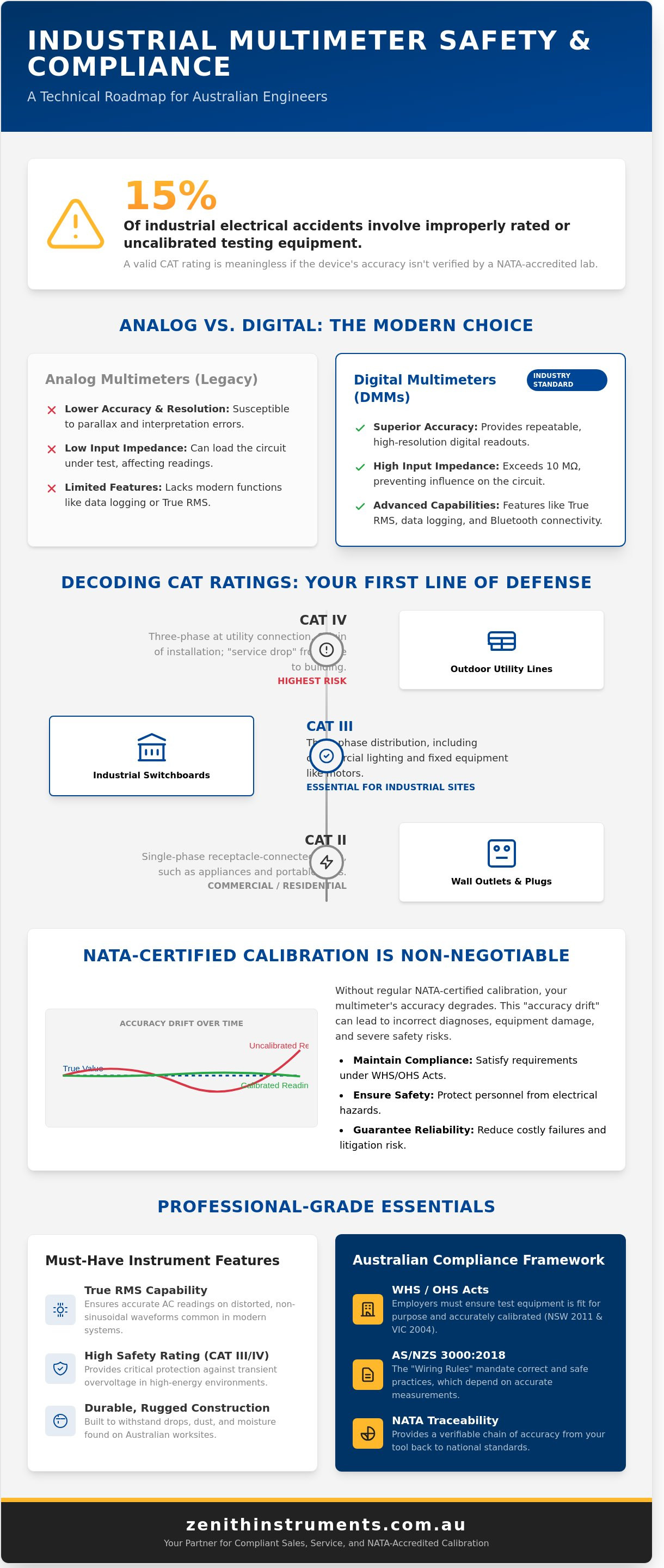
A CAT III rating on a generic multimeter doesn't guarantee your safety if the internal components haven't seen a NATA-accredited laboratory since 2023. We understand that for engineers across Sydney and Melbourne, a tool is only as reliable as its last calibration certificate. You rely on your multimeter to protect your team and your infrastructure from catastrophic electrical failure, yet industry data suggests that up to 15% of industrial electrical accidents involve improperly rated or uncalibrated testing equipment.
We're here to bridge the gap between basic functionality and industrial-grade precision. You'll discover how to select a compliant, durable instrument that adheres to strict Australian standards while ensuring your measurements remain traceable through NATA-certified accuracy. This guide provides a technical roadmap for understanding CAT safety ratings, identifying professional-grade hardware, and securing the local calibration services that keep your operations running safely. We'll examine the specific requirements for 2026 to ensure your facility remains compliant with the latest regulatory frameworks and high-performance standards.
Key Takeaways
- Understand the critical distinctions between analog and digital units to determine the most reliable standard for Sydney and Melbourne industrial applications.
- Learn to decode CAT safety ratings and True RMS capabilities to ensure your equipment meets rigorous Australian electrical environment requirements.
- Discover why NATA-certified calibration is essential for mitigating accuracy drift and maintaining the long-term precision of your multimeter.
- Gain insights into selecting professional-grade instrumentation from leading brands like Fluke to guarantee compliance and operational efficiency.
- Identify the maintenance protocols required to protect your technical investments against the specific environmental factors found across Australian worksites.
Understanding the Multimeter: The Core of Electrical Testing in Australia
A multimeter is a diagnostic tool that combines several measurement functions in one unit. Often described as the "Swiss Army Knife" of electrical testing, this instrument is foundational for professionals maintaining the pulse of Sydney's expanding infrastructure. As we move through 2026, the complexity of high-density residential developments and the Sydney Metro West expansion demands a level of diagnostic precision that older tools simply cannot provide. We've witnessed a significant shift from basic analog movements to smart digital models that offer Bluetooth connectivity and real-time data logging for complex troubleshooting.
In Melbourne, the manufacturing and medical sectors rely on these devices to uphold stringent safety protocols. A fault in a medical imaging suite or an automated assembly line isn't just a technical glitch; it's a risk to life and productivity. Modern multimeters allow technicians to identify these risks before they escalate. By integrating advanced sensors, these tools help Melbourne’s industrial hubs comply with rigorous Australian standards while ensuring that every component operates within its designed electrical parameters.
Primary Functions: Voltage, Current, and Resistance
Measuring AC and DC voltage remains the most common application for commercial and industrial contractors. In a commercial setting, verifying a stable 240V supply is essential, while industrial environments often require testing 415V three-phase systems. Understanding Ohms and continuity is equally vital; it’s the fastest way to detect broken wires or high-resistance connections in a circuit. To measure Amperage without interrupting the circuit flow, many professionals now utilize integrated clamp functions. This method prevents downtime in critical systems, allowing for live monitoring of current draw in active switchboards across NSW.
Why Precision Matters for AU Industrial Standards
Precision is the difference between a successful installation and a catastrophic failure. A 0.1% accuracy drift in a multimeter might seem negligible, but in high-stakes engineering projects, such as large-scale solar farms or data centers, it leads to incorrect load calculations and hardware damage. The legal implications of using unverified tools are also severe. Under the NSW Work Health and Safety Act 2011 and the VIC Occupational Health and Safety Act 2004, employers must ensure that testing equipment is fit for purpose and accurately calibrated. We assist firms in meeting these obligations through our electrical equipment calibration services, ensuring every reading is NATA traceable.
- Compliance: Adherence to AS/NZS 3000:2018 wiring rules.
- Safety: CAT III and CAT IV ratings for high-voltage environments.
- Efficiency: Fast sampling rates to catch transient voltage spikes.
- Reliability: Reducing the risk of costly litigation in Sydney and Melbourne workplaces.
Our commitment at Zenith Instruments is to provide the technical certainty that Australian industries require. Whether you're operating in a Melbourne laboratory or a Sydney construction site, your multimeter must be a beacon of accuracy. We focus on delivering calibration services in Sydney and Melbourne that keep your tools within manufacturer specifications, protecting both your staff and your professional reputation.
Analog vs. Digital Multimeters: Which is Best for Your Workplace?
Selecting the right instrumentation for an Australian industrial environment requires a clear understanding of measurement technology. Digital multimeters (DMMs) have largely replaced analog units across Melbourne industrial sectors due to their superior accuracy and ease of use. While analog tools once defined the electrical trade, the shift toward digital precision is driven by the need for repeatable, high-resolution data in complex systems. We see this transition reflected in the 2024 industry standards where digital readouts are the baseline for most compliance-heavy sectors.
The Advantages of Digital Multimeters (DMM)
Digital multimeters provide high input impedance, typically exceeding 10 megohms. This high resistance ensures the multimeter doesn't load the circuit under test, which prevents measurement errors in sensitive electronic components. Melbourne technicians rely on these devices for features like data logging and Min/Max capture, which allow for hands-free monitoring of intermittent faults. For professionals maintaining ISO standards, we provide electrical equipment calibration services to ensure these high-precision instruments remain within their specified tolerances. Backlit displays and ruggedized casings further enhance their utility on demanding Australian work sites.
Analog Multimeters: When the Old School Wins
Analog tools utilize a moving coil and needle to represent values across a scale. They remain relevant in niche applications where you need to track rapidly fluctuating values. The visual trend of a swinging needle is often easier for a technician to interpret than a flickering digital digit that struggles to settle. However, roughly 92% of professional workshops in Brisbane and Canberra now prioritize DMMs for general maintenance. Analog circuits are simpler and can sometimes perform better in high-interference environments, but they lack the advanced safety ratings and automated features found in modern digital equivalents.
Operational efficiency on busy Sydney job sites often hinges on the choice between auto-ranging and manual ranging. Auto-ranging models automatically detect the magnitude of the signal and adjust the internal circuitry accordingly. This saves time and prevents fuse blows caused by incorrect settings. Manual ranging remains a preference for specific laboratory tasks where a technician needs to lock a range to prevent the meter from "hunting" for a signal. At Zenith Instruments, we recommend NATA-accredited tools for any professional application to ensure your readings meet national regulatory requirements. Our team can help you select the most accurate measurement solutions in Sydney to keep your operations running safely.
Modern professionals must weigh the visual feedback of an analog needle against the decimal-point precision of a digital screen. While the legacy of analog tools persists in specialized troubleshooting, the digital multimeter is the undisputed standard for 2026. This technology offers the speed and safety necessary for the high-voltage environments found in Australia’s evolving energy and manufacturing sectors.
Selecting a Professional Multimeter: Safety Ratings and Key Features
Selecting a professional multimeter requires a technical understanding of the rigorous demands found in Australian industrial environments. Precision isn't just a preference; it's a fundamental safety requirement when dealing with high-energy circuits. Professionals must evaluate tools based on their ability to withstand environmental stressors while delivering repeatable, accurate data under varying load conditions.
CAT Safety Ratings Explained for AU Electricians
Electricians in Sydney and Melbourne often work on service entrances or utility-level infrastructure where the risk of high-energy transients is greatest. CAT IV ratings are essential for these primary supply levels because they offer the highest level of protection against surges originating from the utility grid. CAT ratings define the magnitude of transient impulses a meter can withstand. For instance, a CAT IV 600V meter is engineered to handle transients up to 8,000V, whereas a CAT III 600V unit is only tested for 6,000V. This distinction is critical during an arc flash event, which can reach temperatures exceeding 19,000°C in a matter of milliseconds. We recommend that all field technicians verify their equipment complies with AS/NZS 61010 standards to mitigate these life-threatening risks.
Advanced Features for 2026 Professionals
Modern 2026 workflows demand more than just basic continuity tests. True RMS (Root Mean Square) is now the industry standard for maintaining accuracy on non-linear loads, such as variable speed drives or LED lighting systems common in commercial Melbourne retrofits. Without True RMS, your multimeter might provide voltage readings that are 30% to 40% lower than the actual values. For those troubleshooting complex systems, Bluetooth connectivity allows for remote monitoring via mobile apps, keeping technicians at a safe distance from energized panels. We also suggest utilizing LoZ (Low Impedance) modes to eliminate "ghost voltages" caused by capacitive coupling in long cable runs. For those looking to master these tools, our guide on how to use a multimeter provides deeper operational insights.
Durability is a non-negotiable factor on Newcastle construction sites, where dust and moisture ingress can quickly compromise sensitive electronics. An IP67 rating ensures the device is completely dust-tight and can survive accidental immersion in water for up to 30 minutes. Feature sets should also align with your specific industry requirements. HVAC technicians need microamp measurements for flame sensors, while biomedical engineers require high-resolution millivolt ranges for sensitive diagnostic equipment. Automotive professionals in Sydney's transport hubs should prioritize RPM and duty cycle functions. Regardless of your sector, regular electrical equipment calibration services ensure these advanced features remain accurate over the tool's operational lifespan.
The Critical Role of Multimeter Calibration and Maintenance
A professional multimeter is only as reliable as its last calibration. While every high-end tool arrives with a factory certificate, this document only confirms the device's state at the moment of manufacture. Once the instrument enters the field, accuracy begins to shift. Australian environmental conditions play a significant role in this degradation. High humidity in coastal hubs and the extreme heat found in regional mining sectors cause internal components to drift. Precision components can lose their tight tolerances after just six months of exposure to the 40°C+ temperatures common in Western Australia and Northern Queensland. Accuracy drift isn't just a theoretical concern; it's a physical reality. Resistors and voltage references inside your meter age at different rates, and moisture ingress in humid climates can alter the impedance of internal circuits, leading to skewed resistance readings.
Regular maintenance prevents these minor drifts from becoming major safety hazards. If your readings are inaccurate, you might conclude a circuit is dead when it's actually live. To maintain safety and operational integrity, we recommend the following calibration intervals:
- Mining and Heavy Industry: Every 6 months to account for constant vibration and dust.
- Medical and Biomedical: Every 12 months to meet ISO 13485 compliance requirements.
- General Electrical Contracting: Every 12 months to comply with AS/NZS 3000 standards.
NATA Accreditation: The Gold Standard in Australia
A standard calibration confirms your tool is working, but NATA accreditation proves your measurements are legally defensible. NATA certification is essential for audit readiness and high-stakes industrial projects. It ensures that the measurement uncertainty is precisely calculated and that the equipment used for testing is traceable to international standards. It's the difference between a basic health check and a specialist diagnostic. We maintain a network of specialized facilities, including our calibration services Sydney lab, to provide this level of rigorous technical oversight for your multimeter fleet.
On-Site vs. Lab Calibration: Minimising Downtime
Logistics shouldn't compromise your precision. For facilities with large inventories of test equipment, we offer on-site calibration to keep your team productive. This approach eliminates the risk of damage during transit and reduces turnaround times from days to hours. Our technicians bring the lab to you, ensuring full traceability to national measurement standards. Whether you require calibration services Melbourne wide or at a remote industrial site, we prioritize speed without sacrificing accuracy. We understand that every hour your gear is out of service costs your business money.
Don't risk your safety or compliance on unverified readings. Schedule your professional multimeter calibration with our expert team today.
Zenith Instruments: Your Partner for Multimeter Sales and Service
We provide the technical backbone for electrical professionals across Australia's major industrial hubs. Our inventory features high-specification tools from industry leaders like Fluke and Major Tech. Zenith Instruments operates full-scale laboratories in Sydney and Melbourne, staffed by qualified Australian technicians who understand the rigorous demands of ISO 17025 standards. We don't just sell equipment; we offer a proactive service model that integrates procurement with long-term maintenance.
Our team understands that a multimeter is a critical safety device. Reliability is non-negotiable when working on high-voltage systems in Sydney's manufacturing plants or Melbourne's infrastructure projects. We provide end-to-end solutions that cover the entire equipment lifecycle. This includes initial selection advice, pre-delivery verification, and annual NATA-endorsed calibration. By maintaining local service centers, we achieve a 3 to 5 business day turnaround, ensuring your operations remain productive without extended downtime.
Authorized Sales of Premium Instrumentation
Buying a multimeter from a dedicated calibration house provides a level of quality assurance that general retailers cannot match. Every tool we sell can be pre-verified in our laboratory, ensuring it meets manufacturer specifications the moment it arrives at your site. We are proud suppliers of Major Tech products and Fluke instrumentation, known for their durability in harsh Australian environments. For organizations managing large industrial fleets of 20 or more units, we consult on custom equipment kits. These kits are designed to standardize measurement protocols across your entire workforce, reducing user error and simplifying the compliance process.
Book Your Multimeter Service Today
We've simplified the process for maintaining your testing fleet. You can choose between convenient laboratory drop-offs in Sydney or Melbourne, or schedule an onsite visit for large-scale facility audits. Our meticulous technicians use state-of-the-art calibrators to test every function of your device, from basic voltage to complex frequency and capacitance ranges. We manage your equipment lifecycle through Zenith’s digital certificate portal. This system provides 24/7 access to your NATA-endorsed records, making it easy to prove compliance during safety audits or insurance reviews. Don't let uncalibrated tools compromise your site safety or data integrity. Contact Zenith Instruments for Multimeter Sales and NATA Calibration to secure your equipment's accuracy today.
Future-Proof Your Electrical Testing Standards
Selecting the right multimeter for your specific industrial application ensures both measurement accuracy and technician safety. As Australian industries move toward 2026, adherence to strict ISO compliant processes and safety ratings like CAT III and CAT IV remains non-negotiable. Precision isn't accidental; it's the result of disciplined maintenance and rigorous testing protocols. We understand that equipment downtime creates significant bottlenecks in engineering and manufacturing sectors. That's why our service model prioritizes fast turnaround times and technical excellence across all measurement parameters. Our NATA Accredited Laboratory provides the essential documentation you need for regulatory audits and quality assurance. With dedicated facilities in Sydney and Melbourne, we offer Australia-wide coverage to support your operations regardless of your location. You'll gain peace of mind knowing your instruments meet the highest international standards for reliability and precision. Let's ensure your equipment performs at its peak through every project phase.
Get a Quote for NATA-Certified Multimeter Calibration
We're ready to help you maintain the exactness your professional standards demand.
Frequently Asked Questions
How often should I calibrate my multimeter in Australia?
You should calibrate your multimeter every 12 months to maintain compliance with AS/NZS 3000 and ISO 9001 standards. High-precision industries in Sydney often adopt a 6-month cycle to mitigate the risk of measurement drift in critical systems. Regular intervals ensure your readings remain within the manufacturer's specified tolerance levels; we provide detailed certificates for every calibration to assist with your annual safety audits.
What is the difference between CAT III and CAT IV multimeters?
The primary difference lies in the level of transient overvoltage protection the device provides. A CAT III multimeter is engineered for fixed installations like distribution boards and heavy-duty circuit breakers. In contrast, CAT IV devices are mandatory for utility connections and service entrance points where fault current levels are highest. We ensure your technicians use the correct category to prevent catastrophic failures during high-energy surges.
Do I really need a NATA-certified calibration for my multimeter?
You need NATA-certified calibration if your work involves government contracts, medical equipment, or legal forensic reporting. While standard calibration suffices for general electrical work, NATA accreditation provides the highest level of technical competence and international traceability. It's the gold standard for Australian professionals who must prove their measurements meet the strict requirements of ISO/IEC 17025.
Can I calibrate my own multimeter at home or in the shop?
You can't calibrate a multimeter at home because you lack a traceable reference standard with a 4:1 accuracy ratio. Professional calibration requires controlled laboratory conditions to prevent thermal drift and electromagnetic interference. We utilize specialized multi-product calibrators that are themselves verified against national standards. Self-checking might show consistency, but it doesn't provide the legal compliance or accuracy certification your business requires.
What causes a multimeter to lose its accuracy over time?
Component aging and environmental exposure are the primary drivers of measurement drift. Internal resistors and capacitors change value over 365 days due to heat cycling and humidity. Physical shocks or dropping the unit can also misalign sensitive internal components. We've found that units used in harsh Melbourne industrial environments often drift 15 percent faster than those kept in climate-controlled labs.
Is a digital multimeter better than an analog one for industrial work?
Digital units are superior for 95 percent of industrial applications due to their high input impedance and parallax-free displays. They offer features like auto-ranging and data logging that analog units lack. However, analog meters remain useful for monitoring rapidly fluctuating values where a digital display's update rate is too slow. We calibrate both types to ensure your specific diagnostic needs are met with precision.
What should I look for when buying a multimeter for a medical facility?
You must prioritize True RMS capability and high input impedance to ensure accurate readings on non-linear medical loads. The device should meet CAT III 600V safety standards at a minimum to protect staff and patients. We recommend choosing models that support NATA-traceable calibration to satisfy the 100 percent compliance requirements of AS/NZS 3551:2012 for medical equipment management.
How much does professional multimeter calibration cost in Sydney?
Professional calibration costs vary based on the device's complexity and whether you require a NATA-endorsed certificate. Standard turnaround for a handheld multimeter in our Sydney laboratory typically involves a base fee plus additional costs for repairs or adjustments. We provide onsite services for large facilities to reduce downtime and logistical hurdles. Contact our team for a specific quote tailored to your fleet's technical specifications.