

A NATA-endorsed calibration certificate is a high-stakes diagnostic tool for your business, yet many professionals treat it as a mere compliance checkbox. With the ISO 9001:2026 update introducing more rigorous requirements for data integrity and quality culture, simply filing these reports away is no longer sufficient for regulatory safety. You need to know exactly how to read a NATA calibration certificate to identify equipment drift before it compromises your operations. We understand that the dense technical jargon and complex tables can be overwhelming, especially when an ISO 17025 audit is approaching and the precision of your instruments is under scrutiny.
This professional guide will give you the confidence to interpret every measurement on your report, from 'As Found' baseline data to the final 'As Left' results. You'll master the complexities of measurement uncertainty and learn to spot the subtle signs of instrument fatigue that others miss. By the end of this article, your documentation won't just be ready for the 4,400 NATA-accredited facilities across Australia; it'll be a strategic asset that ensures your equipment operates with absolute precision and full regulatory compliance.
Key Takeaways
- Understand why the NATA emblem is the definitive benchmark for ISO/IEC 17025 compliance and technical laboratory competence in Australia.
- Master how to read a NATA calibration certificate by identifying the five essential sections required for precise asset tracking and audit readiness.
- Decode the technical difference between 'As Found' and 'As Left' data to monitor instrument drift and ensure long-term measurement accuracy.
- Determine whether your industry, such as mining, medical, or aviation, mandates a NATA-endorsed report or if a standard traceable calibration is sufficient.
- Recognize how dual laboratory presence in Sydney and Melbourne facilitates rapid turnaround times for NATA-certified pressure, electrical, and thermal categories.
The NATA Endorsement: Understanding the Gold Standard of AU Calibration
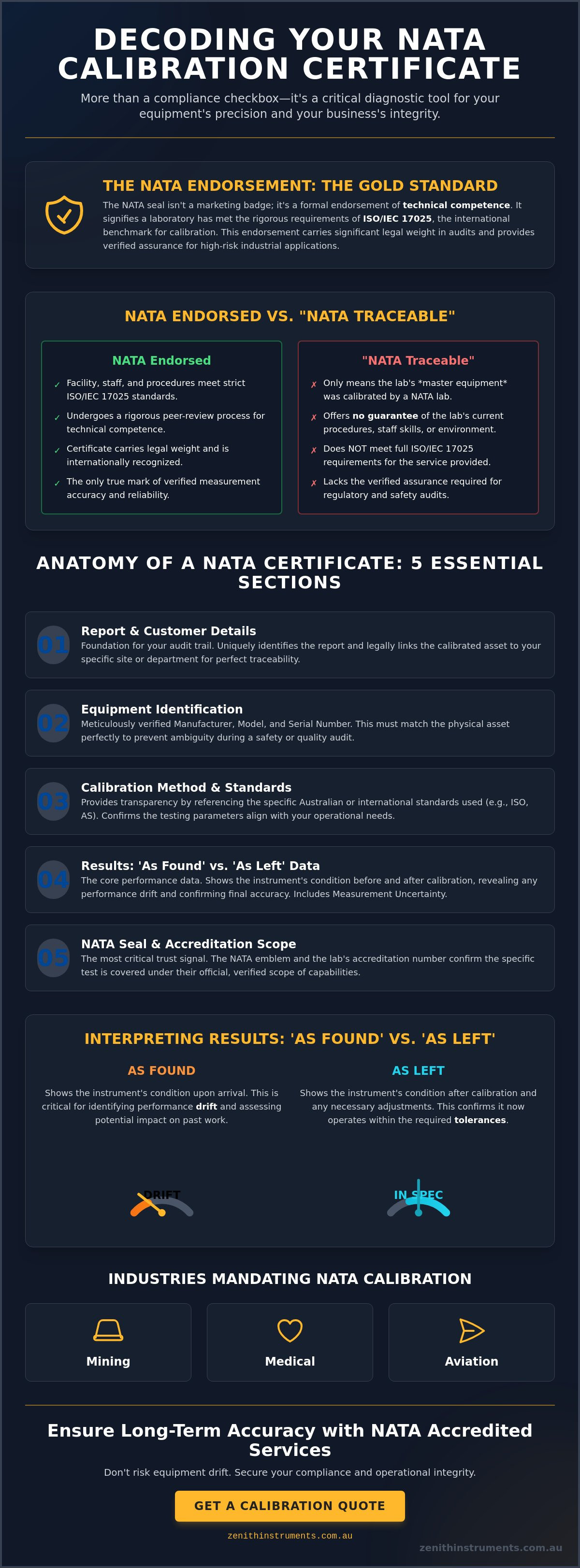
The National Association of Testing Authorities (NATA) operates as the sole accreditation body in Australia, serving as the authority that bridges the gap between local industrial measurement and international standards. When you are learning how to read a NATA calibration certificate, you must first recognize that the NATA logo is not a marketing badge. It is a formal endorsement. It signifies that a laboratory has undergone a rigorous peer-review process to prove its technical competence. Without this endorsement, a report lacks the verified assurance required for high-risk industrial applications.
In Australian courts and regulatory safety audits, a NATA-endorsed report carries significant legal weight. It provides a robust defense by proving that your equipment was calibrated using validated methods in a controlled environment. Many providers claim their services are 'NATA-traceable', but this is a common point of confusion. A traceable claim simply means the lab's own master equipment was calibrated by a NATA lab at some point. It does not mean the lab's current procedures, staff, or environmental controls meet NATA's strict standards. Only a NATA-accredited facility can issue an endorsed certificate that meets the full requirements of ISO/IEC 17025.
ISO/IEC 17025 and Technical Competence
Accreditation to AS ISO/IEC 17025:2018 is the definitive international benchmark for testing and calibration laboratories. While ISO 9001 focuses on general quality management, ISO 17025 specifically evaluates the technical proficiency of the staff and the reliability of the results produced. It ensures that we use validated procedures for every pressure gauge calibration or electrical test. Because NATA is a signatory to the ILAC Mutual Recognition Arrangement, these certificates are recognized internationally. This global alignment ensures that equipment calibrated in our Sydney or Melbourne laboratories meets the same standards as any top-tier facility in Europe or North America.
The Significance of the NATA Seal
The visual presence of the NATA emblem and the laboratory's unique accreditation number is the most critical trust signal on your report. If this seal is absent from the header, the laboratory is not endorsing that specific test under their accreditation scope. You should never assume a lab is accredited for every service they advertise. A facility might be accredited for electrical calibration services but lack the accreditation for specialized gas monitors. Always verify the laboratory’s current scope on the official NATA website. Understanding how to read a NATA calibration certificate starts with confirming that the specific measurement parameters of your instrument fall within the lab's authorized capabilities.
Decoding the Anatomy: 5 Essential Sections of a NATA Certificate
Every NATA-endorsed report follows a standardized architecture designed for maximum transparency and data integrity. Knowing how to read a NATA calibration certificate requires a systematic approach to each data field, starting with the unique report number and customer details. These identifiers are foundational for asset tracking; a report number provides the primary reference for your internal audit trail, while accurate customer details ensure the asset is legally linked to your specific site or department. Without these, your quality management system cannot maintain a verifiable record of equipment history.
The description of equipment must be meticulously verified against the physical asset. We ensure the manufacturer, model, and serial number match perfectly to prevent any ambiguity during a safety audit. Following this, the calibration method section references the specific Australian or international standards used during testing. This transparency allows your technical team to confirm that the testing parameters align with your operational requirements. If your current reports lack this level of detail, consider our calibration services in Sydney for comprehensive, audit-ready documentation.
Traceability to National Standards
Traceability is the unbroken chain of comparisons that links your instrument back to the primary standards held at Australia's National Measurement Institute (NMI). This chain is a non-negotiable requirement for ISO 9001 quality management systems, as it proves your measurements are grounded in a recognized national framework. We maintain this rigorous chain for all equipment, including high-precision pressure gauges and critical electrical tools, ensuring your data is defensible at every level of the supply chain.
Understanding Measurement Uncertainty
Measurement uncertainty is the most critical technical value on the certificate. It represents the statistical range within which the "true" value of the measurement lies. When you evaluate your equipment's performance, you must factor this uncertainty into your pass/fail criteria. If the reported error plus the uncertainty exceeds your required tolerance, the tool may no longer be fit for purpose. A lower uncertainty value indicates a more refined and controlled calibration process, providing you with greater confidence in your instrument’s daily performance. Mastering this data point is the final step in ensuring your equipment meets the highest safety standards.
Interpreting Results: 'As Found' vs. 'As Left' Data
Understanding the distinction between 'As Found' and 'As Left' data is the most practical skill when learning how to read a NATA calibration certificate. These two data sets provide a complete narrative of your instrument's performance over time. 'As Found' data represents the instrument's condition exactly as it arrived at our laboratory, before any cleaning, adjustments, or repairs. This data is critical for your quality records because it proves whether the tool was still accurate while you were using it in the field. If the 'As Found' readings are within tolerance, your previous work remains valid. If they are not, you may face a significant compliance risk.
'As Left' data represents the final performance of the instrument after we've performed any necessary servicing. This is the baseline you will use for your next calibration cycle. By comparing these two points, you can calculate 'Drift'—the mathematical change in an instrument's accuracy over a specific period. We recommend tracking this drift across multiple certificates to predict when an instrument might fall out of tolerance. If an instrument shows minimal, stable drift over several years, you might justify extending your calibration intervals to reduce costs. Conversely, high or erratic drift is a clear signal that you should shorten the interval to maintain safety standards.
Analyzing Out-of-Tolerance (OOT) Conditions
If your 'As Found' data exceeds the manufacturer's specified limits, you have an Out-of-Tolerance (OOT) condition. This is a critical moment for your quality management system. You must perform a 'Risk Impact Assessment' to determine if the faulty measurements affected the safety or quality of your past projects. Our technicians at our Sydney and Melbourne facilities immediately flag OOT findings to our clients. This proactive alert allows you to begin your internal investigation before the tool even returns to your site, minimizing the window of operational uncertainty.
Pass/Fail Statements and Compliance
Many professionals look only for a 'Pass' or 'Fail' label on their report, but how to read a NATA calibration certificate properly involves looking deeper at the 'Statement of Compliance'. This statement is governed by a 'Decision Rule', which determines how measurement uncertainty is factored into the final result. If a measurement is very close to the tolerance limit, the uncertainty might mean we cannot technically guarantee a 'Pass', even if the raw number looks acceptable. You should always review the raw data tables. A 'Pass' label is helpful, but the raw figures tell the real story of how much safety margin you actually have left before the tool becomes a liability.
NATA vs. Traceable: Which Certificate Does Your Business Need?
Choosing between NATA and traceable calibration depends entirely on your specific regulatory environment and risk profile. Traceable calibration is often sufficient for non-critical tools or internal reference checks where the legal burden of proof is minimal. However, for regulated industries such as medical, mining, and aviation, NATA calibration is mandatory. Tier 1 contractors across Brisbane and Sydney typically demand NATA-endorsed reports for all site equipment to mitigate liability and ensure project integrity. When you master how to read a NATA calibration certificate, you quickly recognize the superior technical depth and defensibility it provides compared to a standard traceable report.
Weighing the cost of NATA against the risk of an audit failure is a critical business decision. While a traceable certificate confirms a link to national standards, it doesn't guarantee the lab's technical competence or the validity of their internal procedures. A NATA-endorsed report is an investment in safety that pays for itself during a rigorous ISO 9001 or ISO 17025 audit. It provides the highest level of assurance that your measurements are accurate, repeatable, and legally defensible.
Industry-Specific Requirements in Australia
Mining and construction sectors prioritize site safety and precision above all else. This is why laser level calibration often requires a NATA-endorsed report to ensure site-wide alignment accuracy and compliance with regional safety mandates. In medical and laboratory environments, the thermometer calibration process must be NATA-accredited to meet strict healthcare standards and vaccine storage requirements. Electrical contractors also face high stakes; staying compliant with Australian Standards, specifically AS/NZS 3000, often necessitates high-tier certification for their testing equipment to prevent hazardous operational failures.
The Risk of 'NATA-Traceable' Marketing
Exposing the myth of 'NATA-traceable' marketing is essential for any professional responsible for asset management. This phrase is frequently used by non-accredited laboratories to imply a level of quality they haven't officially earned through peer review. Just because a lab uses NATA-certified master equipment doesn't mean their own reports are NATA-endorsed. You must learn to spot these misleading claims on non-accredited certificates to avoid costly regulatory breaches. Ensuring your electrical equipment calibration meets the highest AU standards requires looking for the actual NATA emblem and accreditation number. If you need absolute certainty for your next regulatory audit, book your NATA calibration service with our expert technicians to guarantee full compliance.
Ensuring Long-Term Accuracy with Zenith’s NATA Accredited Services
Zenith Sales & Calibrations Pty Ltd operates as a high-performance partner for Australian industries requiring meticulous measurement accuracy and regulatory safety. With a dual laboratory presence in Sydney and Melbourne, we provide rapid turnaround times that minimize operational disruptions. Our commitment to NATA-certified standards remains steadfast across pressure, electrical, and thermal categories. We don't just deliver a document; we provide a technical solution backed by formal certification, ensuring you know exactly how to read a NATA calibration certificate for every asset we service.
Technical experts at Zenith Sales & Calibrations Pty Ltd bridge the gap between receiving a technical report and fully mastering how to read a NATA calibration certificate. We assist your engineering and quality teams in interpreting complex data sets to identify equipment fatigue early. This proactive analysis helps you move from reactive repairs to predictive maintenance, which ultimately extends the service life of your high-value assets. We prioritize clear communication, ensuring that specialists and decision-makers alike understand the implications of their calibration results and the current state of their equipment drift.
For regional Australian industries in mining, agriculture, or manufacturing, our mobile on-site calibration services provide a specific competitive advantage. We bring our laboratory-grade precision directly to your facility, which is essential for large-scale operations where equipment downtime is exceptionally costly. We understand the logistical needs of regional hubs, and our wide-reaching network ensures we provide a localized service touch. This mobile capability ensures your equipment remains compliant without the risk of shipping sensitive instruments to a fixed laboratory.
Comprehensive Solutions for Australian Industry
We provide specialized expertise in pressure gauge calibration, supporting critical infrastructure in manufacturing and HVAC sectors where pressure integrity is paramount. Our technicians also perform precise torque wrench calibration for heavy industry and automotive applications where exactness is a foundational pillar of operational safety. Whether your facility manages a single asset or a complex fleet of instruments, we deliver the meticulous service required to meet Australian standards. For a deeper look at the current regulatory framework, see our full guide on Instrument Calibrations in Australia.
Booking Your Next NATA Calibration
Efficiency and speed define our service model. We offer a streamlined online booking system and digital equipment tracking for clients in Sydney, Melbourne, and Brisbane, ensuring your documentation is always audit-ready and easily accessible. Zenith Sales & Calibrations Pty Ltd projects the personality of a Dependable Expert, providing the organized, disciplined service your specialized industrial or manufacturing sector requires. We value technical excellence above all else, positioning ourselves as a high-performance partner for your business. Contact Zenith Sales & Calibrations Pty Ltd today for NATA-accredited calibration services and secure the technical excellence your business demands.
Securing Regulatory Compliance for Your Industrial Assets
Maintaining a rigorous calibration schedule is the only way to ensure your business stays ahead of evolving standards like ISO 9001:2026. Mastering how to read a NATA calibration certificate empowers your technical team to move beyond basic compliance and embrace predictive maintenance. By analyzing the subtle shifts between 'As Found' and 'As Left' data discussed earlier, you protect your operations from unexpected failures and costly regulatory breaches. This technical oversight is what separates high-performance industrial leaders from those who merely react to equipment failure; it ensures your data is defensible in any audit or safety investigation.
Our commitment to precision at Zenith Sales & Calibrations Pty Ltd is backed by NATA-certified standards and ISO-compliant processes at our advanced Sydney and Melbourne laboratory facilities. We understand the high stakes of Australian industrial measurement and provide the authoritative documentation your auditors demand. Whether you are managing a fleet of pressure gauges or complex electrical testers, our experts deliver the reliability your sector requires. Take the next step in optimizing your asset management strategy and ensure your equipment meets the gold standard of Australian measurement. Precision is a continuous commitment, and we are here to support your technical measurement needs at every stage.
Book Your NATA-Endorsed Calibration with Zenith Sales & Calibrations Pty Ltd Today to secure your facility's operational safety and long-term accuracy.
Frequently Asked Questions
What is the difference between a NATA certificate and a traceable certificate?
A NATA certificate provides a formal endorsement of a laboratory's technical competence and adherence to ISO/IEC 17025 standards. A traceable certificate only confirms that the measurements are linked to national standards through an unbroken chain. While traceable calibrations are suitable for non-critical tools, NATA reports are mandatory for high-risk industries that require legally defensible data for regulatory audits.
How long is a NATA calibration certificate valid for in Australia?
The validity period is determined by your organization’s quality management system and the specific risk profile of the equipment. Most industrial standards suggest a 12-month interval, but critical instruments in medical or mining sectors often require six-month checks. We help you evaluate equipment drift to determine if you should adjust these intervals to maintain safety and compliance across your asset fleet.
Can I use an expired NATA certificate for an ISO 9001 audit?
No, using an expired certificate is a major non-conformance during an ISO 9001 or ISO 17025 audit. It indicates a failure in your asset management process and suggests that your measurements may no longer be reliable. You must ensure all critical instruments are recalibrated before the expiry date to maintain a continuous, valid audit trail and avoid costly regulatory penalties.
What does 'Measurement Uncertainty' mean on my report?
Measurement uncertainty represents the statistical range within which the actual value of a measurement is expected to lie. It accounts for variables like environmental conditions and the precision of the master equipment. Learning how to read a NATA calibration certificate requires factoring this uncertainty into your pass/fail criteria to ensure your tool’s error doesn't exceed your specific operational tolerances.
Why is the NATA logo missing from my calibration report?
The absence of a NATA logo usually means the laboratory is not accredited for that specific measurement parameter or they have chosen not to endorse that particular report. Laboratories often have a limited scope of accreditation. If the seal is missing, the results are not officially NATA-endorsed, even if the facility holds accreditation for other categories of testing or maintenance.
How do I verify if a laboratory is actually NATA accredited?
You can verify a laboratory's status by searching the official NATA website using the facility’s name or its unique accreditation number. This search provides the "Scope of Accreditation," which lists every specific test the lab is authorized to perform. We encourage clients to check our scope to confirm our technical capabilities in categories like pressure, thermal, and electrical calibration services.
What should I do if my instrument's 'As Found' data is out of tolerance?
If an instrument is found out of tolerance, you must immediately perform a risk impact assessment on any measurements taken since the last calibration. This process determines if the inaccuracy compromised product quality or site safety. We provide detailed guidance on how to read a NATA calibration certificate to help you interpret these findings and implement the necessary corrective actions within your quality system.