

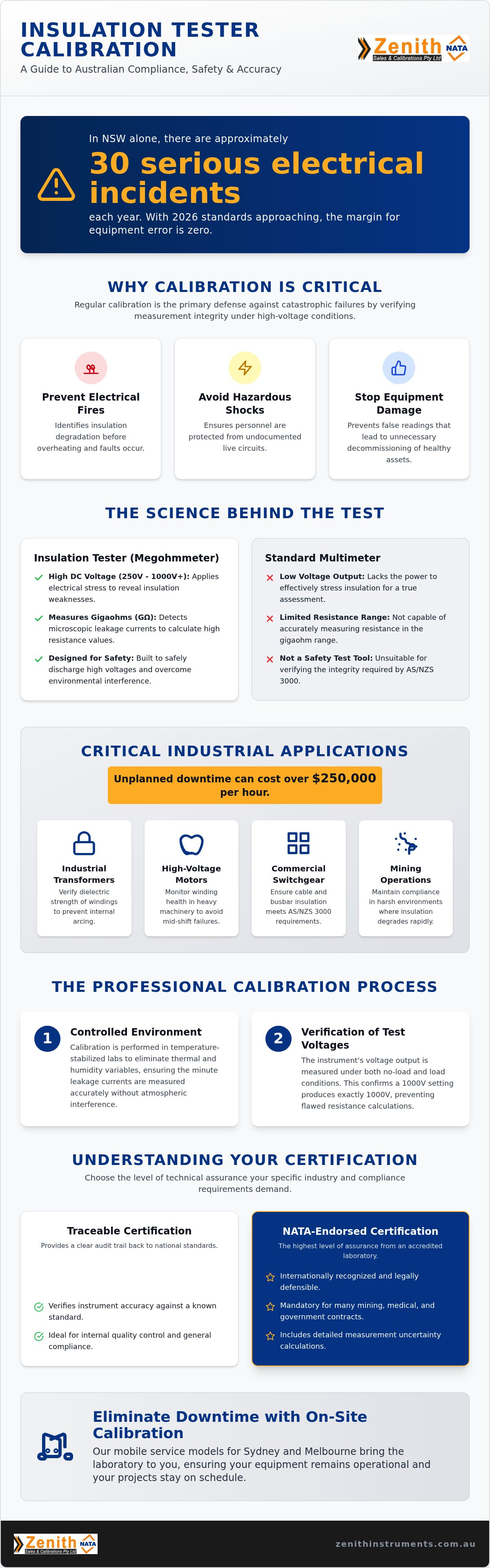
With approximately 30 serious electrical workplace incidents occurring in New South Wales each year, the margin for equipment error in 2026 has effectively vanished. We recognize that maintaining a fleet across Sydney and Melbourne is often a balancing act between rigorous safety standards and the practical need to avoid operational delays. You likely feel the pressure of upcoming safety audits and the uncertainty of whether your current certification will satisfy a meticulous inspector. Ensuring your insulation tester calibration is up to date isn't just about ticking a box; it's about verifying the integrity of every measurement you take in the field.
This article provides the technical clarity required to navigate Australian compliance, specifically focusing on the mandatory requirements of AS/NZS 3000. You'll learn the critical distinctions between NATA-endorsed and traceable certification, alongside the technical reasons why instrument drift occurs in even the highest quality megohmmeters. We'll preview the professional calibration processes used to guarantee accuracy and explain how mobile service models are now eliminating the traditional downtime associated with laboratory testing. By the end of this guide, you'll have a clear roadmap for keeping your equipment safe, accurate, and fully compliant with the latest 2026 industrial standards.
Key Takeaways
- Understand how AS/NZS 3000 mandates specific insulation resistance thresholds and why regular verification is essential for workplace safety.
- Learn the professional verification steps for voltage output and resistance accuracy used to ensure your megohmmeter meets laboratory standards.
- Differentiate between NATA-endorsed and traceable certifications to determine which level of technical assurance your specific industry requires.
- Discover how professional insulation tester calibration services in Sydney and Melbourne utilize on-site testing to eliminate operational downtime.
- Identify the physical and operational indicators that suggest your equipment has drifted out of spec before your next scheduled audit.
Why Insulation Tester Calibration is Critical
Insulation tester calibration is the rigorous verification of high-resistance measurement accuracy under high-voltage conditions. This technical process ensures that a megohmmeter provides precise readings when compared against a traceable laboratory standard. In industrial environments, the integrity of electrical insulation is the primary defense against catastrophic failures. Regular calibration prevents electrical fires, hazardous shocks, and expensive equipment damage by confirming that your tester correctly identifies insulation degradation before a fault occurs. Because these instruments apply significant stress to a circuit, often ranging from 250V to well over 1000V, any inaccuracy in the voltage output or the resistance return can lead to a false sense of security or the unnecessary decommissioning of healthy assets.
The Science of High Resistance Measurement
Accurate insulation testing relies on a specialized application of Ohm’s Law. While a standard multimeter measures resistance using low voltage and low current, an insulation tester must measure leakage current in the micro-ampere range while discharging high DC voltages. We calculate resistance by dividing the applied voltage by the measured leakage current ($R = V/I$). In the gigaohm (GΩ) range, even microscopic amounts of current leakage can significantly alter the displayed value. Environmental factors like high humidity or surface contamination on the test leads often create parallel resistance paths, which can skew results if the instrument is not properly calibrated to handle these variables. Understanding How an Insulation Tester (Megohmmeter) Works is essential for technicians who must distinguish between actual insulation breakdown and environmental interference. A dedicated insulation tester is designed to overcome the limitations of standard multimeters, which lack the internal power supply necessary to stress insulation effectively.
Common Applications for Calibrated Testers
In the Australian mining and manufacturing sectors, the cost of unplanned downtime often exceeds $250,000 per hour. Consequently, professionals rely on our electrical calibration services to maintain the reliability of their preventative maintenance programs. Calibrated testers are essential for several high-stakes applications:
- Industrial Transformers: Verifying the dielectric strength of winding insulation to prevent internal arcing.
- High-Voltage Motors: Monitoring the health of motor windings in heavy machinery to avoid mid-shift failures.
- Commercial Switchgear: Ensuring cable integrity and busbar insulation meet the mandatory requirements of AS/NZS 3000.
- Mining Operations: Maintaining safety compliance in harsh, damp environments where insulation is prone to rapid degradation.
Our laboratories in Sydney and Melbourne provide the technical precision required to ensure these tools remain accurate. By maintaining a strict calibration schedule, organizations protect their personnel and ensure their infrastructure remains compliant with national safety standards.
The Technical Process: How Professional Calibration is Performed
Professional insulation tester calibration requires a controlled setting to eliminate environmental variables that could compromise measurement integrity. At our specialized facilities in Sydney and Melbourne, we maintain temperature-stabilized laboratories to ensure every test is conducted under identical conditions. This is vital because the ultra-high resistance values measured by megohmmeters are extremely sensitive to thermal fluctuations and humidity. Without these controls, the minute leakage currents being measured could be masked or exaggerated by atmospheric interference, leading to inaccurate certification results.
Verification of Test Voltages
The first stage of the technical process involves measuring the instrument's actual voltage output. We test the terminal voltage under both no-load and load conditions to ensure the tester delivers the exact DC voltage selected on the interface. If an instrument set to 1000V only produces 950V, the resulting resistance calculation will be fundamentally flawed. Our technicians monitor voltage stability throughout the entire measurement cycle, ensuring the power supply does not dip or oscillate. This verification confirms that the instrument provides the necessary electrical stress to the insulation under test, as defined by the manufacturer’s specified tolerances.
Resistance Standards and Decade Boxes
We utilize NATA-traceable resistance standards and high-voltage decade boxes to verify the meter's accuracy across its entire range. These standards typically span from the kilohm (KΩ) level up to several hundred gigaohms (GΩ). It is critical that the calibration equipment itself possesses superior internal insulation to prevent internal leakage currents from tainting the results. By cross-referencing the tester's readings across multiple precise test points, we verify the linearity of the instrument’s sensor array. This multi-point check ensures the device remains accurate at both the low end of the scale and at its maximum measurement capability.
Beyond resistance and voltage, our process includes verifying auxiliary functions such as timer accuracy and short-circuit current limits. Accurate timers are essential for technicians performing Polarization Index (PI) and Dielectric Absorption Ratio (DAR) tests, where time-stamped readings are critical for trending data. The Technical Process of Insulation Testing emphasizes that these parameters are foundational for reliable field diagnostics. We also measure the short-circuit current to confirm it remains within safe, regulated limits to protect both the operator and the equipment. If your team requires this level of technical precision to meet safety audits, our electrical equipment calibration services provide the formal documentation and accuracy required for Australian industrial operations.
Compliance with Australian Standards and NATA Requirements
AS/NZS 3000, commonly known as the "Wiring Rules," establishes the mandatory framework for electrical safety across Australia. This standard requires that every new or modified installation undergoes rigorous verification before being energized. A central component of this verification is insulation resistance testing, which must be performed with equipment that is proven to be accurate. To satisfy these legal mandates, insulation tester calibration must be performed by laboratories that adhere to ISO 17025. This international standard governs laboratory competence and ensures that the calibration process is technically valid, providing a foundation for safety that Australian industries rely on.
High-risk sectors, such as Australian mining and medical facilities, typically mandate NATA-certified documentation rather than simple traceable reports. While "traceable" calibration links an instrument back to national standards, a NATA-endorsed certificate carries the formal accreditation of the National Association of Testing Authorities. This endorsement serves as the highest level of technical assurance. It confirms that the laboratory has been independently audited for its technical proficiency, equipment accuracy, and staff expertise. For contractors working on major infrastructure projects, using NATA-calibrated equipment is often a contractual requirement to mitigate liability and ensure precise safety data.
Understanding Your Calibration Certificate
A professional calibration certificate is a technical document that details the instrument's performance under specific conditions. It must include the "uncertainty of measurement," which quantifies the potential margin of error at specific test points. We provide "as found" data to show how the instrument performed upon arrival, followed by "as left" data after any necessary adjustments. This transparency is vital during site safety audits to demonstrate that your equipment was functioning within tolerance throughout its service life. You can review our resources on electrical equipment calibration services to understand how these documents support your compliance strategy.
Regulatory Intervals for Electrical Testing
The industry standard for insulation tester calibration is a 12-month interval. However, equipment used in harsh environments, such as dusty mining sites or high-humidity manufacturing plants, may require a 6-month cycle to account for accelerated instrument drift. Using uncalibrated equipment on Australian construction sites poses a significant legal risk. If an electrical fault leads to an incident and the testing equipment is found to be out of spec, the person in control of the business (PCBU) may face severe penalties for failing their "due diligence" requirements. We maintain NATA-certified labs in Sydney and Melbourne to help you meet these regulatory obligations with speed and precision.
When to Calibrate: Signs Your Insulation Tester is Out of Spec
Maintaining a regular schedule for insulation tester calibration is the foundation of electrical safety, yet environmental stress often necessitates intervention before the 12-month mark. Technicians must remain vigilant for subtle signs that an instrument’s precision has been compromised. We recommend following this five-step evaluation process to determine if your megohmmeter requires immediate laboratory attention:
- Step 1: Verify the calibration sticker. This is the most basic compliance check. If the expiration date has passed, the instrument's readings are no longer legally defensible in a safety audit.
- Step 2: Monitor for inconsistent readings. Test the meter against a known "good" circuit or a dedicated verification box. If a circuit that consistently reads 100MΩ suddenly reports 60MΩ without a change in environmental conditions, the internal reference may have shifted.
- Step 3: Inspect terminals and leads. High-voltage terminals must be free of corrosion. Check the high-voltage leads for cracks, abrasions, or stiffness, as compromised lead insulation will bleed current and skew your results.
- Step 4: Evaluate after physical incidents. Dropping a tester or exposing it to heavy moisture can misalign internal sensors or damage the high-voltage generator. If a tool is dropped, it should be re-verified regardless of its previous calibration date.
- Step 5: Review battery health. Low battery levels can lead to unstable high-voltage output. If your tester struggles to maintain a steady test voltage under load, it's a sign that the power regulation circuitry or the battery itself is failing.
Identifying Measurement Drift
Internal components, such as reference resistors and voltage regulators, experience natural aging that causes their electrical characteristics to shift over time. This phenomenon, known as measurement drift, occurs even if the device appears physically pristine. The primary danger lies in "false positives," where a degraded tester reports a passing resistance value for a circuit that is actually failing. This error can lead to catastrophic insulation failure once the system is energized. For broader insights into maintaining your diagnostic toolkit, refer to Zenith’s Multimeter Guide.
The Impact of Lead Resistance
Your test leads are an integral part of the measurement system. In high-resistance testing, the quality of the lead insulation is just as important as the meter's internal circuitry. Faulty or contaminated leads can create parallel leakage paths that mimic insulation breakdown in the equipment under test. We recommend performing nulling and zeroing procedures before every field test to compensate for lead resistance. However, if zeroing the meter doesn't produce a stable result, the leads or the internal circuitry likely require professional attention. If you suspect your readings are inconsistent, contact us to book your insulation tester calibration at our Sydney or Melbourne laboratories.
Professional Calibration Services in Sydney and Melbourne
Zenith Instruments maintains specialized, NATA-accredited laboratories in both Sydney and Melbourne to support the rigorous demands of the Australian industrial sector. We understand that insulation tester calibration is a critical component of your safety infrastructure, requiring both technical precision and logistical efficiency. For businesses operating across New South Wales and Victoria, our local presence ensures rapid response times and reduced transit risks. We also offer streamlined, courier-based logistics for regional and interstate clients, providing Australia-wide coverage that maintains the integrity of the national electrical grid.
On-Site Mobilisation vs. Laboratory Calibration
Choosing between on-site service and laboratory-based testing depends on your specific operational requirements. For high-volume instrument fleets, our on-site mobilization service is the most effective way to minimize downtime. We bring our technical expertise directly to your facility, allowing for immediate verification and certification of your equipment without the need for shipping. This is particularly beneficial for large-scale manufacturing plants or major construction contractors in Sydney and Melbourne who can't afford to have critical tools out of rotation for extended periods.
While on-site service offers unparalleled convenience, laboratory calibration remains the gold standard for high-precision or high-voltage equipment. Our temperature-controlled environments eliminate the atmospheric variables discussed in previous sections, ensuring the lowest possible measurement uncertainty. We prioritize a fast turnaround in our workshops to get your tools back into the field as quickly as possible. Whether you choose on-site or lab-based service, every insulation tester calibration we perform results in a comprehensive certificate that satisfies both NATA and ISO 17025 standards.
Expert Support for All Major Brands
Our technicians possess the specialized training required to calibrate and maintain instruments from all leading manufacturers, including Fluke, Megger, Kyoritsu, and Hioki. We don't just verify readings; we understand the internal architecture of these devices. If an instrument fails to meet its specified tolerances, we provide technical repair services to restore its accuracy. This proactive service model prevents the need for costly equipment replacements and ensures your diagnostic tools remain reliable assets for years to come. Reliability is our priority, and we're committed to delivering meticulous expert service for every client. Contact Zenith Instruments for a calibration quote today to ensure your equipment remains compliant and safe.
Securing Your Electrical Safety Infrastructure for 2026
Maintaining precise insulation resistance measurements is a non-negotiable requirement for Australian electrical professionals. We have explored how rigorous insulation tester calibration ensures compliance with AS/NZS 3000 and protects your assets from catastrophic failure. By understanding the technical nuances of measurement drift and the necessity of NATA-accredited standards, you can better manage your equipment's lifecycle and avoid the risks associated with inaccurate data.
Our specialized facilities in Sydney and Melbourne deliver NATA accredited laboratory standards for every instrument we handle. We also offer on-site calibration services to eliminate logistical delays for large fleets, ensuring your team remains productive. If your equipment falls out of spec, our team provides expert technical support and repairs to restore your tools to peak performance. Book Your Insulation Tester Calibration in Sydney or Melbourne to secure your next certification. We look forward to partnering with you to maintain the highest levels of safety and precision in your operations.
Frequently Asked Questions
How often should an insulation tester be calibrated in Australia?
An insulation tester should be calibrated every 12 months under standard operating conditions to comply with industry benchmarks. However, for equipment utilized in harsh environments like mining or high-humidity manufacturing, we recommend a 6-month interval to account for accelerated instrument drift. Regular scheduling ensures that your measurements remain accurate and that you fulfill the due diligence requirements mandated by Australian safety regulations and AS/NZS 3000.
What is the difference between NATA and Traceable calibration for insulation testers?
NATA calibration is performed in a facility accredited to ISO 17025 standards, providing a formal endorsement that the laboratory has been independently audited for technical competence. Traceable calibration means the instrument was tested against a standard linked to national benchmarks, but it lacks the formal NATA seal of approval. High-risk sectors like medical and mining often mandate NATA-endorsed certificates to satisfy rigorous safety audits and contractual obligations.
Can I calibrate my own insulation tester using a standard resistor?
You cannot perform a legitimate insulation tester calibration using a standard resistor because the process requires more than a simple resistance check. Professional calibration involves verifying the exact DC voltage output under load and measuring leakage current at the micro-ampere level. Standard resistors are not designed to handle the high voltages applied by a megohmmeter, and self-testing lacks the formal traceability required to satisfy Australian regulatory compliance.
Does calibration include the testing of the leads and probes?
Professional calibration must include the testing of the leads and probes because they are integral components of the measurement system. Faulty or contaminated leads can introduce parallel resistance paths, which significantly skew insulation resistance readings. Our technicians inspect leads for physical insulation integrity and verify their performance under high-voltage stress. This comprehensive approach ensures that the entire diagnostic kit, not just the meter, provides accurate data in the field.
What happens if my insulation tester fails calibration?
If your insulation tester fails calibration, we provide a detailed report identifying the specific test points where the instrument drifted out of tolerance. We offer expert technical support and repair services to restore the device to its specified accuracy levels. In cases where the internal circuitry is beyond repair, we recommend decommissioning the unit to prevent the risk of relying on false positive readings during critical safety inspections.
How long does the calibration process typically take at Zenith?
We prioritize rapid turnaround times to minimize the impact on your operational schedule. While specific durations depend on the current laboratory volume, our structured workflow in Sydney and Melbourne is designed for efficiency. We understand the cost of downtime, so we move efficiently from receipt to formal certification. For large fleets, our on-site mobilization service provides an even faster solution by performing the entire process at your facility.
Is on-site insulation tester calibration available in Sydney and Melbourne?
Yes, we provide on-site insulation tester calibration services across the Sydney and Melbourne metropolitan areas. This mobile service is specifically designed for industrial plants, large contractors, and mining operations that require high-volume testing without the delays of laboratory shipping. Our technicians bring NATA-traceable standards directly to your site, ensuring your equipment remains within rotation while meeting all Australian compliance mandates and safety documentation requirements.
Why is NATA accreditation important for electrical safety compliance?
NATA accreditation is important because it serves as the highest level of technical assurance in Australia. It confirms that a laboratory operates under the ISO 17025 framework and has been rigorously audited for precision and staff competence. Using a NATA-accredited facility for your insulation tester calibration provides legally defensible documentation. This is critical for demonstrating due diligence during workplace safety investigations or when working in high-risk industrial environments.