

Did you know that electrical faults and shocks lead to approximately 30 serious workplace incidents across New South Wales every year? This statistic highlights the life-altering stakes of equipment accuracy. We recognize that managing your insulation tester calibration sydney requirements often presents a difficult choice between maintaining site safety and suffering through lengthy operational downtime. It's frustrating to lose access to vital tools while navigating the technical differences between NATA and traceable certification.
Our 2026 guide simplifies these regulatory hurdles so you can maintain full compliance with SafeWork NSW and the latest AS/NZS 3000 standards. You'll learn how to master the transition to the mandatory BCNSW eCert portal and the updated Electricity Supply Regulation 2026. We provide a clear roadmap for securing fast turnaround times and precise high-voltage readings; this ensures your professional liability is protected and your audit trails remain beyond reproach. We'll break down the essential technical requirements you need to stay productive and compliant in an increasingly digital landscape.
Key Takeaways
- Master the legal framework involving AS/NZS 3000 and SafeWork NSW to ensure your high-resistance measurements meet mandatory safety benchmarks.
- Recognize how environmental factors and component aging trigger instrument drift, necessitating regular verification of DC voltage accuracy.
- Determine whether mobile on-site services or laboratory-grade precision best suits your operational needs for insulation tester calibration sydney.
- Implement a 12-month baseline calibration interval, adjusted for risk in harsh environments, to maintain tool reliability and professional liability protection.
- Secure your compliance records with NATA-traceable certification, facilitating seamless integration with the mandatory BCNSW eCert portal.
Why Insulation Tester Calibration is Mandatory for Sydney Electricians
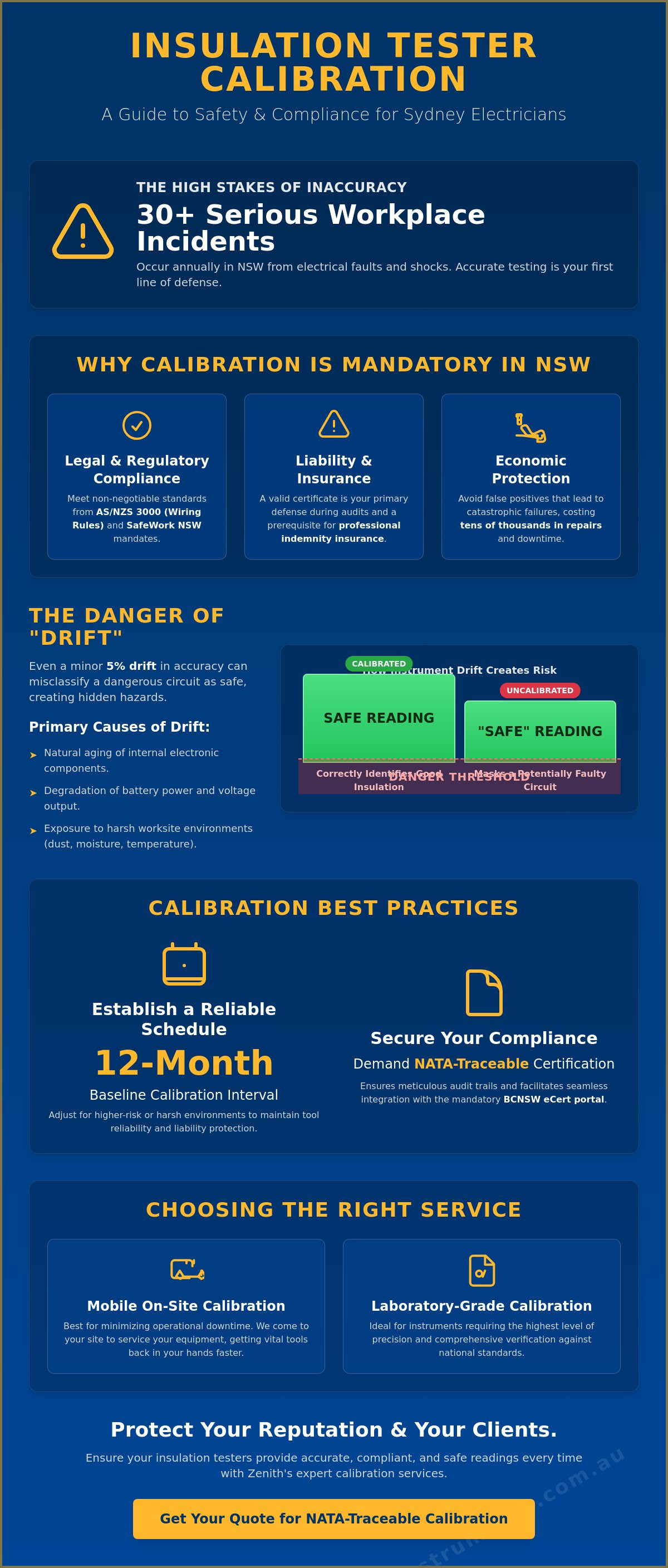
Professional insulation tester calibration sydney is the disciplined process of verifying a megohmmeter’s accuracy against established, high-resistance standards. This procedure ensures that the instrument’s high DC voltage output, typically ranging from 250V to over 1000V, correctly identifies leakage current without false readings. For Sydney contractors, this isn't just a maintenance task. It's a critical safety protocol. We understand that a mere 5% drift in instrument accuracy can be catastrophic. Such a deviation might show a "safe" reading on a circuit with degraded insulation that actually sits below the mandatory resistance threshold. This creates a hidden hazard, potentially leading to catastrophic equipment failure or electrical fires.
The legal framework governing this requirement is rigid. Compliance with AS/NZS 3000, commonly known as the Wiring Rules, is non-negotiable for any licensed electrician operating in New South Wales. SafeWork NSW mandates that all testing equipment must be maintained in a state that ensures accurate results. A valid calibration certificate serves as your primary defense during site audits and is a prerequisite for professional indemnity insurance. Without documented proof of accuracy, your liability in the event of an incident is significantly increased. Our meticulous approach ensures that your documentation stands up to the most rigorous scrutiny.
Compliance with AS/NZS 3000 and NSW Safety Standards
Adhering to the mandatory testing requirements for new and existing installations requires high-precision tools. Tier 1 construction contractors in Sydney now view current calibration certificates as a primary trust signal before allowing subcontractors on-site. By understanding The Technical Science of Insulation Resistance, we can better appreciate how insulation resistance (IR) testing serves as a frontline defense against electrical fires. Regular calibration ensures that these measurements remain precise, satisfying both regulatory bodies and project stakeholders. It's about establishing a partnership based on safety and verified performance.
The Economic Risk of Instrument Inaccuracy
The cost of a "false positive" during industrial maintenance far outweighs the price of routine service. If an inaccurate tester clears a faulty motor or transformer, the resulting burnout can lead to tens of thousands of dollars in replacement costs and unplanned downtime. Instrument drift, often caused by component aging or environmental exposure on Sydney worksites, directly impacts the longevity of your client's switchgear. Maintaining your equipment through professional electrical equipment calibration services ensures that your readings remain a reliable basis for preventative maintenance decisions. We provide the technical certainty needed to protect both your reputation and your client’s assets.
The Technical Science of Insulation Resistance and Instrument Drift
Understanding the physics behind insulation resistance is fundamental to maintaining electrical safety. Insulation testers operate by applying a high DC voltage, typically between 250V and 1000V or higher, across an insulator. By measuring the resulting minute flow of electricity, the instrument calculates resistance using Ohm’s Law (R=V/I). However, the accuracy of this calculation depends entirely on the stability of the internal components. Over time, every megohmmeter experiences instrument drift. This gradual change in measurement accuracy occurs due to the natural aging of internal resistors, battery degradation, and prolonged exposure to harsh work environments. Without regular insulation tester calibration sydney, these subtle shifts can lead to significant errors in reported resistance values.
Precision calibration focuses on verifying the actual voltage output rather than just the resistance reading shown on the display. If an instrument fails to deliver the full rated voltage, it won't stress the insulation sufficiently to reveal potential faults. We utilize high-accuracy decade boxes and calibrated voltmeters to ensure every device aligns with Mandatory Australian Standards. This technical rigor ensures that when your tester indicates a pass, the result is backed by verified physical performance. If you suspect your readings are inconsistent, our team can provide expert electrical equipment calibration services to restore your tool's precision.
Voltage Output vs. Resistance Accuracy
A common technical failure occurs when a tester displays a nominal 500V while only outputting 450V. This discrepancy leads to dangerous under-testing, where insulation appears healthy only because it hasn't been subjected to the required electrical stress. We verify the actual high-voltage source and test the "trip" or "cut-off" points in modern digital testers. This process ensures the instrument correctly identifies the threshold where insulation failure occurs, providing a reliable safety margin for your installations.
Environmental Factors: Sydney Humidity and Leakage Current
Sydney’s coastal geography introduces specific challenges for high-resistance measurements. In areas like Botany or Manly, high ambient humidity can create a thin film of moisture on the surface of the equipment being tested. Leakage current is the unintended flow of electricity through or over the surface of insulation. This moisture significantly increases surface leakage current, which an uncalibrated or poorly shielded tester might misinterpret as an internal insulation failure. We perform our insulation tester calibration sydney in laboratory-controlled environments to eliminate these environmental variables. This ensures the instrument is baseline-perfect before it ever faces the humid conditions of a coastal Sydney worksite.
On-Site vs. Laboratory Calibration in Sydney: Choosing the Right Service
Deciding between on-site and laboratory service is a strategic operational choice that impacts both your project timelines and measurement certainty. For many Sydney-based firms, the priority is balancing meticulous accuracy with the need to keep tools in the field. While both pathways provide essential certification, the technical requirements of your specific insulation tester often dictate the necessary environment. We recognize that high-stakes sectors require different levels of intervention compared to general residential electrical work. Choosing the correct service model ensures your insulation tester calibration sydney remains a reliable component of your safety management system.
Mobile Calibration for Large Sydney Workforces
Large electrical contractors managing extensive fleets often find that mobile calibration services sydney offer the highest efficiency gains. We can deploy technicians to industrial hubs like Parramatta or Western Sydney to calibrate entire fleets of testers at a single site. This eliminates the logistical burden of shipping equipment and ensures your team stays productive without tool shortages. However, on-site success depends on specific logistical requirements. We require a stable power source and a clean, vibration-free environment to maintain measurement integrity. If these environmental factors can't be guaranteed on-site, laboratory intervention becomes the safer technical choice to avoid inaccurate readings.
When Laboratory Precision is Mandatory
Certain technical scenarios make laboratory-grade precision non-negotiable. If you're operating in the medical or telecommunications sectors, the margin for error is effectively zero. High-voltage testers that exceed 5kV require specialized lab benches that are not portable. These benches provide the necessary shielding and stability to measure extremely high resistance without external interference. Our Sydney facility is designed for ISO 17025 compliance, meaning every variable from temperature to humidity is strictly controlled. This level of environmental regulation is vital for maintaining the traceability chain back to Australian National Standards. You can learn more about our specialized electrical equipment calibration services for these high-precision requirements.
We prioritize minimizing your downtime regardless of the service model you choose. Our Sydney laboratory is optimized for rapid-turnaround services, ensuring that even complex high-voltage testers don't stall your project timelines. By selecting the appropriate service level for your insulation tester calibration sydney needs, you ensure your equipment remains a dependable asset for critical site safety and compliance audits. We partner with you to determine the most efficient path to full regulatory adherence.
Establishing a Reliable Calibration Schedule for Your Equipment
A disciplined calibration schedule is the only way to guarantee the long-term accuracy of your high-voltage measurements. For most Sydney contractors, a 12-month interval serves as the industry-standard baseline. This timeframe aligns with the general recommendations of major manufacturers and satisfies most regulatory audit requirements. However, we recommend a risk-based approach rather than a one-size-fits-all policy. If your equipment is frequently exposed to the dust and vibration of large-scale Sydney construction sites, a more frequent six-month cycle may be necessary to mitigate the risk of instrument drift.
We also advise implementing intermediate checks between your official insulation tester calibration sydney appointments. By using a known resistance standard, such as a dedicated check box, you can verify your instrument’s consistency on a weekly or monthly basis. These checks don't replace formal certification, but they act as an early warning system. They help you identify potential issues before they lead to a failed audit or, worse, an unsafe site condition. Our team at Zenith Sales & Calibrations can help you establish a schedule that balances operational efficiency with uncompromising safety.
Signs Your Insulation Tester is Drifting
Recognizing the warning signs of equipment failure can prevent costly errors in the field. You should monitor your device for these specific red flags:
- Inconsistent readings: Obtaining different results on the same circuit under identical environmental conditions suggests internal component instability.
- Physical damage: Frayed leads or corroded terminals introduce parasitic resistance, which skews high-range measurements.
- Slow response times: A failure to reach the selected test voltage quickly often indicates battery degradation or failing high-voltage circuitry.
Documentation and Audit Readiness
A calibration certificate is more than a pass/fail document. It provides a detailed record of the uncertainty of measurement, which is critical for high-precision industrial applications. Sydney businesses seeking to meet ISO 9001 quality requirements must maintain organized digital records of these certificates. This ensures that every tool in your fleet has a verifiable history of accuracy, making site audits and compliance reviews straightforward and stress-free. If your current records are incomplete, we invite you to contact Zenith Sales & Calibrations to formalize your equipment maintenance program.
Zenith Instruments: Sydney’s Dependable Experts in Electrical Calibration
We maintain a rigorous commitment to NATA-traceable standards and ISO-compliant processes, ensuring that every measurement we verify stands up to the strictest regulatory scrutiny. Our expertise covers the full spectrum of high-resistance measurement tools. Whether your team utilizes compact, handheld Meggers for residential circuit testing or complex industrial high-voltage testers for grid maintenance, we provide the technical certainty required for safe operation. Professional insulation tester calibration sydney is a foundational pillar of our service model, designed to help you satisfy SafeWork NSW audits and AS/NZS 3000 requirements without compromise.
Our Sydney laboratory is optimized for precision and speed. We recognize that every day your tools spend in a lab is a day of lost productivity on-site. We prioritize fast turnaround times, utilizing automated calibration benches and highly disciplined workflows to return your equipment to the field as quickly as possible. Unlike basic service providers, we offer a comprehensive technical solution. If our technicians identify instrument drift or component failure, we have the capability to diagnose and repair faulty instrumentation in-house. This proactive approach saves you the expense and logistical headache of coordinating with multiple vendors or purchasing new equipment prematurely.
Comprehensive Electrical and Telecommunication Support
We support the backbone of the city's infrastructure through specialized Telecommunication & Networking Calibration. This ensures that high-speed data networks remain reliable and compliant with national standards. Our technicians also safeguard critical healthcare environments with Biomedical Equipment Calibration, where instrument accuracy is literally a matter of life and death. We possess deep technical knowledge of leading industry brands, including Fluke, Megger, and Kyoritsu. This brand-specific expertise allows us to maintain the original manufacturer’s performance specifications throughout the tool's lifecycle.
Get a Professional Quote for Your Sydney Workshop
Securing a professional quote for your workshop is a streamlined, efficient process. We offer flexible service options to suit your operational scale, including local drop-off points for individual contractors and mobile service requests for larger firms. We specialize in developing customized calibration plans for multi-instrument fleets. This holistic management approach covers your entire toolkit, from multimeters and clamp meters to Portable Appliance Testers. For a deeper look at maintaining your essential electrical tools, we recommend reviewing our Multimeter Guide 2026: The Essential Tool for Sydney & Melbourne Professionals. We invite you to partner with us to ensure your insulation tester calibration sydney needs are handled with the meticulous care your profession demands.
Prioritize Precision for Your Next Electrical Audit
Maintaining accurate high-voltage measurements is a non-negotiable requirement for ensuring site safety and regulatory adherence. By understanding the technical nuances of instrument drift and the rigid demands of AS/NZS 3000, you position your business as a leader in electrical safety. We've explored how the choice between mobile services and laboratory precision impacts your operational efficiency, especially as NSW transitions toward mandatory digital compliance via the BCNSW eCert portal. Adopting a risk-based calibration schedule ensures your tools remain dependable assets rather than liabilities.
Reliable insulation tester calibration sydney serves as your primary defense against professional liability and equipment failure. Our team brings over 20 years of technical expertise to every project, utilizing ISO 9001 compliant processes and NATA-certified standards to guarantee measurement certainty. We partner with you to maintain a rigorous maintenance schedule that keeps your tools in the field and your team protected. This disciplined approach to equipment maintenance reflects the high standards of the technical industries we serve.
Don't leave your compliance to chance. Book Your Insulation Tester Calibration in Sydney Today to ensure your equipment meets the highest industrial benchmarks. We look forward to supporting your ongoing success and safety.
Frequently Asked Questions
How often should I calibrate my insulation tester in Sydney?
You should calibrate your insulation tester every 12 months to satisfy standard industry requirements and manufacturer recommendations. If your equipment is frequently exposed to the high-vibration and dusty environments typical of Western Sydney construction sites, we recommend a six-month interval. This proactive approach ensures your readings remain accurate and mitigates the risk of instrument drift during critical site inspections.
What is the difference between NATA and traceable calibration for electrical tools?
NATA calibration involves a full assessment by a facility accredited by the National Association of Testing Authorities, ensuring compliance with ISO 17025 standards. Traceable calibration verifies your tool against a known standard that's itself linked to national standards, but it lacks the formal NATA endorsement. Most standard electrical contracting work in Sydney accepts traceable certification, while high-risk sectors often mandate full NATA accreditation for insulation tester calibration sydney.
Can I calibrate my own insulation resistance tester using a decade box?
You can't legally calibrate your own instrument for compliance purposes, though you can perform intermediate verification checks using a decade box. Official certification requires a controlled laboratory environment and reference standards with a documented chain of traceability. Attempting a DIY calibration fails to provide the necessary audit trail required by SafeWork NSW and professional indemnity insurers. We provide the formal documentation needed to prove your tool's accuracy.
What happens if my insulation tester fails calibration?
If your tester fails to meet the required accuracy thresholds, our technicians will diagnose the underlying fault. We often find that failures stem from aging internal resistors or degraded high-voltage circuitry. We provide detailed repair options to restore the instrument to manufacturer specifications. If the device is beyond economical repair, we'll provide a technical report so you can make an informed decision about purchasing a replacement.
Does Zenith Instruments offer on-site calibration in Western Sydney?
We offer comprehensive on-site calibration services across Western Sydney for companies managing large fleets of electrical instruments. This mobile service minimizes your operational downtime by bringing our technical expertise directly to your facility in hubs like Blacktown or Penrith. We require a stable power supply and a clean workspace to maintain measurement integrity. Our mobile technicians ensure your insulation tester calibration sydney is completed efficiently without the equipment ever leaving your site.
Is insulation tester calibration required for AS/NZS 3000 compliance?
Yes, AS/NZS 3000 compliance relies on the accuracy of your test results, which can only be guaranteed through regular calibration. The Wiring Rules mandate specific insulation resistance values for safety, and using an uncalibrated instrument risks recording false "pass" results. Maintaining a current calibration certificate provides the technical evidence that your installations meet the safety standards required by the Electricity Supply Regulation 2026.
How long does a typical insulation tester calibration take at the Sydney lab?
A standard insulation tester calibration at our Sydney laboratory typically takes between two and three business days. We prioritize a rapid turnaround to ensure your team stays productive and your project timelines remain on track. If you have a large volume of instruments or require urgent processing, we can coordinate specific schedules to meet your logistical needs. Our structured workflow ensures every device undergoes rigorous testing without unnecessary delays.
Do I need to calibrate my test leads along with the insulation tester?
You must include your test leads during the calibration process because they are an integral part of the measurement circuit. Frayed or damaged leads introduce parasitic resistance and leakage current, which can significantly skew your high-voltage readings. We inspect and test your leads as part of our comprehensive service. This ensures the entire measurement system, not just the meter itself, provides the precision required for high-resistance testing.