

Would your maintenance records survive a rigorous SafeWork Australia audit if a critical asset failed tomorrow? We recognize that navigating the technical demands of AS/NZS 3000 while managing high-stakes industrial environments is a constant challenge. You're likely frustrated by the ambiguity of test voltage requirements or the five to ten days of lost productivity that occurs when your primary insulation tester is sent away for routine service. It's a risk to your operational continuity that demands a precise, technical solution.
This guide ensures you master the nuances of your equipment and maintain absolute compliance with Australian industrial safety standards for 2026. We'll provide a comprehensive breakdown of voltage selection for commercial loads, the critical role of NATA-certified calibration, and how our onsite service model across Sydney, Melbourne, and Brisbane keeps your facility running without interruption. We'll help you transform your testing protocols from a compliance burden into a verified asset protection strategy.
Key Takeaways
- Gain a technical understanding of insulation resistance (IR) testing to effectively mitigate electrical leakage and fire hazards across Australian worksites.
- Master the selection process for your next insulation tester by matching specific voltage ranges and display types to your unique industrial or commercial requirements.
- Ensure your operations meet strict Australian compliance standards, with specialized insights into the regulatory protocols for the medical and mining sectors.
- Learn the critical distinction between standard accuracy checks and NATA-accredited calibration to guarantee your equipment remains precise and legally compliant.
- Discover how partnering with qualified Australian technicians and utilizing nationwide support can streamline the maintenance of your high-precision measurement instrumentation.
Understanding Insulation Testers: The Foundation of Electrical Safety in Australia
An insulation tester is a specialized high-resistance ohmmeter designed to measure the integrity of electrical insulation by detecting leakage current. Often referred to professionally as a Megohmmeter, this instrument is vital for identifying the gradual degradation of protective coatings before a catastrophic failure occurs. In the Australian industrial sector, where environmental factors like high humidity and salt spray affect equipment longevity, these testers serve as the first line of defense against electrical fires and lethal shocks.
Compliance with Australian Standards is a legal and operational necessity. Specifically, AS/NZS 3000, known as the Wiring Rules, mandates rigorous testing and verification of electrical installations. Failure to maintain documented proof of insulation resistance (IR) testing can lead to the immediate voiding of industrial insurance policies. For businesses operating in Sydney and Melbourne, maintaining high-accuracy instrumentation is a core requirement for passing annual safety audits. We provide specialized electrical equipment calibration services to ensure these devices meet the precision levels demanded by NATA-accredited frameworks.
How Insulation Resistance Testing Works
The process involves applying a high-voltage DC signal, typically ranging from 250V to 5,000V, across a non-conductive material. While a standard continuity test uses low voltage to check for circuit completion, an insulation test uses high voltage to "stress" the insulation and measure its resistance in megohms. This identifies microscopic cracks or moisture ingress that a standard multimeter would miss. IR testing applies Ohm’s Law by measuring the minute leakage current resulting from a known high-voltage input to calculate the resistance of the insulating material. High resistance readings indicate healthy insulation, whereas low readings signal potential short circuits or grounding issues.
Key Components of a Professional Tester
A professional-grade insulation tester consists of a stable DC voltage generator, a sensitive micro-ammeter, and a clear digital display for real-time data logging. The quality of the lead sets is paramount; they must be rated for the high voltages the unit produces to ensure operator safety. On harsh Australian worksites in Newcastle and Brisbane, the physical build of the device is just as important as its internal circuitry. Heavy-duty, impact-resistant casings with high IP (Ingress Protection) ratings are necessary to withstand dust, grit, and moisture.
- CAT III Rating: Essential for testing fixed installations, such as distribution boards and lighting systems.
- CAT IV Rating: Required for testing at the source of the low-voltage installation, including electricity meters and primary over-current protection devices.
- Digital Logging: Allows technicians to track resistance trends over time, which is a key requirement for predictive maintenance schedules.
Operators must select a tool that matches the specific voltage requirements of their equipment. Using an incorrectly rated tester can damage sensitive electronics or provide false safety readings. Precision is the only way to guarantee site safety and regulatory compliance.
Selecting the Right Tester: Key Features and Voltage Ranges
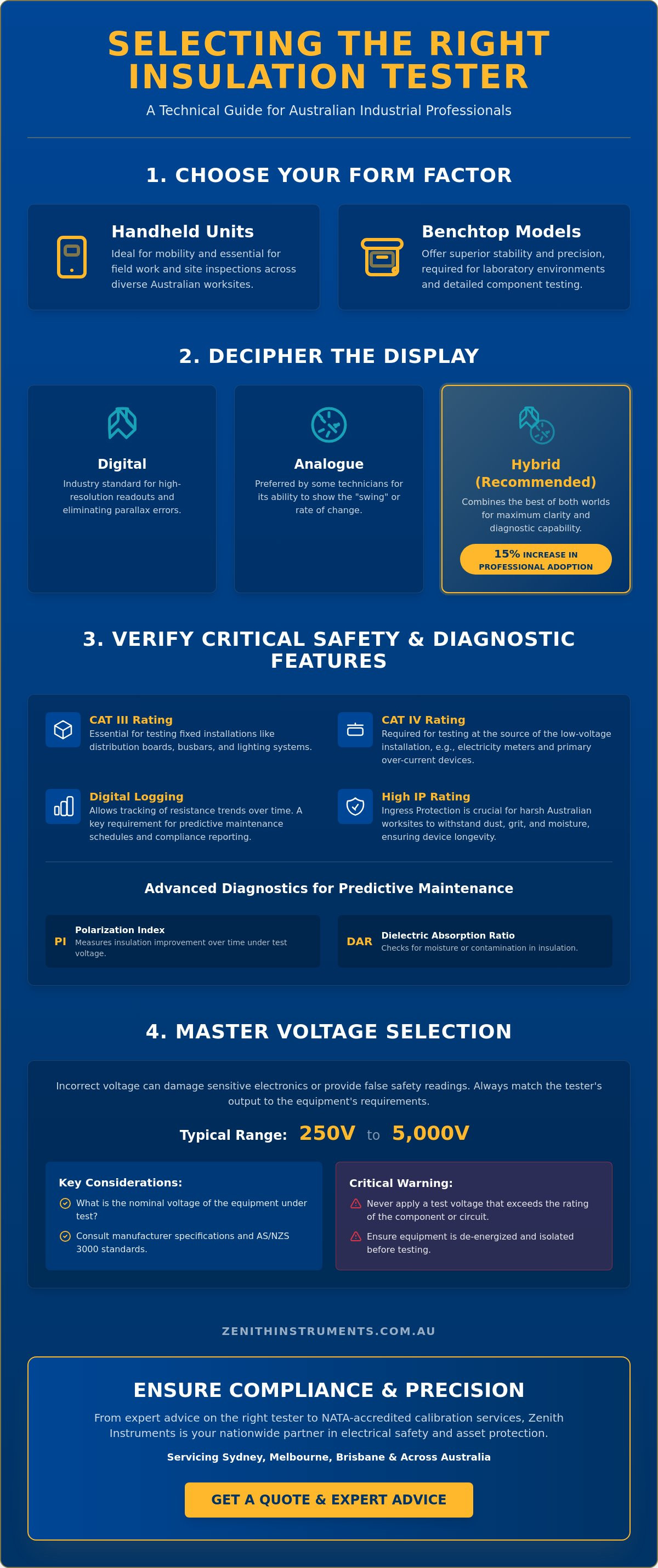
Choosing an insulation tester requires a technical assessment of your specific operational environment and the electrical assets under your care. Handheld units provide the mobility required for site inspections across Melbourne, while benchtop models offer the stability and precision needed for laboratory environments. Digital displays have become the industry standard because they eliminate parallax errors and provide high-resolution readouts. However, some field technicians still prefer analogue scales for their ability to show the "swing" or rate of change in insulation resistance during a test. We've observed a 15% increase in Australian professionals opting for hybrid units that combine both display types to ensure maximum clarity during field work.
Advanced diagnostics like Polarization Index (PI) and Dielectric Absorption Ratio (DAR) are essential for predictive maintenance on large industrial motors. These ratios measure how insulation resistance changes over time, specifically over a 10-minute interval for PI. This data identifies moisture ingress or thermal degradation that a standard one-minute spot test might overlook. Accurate diagnostic data helps your facility meet ISO 9001 quality standards and reduces the risk of unplanned downtime in high-output manufacturing sectors. To maintain the integrity of these measurements, we recommend regular electrical equipment calibration services to ensure your device remains within its specified tolerance levels.
Voltage Selection Guide for AU Professionals
- 250V: Use this setting for telecommunications equipment and sensitive electronics. Higher voltages can permanently damage internal components in these low-power systems.
- 500V: This is the benchmark for domestic and commercial low-voltage installations as per AS/NZS 3000. It's the most common setting used for testing standard 230V/400V circuits.
- 1000V+: Industrial motors, high-voltage transformers, and heavy-duty cabling require 1000V or 5kV testing. These higher potentials are necessary to stress the insulation sufficiently to reveal latent defects.
Advanced Diagnostic Features to Consider
Modern workshops in Sydney and Perth are increasingly adopting insulation tester models with integrated data logging. This feature allows for the digital storage of test results, which can be exported for long-term maintenance reporting. Wireless connectivity through mobile apps simplifies the process of generating compliance certificates on-site, improving administrative efficiency by an estimated 22% compared to manual entry. Safety remains the highest priority. Auto-discharge functions are a non-negotiable requirement for any modern unit. This feature safely bleeds off stored energy from high-capacitance circuits after a test, protecting the technician from accidental shocks. Since January 2024, updated safety protocols have highlighted the necessity of verifying these discharge circuits during routine maintenance cycles.
Insulation Testing Across Australian Industries: From Medical to Mining
Australia's industrial landscape demands rigorous electrical safety standards that vary significantly by sector. We see these requirements firsthand when providing calibration services across the country. Whether you're operating a high-rise in Canberra or a remote mine site in the Pilbara, your insulation tester must deliver precise results to ensure regulatory compliance and personnel safety. Reliable measurement isn't just a technical preference; it's a legal necessity under various state-based Work Health and Safety (WHS) frameworks.
Biomedical and Healthcare Applications
In major hubs like Sydney and Melbourne, biomedical facilities operate under the strict AS/NZS 3551 standard. This framework governs the management of medical devices where even a minor leakage current can have fatal consequences for patients. We provide specialized Biomedical Equipment Calibration Services to help healthcare providers maintain these critical safety margins. Testing sensitive diagnostic machinery requires high-resolution instruments that can detect insulation degradation before it poses a risk to patient-connected circuits. Regular verification ensures that every piece of equipment, from patient monitors to surgical lasers, remains safe for clinical use.
Mining and Heavy Industrial Requirements
The mining sectors in Queensland and Western Australia present the most challenging environments for electrical testing. Equipment in Newcastle and the Hunter Valley often faces extreme dust, moisture, and constant vibration. Technicians must regularly test large-scale motors and heavy-duty switchgear to prevent catastrophic failures and costly downtime. In explosive atmospheres, such as underground coal mines, the use of an intrinsically safe insulation tester is a non-negotiable safety requirement to prevent ignition sources. We prioritize NATA-traceable calibration for these tools to ensure they withstand the rigors of heavy industrial applications while providing accurate data.
The transition toward renewable energy has introduced new complexities for electrical contractors. Solar farms and wind turbines require specialized insulation resistance testing to handle high DC voltages and environmental stressors. These installations often span vast areas, making portable and durable testing equipment essential. Meanwhile, in Canberra, high-density commercial developments prioritize electrical safety to protect thousands of occupants within integrated building management systems. Managing these complex systems requires a structured testing regime that aligns with local building codes and national safety standards. We ensure your tools are calibrated to meet these demanding specifications, providing the documentation needed for site handovers and annual safety audits.
- Solar Infrastructure: Testing PV arrays and inverters for ground faults in high-temperature environments.
- Wind Energy: Insulation monitoring of nacelle components and underground cabling.
- Commercial High-Rise: Routine testing of distribution boards and emergency lighting circuits in Canberra's CBD.
- Industrial Motors: Polarization Index (PI) and Dielectric Absorption Ratio (DAR) testing for 11kV assets.
The Critical Role of Calibration for Insulation Testers in Sydney & Melbourne
Purchasing a high-end insulation tester provides the hardware, but it doesn't guarantee regulatory compliance. Many Australian electrical contractors mistakenly rely on factory-issued certificates of conformity. These documents often lack the rigorous traceability required for legal defense or safety audits under AS/NZS 3000:2018. Out-of-the-box accuracy is a baseline, not a permanent state. For professionals operating in high-stakes environments, verified precision is a mandatory safety protocol.
Australia's environmental conditions are particularly taxing on sensitive measurement electronics. In Sydney, high coastal humidity can lead to moisture ingress, while Melbourne's 15-degree temperature swings in a single day cause thermal expansion in internal components. These factors accelerate instrument drift. We've observed that approximately 15% of instruments left uncalibrated for over 18 months fall outside of acceptable tolerance levels. Maintaining a 6 to 12-month calibration cycle is the only way to ensure your insulation tester remains a reliable safety tool. This interval is the industry standard for maintaining the integrity of your test data.
NATA Accreditation: The Gold Standard
NATA accreditation isn't just a badge; it's a requirement for 100% of high-tier industrial and government contracts across Australia. A NATA-endorsed report provides a level of legal and technical certainty that standard checks cannot match. It confirms that your equipment has been tested in a controlled environment with direct traceability to national measurement standards. This process involves a meticulous evaluation of the instrument’s performance across its entire range, ensuring that your measurements are accurate enough to protect lives and infrastructure. Explore our Electrical Equipment Calibration Services to learn more about our technical capabilities.
On-Site vs. Lab Calibration
Minimizing downtime is vital for maintaining project timelines in Sydney and Melbourne. On-site calibration services allow our technicians to verify your equipment at your facility, eliminating the logistics of shipping and the risk of transit damage. It's an efficient solution for large fleets of testers. However, if an insulation tester fails its initial verification or shows signs of physical damage, a lab-based deep-dive is necessary. Our laboratories are equipped for complex repairs and component-level adjustments that can't be performed in the field. For local bookings and fast turnaround times, visit our Calibration Service Melbourne page.
Keep your equipment compliant and your workforce safe by booking a professional service today. Schedule your insulation tester calibration with our expert team.
Zenith Instruments: Your Partner for Sales and Calibration Nationwide
Zenith Instruments serves as the primary technical partner for over 3,000 Australian organizations requiring precision and compliance. We maintain a comprehensive inventory of high-performance test equipment designed for the rigorous demands of the local energy and construction sectors. Our technical team operates from specialized facilities in Sydney, Melbourne, and Brisbane to provide localized support across the continent. When you acquire an insulation tester from our team, you receive more than a hardware shipment. You gain access to a full lifecycle of support including procurement, expert repair, and NATA-certified calibration under one roof.
Our technical staff consists of qualified Australian technicians who understand the specific environmental challenges of the Outback and the high-density requirements of metropolitan infrastructure. We bridge the gap between simple retail and professional engineering support. This integrated model ensures that any equipment purchased through Zenith remains compliant with AS/NZS 3000 standards from the first day of operation until its eventual decommissioning. We prioritize speed and accuracy to help your business avoid the costly delays associated with uncertified or malfunctioning gear.
Why Choose Zenith for Your Next Tester?
We don't just sell tools; we ensure they stay accurate for their entire lifespan through rigorous testing protocols. Our inventory features industry-leading brands such as Major Tech and Fluke. These instruments are selected for their durability and precision in field conditions. Our facilities in Sydney and Melbourne are equipped with state-of-the-art reference standards to maintain your fleet's integrity.
Our electrical equipment calibration services adhere to ISO/IEC 17025 standards, providing you with a NATA-endorsed certificate that acts as a primary trust signal for your clients. We provide tailored solutions for diverse operations. A small electrical contractor might require a portable 500V unit, while a large-scale industrial fleet requires 10kV diagnostic tools for high-voltage transformer testing. Zenith Instruments delivers the specific hardware and the recurring certification needed to keep every technician safe and every reading defensible.
Get Started with Zenith Today
Securing your next insulation tester or scheduling a service is a straightforward process. You can request a comprehensive quote for new equipment or calibration through our digital portal. For professionals looking to expand their diagnostic capabilities, our Multimeter Guide 2026 provides essential insights into complementary tools for the modern Australian sparky.
We offer flexible service models to suit your operational tempo. This includes a standard 3-5 business day turnaround for laboratory-based testing and mobile onsite units for larger facilities. Our onsite technicians travel to major Australian hubs to minimize your operational downtime. This proactive service model allows your team to maintain peak productivity without the logistical delays of traditional shipping. Contact Zenith Instruments today to book an onsite service or discuss your fleet's technical requirements with a dependable expert.
Securing Precision and Compliance for Your Australian Operations
Maintaining the integrity of electrical systems requires more than just high-quality hardware. Selecting the right insulation tester involves matching specific voltage ranges to your industrial requirements, whether you're operating in Sydney’s medical facilities or Northern Territory mining sites. Regular calibration ensures these instruments remain accurate under rigorous Australian conditions. Our NATA Accredited Laboratory provides the technical certainty required for ISO 9001 compliant processes. We eliminate downtime through our Australia-wide on-site service, delivering meticulous results where you need them most. Precision isn't optional when safety is at stake. We partner with you to maintain the highest standards of measurement accuracy and regulatory adherence. Our technicians understand the strict demands of Australian standards and work to ensure your fleet meets every requirement. Trust our team to keep your equipment performing at its peak with the reliability your industry demands.
Book Your NATA-Certified Insulation Tester Calibration Now
We're ready to support your commitment to electrical safety and technical excellence across Australia.
Frequently Asked Questions
How often should I calibrate my insulation tester in Australia?
You should calibrate your insulation tester every 12 months to maintain compliance with Australian Standards like AS/NZS 3000. While some high-usage industrial environments require 6-month intervals, an annual certification ensures your instrument maintains the precision required for safety audits. We provide NATA accredited calibration across our Sydney and Melbourne laboratories to verify that your equipment meets ISO 17025 requirements.
What is a good insulation resistance reading for a 240V circuit?
A reading of at least 1 MΩ is the minimum acceptable limit for a 240V circuit according to AS/NZS 3000:2018 Wiring Rules. However, new installations typically yield readings exceeding 100 MΩ. If your measurement falls below 5 MΩ, it indicates potential insulation degradation or moisture ingress that requires immediate investigation to prevent circuit failure or electrical fire hazards.
Can I use a multimeter instead of an insulation tester?
You can't use a standard multimeter as a substitute for a dedicated insulation tester because multimeters lack the high-voltage output necessary to stress the insulation. A multimeter typically uses a 9V battery, whereas an insulation tester applies 250V, 500V, or 1000V to detect leakage paths. Using the wrong tool produces misleading results and compromises the safety of the electrical installation.
Is NATA calibration mandatory for all electrical contractors in Sydney?
NATA calibration isn't legally mandatory for every residential contractor in Sydney, but it's a strict requirement for those working on government infrastructure, medical facilities, or Tier 1 construction sites. Holding a NATA endorsed certificate provides the highest level of legal traceability in Australia. We recommend this level of service for any firm operating under ISO 9001 quality management systems to ensure total technical compliance.
What is the difference between a 2-wire and 3-wire insulation test?
The primary difference is that a 2-wire test measures resistance between two points, while a 3-wire test utilizes a guard terminal to eliminate surface leakage errors. In high-humidity environments or when testing high-voltage cables, the 3-wire method ensures that only the internal insulation resistance is measured. This extra precision prevents "ghost" readings caused by dirt or moisture on the outer jacket of the equipment.
Can temperature affect my insulation resistance readings?
Temperature significantly impacts insulation resistance, with readings typically halving for every 10 degrees Celsius increase in conductor temperature. To maintain accuracy, you must correct your readings to a base temperature of 20 or 40 degrees Celsius using standard IEEE coefficients. Failing to account for a 35-degree day in Brisbane compared to a 10-degree morning in Hobart will result in inconsistent data across your maintenance logs.
What safety precautions should I take before performing an insulation test?
You must ensure the circuit is fully de-energized and locked out according to AS/NZS 4836 before you connect your insulation tester. Verify the absence of voltage with a secondary tester and discharge any capacitive charge in the system after the test is complete. We emphasize that skipping these steps exposes technicians to lethal shocks from stored energy, even after the main power is disconnected.