

What if a single decimal point error on a safety tester led to a catastrophic equipment failure during your next facility audit? As the National Measurement Guidelines 2026 replace foundational standards this April, the margin for error in multimeter calibration australia wide hasn't been this slim in over a decade. You likely recognize that maintaining precision is non-negotiable for industrial safety, yet the logistical burden of tool transit often creates expensive operational bottlenecks. At Zenith Sales & Calibrations Pty Ltd, we understand that for engineers in Sydney and Melbourne, every hour an instrument spends in transit is an hour of lost productivity.
We believe that technical certainty shouldn't come at the cost of your schedule. This professional guide provides the technical roadmap you need to master the ISO 9001:2026 transition and ensure your equipment meets NATA-accredited benchmarks without the typical downtime. We'll clarify the critical distinctions between traceable and NATA-endorsed certificates, explain the technical testing methodology, and demonstrate how our proactive onsite service model keeps your workflow moving. By the end of this article, you'll have a clear strategy to secure compliance and maintain the absolute measurement accuracy your industry demands.
Key Takeaways
- Align your maintenance protocols with AS/NZS 3000:2018 and the 2026 National Measurement Guidelines to ensure your facility remains compliant with updated Australian standards.
- Determine whether onsite or laboratory-based multimeter calibration australia services best suit your workflow by comparing logistical speed against ambient condition controls.
- Gain insight into the technical precision required for zero-point adjustments and the elimination of residual resistance during a professional instrument inspection.
- Secure your audit outcomes by understanding the mandatory requirements for NATA accreditation and the ISO/IEC 17025 "Chain of Traceability" to the National Measurement Institute.
- Leverage the expertise of NATA-accredited laboratories in Sydney and Melbourne to maintain industrial safety and equipment longevity across the mining, medical, and energy sectors.
Understanding Multimeter Calibration Standards in Australia
In a rigorous technical environment, multimeter calibration australia represents the essential process of comparing a device’s readings against a known reference standard to quantify and correct inaccuracies. This isn't merely a check-box exercise. True calibration involves a structured methodology to ensure that an instrument's output aligns with the primary standards held by the National Measurement Institute. While some technicians use the terms interchangeably, we distinguish between verification, which simply confirms an instrument is within a broad tolerance, and calibration, which provides a detailed report of measurement uncertainty and traceability.
Compliance hinges on adherence to AS/NZS 3000:2018, commonly known as the Wiring Rules. This standard mandates that electrical installations are tested and verified before being placed into service. As we move through 2026, the demand for precision has intensified, particularly within the medical and renewable energy sectors. High-voltage battery storage systems and sensitive diagnostic equipment require tighter tolerances than traditional residential circuits. Failure to meet these updated benchmarks can lead to catastrophic hardware failure or regulatory sanctions under the National Measurement Act 1960.
The 12-Month Calibration Interval: Why It Matters
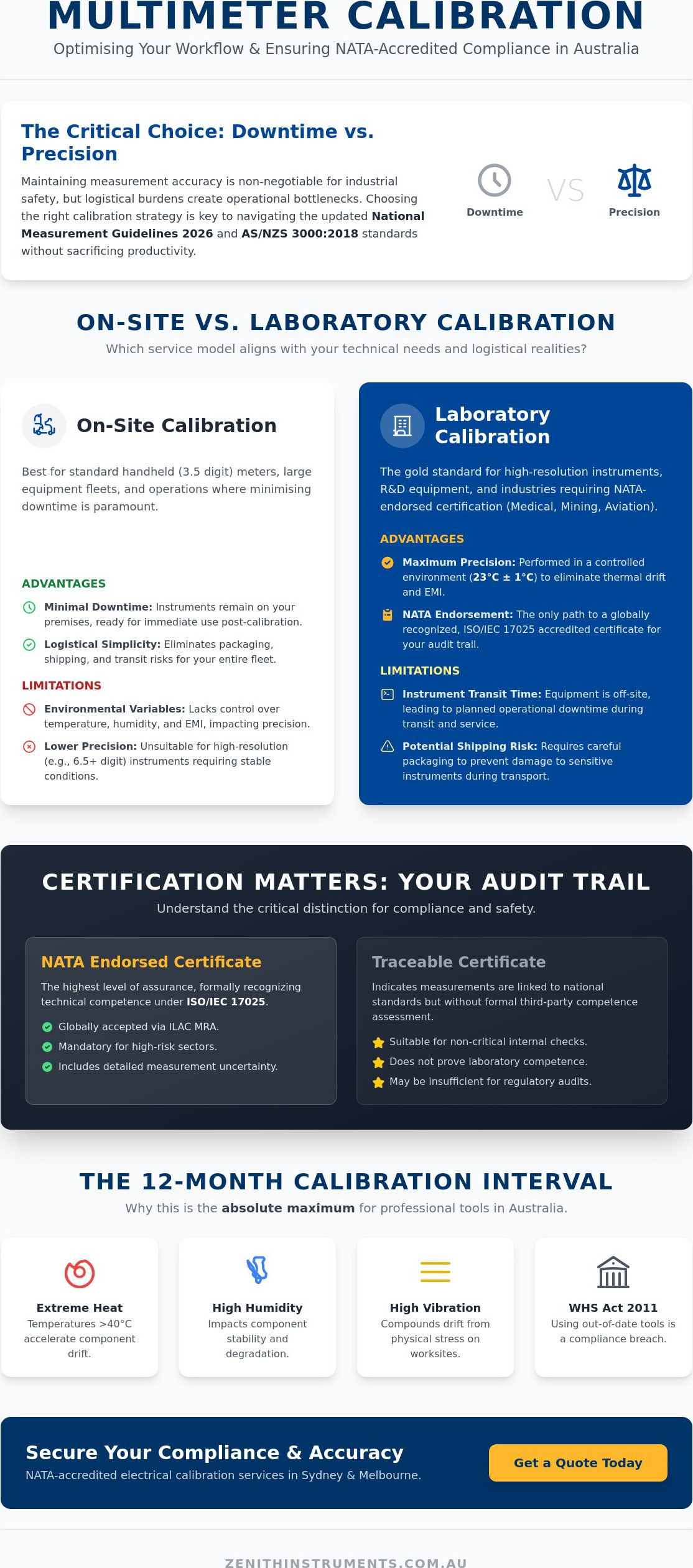
We recommend a 12-month interval as the absolute maximum for professional tools. Australia’s extreme environmental conditions, where ambient temperatures often exceed 40°C in industrial settings, accelerate the drift of internal resistors and capacitors. High humidity levels also impact component stability, leading to measurement degradation. Frequent usage in high-vibration environments further compounds this drift. On Australian worksites, using out-of-date equipment is a breach of the Work Health and Safety Act 2011. This exposes your business to significant legal liability if a measurement error results in an onsite incident.
NATA Accreditation vs. Traceable Calibration
Choosing the right certification level is critical for your audit trail. NATA (National Association of Testing Authorities) accreditation signifies that a laboratory has been formally recognized for its technical competence under ISO/IEC 17025. Through the ILAC Mutual Recognition Arrangement, NATA certificates are accepted globally. While a "traceable" certificate might suffice for non-critical internal checks, NATA endorsement is often mandatory for high-risk industries like aviation, mining, or medical manufacturing. You can identify a genuine report by the NATA emblem and the specific accreditation number. We provide comprehensive electrical calibration services that meet these exacting standards at our facilities in Sydney and Melbourne.
Lab vs. On-Site Calibration: Optimising Your Operational Workflow
Optimising your workflow for multimeter calibration australia requires a calculated assessment of your facility’s specific accuracy requirements and operational constraints. While some providers suggest onsite service is always superior for large fleets, this ignores the technical realities of high-resolution instrumentation. Laboratory environments provide the stability needed to meet the most stringent Australian measurement standards, particularly for benchtop units used in R&D or medical manufacturing. We prioritize a balanced approach that aligns with your technical needs and logistical realities.
Ambient conditions significantly influence the uncertainty of a measurement. In a laboratory, we maintain temperatures at a precise 23°C ± 1°C to prevent thermal drift in sensitive internal circuits. Electromagnetic interference (EMI) is also strictly controlled, which is nearly impossible to replicate in a busy manufacturing plant or mining site. For standard handheld 3.5 digit meters, these factors are less critical, making onsite service a viable option. However, for 6.5 digit multimeters and above, the controlled environment of a lab is non-negotiable for maintaining technical integrity.
Managing downtime involves more than just turnaround time; it requires a strategy for rotating equipment. Many of our clients utilize a staggered schedule where 25% of the fleet is calibrated while the remaining 75% maintains operations. From a cost perspective, you must weigh mobilization fees for a technician against the cumulative expense of shipping, insurance, and the risk of transit damage. For a single meter, shipping is often logical. For a facility with 50+ instruments, onsite multimeter calibration australia becomes the most cost-effective path.
When to Choose In-House Laboratory Calibration
Laboratory calibration is essential for high-precision bench multimeters and instruments requiring complex repairs. Our Zenith Melbourne lab services provide the specialized tooling and clean-room conditions necessary for deep-level technical adjustments. If your equipment provides the primary reference for an entire production line, the laboratory is the only place to guarantee the lowest possible measurement uncertainty and environmental stability.
The Benefits of On-Site Calibration for Australian Industry
Onsite service eliminates the transit risk where tools are often delayed or mishandled by third-party couriers. By utilizing Zenith Sydney on-site services, your technicians regain access to their tools immediately after the certificate is issued. This is particularly valuable for critical infrastructure where equipment cannot leave the site. If you're managing a large-scale facility, our electrical calibration services can be integrated into your scheduled maintenance shutdowns to ensure zero impact on production and immediate operational readiness.
Technical Breakdown: What Happens During a Professional Multimeter Calibration?
A professional calibration sequence begins long before we energize the instrument. We start with a rigorous physical inspection to identify potential failure points that could skew results or endanger the user. Our technicians examine the housing for cracks, verify battery health to prevent voltage drop-off during testing, and inspect the integrity of the test leads. Frayed leads or oxidized connectors introduce parasitic resistance that can invalidate low-ohm measurements. This foundational step ensures the device is physically capable of maintaining the precision required for multimeter calibration australia standards.
Once we establish physical integrity, we perform a zero-point adjustment to eliminate residual resistance and offset errors. We then compare the multimeter’s readings against high-precision multi-product calibrators, such as the Fluke 5500 series, which provide a reference standard significantly more accurate than the device under test. Our methodology strictly follows NATA requirements for technical competence, ensuring that every result is traceable and defensible. We apply these rigorous steps to all electrical calibration services we perform, documenting every deviation to calculate the final measurement uncertainty.
Testing the Primary Functions: Voltage, Current, and Resistance
We verify AC and DC voltage across the instrument's full range, from millivolts to the maximum rated capacity. For AC functions, we test at multiple frequency points, typically ranging from 45 Hz to 1 kHz, to ensure the internal converter remains linear across the spectrum. Resistance testing is equally comprehensive; we validate accuracy from milliohms in grounding circuits up to the megaohm ranges used in insulation diagnostics. True RMS (Root Mean Square) is a measurement method that calculates the equivalent DC value of an AC waveform, ensuring accurate readings for non-linear loads like variable frequency drives or switching power supplies. Without this specific verification, your readings on modern industrial equipment will likely be inaccurate.
Advanced Functionality and Safety Checks
Beyond the basics, we calibrate advanced features that HVAC and motor control professionals rely on daily. This includes capacitance testing for motor start capacitors and frequency verification for signal processing. If your multimeter features an integrated temperature function, we calibrate the K-type thermocouple input using a precision simulator to ensure thermal accuracy. Finally, we verify internal protection circuits. We check the continuity and rating of internal fuses to ensure they'll clear safely during an overcurrent event. This safety check is a critical part of multimeter calibration australia, as it protects the technician from arc flash hazards in the field.
Compliance and Safety: Navigating NATA Requirements for Electrical Testers
In the current regulatory environment, NATA accreditation isn't just a badge; it's a legal safeguard for your operation. As ISO/IEC 17025 standards evolve through 2026, the emphasis on risk-based thinking and technical data integrity has never been higher. For multimeter calibration australia, this means every measurement must be part of an unbroken "Chain of Traceability." This chain starts at your handheld device and reaches back through our laboratory reference standards to the primary standards held by the National Measurement Institute (NMI). Without this documented link, your measurements lack legal standing in an Australian court or during a rigorous safety audit. We ensure this chain remains intact for every instrument we service.
A common misconception persists that "self-checking" a multimeter against a battery or a known power supply is an adequate substitute for professional service. It isn't. Self-checking fails to account for measurement uncertainty, complex environmental variables, or the inherent drift of the reference source itself. Professional calibration quantifies these errors using specialized equipment, providing a mathematical certainty that self-checks simply can't offer. By identifying out-of-tolerance conditions before they lead to failure, we help you mitigate the risk of electrical incidents and the massive liability associated with equipment failure on a worksite. Our electrical calibration services are designed to provide this level of technical certainty and safety.
Preparing for an Audit: Documentation and Labels
Audit readiness requires meticulous record-keeping and clear physical indicators. A compliant calibration label must display the instrument ID, date of service, the performing technician's name, and the scheduled next due date. In 2026, digital certificates have become the standard for ISO 9001:2026 compliance, allowing for instant retrieval and long-term trend analysis. For a broader look at the regulatory landscape, consult our Instrument Calibrations in Australia guide for essential context.
Common Multimeter Brands and Their Specific Needs
Different brands require distinct technical approaches to maintain their factory specifications. Fluke multimeters remain the industrial gold standard, but their internal reference components still require annual adjustment to maintain peak reliability. We also provide specialized multimeter calibration australia for Keysight, Hioki, and Major Tech instruments, ensuring each brand’s unique protection circuits and high-resolution ranges are verified. If you're unsure about your fleet's compliance status, contact us for a technical audit of your testing equipment today.
Zenith Instruments: Your National Partner for Electrical Calibration
Zenith Sales & Calibrations Pty Ltd brings over two decades of industrial expertise to the Australian market, serving the critical infrastructure that powers our mining, medical, and energy sectors. We maintain a robust presence across major hubs, ensuring that our technical support is accessible to facilities from Newcastle to Brisbane. Our NATA-accredited facilities in Sydney and Melbourne serve as the primary technical hubs where we execute high-precision multimeter calibration australia wide. We've built our reputation on a meticulous, no-nonsense approach that ensures every instrument leaving our bench meets the exact requirements of the National Measurement Act 1960. Our partnership model prioritizes your operational safety through technical excellence.
Our "Sales, Service, and Repair" model represents a proactive partnership with your maintenance team. While many providers simply identify a measurement failure, Zenith Sales & Calibrations Pty Ltd technicians possess the technical depth to fix it. We maintain an extensive inventory of OEM parts and utilize specialized diagnostic equipment to rectify issues with internal resistors, display modules, or protection circuits. This end-to-end service model ensures your equipment returns to the field faster and with a renewed lifecycle. By choosing a partner that can both calibrate and repair, you reduce the logistical burden of managing multiple vendors and ensure a single, defensible point of accountability for your entire tool fleet.
Beyond the Multimeter: A Holistic Calibration Solution
Efficient facility management requires a streamlined approach to tool maintenance. We offer bundled services that allow you to calibrate clamp meters, insulation testers, and PAT testers during a single technician visit. This holistic strategy reduces logistical complexity and ensures every electrical safety tool in your inventory meets the same high standard of precision. Workshop managers should consult our Torque Wrench Calibration Guide for mechanical precision insights. Additionally, our Zenith pressure gauge services provide the necessary technical support for your facility’s fluid and gas measurement systems.
Ready to Ensure Precision?
Securing your facility's compliance starts with a transparent and fast quoting process. We provide detailed estimates for individual units or comprehensive fleet management plans that align with your specific audit cycles. You can easily book an onsite technician for minimal disruption or arrange a drop-off at our Sydney or Melbourne facilities for specialized laboratory work. Our team is ready to assist you in meeting the 2026 standards with technical authority and meticulous care. Contact Zenith Sales & Calibrations Pty Ltd for NATA-accredited multimeter calibration today to lock in your 2026 compliance and ensure the ongoing safety of your electrical operations.
Securing Your Operational Precision for 2026
Maintaining measurement integrity is a continuous commitment to industrial safety and regulatory compliance. As the National Measurement Guidelines 2026 replace existing standards this April, your facility’s adherence to NATA-accredited benchmarks will define your audit success and long-term operational reliability. We've detailed how technical precision, from zero-point adjustments to True RMS verification, protects your workforce from the legal and physical risks of equipment failure. Technical certainty is the only defense against the liability of an electrical incident.
Effective multimeter calibration australia wide requires a partner that understands the specific logistical and technical demands of local industry. We provide that certainty through our NATA-accredited laboratories in Sydney and Melbourne, offering both onsite flexibility and expert technical repair capabilities. By integrating your calibration cycles with our proactive service model, you eliminate the need for multiple vendors and significantly reduce equipment downtime. Our meticulous approach ensures that your tools remain compliant with the latest ISO 9001:2026 requirements.
Don't leave your facility’s accuracy to chance or unverified self-checks. Get a Precision Calibration Quote from Zenith Instruments today. We look forward to supporting your team’s commitment to technical excellence and industrial safety throughout the coming year.
Frequently Asked Questions
How often should a multimeter be calibrated in Australia?
Multimeters require calibration at least every 12 months to maintain compliance with AS/NZS 3000:2018. Harsh Australian conditions, such as high ambient temperatures and humidity, accelerate component drift within the internal circuitry. We recommend this interval to ensure your measurements remain within factory specifications and to satisfy the rigorous requirements of safety audits under the Work Health and Safety Act 2011.
What is the difference between NATA and NIST traceable calibration?
NATA is the Australian body for technical competence, while NIST is the United States equivalent. For multimeter calibration australia, a NATA certificate is the gold standard because it provides a direct, documented link to national standards. Through the ILAC Mutual Recognition Arrangement, NATA certificates are recognized globally, ensuring your equipment meets international ISO/IEC 17025 benchmarks.
Can I calibrate my own multimeter using a reference power supply?
Self-checking against a power supply is a verification step, but it doesn't constitute a professional calibration. You can't establish a mathematical "Chain of Traceability" or calculate measurement uncertainty without specialized calibrators like the Fluke 5500 series. Professional service ensures your device is adjusted to correct drift, which a simple reference check cannot achieve.
Does Zenith Sales & Calibrations Pty Ltd provide on-site multimeter calibration in Brisbane and Newcastle?
Yes, we provide comprehensive onsite multimeter calibration australia wide, specifically serving major industrial hubs like Brisbane, Newcastle, and Canberra. Our mobile technicians bring NATA-traceable standards directly to your facility, allowing for immediate tool turnaround. This localized service model ensures that regional operations receive the same technical precision as our primary laboratory-based clients in Sydney and Melbourne.
How long does a standard multimeter calibration take?
Laboratory turnaround typically ranges from 3 to 5 business days, while onsite services are completed during the scheduled visit. We prioritize speed and technical precision to ensure your workflow remains uninterrupted. For urgent requirements, we offer expedited laboratory services to return your critical testing equipment to the field as quickly as possible.
What happens if my multimeter fails calibration?
Zenith Sales & Calibrations Pty Ltd operates a comprehensive "Sales, Service, and Repair" model that goes beyond simple testing. If your instrument fails to meet specifications, our technicians diagnose the fault and perform precision repairs to restore accuracy. We won't simply issue a failure report; we'll provide a technical solution or recommend a compliant replacement to keep your operations running safely.
Is Fluke multimeter calibration different from other brands?
The core principles of comparison against a reference standard remain consistent, but different brands have unique internal protection circuits and resolution ranges. Fluke instruments are built for industrial durability, yet they still require meticulous zero-point adjustments. Zenith Sales & Calibrations Pty Ltd technicians follow specialized procedures for Fluke, Keysight, and Hioki to ensure every brand-specific feature is verified and adjusted to original factory tolerances.
Do I need a NATA certificate for residential electrical work in AU?
Residential contractors must prove their testers are accurate under the Wiring Rules, but NATA certification is typically mandatory for high-risk industrial and medical sectors. While a traceable certificate might satisfy a basic residential audit, a NATA-endorsed report provides the highest level of legal protection. It's the most effective way to mitigate liability in the event of an electrical incident on any worksite.