

Could your next ISO 9001 audit fail because of a single word on a calibration certificate? Many quality managers believe a "traceable" certificate provides sufficient coverage, but auditors are increasingly scrutinizing the technical competence behind every measurement. Relying on NATA calibration for ISO 9001 compliance is the only way to guarantee that your pressure gauges, multimeters, and gas monitors meet the rigorous requirements of Clause 7.1.5. With NATA conducting over 3,400 assessment activities annually, the benchmark for technical precision in Australia has never been higher.
We recognize the frustration of deciphering complex regulatory jargon and the fear of operational downtime while tools sit in a distant laboratory. You need a clear path to compliance that doesn't compromise your production schedule. This guide explains how NATA-endorsed calibration provides the absolute traceability and technical validity your quality management system requires. We'll examine the critical differences between traceable and endorsed certificates, the upcoming ISO 9001:2026 revision, and how our specialized service model keeps your operations in Sydney and Melbourne running at peak efficiency.
Key Takeaways
- Understand how ISO 9001 Clause 7.1.5 mandates specific controls over monitoring and measuring resources to ensure the validity of your technical results.
- Distinguish between standard traceable reports and NATA-endorsed certificates to eliminate documentation gaps that frequently trigger audit non-conformance.
- Learn why incorporating measurement uncertainty into your records is a critical requirement for effective risk management under the current ISO framework.
- Establish a rigorous schedule for NATA calibration for ISO 9001 compliance to ensure your equipment remains within defined tolerance limits throughout the 2026 transition.
- Utilize a structured checklist to build a comprehensive asset register that maps required accuracy levels to every specific measurement tool in your inventory.
Understanding the Link Between NATA and ISO 9001 Compliance
ISO 9001 Clause 7.1.5 establishes the fundamental requirement for monitoring and measuring resources. It mandates that organizations provide objective evidence that their measurement equipment is fit for its intended purpose. When an auditor evaluates your quality management system, they seek proof of measurement validity through a documented chain of traceability. In the Australian regulatory landscape, the National Measurement Institute (NMI) maintains the primary standards, while the National Association of Testing Authorities (NATA) provides the framework for laboratory accreditation. Securing NATA calibration for ISO 9001 compliance ensures your system rests on a foundation of technical accuracy that meets these stringent international expectations.
We often see confusion between management standards and technical standards. ISO 9001 is a broad management framework focusing on business processes and customer satisfaction. It doesn't, however, certify the technical proficiency of a laboratory's specific measurement capabilities. This is where NATA accreditation becomes essential. Currently, 65% of all NATA-accredited facilities hold accreditation to the ISO/IEC 17025 standard, which is the definitive benchmark for technical testing and calibration labs. Without this specific technical endorsement, your measurement data may lack the legal and technical standing required during a high-stakes audit.
The Role of Traceability in Quality Management
Measurement traceability is an unbroken chain of comparisons, where each link must have a documented uncertainty. Many service providers claim their results are "Traceable to NMI" or "Traceable to NIST," yet these claims often lack the rigorous third-party verification that auditors demand. A NATA-endorsed certificate provides the specific evidence of technical validity required by ISO 9001 Clause 7.1.5.2. It proves the lab has been peer-assessed for its environment, staff expertise, and equipment accuracy. For businesses operating in Sydney and Melbourne, this level of documentation is the primary defense against audit non-conformance and operational risk.
ISO 9001 vs. ISO/IEC 17025: Key Differences
It's vital to distinguish between these two frameworks to avoid compliance gaps. ISO 9001 focuses on the "how" of business management, ensuring processes are consistent. In contrast, ISO/IEC 17025 (the standard NATA uses for accreditation) focuses on the "what" and "how well" of technical results. An ISO 9001 certified laboratory might manage its paperwork efficiently, but it isn't necessarily a NATA accredited lab. For critical assets like pressure gauges or gas monitors, technical competence is non-negotiable. Relying on a lab that lacks NATA accreditation introduces uncertainty into your quality system, as their measurement results haven't been subjected to the same level of disciplined technical scrutiny.
Why NATA Endorsed Calibration is the Gold Standard for Audits
A NATA-endorsed certificate represents more than a simple validation of accuracy; it's a statement of technical superiority. While standard traceable reports rely on a lab's self-declaration, NATA accreditation involves rigorous third-party oversight. In 2024 alone, NATA performed 3,400 assessment activities to ensure that laboratories maintain the highest standards of equipment maintenance and staff proficiency. This level of scrutiny aligns perfectly with the principles of ISO 9001 quality management, providing auditors with a high-confidence data point during your evaluation.
Choosing NATA calibration for ISO 9001 compliance also secures your place in the global market. Through the ILAC Mutual Recognition Arrangement (MRA), NATA-endorsed reports are accepted in over 100 economies. This eliminates the need for redundant testing when exporting products or services. For regional industrial hubs in Sydney and Melbourne, this global recognition is a critical badge of honor that reinforces local technical excellence with international validity.
The Risks of Non-Accredited Calibration
Relying on non-accredited providers often leads to Non-Conformance Reports (NCRs) during ISO audits. If an auditor identifies a lack of technical competence or missing uncertainty data, they may question the validity of every measurement taken since the last calibration. The cost of rework in such scenarios is staggering. In high-risk sectors like mining or medical manufacturing, using non-endorsed data can lead to significant liability issues and safety failures. We ensure your documentation remains bulletproof by providing precise gas detector calibration and pressure testing that withstands the most meticulous auditor's gaze.
Measurement Uncertainty and Risk Management
ISO 9001:2015 places a heavy emphasis on risk-based thinking. In the context of measurement, risk is managed through a clear understanding of measurement uncertainty. Uncertainty isn't just an "error margin"; it's a quantified range within which the true value lies. Without this data, you don't have the means to accurately determine if a tool is truly within its tolerance limits. NATA-level documentation provides the granular data needed to set realistic calibration intervals. By analyzing the drift in your equipment over time, we help you optimize your maintenance schedule, reducing unnecessary downtime while maintaining absolute compliance.
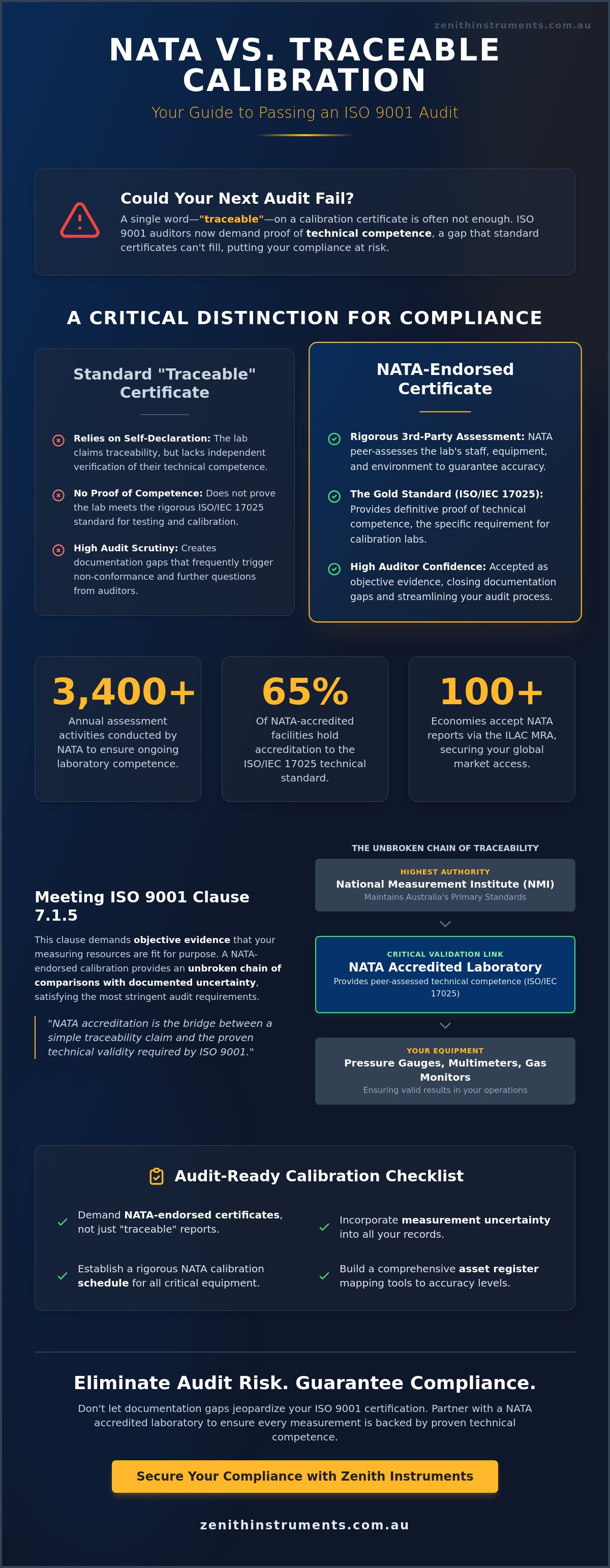
NATA vs. Traceable Calibration: Choosing the Right Level
Deciding on the appropriate tier of NATA calibration for ISO 9001 compliance requires a balanced assessment of risk versus operational cost. A standard "traceable" certificate indicates that the instruments used during calibration are linked to national standards, but it doesn't confirm the laboratory’s technical competence through third-party peer review. In contrast, a NATA-endorsed certificate provides a comprehensive data set, including measurement uncertainty and a formal statement of compliance with specific NATA accreditation standards. This distinction is critical for your quality management system, as auditors look for the NATA emblem as the ultimate proof of technical validity.
For high-risk equipment like pressure gauges used in safety-critical systems or electrical calibration services for medical devices, NATA endorsement is non-negotiable. The cost of a NATA certificate is higher than a standard report, yet it provides a level of legal and technical security that "traceable-only" options lack. Standard traceable certificates might suffice for lower-risk tools, such as general-purpose reference thermometers used for non-critical ambient monitoring, provided your quality manual allows for it. We recommend using NATA calibration for any tool that directly impacts product quality or safety to ensure your audit trail remains unbroken.
When is NATA Mandatory?
Certain sectors leave no room for choice. Regulatory frameworks in aviation, defence, and human pathology often mandate NATA-endorsed results. For instance, NATA is currently overseeing the transition of human pathology labs to ISO 15189:2022, with a deadline of December 2025. Similarly, tier-one contractors in the construction and mining industries frequently include clauses requiring all thermometer calibration and measurement data to be NATA-endorsed. If your contract specifies "accredited calibration," a standard traceable report will result in a non-conformance finding.
Decision Framework for Quality Managers
We suggest a structured approach to selecting your calibration tier. First, assess the criticality of the measurement. If a tool's failure or inaccuracy could lead to a product recall or safety incident, NATA calibration is essential. Second, review your internal Quality Manual. If your documentation specifies NATA-endorsed service, you must adhere to that standard regardless of the tool’s risk level. Finally, consult with your ISO 9001 auditor. Many auditors prefer NATA calibration for ISO 9001 compliance because it simplifies their review process, as the technical competence of the lab has already been verified by NATA’s own specialist assessors.
Preparing for an ISO 9001 Audit: A Calibration Checklist
Audit preparation requires a methodical approach to technical documentation and equipment management. To ensure your quality management system withstands scrutiny, you must move beyond simple maintenance and implement a rigorous verification process. We recommend following this four-step checklist to secure your NATA calibration for ISO 9001 compliance before an auditor arrives at your facility.
- Step 1: Create a Comprehensive Asset Register. List every piece of measuring equipment, including multimeters, pressure gauges, and gas monitors. This register must serve as the single source of truth for your measurement inventory.
- Step 2: Define Required Accuracy and Tolerance. Specify the exact precision needed for each tool based on its application. An auditor will check if your chosen calibration standard matches the technical requirements of your production processes.
- Step 3: Proactive Scheduling. Align your calibration cycles to ensure no tool expires during the audit window. We recommend scheduling services at least 30 days in advance to account for logistics and documentation processing.
- Step 4: Verify NATA Credentials. Inspect every certificate for the NATA logo and a valid accreditation number. Without these markers, the document doesn't provide the technical endorsement required for high-level ISO 9001 compliance.
Organising Your Calibration Documentation
Meticulous record-keeping is the difference between a smooth audit and a non-conformance report. We suggest maintaining a digital repository where tool IDs perfectly match the serial numbers on your NATA reports. This eliminates confusion when an auditor selects a random tool from the floor for verification. For a deeper look at managing these records, refer to our guide on Instrument Calibrations in Australia. Storing physical copies in a centralized folder near the equipment also provides a secondary layer of accessibility for site managers.
On-Site vs. Lab Calibration: Managing Logistics
Managing the movement of sensitive tools is a significant logistical challenge. Many businesses face unnecessary downtime when shipping essential instruments to a laboratory. Utilizing calibration services in Sydney for on-site testing allows your technicians to maintain productivity while we handle the technical verification. Our mobile service capabilities extend to Melbourne and Brisbane, ensuring that your gas monitor calibration and electrical testing occur with minimal disruption. On-site service also simplifies the chain of custody, as instruments never leave your controlled environment, reducing the risk of transport-related damage or loss. If you need to streamline your next audit cycle, contact our technical team to discuss a tailored on-site service schedule.
Zenith Sales & Calibrations Pty Ltd: Your NATA Accredited Partner for 2026
Zenith Sales & Calibrations Pty Ltd operates as a high-performance technical partner, bridging the gap between complex regulatory requirements and operational efficiency. We maintain a rigorous adherence to NATA accreditation standards, ensuring that every measurement we deliver is technically valid and audit-ready. For organizations navigating the transition toward the upcoming 2026 standards, our specialized NATA calibration for ISO 9001 compliance provides the definitive evidence of traceability required by both national and international auditors. We serve as a wide-reaching partner with a localized touch, maintaining a strong presence across Sydney, Melbourne, Newcastle, Canberra, and Brisbane to support regional industrial growth.
Our commitment to precision is reflected in our disciplined, no-nonsense approach to service delivery. We don't just provide a certificate; we provide a partnership built on technical excellence and regulatory certainty. By aligning our internal quality processes with the Harmonised Structure of modern ISO standards, we ensure that your asset register remains compliant and your risk management strategy stays robust. Our technicians possess deep expertise across pressure, electrical, temperature, and dimensional measurement categories, making Zenith Sales & Calibrations Pty Ltd a single-source solution for complex equipment inventories.
Specialised Calibration for Every Industry
Technical expertise must be matched by industry-specific knowledge to be truly effective. We provide precise pressure gauge calibration to ensure manufacturing systems operate within safe and efficient parameters. For site safety and compliance with Australian standards, our electrical equipment calibration covers multimeters, clamp meters, and insulation testers with meticulous detail. Additionally, we support the healthcare sector through biomedical equipment calibration, ensuring that critical diagnostic tools meet the stringent requirements of medical compliance and patient safety. This breadth of service allows us to manage the diverse needs of multi-disciplinary facilities without the need for multiple contractors.
Fast Turnaround and Mobile Service Capabilities
We understand that shipping sensitive tools to a laboratory often results in costly production delays and logistical headaches. To mitigate this risk, Zenith Sales & Calibrations Pty Ltd utilizes mobile calibration labs that bring our technical expertise directly to your facility. This on-site approach ensures minimal production downtime and maintains a strict chain of custody for your most sensitive instruments. Our rapid response times are specifically designed to meet the logistical needs of regional Australian industries, where operational continuity is paramount. Whether you require thermometer calibration in a laboratory setting or on-site electrical testing, our disciplined workflow guarantees precision and speed. Contact Zenith Sales & Calibrations Pty Ltd today for a NATA-compliant calibration quote to secure your equipment's compliance for the 2026 audit cycle.
Secure Your Measurement Integrity for the 2026 Audit Cycle
Maintaining compliance in an evolving regulatory landscape requires more than just keeping up with paperwork. It demands a commitment to technical precision that only NATA-accredited laboratories provide. We've explored how the upcoming ISO 9001:2026 revision places a greater emphasis on risk responsiveness, making the inclusion of measurement uncertainty on your certificates a critical requirement for audit success. Implementing NATA calibration for ISO 9001 compliance ensures that your measurement data remains beyond reproach and your production processes stay optimized.
Zenith Sales & Calibrations Pty Ltd leverages over 20 years of technical expertise and ISO 9001 compliant processes to deliver reliable results through our Australia-wide mobile service. We help you eliminate the confusion between traceable and endorsed certificates, ensuring your asset register is always audit-ready. Our meticulous approach to equipment maintenance provides the safety and reliability your industry demands. Don't leave your next audit to chance; partner with experts who understand the exactness of your technical requirements. Request a NATA-Endorsed Calibration Quote today and move forward with absolute confidence in your measurement systems.
Frequently Asked Questions
Is NATA calibration mandatory for ISO 9001 certification?
NATA calibration isn't strictly mandatory for all ISO 9001 certifications, but it's the most efficient method to satisfy Clause 7.1.5 requirements. While the standard allows for other forms of traceability, auditors frequently mandate NATA-endorsed reports for critical equipment where measurement accuracy directly impacts product safety. Choosing NATA calibration for ISO 9001 compliance removes the burden of proving a laboratory's technical competence during your audit.
How long does a NATA calibration certificate remain valid in Australia?
Validity periods aren't set by NATA itself but are determined by your organization’s risk assessment and equipment usage. Most industrial standards and quality manuals specify a 12 month interval for tools like pressure gauges and multimeters. You must document these intervals in your asset register. If an instrument shows significant drift or suffers physical damage, you should recalibrate it immediately regardless of the remaining time on the certificate.
What is the difference between NATA accreditation and ISO 9001 certification?
ISO 9001 certification confirms that your management system meets international quality standards for business processes. NATA accreditation, usually based on ISO/IEC 17025, is a formal recognition of a laboratory's technical competence to perform specific tests or calibrations. While an ISO 9001 system ensures consistent paperwork, NATA accreditation ensures the technical validity and accuracy of the actual measurement results produced by the laboratory.
Can I perform my own calibrations for ISO 9001 compliance?
You can perform internal calibrations if you have the appropriate reference standards and a documented procedure. However, you must be able to prove an unbroken chain of traceability to national standards and provide a calculated measurement uncertainty for every result. Most businesses find that the cost of maintaining high-precision reference tools and staff training outweighs the convenience of outsourcing to a NATA-accredited partner.
How do I verify if a laboratory is actually NATA accredited?
You can verify a laboratory’s status by searching the official NATA website directory using their name or accreditation number. It's essential to check their specific "Scope of Accreditation" to ensure they're authorized to calibrate your specific instrument type. A laboratory might be NATA accredited for electrical testing but not for pressure or temperature, so always confirm their technical reach before shipping your equipment.
What happens if an auditor finds an uncalibrated tool on my production floor?
Finding an uncalibrated or expired tool typically results in a Non-Conformance Report (NCR). The auditor may require you to quarantine any products manufactured using that tool until its accuracy is verified. If the tool is found to be out of tolerance, you might face a significant rework event or a product recall. Maintaining a rigorous schedule for NATA calibration for ISO 9001 compliance prevents these costly operational disruptions.
Does NATA calibration cover international standards outside of Australia?
NATA certificates are recognized globally through the ILAC Mutual Recognition Arrangement (MRA). This means that a calibration performed in an Australian NATA lab is technically equivalent to one performed by accredited bodies in over 100 other countries. If you export products to Europe, North America, or Asia, your NATA-endorsed documentation serves as a universally accepted proof of measurement accuracy and technical compliance.