

A single point of data isn't a calibration; it's a calculated guess that can cost your facility $50,000 in project rework or total equipment failure. We know that maintaining precise thermal uniformity is the backbone of your production quality, yet the persistent risk of a failed NATA audit or a hidden cold spot ruining a critical batch remains a constant operational pressure. It's a challenge to balance the need for meticulous exactness with the demanding reality of a heavy production schedule.
Our 2026 guide provides the technical roadmap you need to secure industrial thermal accuracy through a professional oven calibration service. We'll show you how to move beyond basic sensor checks toward comprehensive multi-point thermal mapping that guarantees compliance with ISO/IEC 17025:2017 standards. You'll discover how our mobile laboratory capabilities and NATA-accredited processes eliminate the difficult choice between accuracy and efficiency. This guide covers everything from navigating the latest regulatory frameworks to optimizing calibration cycles for harsh industrial environments; ensuring your facility stays audit-ready, compliant, and highly productive.
Key Takeaways
- Understand the critical distinction between basic thermometer checks and NATA-accredited calibrations required for ISO/IEC 17025:2017 regulatory compliance.
- Learn how multi-point thermal mapping utilizes multi-channel data loggers to identify spatial temperature variances and eliminate hidden cold spots.
- Discover how an on-site oven calibration service minimizes production downtime by bringing NATA-certified mobile laboratories directly to your facility in Sydney or Melbourne.
- Establish a risk-based maintenance schedule that balances operational efficiency with the 6 to 12-month calibration intervals required for high-precision industrial sectors.
What is Oven Calibration Service and Why is it Critical?
Precision in industrial heating processes isn't merely a preference; it's a regulatory mandate. An oven calibration service involves the systematic verification and adjustment of an oven's temperature output against a recognized, traceable standard. This technical process ensures that the digital readout on your controller accurately reflects the actual thermal conditions within the chamber. To understand the broader context of these procedures, one might ask, What is Calibration? In an industrial setting, it's the definitive line between a validated process and a significant liability.
Many operators mistake a basic thermometer calibration service for a full oven validation. While checking a single probe is useful, it doesn't account for spatial uniformity or the complex airflows of a large industrial furnace. Thermal drift, the gradual deviation of sensors over time, often leads to catastrophic batch failures. In manufacturing or medical laboratories, a variance of just a few degrees can compromise material integrity or render a sterilization cycle invalid.
Australian businesses must navigate a rigorous regulatory landscape. Adhering to ISO/IEC 17025:2017 is the benchmark for technical competence. In Australia, the National Association of Testing Authorities (NATA) serves as the primary accreditation body. Choosing a NATA-accredited service provider ensures your documentation stands up to the most stringent audits. We've seen how a single inaccurate measurement in high-pressure engineering can result in project rework costs exceeding $50,000. It's a risk no professional facility should take.
The Consequences of Uncalibrated Thermal Equipment
Operating with uncalibrated equipment introduces severe safety risks. In chemical processing, overheating can lead to volatile reactions or equipment fires. Beyond safety, the financial burden of compliance failure is high. Failing a quality audit due to a lack of certification can result in immediate operational shutdowns or the loss of key contracts. Additionally, calibrated ovens operate more efficiently; by optimizing heat cycles and preventing "over-shooting" target temperatures, you reduce operational energy costs and extend the lifespan of your heating elements.
Key Industries Requiring Regular Calibration
The stakes vary across sectors but remain universally high. In the medical and pharmaceutical industries, precise thermal control is essential for sterilization and long-term stability testing. Food and beverage producers rely on accurate heat to maintain HACCP standards and prevent bacterial growth. Meanwhile, the aerospace and mining sectors use industrial ovens to stress-test materials at exact thresholds. In these environments, even minor inaccuracies can lead to structural failures or product recalls. For these specialized needs, a dedicated lab equipment calibration service is indispensable for maintaining operational excellence.
The Technical Process: Multi-Point Thermal Mapping
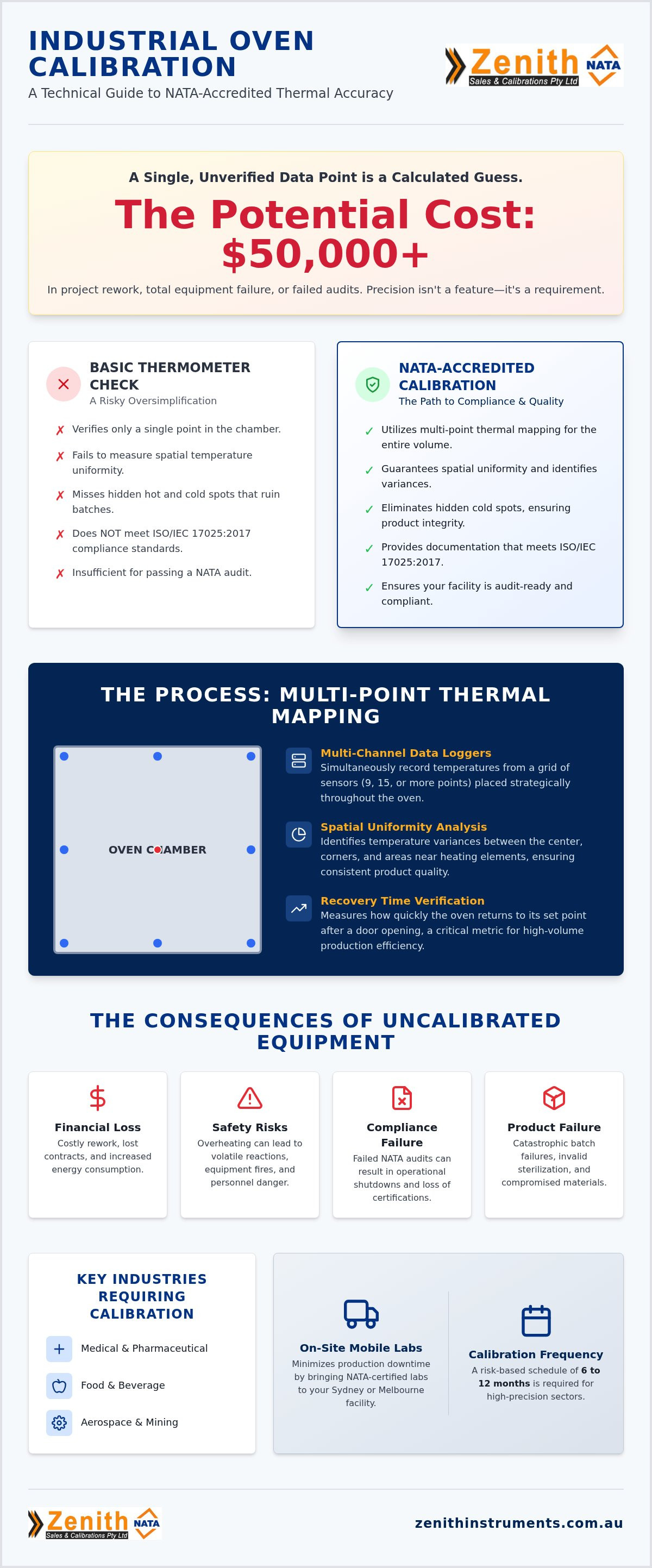
A comprehensive oven calibration service transcends basic sensor verification by analyzing the entire internal volume of the equipment. We focus on spatial uniformity because the center of the oven often fails to represent the thermal reality of the corners or areas near the heating elements. Relying on a single built-in controller probe leaves your process vulnerable to hidden "cold spots" that compromise product integrity. To achieve true accuracy, we utilize multi-channel data loggers capable of recording temperatures simultaneously at multiple heights and depths.
This multi-point approach is essential for identifying hot spots that could damage sensitive materials or cold spots that might lead to incomplete sterilization. We also measure recovery times. This verification determines how quickly the oven returns to its set point after the door is opened; it's a critical metric for high-volume manufacturing environments where cycle efficiency is paramount. Our technical procedures align with the international standards for calibration labs, ensuring every data point we collect is robust and defensible.
Sensor Placement and Grid Patterns
We follow rigorous 9-point or 15-point mapping protocols depending on the chamber volume and the criticality of the application. Sensors are strategically placed in a grid pattern that includes all eight corners and the geometric center. In larger industrial furnaces, we add additional points near the heating elements and air intake vents. We maintain a strict "no-contact" sensor placement policy. This ensures we measure the actual air temperature rather than the thermal mass of the oven shelving, providing a more accurate profile of the operating environment.
Data Analysis and Reporting
Once the thermal mapping cycle is complete, we interpret the resulting profiles to identify maximum, minimum, and average temperature deviations. This granular analysis allows us to verify if the oven stays within the required tolerance across its entire volume. Every measurement is linked back to Australian National Standards through a clear chain of traceability. If your facility requires more localized sensor checks, you can learn more about our Thermometer Calibration Service for related instrumentation.
Precision mapping is the only way to guarantee batch consistency across your entire production line. If you're concerned about thermal variance in your facility, our team can provide a specialized technical assessment to identify and mitigate potential risks.
On-Site vs. Laboratory Calibration: Logistics for AU Businesses
Deciding between on-site and laboratory-based calibration is a critical logistical choice for Australian facility managers. For fixed industrial furnaces, the "Downtime Dilemma" often dictates the strategy. Large-scale equipment is typically integrated into complex production lines, making removal for external testing physically impossible or financially prohibitive. We address this by providing a comprehensive on-site oven calibration service that brings NATA-certified expertise directly to your facility floor.
Calibrating within the oven's actual operating environment yields higher real-world accuracy. Laboratory conditions are strictly controlled, but your production floor has unique variables like ambient temperature shifts, localized air currents, and specific air intake patterns. By performing on-site thermal mapping, we capture how your equipment performs under its true load and environmental stress. This is vital for facilities in major industrial hubs where high production throughput demands consistent performance.
We maintain dedicated mobilization teams in Sydney and Melbourne, allowing us to service regional and metropolitan industries with minimal lead times. While on-site service is the gold standard for large units, laboratory calibration remains a viable option for smaller benchtop or portable ovens. These units can be safely transported to our facilities, where we perform precision testing in a vibration-free, temperature-stabilized environment that meets the most exacting standards.
The Benefits of On-Site Calibration
On-site service offers immediate technical advantages. Our technicians provide real-time adjustments while the equipment is under test, ensuring any deviations are corrected without the need for a follow-up visit. This proactive model eliminates transit risks; sensitive heating elements and ceramic linings are often susceptible to damage during shipping. For facilities requiring localized support, you can explore our Calibration Services in Sydney to see how we manage site-specific requirements with precision and speed.
Preparing Your Facility for a Calibration Visit
To ensure an efficient visit, we recommend clearing the oven chamber of all product and debris before our arrival. Power stability is essential for the duration of the test. Ensure the equipment is connected to a reliable source that won't fluctuate during the multi-hour mapping process. Our technical team requires clear access to control panels and internal sensor ports to install our data loggers. We suggest scheduling these visits during low-production windows to minimize the impact on your operational throughput. This disciplined preparation allows our experts to execute the calibration with surgical precision and minimal disruption.
Determining Calibration Frequency and Maintenance
Establishing a rigorous schedule for your oven calibration service is a foundational requirement for maintaining ISO 9001 compliance. While a 12-month interval serves as the standard baseline for most industrial applications, high-precision sectors often mandate bi-annual cycles to mitigate the risk of thermal drift. We determine these intervals based on the criticality of your process and the equipment's historical stability. For ovens operating in harsh environments characterized by extreme heat or constant vibration, a 6-month frequency is highly recommended to prevent measurement inaccuracies that could lead to total batch failure.
Between professional calibration visits, your team should perform internal drift checks. This involves comparing your oven's built-in controller readings against a secondary, calibrated reference thermometer. While these checks don't replace a full NATA-accredited validation, they act as an early warning system. If you notice a widening gap between the two readings, it's a clear sign that your equipment requires an unscheduled technical assessment to maintain accuracy. Catching these deviations early prevents the high cost of project rework, which can exceed $50,000 in specialized engineering sectors.
Creating a Calibration Schedule
- Step 1: Identify the specific level of accuracy and thermal tolerance required for your manufacturing or laboratory process.
- Step 2: Review manufacturer recommendations alongside regulatory compliance mandates specific to your industry, such as HACCP or aerospace standards.
- Step 3: Factor in the harshness of your operating environment, accounting for high humidity, corrosive gases, or 24/7 duty cycles.
- Step 4: Establish a formal record-keeping system that stores your NATA-certified reports for immediate audit readiness.
Maintenance Tips for Improved Thermal Stability
Thermal stability is heavily influenced by the physical condition of the hardware. Damaged door seals allow heat to escape, creating uneven cooling patterns that compromise the spatial uniformity we measure during mapping. Similarly, dust accumulation on heating elements or fan blades restricts airflow, leading to localized hot spots within the chamber. Consistent cleaning and inspection routines are essential for preserving the results of your last calibration. For a broader perspective on maintaining your facility's technical standards, you can read our Professional Guide to Instrument Calibrations.
Don't wait for a failed audit to address equipment drift; contact our technical team today to establish a compliant calibration schedule for your facility.
Zenith Instruments: NATA-Accredited Oven Calibration Solutions
Since our founding in 2004, Zenith Instruments has established a legacy of technical excellence within the Australian industrial landscape. We specialize in high-precision thermal mapping, a discipline that requires both sophisticated instrumentation and a deep understanding of thermodynamics. Our oven calibration service is designed to meet the rigorous demands of specialized manufacturing, where even a minor temperature variance can jeopardize project integrity. We don't just check sensors; we validate the entire thermal performance of your equipment to ensure it operates within specified tolerances.
Compliance is the cornerstone of our operations. Every calibration we perform results in a comprehensive, NATA-traceable report that ensures your facility is fully audit-ready. These documents provide the objective evidence required to satisfy ISO/IEC 17025:2017 standards and other industry-specific regulatory frameworks. Our strategic presence across Australia allows us to respond rapidly to client needs. With dedicated facilities in Sydney and Melbourne, and mobilization capabilities reaching Brisbane, Newcastle, and Canberra, we provide a localized service touch backed by national expertise and resources.
Why Partner with Zenith for Thermal Calibration?
Our team consists of highly qualified technicians who specialize in both mechanical and electronic instrumentation. This dual expertise is vital for modern industrial ovens that rely on complex digital controllers and integrated safety systems. We utilize state-of-the-art mobile laboratory equipment to perform precise on-site mapping, identifying spatial temperature deviations that standard checks often miss. Beyond industrial furnaces, we offer a full range of Laboratory Equipment Calibration Services to support your entire technical infrastructure with the same level of meticulous detail.
Contact Zenith for Professional Calibration
We understand that every facility has unique operational requirements. We invite you to request a technical consultation to assess your oven's specific spatial mapping needs and regulatory obligations. For multi-site industrial operations, we develop customized service agreements that align with your production cycles and maintenance schedules. This proactive approach ensures your equipment remains compliant while minimizing the impact on your operational throughput. Our technicians work around your schedule to deliver precision without the typical downtime associated with laboratory-bound services. Get a Quote for Your Oven Calibration Service Today and ensure your facility meets the highest standards of thermal accuracy.
Securing Your Facility’s Thermal Future
Achieving industrial thermal accuracy requires a transition from basic sensor checks to comprehensive spatial mapping. We've detailed how multi-point validation identifies hidden cold spots that jeopardize production quality and regulatory standing. By prioritizing a professional oven calibration service, you safeguard your operations against the high cost of batch failure and ensure full compliance with NATA-certified standards.
Since 2004, Zenith Instruments has functioned as a dependable expert for the Australian industrial sector. Our technicians specialize in ISO-compliant processes and offer Australia-wide on-site mobilization to minimize your production downtime. We provide the meticulous data and formal certification required to satisfy the most stringent audits; whether you operate in Sydney, Melbourne, or regional hubs. This disciplined approach guarantees that your equipment remains a high-performance asset rather than a compliance risk.
Request an Oven Calibration Quote from Zenith Instruments to secure your facility's technical excellence. We're ready to partner with you to achieve absolute thermal uniformity and operational reliability.
Frequently Asked Questions
How often should an industrial oven be calibrated?
Most industrial ovens require calibration every 12 months to maintain ISO 9001 compliance. However, if your equipment operates in harsh environments with high heat or constant vibration, we recommend a 6-month interval. Critical sectors like medical or aerospace often mandate more frequent checks to mitigate the risk of thermal drift. Establishing a formal, risk-based schedule ensures your production remains consistent and audit-ready throughout the year, protecting you from costly batch failures.
What is the difference between temperature calibration and thermal mapping?
Temperature calibration verifies the accuracy of a specific sensor or controller against a traceable standard. In contrast, thermal mapping analyzes the entire internal volume of the oven using multiple sensors. This process identifies spatial temperature variances, hot spots, and cold spots that a single-point check would miss. Mapping is essential for ensuring uniform heat distribution, which is a core requirement of a comprehensive oven calibration service for industrial or scientific applications.
Can oven calibration be performed on-site at our facility?
Yes, we provide on-site calibration services across Australia, including Sydney, Melbourne, Brisbane, Newcastle, and Canberra. Our mobilization teams bring NATA-certified standards and mobile laboratory equipment directly to your facility. This approach eliminates the downtime and transit risks associated with shipping large industrial furnaces. By testing in the actual operating environment, we capture real-world performance data that laboratory-bound tests cannot replicate, ensuring higher operational accuracy and safety for your regional facility.
How long does a standard oven calibration service take?
A standard oven calibration service typically takes between three to six hours depending on the oven's size and the number of mapping points required. The process involves setting up multi-channel data loggers, allowing the chamber to reach thermal stability at various set points, and recording recovery times. We work efficiently to minimize production disruption, often scheduling these technical assessments during low-production windows to ensure your facility maintains its operational throughput while achieving full regulatory compliance.
What information is included in a NATA-traceable calibration certificate?
A NATA-traceable certificate includes the instrument's identification, the specific test conditions, and the measured deviations against national standards. It details the expanded uncertainty of measurement and provides a clear pass or fail statement based on your industry's required tolerances. These reports serve as objective evidence during quality audits, confirming that your equipment meets ISO/IEC 17025:2017 requirements and is technically competent for its intended industrial or laboratory use across Australian jurisdictions.
Is it necessary to calibrate the oven if I only use it for drying non-critical parts?
Even for non-critical drying, regular calibration is essential for operational safety and energy efficiency. Uncalibrated ovens can develop hot spots that present fire hazards or cold spots that lead to incomplete drying. Furthermore, an oven that "overshoots" its target temperature wastes significant energy and places unnecessary stress on heating elements. Maintaining a consistent calibration schedule protects your hardware investment and ensures your facility remains compliant with general Australian workplace safety and environmental standards.
What happens if my oven fails the calibration test?
If your oven fails to meet the required tolerances, our technicians first attempt to adjust the controller or sensor offsets to bring it back into compliance. If the failure is due to hardware issues like damaged door seals or faulty heating elements, we provide technical repair recommendations. Once repairs are completed, a follow-up calibration is performed to verify the fix. This proactive model ensures you don't continue production with inaccurate thermal data that risks quality.
Does Zenith provide calibration services for incubators and furnaces as well?
Yes, we specialize in high-precision thermal mapping for a wide range of equipment, including laboratory incubators, industrial furnaces, and environmental chambers. Our technicians use the same NATA-certified protocols to ensure these units maintain the exact spatial uniformity required for sensitive biological or metallurgical processes. Whether you're managing a medical lab in Sydney or a mining facility in regional Australia, we provide the technical expertise needed to secure your equipment's long-term accuracy and reliability.